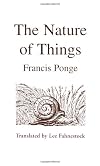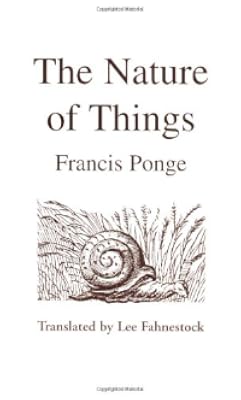
The Nature of Things
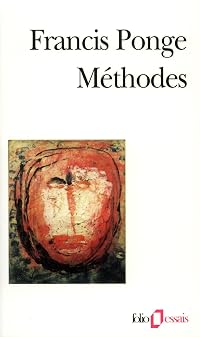
by Francis Ponge
On This Page
Description
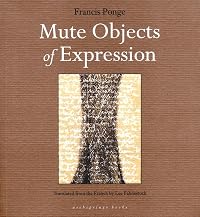
Poetry. Translated from the French by Lee Fahnestock. First published in 1942 and considered the keystone of Francis Ponge's work, Le parti pris de choses appears here in its entirety. It reveals his preoccupation with nature and its metaphoric transformation through the creative ambiguity of language. "My immediate reaction to Lee Fahnenstock's translation was: this must certainly be 'Ponge's voice in English'...[She] gives us his tones, rhythms, humor...[and] maneuvers his word play with show more respect and unostentatious discretion"--Barbara Wright, translator of Queneau, Pinget, Sarraute. show lessTags
Recommendations














Member Reviews
So poetic - Hail to the Snail!
VG-3
May 25, 2022Catalan
Ratings
Members
- Recently Added By
Lists

Les 50 meilleurs livres de langue française de 1900 à aujourd’hui
69 works; 2 members
Author Information

85+ Works 1,234 Members
A poet long unread, Ponge has come into his own since the 1950s with admirers from Sartre to Sollers. Sartre considered him the poet of existentialism. Yet Ponge's poetry is concerned with the priority of objectivity, with things as they exist apart from people. This objectivity has attracted him to writers of the new novel and to the group of show more semiotic critics centered on the literary review Tel Quel. Among his major collections are Le Parti Pris des Choses (The Voice of Things, 1942), Le Grand Recueil (The Big Collection, 1961), and Le Savon (Soap, 1967). (Bowker Author Biography) show less
All Editions
Some Editions
Awards and Honors
Notable Lists
Series
Belongs to Publisher Series
Poesia del segle XX (14)
Common Knowledge
- Canonical title
- The Nature of Things
- Original title
- Le parti pris des choses
- Original publication date
- 1942
- Quotations*
- Les mûres Aux buissons typographiques constitués par le poème sur une route qui ne mène hors des choses ni à l’esprit, certains fruits sont formés d’une agglomération de sphères qu’une goutte d’encre remplit.... (show all)Noirs, roses et kakis ensemble sur la grappe, ils offrent plutôt le spectacle d’une famille rogue à ses âges divers, qu’une tentation très vive à la cueillette.Vue la disproportion des pépins à la pulpe les oiseaux les apprécient peu, si peu de chose au fond leur reste quand du bec à l’anus ils en sont traversés.Mais le poète au cours de sa promenade professionnelle, en prend de la graine à raison : « Ainsi donc, se dit-il, réussissent en grand nombre les efforts patients d’une fleur très fragile quoique par un rébarbatif enchevêtrement de ronces défendue. Sans beaucoup d’autres qualités, - mûres, parfaitement elles sont mûres – comme aussi ce poème est fait. » Le parti pris des choses
*Some information comes from Common Knowledge in other languages. Click "Edit" for more information.
Classifications
Statistics
- Members
- 263
- Popularity
- 122,997
- Reviews
- 2
- Rating
- (3.77)
- Languages
- 12 — Catalan, Danish, Dutch, English, French, German, Italian, Japanese, Portuguese, Slovak, Spanish, Swedish
- Media
- Paper, Ebook
- ISBNs
- 16
- ASINs
- 6