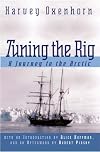
Tuning the Rig: A Journey to the Arctic
by Harvey Oxenhorn
On This Page
Description
A high seas adventure, a wildlife study, & the author's quiet quest for self discovery.Tags
Recommendations












































Member Recommendations


Member Reviews
One mark of a great author must be the ability to make the reader interested in a topic they had never before considered. In the 15 years I lived near Green Bay, WI, I never attended their Tall Ships Festival. Now I wish I had.
Never before at sea, Oxenhorn signs on as crew to a 3-masted brigantine which will be sailing into the Arctic Circle to study whales. While his descriptions of the cold, water-soaked bunks, and fearful ascents into the rigging don't entice me to crew a ship, his descriptions of face-to-face whale sightings, dolphins following, birds overhead, explorations of small northern harbors all makes me wish to set sail.
More than just a travelogue, Oxenhorn brings us into his inner journey as well, as he writes of his own show more doubts about being able to do the work expected, his questioning of captain's authority, his feeling of purposelessness in his life, and his growing realization of how individual lives are important working together as stewards of this world. One passage which impressed me, as I think about how to live my life: "you are asked not to exert extraordinary skill but to place extraordinary trust in the skill you already possess." (p. 94)
He notices a change in the posture of his other novice crewmates: "Time aboard a small ship redistributes weight throughout one's body, lowering the center of gravity and focusing strength in the pelvis, belly, and thighs...the constant rocking from side to side promotes a physiological integration between right and left sides of the body and functions of the brain...the body in a conversation with the forces that pass through it--gravity, the energy of waves. As that dialogue continues, ceaselessly, the illusion of stability (as something we are granted) gives way to the reality of balance (a process we achieve)." (p 203-4) This is an apt metaphor for how your approach to life can change.
Not only do we learn about life onboard, we hear about how to navigate "shooting the stars", whaling history, the ecology of whales and birds and fish--how their lives are tied together. Yet the book is not all serious. There are just as many moments describing shore leave and local pubs. And this gem "All we can see of Newfoundland is the pier's cracked side and the nostrils and chins of some people peering down. Viewed from below, their faces call to mind old horror movies. When I climb up a shroud to get a better look, they still do." (p. 57)
While he describes many nautical terms in the early book, as he is learning them, I didn't remember them and wish there had been a glossary so I could read later chapters without skipping over "overhauling the buntlines" etc which he, now casually, mentions.
As the ship approaches port, Oxenhorn's writing becomes more reflective and aphoristic as he summarizes the lessons he has learned. show less
Never before at sea, Oxenhorn signs on as crew to a 3-masted brigantine which will be sailing into the Arctic Circle to study whales. While his descriptions of the cold, water-soaked bunks, and fearful ascents into the rigging don't entice me to crew a ship, his descriptions of face-to-face whale sightings, dolphins following, birds overhead, explorations of small northern harbors all makes me wish to set sail.
More than just a travelogue, Oxenhorn brings us into his inner journey as well, as he writes of his own show more doubts about being able to do the work expected, his questioning of captain's authority, his feeling of purposelessness in his life, and his growing realization of how individual lives are important working together as stewards of this world. One passage which impressed me, as I think about how to live my life: "you are asked not to exert extraordinary skill but to place extraordinary trust in the skill you already possess." (p. 94)
He notices a change in the posture of his other novice crewmates: "Time aboard a small ship redistributes weight throughout one's body, lowering the center of gravity and focusing strength in the pelvis, belly, and thighs...the constant rocking from side to side promotes a physiological integration between right and left sides of the body and functions of the brain...the body in a conversation with the forces that pass through it--gravity, the energy of waves. As that dialogue continues, ceaselessly, the illusion of stability (as something we are granted) gives way to the reality of balance (a process we achieve)." (p 203-4) This is an apt metaphor for how your approach to life can change.
Not only do we learn about life onboard, we hear about how to navigate "shooting the stars", whaling history, the ecology of whales and birds and fish--how their lives are tied together. Yet the book is not all serious. There are just as many moments describing shore leave and local pubs. And this gem "All we can see of Newfoundland is the pier's cracked side and the nostrils and chins of some people peering down. Viewed from below, their faces call to mind old horror movies. When I climb up a shroud to get a better look, they still do." (p. 57)
While he describes many nautical terms in the early book, as he is learning them, I didn't remember them and wish there had been a glossary so I could read later chapters without skipping over "overhauling the buntlines" etc which he, now casually, mentions.
As the ship approaches port, Oxenhorn's writing becomes more reflective and aphoristic as he summarizes the lessons he has learned. show less
Why, oh why is this masterwork "long out of print"? Because the author died so young perhaps, in a fatal accident shortly after it was published? That accident deprives us, a potentially great, engaging author lost to readers far too early. Probably a greater loss to teaching and scholarship. An incredibly good read, great easy-flowing prose, startling revelations and insights as this "landlubber" grows into a tall-ship sailor.
A whale-watching research cruise into the Arctic, up among our beloved "newfies" and their hard fishing lives, this Professor finds several 'animals' of interest. "To think differently about these animals is to think differently about ourselves as well. From now on, we must all stand watch. One tribe. One family. show more One crew."
The work reduced this reader to tears by the final chapters, even as he read and sang-along to those half remembered shanties, feeling again those wet-feet moments and the hearing the laughter and jeers of long forgotten shipmates. An apt and regretted memorial to this author.
If you find a copy, do read and enjoy it. show less
A whale-watching research cruise into the Arctic, up among our beloved "newfies" and their hard fishing lives, this Professor finds several 'animals' of interest. "To think differently about these animals is to think differently about ourselves as well. From now on, we must all stand watch. One tribe. One family. show more One crew."
The work reduced this reader to tears by the final chapters, even as he read and sang-along to those half remembered shanties, feeling again those wet-feet moments and the hearing the laughter and jeers of long forgotten shipmates. An apt and regretted memorial to this author.
If you find a copy, do read and enjoy it. show less
Oxenhorn, about 8 years ago, thought it would be fun to ,join a group of students, researchers and sailors on a trip to the arctic to study humpback whales. Their mode of transportation was to be the barkentine, Regina Maris, a fully-rigged clipper ship built in 1908. The students would man the sails. "Tuning the Rig" is the process of finding just the right tension in all the stays, lines and shrouds so the ship not only stays together but functions at peak performance. This tuning becomes a metaphor for the interactions of the heterogeneous group of people on board. They are as diverse as can be, each striving to maintain his individuality. Oxenhorn, himself, resists the overwhelming force of the ship, which coerces everyone to work show more together. It's a humbling experience and Oxenhorn finally comes to agree with George (the captain and former Harvard Medical School Dean) that the crew is not so much a group of people working together as a family, with all the inherent strife and conflict and petty grievances, but bound together as a rope made up of individual strands; each by itself virtually useless, but together incredibly strong. Oxenhorn perceives that the search for individual unity may be but an illusion. When he returns from the voyage after surviving awesome hardships, he tries to convey some of his experiences to friends, but finds their crises (whether to decorate with butcher block or oak) somewhat puerile. He asks George at one point why the captain gave up so much to become involved with a clearly risky educational venture. George responds that it can be summed up by the Russian word, Nitchevo (very loosely translated as "what the hell.") Most people would abolish weather if they could; eliminate risk. So many people spend their lives doing one thing so they will be able to do something else. One should "choose as life's work whatever feels most like play." The descriptions in this book of climbing in the rigging during a gale to reef the sails are awesome. show less
Ratings
Members
- Recently Added By
Author Information
3 Works 81 Members
Some Editions
Common Knowledge
- Original publication date
- 1990
- People/Characters
- Harvey Oxenhorn; George Nichols (Captain); Gregg Swanzey (First Mate); Bill Cowan (Second Mate); Fran Grost (Engineer)
- Important places
- Newfoundland, Canada; Labrador, Canada; Greenland
- Epigraph
- Knowledge the shade of a shade,
Yet must thou sail after knowledge
Knowing less than drugged beasts.
--Ezra Pound, Canto 47
The object of knowledge is relation.
--James Clerk Maxwell - Dedication
- To the memory of my father, Joseph M. Oxenhorn, with love and gratitude.
- First words
- On a hot June night on the Boston waterfront, I stood alone beneath the Central Artery, looking outward, east, at dusk, to the quiet harbor.
[Introduction] By nature, our friend was a searcher.
[Afterword] Tuning the Rig was not written to be the book of a life, but this tough, soulful work, which is both an adventure story and a meditation, is worthy to be such a book. - Quotations
- All the way to heaven is heaven, all of it a kiss. (p 275)
In the manic pursuit of gaining and becoming, what is lost is the capacity for simply being: with each other, with nature, with ourselves...In exercising self-restraint, in accepting the kinds of limits that I had previously ... (show all)squandered so much energy evading, I experienced a sense of purpose and a kind of solidarity I'd never known before...relieved of the burden of specialness, reprieved from the lonely ego, released but also reengaged. (p 279)
To change our behavior for the sake of results we won't immediately see, to take steps that may not bear fruit until after we ourselves are gone, requires a motive. That motive can't be altruism. Most of what people claim to... (show all) do for the sake of others has more to do with themselves than with the actual deed...What might the motive be?...maybe our only hope as a species is ... to encompass other species ...we must shepherd on a global scale. (p 264)
What is 'wicked,' ...is not the conscious commission of an evil deed but the capacity for separation and denial of connections...(p 263-4)
I have found myself touched by...an attitude toward work, toward living, that is grounded centrally and simply in necessity. (p 253)
On almost any day I have felt every kind of emotion with a purity and intensity I rarely knew before. It makes me realize that back home, if the environment is neutral--not too noisy, too filthy, too intrusive--then I think ... (show all)things are all right. But in fact a truce with our senses is not the same as an alliance...The absence of constant nourishment through the senses divorces us from nature's rhythms, traps us in ourselves and in each other, makes us brittle and subjective, thins the blood. In the city, sensuality is overemphasized and yet, paradoxically, is confined to certain types of relationships and situations. Here it is a ceaseless, wordless dialogue with patterns larger than oneself, a constant rinsing. Intimate, impersonal, this dialogue-sensation feeds the habit of perception, breeds deep feeling and clear thought. (p. 220-1)
When I first came on board, I thought the world owed me. I was ready to make music...I was disappointed, angry that so little in my life would stay in tune...It is arrogance to expect that our life always be music. It is fal... (show all)se pride to demand to know the score. Harmony, like a following breeze at sea, is the exception. In a world where more things wind up broken or lost, our lot is to tack and tune. (p. 178) - Last words
- (Click to show. Warning: May contain spoilers.)I like to think of her waiting until everyone was safe ashore, and no one was there to see, when she lowered her beautiful bulwarks to the waves at last, and said goodbye.
(Click to show. Warning: May contain spoilers.)[Introduction] And for this last gift, and for that long journey we shared with him past icebergs and agents, we are truly grateful.
(Click to show. Warning: May contain spoilers.)[Afterword] That incident, narrated with unpompous tact, has its parallel in the achievement of this book, that yields the explorer's gifts of pleasure, marvel and adventure.
Classifications
- Genres
- Nonfiction, Travel, General Nonfiction, Biography & Memoir
- DDC/MDS
- 919.804 — History & geography Geography & travel Geography of and travel in Australasia, Pacific Ocean islands, Atlantic Ocean islands, Arctic islands, Antarctica and on extraterrestrial worlds Polar regions
- LCC
- G627 .O84 — Geography, Anthropology and Recreation Geography (General) Arctic and Antarctic regions
Statistics
- Members
- 79
- Popularity
- 401,327
- Reviews
- 3
- Rating
- (3.90)
- Languages
- English
- Media
- Paper
- ISBNs
- 3
- ASINs
- 1