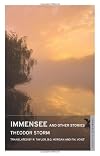
Immensee
by Theodor Storm
On This Page
Description
Off into the wood they went, on and on; on through moist shady glens, where everything was so peaceful, except for the cry of the falcon flying unseen in the heavens far above their heads; on again through the thick brushwood, so thick that Reinhard must needs go on ahead to make a track, here snapping off a branch, there bending aside a trailing vine. But ere long he heard Elisabeth behind him calling out his name. He turned round."Reinhard " she called, "do wait for me Reinhard "Reinhard show more and Elizabeth have grown together -- as children in their make-believe home in the fields, where they share fairy-stories; and as youths in the woodlands, where they go in search of strawberries. Yet he is the older of the two, and must go abroad to further his schooling: and with him he takes a book of poems he has been writing. They are songs of his youth, and of love, that he dares not show her. show lessTags
Recommendations





































Member Reviews
This is the first novella in an audio compendium of 15 Great Novellas that I've had around for a while. I wasn't interested in starting another huge history tome just now, and novellas are a good size for walking. This was an interesting example of traditional 19th century German fiction, initially charming and then quite sad, dealing with life choices and mistakes.
This short and wistful German novella from 1849 was Theodor Storm's most popular work during his lifetime, it made him world famous. On the surface it's a love story but heavy with symbolism allowing for a multitude of interpretations. Critics often interpret the tone of resignation and missed opportunity as part of the Zeitgeist in the aftermath of the failed Revolutions of 1848.
Some of the symbolism is difficult for a non-specialist. For example in the 19th century, water lilies had a reputation as symbolizing female sexual power. Thus when Reinhardt swims in the lake at night and becomes entangled in the vines of a water lily, we know what was likely happening. Likewise when Reinhardt tosses a gold coin into the lap of a dark Gypsy show more girl, this symbolizes more than an act of charity. The mother carries keys representing power and control; the titular bees of the lake? I'm not sure. Overall I'd say this is worth reading for the story alone, and if you enjoy teasing out symbolism in 19th century German novellas. It can be read in a single sitting with a beautifully illustrated edition freely available online. show less
Some of the symbolism is difficult for a non-specialist. For example in the 19th century, water lilies had a reputation as symbolizing female sexual power. Thus when Reinhardt swims in the lake at night and becomes entangled in the vines of a water lily, we know what was likely happening. Likewise when Reinhardt tosses a gold coin into the lap of a dark Gypsy show more girl, this symbolizes more than an act of charity. The mother carries keys representing power and control; the titular bees of the lake? I'm not sure. Overall I'd say this is worth reading for the story alone, and if you enjoy teasing out symbolism in 19th century German novellas. It can be read in a single sitting with a beautifully illustrated edition freely available online. show less
Ein alter Herr, wir erfahren, daß er zurückgezogen mit seiner Haushälterin in einem großen Haus in einer Kleinstadt wohnt, erinnert sich seiner unausgesprochenen Jugendliebe. Eine schwermütige, sehr stille romantische Dichtung. Bei ihrem Erscheinen 1850, brachte diese kleine Novelle Storm große Anerkennung. Für unsere Zeit erscheint die Erzählung vielleicht vielen als zu gefühlsvoll, aber sie gleitet nie ins sentimentale ab. (IX-11)
Sep 16, 2011German
Heinz Killian liest es wirklich passend, aber die Geschichte an sich gefällt mir nicht so sehr.
Jul 1, 2011German
Ratings
Members
- Recently Added By
Lists

Literary Works Read in College
316 works; 15 members

Harold Bloom - The Western Canon: C. The Democratic Age
336 works; 15 members
Author Information

Some Editions
Awards and Honors
Notable Lists
Series
Belongs to Publisher Series
Work Relationships
Common Knowledge
- Canonical title
- Immensee
- Original title
- Immensee
- Alternate titles
- Bee's Lake; Lake of the Bees
- Original publication date
- 1849
Classifications
Statistics
- Members
- 157
- Popularity
- 209,148
- Reviews
- 5
- Rating
- (3.74)
- Languages
- 9 — Chinese, Czech, English, Esperanto, French, German, Hungarian, Russian, Spanish
- Media
- Paper, Audiobook, Ebook
- ISBNs
- 42
- ASINs
- 13