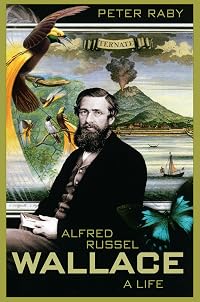
Alfred Russel Wallace: A Life
by Peter Raby
On This Page
Description
In 1858, Alfred Russel Wallace, aged thirty-five, weak with malaria, isolated in the Spice Islands, wrote to Charles Darwin: he had, he said excitedly, worked out a theory of natural selection. Darwin was aghast--his work of decades was about to be scooped. Within two weeks, his outline and Wallace's paper were presented jointly in London. A year later, with Wallace still on the opposite side of the globe, Darwin published On the Origin of Species. This new biography of Wallace traces the show more development of one of the most remarkable scientific travelers, naturalists, and thinkers of the nineteenth century. With vigor and sensitivity, Peter Raby reveals his subject as a courageous, unconventional explorer and a man of exceptional humanity. He draws more extensively on Wallace's correspondence than has any previous biographer and offers a revealing yet balanced account of the relationship between Wallace and Darwin. Wallace lacked Darwin's advantages. A largely self-educated native of Wales, he spent four years in the Amazon in his mid-twenties collecting specimens for museums and wealthy patrons, only to lose his finds in a shipboard fire in the mid-Atlantic. He vowed never to travel again. Yet two years later he was off to the East Indies on a vast eight-year trek; here he discovered countless species and identified the point of divide between Asian and Australian fauna, 'Wallace's Line.' After his return, he plunged into numerous controversies and published regularly until his death at the age of ninety, in 1913. He penned a classic volume on his travels, founded the discipline of biogeography, promoted natural selection, and produced a distinctive account of mind and consciousness in man. Sensitive and self-effacing, he was an ardent socialist--and spiritualist. Wallace is one of the neglected giants of the history of science and ideas. This stirring biography--the first for many years--puts him back at center stage, where he belongs. show lessTags
Recommendations













Member Reviews
Peter Raby has produced an excellent biography of Alfred Russel Wallace. It outlines Wallace's career as a widely-travelling professional collector of plants and animals, as a naturalist, and as a theorist. It also covers his political views and his later belief in spiritualism.
Wallace is best known for coming up with the theory of evolution by natural selection independently from Darwin. He certainly deserves credit for this, but nobody should take seriously the ridiculous conspiracy theory which claims that Darwin stole the theory of natural selection from Wallace.
Wallace himself was always happy to play second fiddle to Darwin. For example, in 1908 Wallace made a speech to the Linnaean Society in which he explicitly defended Darwin's show more priority, pointing out that "...the idea occurred to Darwin in October 1838, nearly twenty years earlier than to myself (in February 1858); and that during the whole of that twenty years he had been laboriously collecting evidence..."
Darwin's notebooks from the 1830s and his essays of 1842 and 1844 show that Darwin had developed his theory long before he published "On the Origin of Species" and long before Wallace had his brainwave.
Wallace was an admirable character. He did not have the advantages of wealth that Darwin had; he was a socialist (of sorts) who had progressive views on many issues; and his attitude towards native peoples was unusually enlightened for an era when racism was rife.
Wallace also disagreed (later in his life, at least) with Darwin's mistaken decision to allow into his evolutionary theory a subsidiary role for the Lamarckian idea of the inheritance of acquired characteristics. In this, Wallace has been said to be more Darwinian than Darwin himself.
Unfortunately, on the negative side, Wallace also ended up believing in spiritualism and arguing that the human brain/mind could not have evolved. Darwin and Wallace had become good friends, but Darwin was disappointed with Wallace over this issue. Darwin and Wallace also differed over the relative importance of natural selection and sexual selection. But these differences of opinion did not stop Darwin successfully campaigning to get a state pension for Wallace. show less
Wallace is best known for coming up with the theory of evolution by natural selection independently from Darwin. He certainly deserves credit for this, but nobody should take seriously the ridiculous conspiracy theory which claims that Darwin stole the theory of natural selection from Wallace.
Wallace himself was always happy to play second fiddle to Darwin. For example, in 1908 Wallace made a speech to the Linnaean Society in which he explicitly defended Darwin's show more priority, pointing out that "...the idea occurred to Darwin in October 1838, nearly twenty years earlier than to myself (in February 1858); and that during the whole of that twenty years he had been laboriously collecting evidence..."
Darwin's notebooks from the 1830s and his essays of 1842 and 1844 show that Darwin had developed his theory long before he published "On the Origin of Species" and long before Wallace had his brainwave.
Wallace was an admirable character. He did not have the advantages of wealth that Darwin had; he was a socialist (of sorts) who had progressive views on many issues; and his attitude towards native peoples was unusually enlightened for an era when racism was rife.
Wallace also disagreed (later in his life, at least) with Darwin's mistaken decision to allow into his evolutionary theory a subsidiary role for the Lamarckian idea of the inheritance of acquired characteristics. In this, Wallace has been said to be more Darwinian than Darwin himself.
Unfortunately, on the negative side, Wallace also ended up believing in spiritualism and arguing that the human brain/mind could not have evolved. Darwin and Wallace had become good friends, but Darwin was disappointed with Wallace over this issue. Darwin and Wallace also differed over the relative importance of natural selection and sexual selection. But these differences of opinion did not stop Darwin successfully campaigning to get a state pension for Wallace. show less
I read this biography of Wallace while simultaneously reading Wallace's Malay Archipelago. At first, I thought the two were redundant and I was about to abandon the Raby volume, but after a slow start, he begins to add other information to Wallace's accounts of his travels and studies which definitely enrich the reading experience. For example, while Wallace may have written of an incident in Malay Archipelago, Raby will recount parts of a letter he may have written to his mother or brother or friend about the same incident that are far more revealing into his true thoughts. This is what good biography is all about: digging beyond the person's 'official life' into the behind-the-scenes motivations, thoughts, ruminations, fears, etc. So show more buy the Raby book and download the free Malay Archipelago. Next up is Paul Sochaczewski's An Inordinate Fondness for Beetles: Campfire Conversations with Alfred Russel Wallace on People and Nature Based on CommonTravel in the Malay Archipelago. show less
Ratings
Members
- Recently Added By
Lists

In Our Time books
4,934 works; 2 members
Author Information

12+ Works 360 Members
Peter Raby lectures in Drama and English at the University of Cambridge
Common Knowledge
- Canonical title
- Alfred Russel Wallace: A Life
- Original publication date
- 2001
- People/Characters
- Alfred Russel Wallace
- Blurbers
- Malik, Kenan; Browne, Janet
Classifications
Statistics
- Members
- 109
- Popularity
- 298,547
- Reviews
- 2
- Rating
- (3.93)
- Languages
- English
- Media
- Paper, Ebook
- ISBNs
- 5
- ASINs
- 1