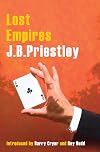
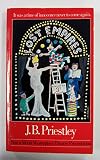
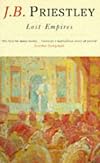
Lost Empires
by J. B. Priestley
On This Page
Description
In the months before the First World War, Richard Herncastle joins his uncle's illusionist act on the Music Hall stage where he comes into contact with larger than life, garish and outrageous characters. Both funny and sad, 'Lost Empires' tells of a young man's awakening to the world of love and sex, and is also a richly coloured portrait of a dying world of theatre and of lives and a society that the Great War would soon change irrevocably.Tags
Recommendations













Member Reviews
A novel written as a memoir, this is narrated by Richard Herncastle, the famous English painter. Left poor and on his own at twenty, Richard is surprised to be rescued by the black sheep of the family, his Uncle Nick, a magician on the traveling music hall circuit of 1913. Becoming part of Nick's act, learning about thinking on one's feet and living with the people who made their living moving from stage to stage gives Richard experiences he never would have had in his tiny Northern town.
On the surface, this probably sounds like a book of sweet nostalgia for the days of the Edwardian music halls. The world of acrobats, dog acts and audiences adoring grown women dressed as little girls are remembered, but not with fondness. Richard's show more dealings with his prickly Uncle Nick, his attractions to women and his growing confidence make up the real plot, but we also get an affair with an older woman, violence and infidelities, a murder and Uncle Nick's treatment of his girlfriend Cissie is the opposite of romantic. Highly recommended. show less
On the surface, this probably sounds like a book of sweet nostalgia for the days of the Edwardian music halls. The world of acrobats, dog acts and audiences adoring grown women dressed as little girls are remembered, but not with fondness. Richard's show more dealings with his prickly Uncle Nick, his attractions to women and his growing confidence make up the real plot, but we also get an affair with an older woman, violence and infidelities, a murder and Uncle Nick's treatment of his girlfriend Cissie is the opposite of romantic. Highly recommended. show less
This is a darker, less idyllic counterpart to The Good Companions (1929). Whilst the earlier book had a contemporary setting, contrasting the picaresque adventures of a seaside concert party with the grim reality of the great depression, Lost Empires was written in the sixties and set fifty years earlier on the eve of the first world war. To make this historical perspective explicit, there is a frame story where "Priestley" visits the watercolourist Herncastle at his retirement cottage in the Dales and is given a copy of Herncastle's reminiscences of the period in 1913-1914 when he worked as assistant to his uncle, a music hall illusionist.
As in The Good Companions, we get to see the unpleasant side of show business - hard work, long show more hours, back-stabbing and bitter rivalry, but there is none of the sense of glamour and escapism. Herncastle is an artist: he doesn't care about the stage, and is working for his uncle because it pays better than clerking in a woollen mill and offers the chance of free time in daylight for sketching. As a bonus (and since this is a novel of the sixties) the theatre also offers him more opportunities for sex.
This is an unusual book - normally you would expect a work set in 1913-1914, especially with such a title, to be regretting a lost world smashed by the war (cf. Larkin's "Never such innocence, / Never before or since"). But Priestley makes it clear that the world of the pre-war music hall stage was full of evil and corruption, and that Herncastle could be redeemed from it only by the purging effect of military service in the war. We get lots of colourful period detail, but there isn't an ounce of nostalgia here: Priestley has seen the old and new worlds and is convinced that the new one is better. show less
As in The Good Companions, we get to see the unpleasant side of show business - hard work, long show more hours, back-stabbing and bitter rivalry, but there is none of the sense of glamour and escapism. Herncastle is an artist: he doesn't care about the stage, and is working for his uncle because it pays better than clerking in a woollen mill and offers the chance of free time in daylight for sketching. As a bonus (and since this is a novel of the sixties) the theatre also offers him more opportunities for sex.
This is an unusual book - normally you would expect a work set in 1913-1914, especially with such a title, to be regretting a lost world smashed by the war (cf. Larkin's "Never such innocence, / Never before or since"). But Priestley makes it clear that the world of the pre-war music hall stage was full of evil and corruption, and that Herncastle could be redeemed from it only by the purging effect of military service in the war. We get lots of colourful period detail, but there isn't an ounce of nostalgia here: Priestley has seen the old and new worlds and is convinced that the new one is better. show less
The story of Richard Herncastle, a young lad from the North of England who goes to work for his stage magician uncle as WWI is about to break loose. Not exactly great literature but highly entertaining. This is the second novel I've read by J.B. Priestley. The guy really knows how to tell a story.
A magician who is part of a traveling variety show in pre-World War I Britain brings his nephew in to help stage the show, and even participate in some of the tricks. As the story moved from one character to another, one town to another, one event to another, it never disappointed me. Story-telling at its best, in my opinion. A thumping good read.
Just wonderful.
Ratings
Members
- Recently Added By
Lists

Stories of War and Revolution
143 works; 54 members
World War I Fiction
94 works; 15 members
Author Information

233+ Works 6,941 Members
English novelist, playwright, and critic J. B. Priestley was born in Bradford in Yorkshire, the setting for many of his stories, and was educated at Cambridge University. Although he first established a reputation with critical writings such as The English Comic Characters (1925), The English Novel (1927), and English Humor (1928), it is for his show more novels and plays that he is best known. Priestley was, like John Galsworthy and Somerset Maugham, a novelist only partially committed to his playwriting. Yet he became the dominant literary figure in the London West End during the 1930s, as he attempted to make realistically rendered domestic conversation the vehicle for a mature study of personality and emotion. Philosophical theories about time, Socialist dogmatism (often erupting into sermons), and a taste for dramatic expressionism may be said to have finally deflected him from his goal. Priestley's experimental bent nevertheless yielded, among his more than 25 plays, a number of striking theatrical situations---the soliloquies of Ever since Paradise, the reviewed life in Johnson over Jordan (1939), the replay of an ill-fated conversational turn in Dangerous Corner (his most successful play, 1934), and the supernatural visitation in An Inspector Calls (his acknowledged masterpiece, 1946). (Bowker Author Biography) show less
Work Relationships
Has the adaptation
Common Knowledge
- Original publication date
- 1965
- People/Characters
- Richard Herncastle
- Important places
- Bradford, Yorkshire, England, UK
- Related movies
- Lost Empires (1986 | IMDb)
Classifications
Statistics
- Members
- 200
- Popularity
- 163,530
- Reviews
- 5
- Rating
- (3.65)
- Languages
- 5 — Czech, Dutch, English, Spanish, Swedish
- Media
- Paper, Ebook
- ISBNs
- 11
- ASINs
- 11