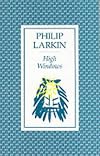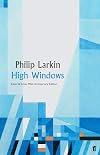
High Windows
by Philip Larkin
On This Page
Description
Larkin's final collection of poems shows, as does all his best work, his ability to adapt contemporary speech rhythms and everyday vocabulary to subtle metrical patterns and poetic forms. Many of the poems in the collection, which includes some of his best-known pieces ('The Old Fools', 'This Be the Verse', 'The Explosion', and the title poem) show the preoccupation with death and transience that is so typical of the poet. Rather than words comes the thought of high windows: The show more sun-comprehending glass, And beyond it, the deep blue air, that shows Nothing, and is nowhere, and is endless. from 'High Windows' show lessTags
Recommendations





























Member Reviews
Even though I quite liked a few of the poems in this collection, I found the overall tone to be rather soul-less. Larkin focuses on describing small, everyday scenarios, but the reader can tell that he is describing these scenes from a distance. The only poems that I felt his voice was connected to were "the Old Fools," "This be the verse," and "Annus Mirabilis." All three poems were truthful and a touch sarcastic, and they seems to touch on common themes in the human experience that anyone should be able to connect with.
This is the first book of poetry (excepting Beowulf) I've sat down to read as an adult, and what a place to start. This slim collection was Larkin's last, and contains both of those iconic poems we all know the first lines to ... ("They f*** you up, your mum and dad" from 'This be the Verse', and "Sexual intercourse began in 1963" from 'Annus Mirabilis').
I found an overall preoccupation with death in all its forms as seen by a grumpy old man loomed large; never more so than in 'The Old Fools' where he's looking to his dotage, equally mourning the loss of childhood in 'Sad steps', or in 'Going, Going' where he sees urban decay taking over England.
I don't feel qualified to comment on the structure, but enjoyed reading these wonderful show more poems immensely. show less
I found an overall preoccupation with death in all its forms as seen by a grumpy old man loomed large; never more so than in 'The Old Fools' where he's looking to his dotage, equally mourning the loss of childhood in 'Sad steps', or in 'Going, Going' where he sees urban decay taking over England.
I don't feel qualified to comment on the structure, but enjoyed reading these wonderful show more poems immensely. show less
A nice read, relatively easy, but also a bit disappointing in the end. There are quite a few poems in here, Going going e.g. that do not really deserve it. So quality level is very variable. At his best Larkin succeeds in writing memorable verses though.
"Only the young can be alone freely.
The time is shorter now for company,
And sitting by a lamp more often brings
Not peace, but other things.
Beyond the light stand failure and remorse
Whispering Dear Warlock-Williams:
Why, of course–"
- Vers de Société
----
P/s: We all should read This Be The Verse.
The time is shorter now for company,
And sitting by a lamp more often brings
Not peace, but other things.
Beyond the light stand failure and remorse
Whispering Dear Warlock-Williams:
Why, of course–"
- Vers de Société
----
P/s: We all should read This Be The Verse.
Pp 19/20 The Old Fools
Aug 17, 2010Dutch
Ratings
Members
- Recently Added By
Lists

Books Read in 2013
1,630 works; 51 members

Poetry Corner
187 works; 15 members

Art of Reading
188 works; 5 members

Books Read in 2018
4,360 works; 110 members
Author Information

59+ Works 6,910 Members
Philip Larkin was a British poet, novelist, critic, and essayist. Born in 1922 in Coventry, England, he graduated from St. John's College, Oxford, in 1940 and then pursued a career as a librarian, becoming the librarian at the University of Hull in 1955. Although he led a retiring life and published infrequently, producing only one volume of show more poetry approximately every 10 years, Larkin was still considered one of the preeminent contemporary British poets. He is often associated with the "Movement," a 1950s literary group that, through the use of colloquial language and common, everyday subjects, endeavored to create poetry that would appeal to the common reader. However, this association came about mainly because Larkin's poem "Church Going," for which he first gained critical attention, was published in New Lines, an anthology of the "Movement" poets. In reality, his work, particularly his later poems, is not typical of the group. Larkin's published a total of only four volumes of poetry: The North Ship (1945), The Less Deceived (1955), The Whitsun Weddings (1964), and High Windows (1974). He also wrote two novels, Jill and A Girl in Winter, and published two volumes of prose, Required Writing and All That Jazz, a collection of his reviews of jazz records. Philip Larkin died in 1985. (Bowker Author Biography) show less
Some Editions
Series
Belongs to Publisher Series
Work Relationships
Is contained in
Contains
Has as a student's study guide
Common Knowledge
- Original publication date
- 1974
- First words
- To step over the low wall that divides
Road from concrete walk above the shore
Brings sharply back something known long before -
The miniature gaiety of seasides. - Last words
- (Click to show. Warning: May contain spoilers.)The dead go on before us, they / Are sitting in God's house in comfort, / We shall see them face to face - / Plain as lettering in the chapels / It was said, and for a second / Wives saw men of the explosion / Larger than in life they managed - / Gold on a coin, or walking / Somehow from the sun towards them, / One showing the eggs unbroken.
- Disambiguation notice
- This is the collection of 24 poems by Larkin. One of the poems shares the title High Windows. Do not combine this collection with the individual poem.
Classifications
Statistics
- Members
- 688
- Popularity
- 41,627
- Reviews
- 5
- Rating
- (4.04)
- Languages
- English, Italian, Spanish
- Media
- Paper, Audiobook, Ebook
- ISBNs
- 14
- ASINs
- 7