On This Page
Description
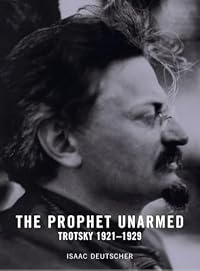
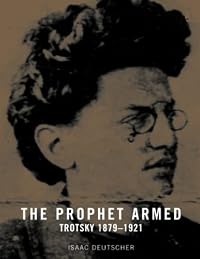
The 3d vol. of the author's trilogy, the 1st of which is The prophet armed: Trotsky, 1879-1921, the 2d of which is The prophet unarmed: Trotsky, 1921-1929.Tags
Recommendations


















Member Reviews
This review is for the entire trilogy.
It has been some fifty years now since this volume was published. Given the gaping maw of history which separates us in 2012 from its original publication, what can we learn from this man and his life?
The first case that can be made is the strength of Deutscher's narrative style. This biography is as much a literary as a historical undertaking. He wants to make Trotsky a tarnished messiah, a Prometheus, a Greek tragedy.
The structure of the biography follows the arc of such a play - hero is brought up by his strengths, develops a fatal flaw which brings him down, and is destroyed. He starts off as a precocious schoolchild in Odessa, multilingual and fiery. Then a writer, then escaped from Siberian show more exile. After that writing newspaper articles and debating with theological fervor the ideas of Marx with Lenin. Shifting from Menshevik to Bolshevik. Journalism in the ethnic wars of the Balkans. Then a generalship in the Civil War, defeating the sixteen foreign armies. Signing a humiliating peace with the Germans to buy some time, then seizing most of the lost territory anyways after their own collapse.
Just a small part of his life would have secured him a place in history. It seemed inevitable for him to receive the mantle of power from the deified Lenin.
Then we see how he was totally outmaneuvered by the supremely political Stalin and all support crushed. His internal then external exile. How he tried to form a 4th Internationale, and shuffled from nation to nation, making prophecy in vain about the rise of fascism but none listened. Hitler screamed at the mention of his name. And we see how he retired to Mexico, and the story closes with an ice ax, a scream, and the bandages around his forehead like a halo.
But now, with the benefit of some seven decades of hindsight, can Trotsky really be considered a hero? His writings still glare and burn after nearly a century. Some scattered few still think of him as an alternative to the deformed state of the USSR. But he was a revolutionary like the rest, and fought as hard as the rest. He shot one man in ten in army units for repeated failures, and held hostage the families of officers who threatened to disobey. But revolutions and civil wars are not gentle.
The Soviet Union is gone, that experiment ended. Perhaps Bernstein was right and the revolution will be democratic. It is still too early to tell. Fortune turns its wheel, and King Lear wanders the fields.
Perhaps now some young fighter in Aleppo or Sana'a is scanning the Arabic translation of this other Prophet's life, hoping to learn from the mistakes and follies of history past. show less
It has been some fifty years now since this volume was published. Given the gaping maw of history which separates us in 2012 from its original publication, what can we learn from this man and his life?
The first case that can be made is the strength of Deutscher's narrative style. This biography is as much a literary as a historical undertaking. He wants to make Trotsky a tarnished messiah, a Prometheus, a Greek tragedy.
The structure of the biography follows the arc of such a play - hero is brought up by his strengths, develops a fatal flaw which brings him down, and is destroyed. He starts off as a precocious schoolchild in Odessa, multilingual and fiery. Then a writer, then escaped from Siberian show more exile. After that writing newspaper articles and debating with theological fervor the ideas of Marx with Lenin. Shifting from Menshevik to Bolshevik. Journalism in the ethnic wars of the Balkans. Then a generalship in the Civil War, defeating the sixteen foreign armies. Signing a humiliating peace with the Germans to buy some time, then seizing most of the lost territory anyways after their own collapse.
Just a small part of his life would have secured him a place in history. It seemed inevitable for him to receive the mantle of power from the deified Lenin.
Then we see how he was totally outmaneuvered by the supremely political Stalin and all support crushed. His internal then external exile. How he tried to form a 4th Internationale, and shuffled from nation to nation, making prophecy in vain about the rise of fascism but none listened. Hitler screamed at the mention of his name. And we see how he retired to Mexico, and the story closes with an ice ax, a scream, and the bandages around his forehead like a halo.
But now, with the benefit of some seven decades of hindsight, can Trotsky really be considered a hero? His writings still glare and burn after nearly a century. Some scattered few still think of him as an alternative to the deformed state of the USSR. But he was a revolutionary like the rest, and fought as hard as the rest. He shot one man in ten in army units for repeated failures, and held hostage the families of officers who threatened to disobey. But revolutions and civil wars are not gentle.
The Soviet Union is gone, that experiment ended. Perhaps Bernstein was right and the revolution will be democratic. It is still too early to tell. Fortune turns its wheel, and King Lear wanders the fields.
Perhaps now some young fighter in Aleppo or Sana'a is scanning the Arabic translation of this other Prophet's life, hoping to learn from the mistakes and follies of history past. show less
I LOVED this trilogy.
The work was fair; Isaac Deutscher was just as willing to show Trotsky's flaws and errors as the heroic successes and produced a cracking read.
I'm still coming to a view on Communism, as a potential answer to the world's problems. Like most left politics, it seems intent on self destruction but...
Whether you have leftward sympathies, or not, this is a cracking read.
The work was fair; Isaac Deutscher was just as willing to show Trotsky's flaws and errors as the heroic successes and produced a cracking read.
I'm still coming to a view on Communism, as a potential answer to the world's problems. Like most left politics, it seems intent on self destruction but...
Whether you have leftward sympathies, or not, this is a cracking read.
2050 The Prophet Outcast Trotsky: 1929-1940, by Isaac Deutscher (read 30 Jan 1987) This covers the years from 1929 to 1940. Trotsky lived from 1929 to 1933 on a Turkish island (Prinkipo), then went to Norway and finally to Mexico, where on Aug 20, 1940, he was attacked by "Jacson" and died the next day. It is a fantastic story, but Deutscher is so ideological, so much the Marxist and Trotsky-idolater, that the book was not a joy to read. I found the weird contrivings of Trotsky's mind repulsive: he was against Stalin, of course, yet he persisted in his devotion to things which had spawned the Stalin tyranny. He seemed to have a most unhappy life, and I wouldn't feel sorry for him. He bragged about his atheism, ridiculed the Church--he show more is no hero to me. I'm glad I have finished this work. show less
A great bad man (as has been said of Oliver Cromwell), and one heck of a read!
In questo terzo volume, "Il Profeta esiliato", con la fuga, l'esilio e infine l'assassinio di Trotskij stesso da parte dei sicari di Stalin, si mettono in scena tutte le contraddizioni di una rivoluzione nata per essere mondiale e che, nell'interpretazione di Deutscher, venne tradita da alcuni dei suoi stessi dirigenti.
Jan 3, 2012Italian
Members
- Recently Added By
Author Information

50+ Works 2,546 Members
Isaac Deutscher was born in 1907 near Krakow and joined the Polish Communist Party in 1926. After his expulsion in 1932, he maintained his opposition to the general drift of Comintern policy in the 1930s. He moved to London in 1939 and continued his journalistic activity until 1946, devoting the rest of his life to historical research
Some Editions
Awards and Honors
Distinctions
Series

Belongs to Publisher Series
Work Relationships
Is contained in
Common Knowledge
- People/Characters
- Leon Trotsky; Joseph Stalin
Classifications
- Genres
- Nonfiction, History, Biography & Memoir, General Nonfiction, Politics and Government
- DDC/MDS
- 320 — Social sciences Political science Political science (Politics and government)
- LCC
- DK254 .T6 .D415 — History of Europe, Asia, Africa and Oceania Russia. Soviet Union. Former Soviet Republics – Poland History of Russia. Soviet Union. Former Soviet Republics History House of Romanov, 1613-1917
- BISAC
Statistics
- Members
- 367
- Popularity
- 85,095
- Reviews
- 7
- Rating
- (4.29)
- Languages
- 7 — English, French, Italian, Portuguese, Spanish, Swedish, Turkish
- Media
- Paper
- ISBNs
- 11
- ASINs
- 7