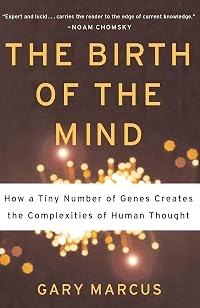
The Birth of the Mind: How a Tiny Number of Genes Creates The Complexities of Human Thought
by Gary Marcus
On This Page
Description
In The Birth of the Mind, award-winning cognitive scientist Gary Marcus irrevocably alters the nature vs. nurture debate by linking the findings of the Human Genome Project to the development of the brain. Scientists have long struggled to understand how a tiny number of genes could contain the instructions for building the human brain, arguably the most complex device in the known universe. Synthesizing up-to-the-minute research with his own original findings on child development, Marcus is show more the first to resolve this apparent contradiction. Vibrantly written and completely accessible to the lay reader, The Birth of the Mind will forever change the way we think about our origins and ourselves. The first book to show precisely how genes build the wonders of the human brain, and why the Human Genome Project could radically alter our view of the world. show lessTags
Recommendations



Member Reviews
This book ranges over a large amount of material, including molecular biology, genetics, developmental biology, brain physiology, plasticity, nature vs. nurture, split brain studies, and language acquisition. The surprising thing is that all of these topics are covered quite nicely. Not too deep but enough to bring them into the discussion of the books central focus: the role of genes in creating mind. In fact this broad yet succinct review of so many topics was what I liked most about the book, with ample notes and references so that you can go deeper into specific areas of interest.
The author does an excellent job of introducing some fundamentals of molecular biology and genetics, tracing the history of genetics going from what he show more calls the Trait Theory (Mendelian) to the Enzyme Theory (one gene, one enzyme) to the Protein Template Theory (genes involved in all proteins) up to the present (what he calls the Autonomous Agent Theory). He then describes how genes regulate themselves (“if-then” rules) and how this naturally leads to a very flexible method of cell differentiation and brain development.
In the author’s words: “It is popular in some quarters to claim that the human brain is largely unstructured of birth; it is tempting to believe that our minds float free of our genomes. Such beliefs are completely at odds with everything that scientists have learned in molecular biology over the past decade. Rather than leaving everything to chance or the vicissitudes of experience, nature has taken everything it has developed for growing the body and put it toward the problem of growing the brain. From cell division to cell differentiation, every process that is used in the development of the body is also used in development of the brain. Genes do for the brain the same things they do for the rest the body: they guide the fates of cells by guiding the production of proteins within those cells”. Pg. 86
and,
“At the core of this book is a very simple idea, that what is good enough for the body is good enough for the brain, that the mechanisms that build brains are just extensions of those that build the body. Like Crick's “astonishing hypothesis” – the idea that the mind is a product of the brain – the idea that the brain is a product of the genes should be (to modern ears) scarcely surprising, an idea so natural we might wonder how we ever doubted it". - Pg. 165 show less
The author does an excellent job of introducing some fundamentals of molecular biology and genetics, tracing the history of genetics going from what he show more calls the Trait Theory (Mendelian) to the Enzyme Theory (one gene, one enzyme) to the Protein Template Theory (genes involved in all proteins) up to the present (what he calls the Autonomous Agent Theory). He then describes how genes regulate themselves (“if-then” rules) and how this naturally leads to a very flexible method of cell differentiation and brain development.
In the author’s words: “It is popular in some quarters to claim that the human brain is largely unstructured of birth; it is tempting to believe that our minds float free of our genomes. Such beliefs are completely at odds with everything that scientists have learned in molecular biology over the past decade. Rather than leaving everything to chance or the vicissitudes of experience, nature has taken everything it has developed for growing the body and put it toward the problem of growing the brain. From cell division to cell differentiation, every process that is used in the development of the body is also used in development of the brain. Genes do for the brain the same things they do for the rest the body: they guide the fates of cells by guiding the production of proteins within those cells”. Pg. 86
and,
“At the core of this book is a very simple idea, that what is good enough for the body is good enough for the brain, that the mechanisms that build brains are just extensions of those that build the body. Like Crick's “astonishing hypothesis” – the idea that the mind is a product of the brain – the idea that the brain is a product of the genes should be (to modern ears) scarcely surprising, an idea so natural we might wonder how we ever doubted it". - Pg. 165 show less
This piece was succinct but effective, I thought, in the point it was trying to make. Generally one encounters strong conceptions about the mind's complexity and the ability of a brain to contain the scope of its phenomena. Even though the causal links between mind and brain are evidenced in every day life in the form of anti-depressents and other medication, many holdouts remain. Some critics decry that materialistic explanations of the brain can never truly understand the mind. In this book, Gary Marcus swiftly dispells these doubts and clarifies the simplicity of the problem with the creative powers of biology.
He begins by discussing the nature/nurture argument before going on to explain concepts like learning and other mental show more processes within this framework. Proceding onto topics in genetics, developmental and molecular biology, Marcus discusses the growth of the brain and how it structures itself into modules that allow our minds to exist. A praise quote on the back of the book mentioned the simplicity of the book, and I agree that this is one of the works most redeeming aspects. Not in that the material or coverage is overtly simplistic, but rather that it simplifies what to many appears to be a system that is actually too complex to ever fully be known. Marcus provides a little light at the end of the tunnel that maybe figuring out the brain isn't so impossible after all. show less
He begins by discussing the nature/nurture argument before going on to explain concepts like learning and other mental show more processes within this framework. Proceding onto topics in genetics, developmental and molecular biology, Marcus discusses the growth of the brain and how it structures itself into modules that allow our minds to exist. A praise quote on the back of the book mentioned the simplicity of the book, and I agree that this is one of the works most redeeming aspects. Not in that the material or coverage is overtly simplistic, but rather that it simplifies what to many appears to be a system that is actually too complex to ever fully be known. Marcus provides a little light at the end of the tunnel that maybe figuring out the brain isn't so impossible after all. show less
Says that we are prewired but not hardwired. http://garymarcus.net
lent to Blaze 10-21-20
Ratings
Members
- Recently Added By
Author Information

9+ Works 1,482 Members
Gary Marcus is Associate Professor of Psychology at New York University.
Classifications
Statistics
- Members
- 249
- Popularity
- 130,274
- Reviews
- 4
- Rating
- (4.06)
- Languages
- 5 — English, German, Italian, Korean, Spanish
- Media
- Paper, Ebook
- ISBNs
- 9
- ASINs
- 3