The Anatomy of the Nuremberg Trials: A Personal Memoir
by Telford Taylor
On This Page
Description
History of the Nuremberg war crimes trials by Telford Taylor, who became the American chief counsel.Tags
Recommendations
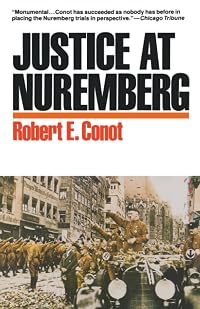














Member Reviews
I have always felt uneasy about the legitimacy and conduct of the Nuremburg Trials and this excellent memoire by one of the senior American prosecutors did little to make me feel more comfortable about the 'justice of the victors'.
Do not misunderstand me. The murderous out-of-control inhuman behaviour of the German military under an extremist and partially irrational political movement could not go unpunished. The victors were in an unenviable position in deciding to go about enforcing 'justice'.
There were four victors speaking for the 'United Nations' (the victors' own ideological construct which survives to this day) - the Soviet Union, France, the British Empire and the United States of America - and all had human rights skeletons in show more their closet.
The Soviet Union had a simple political position - it did not care how the bastards that had wrecked its country were punished but punished they must be. The French were distracted - they were lucky to be included in the victors' roster and had bigger problems rebuilding a shattered economy.
It was the two Western victors - the US and the British Empire, the first clearly by now displacing the latter as 'top dog' - who had to decide whether the victors' triumph should be a matter of simple political decision-making or should somehow be 'legitimised'.
Being pragmatists, the British initially wanted simply to sort things out as a set of political choices but the Americans had other ideas - they wanted a show trial with a difference, one that would be conducted not on Soviet lines but according to proper judicial procedures.
What Telford Taylor's book makes clear is that the Americans made the running in pushing forward the idea of a trial (which the Soviets certainly had no problem with on the basis that its results would be a foregone conclusion to all intents and purposes).
Taylor's book is remarkable as the testimony of the best of America - a decent, thoughtful and educated man trying to make sense of his own experience and giving a three-fold account of the atmosphere of the period, the processes involved and the moral issues raised by the trials.
Before we come to the reasons for unease in this reader (we detect slight unease at times in Telford), we should describe the book. It is an 'anatomy' not only of the trials themselves but of how they came to be, the thinking behind them and the mood of the time.
It is also a description of the Nazi defendants and their behaviour which adds to our understanding of their nature and motivation. It is not merely 'contemporary' narrative history but also a contribution to legal scholarship which the casual reader might find difficult and dull at times.
Nevertheless, it is worth persevering with because, while the legal issues can sometimes seem recondite and its structures built on sand when it comes to ethical considerations, the insight given into how lawyers make decisions in undoubtedly highly political circumstances is invaluable.
This is not to say that the trials were ever overtly political in procedure rather than initiation. The judges took their duty of care towards correct judicial form and as fair a trial as possible very seriously and this was no Vishinsky-style exercise in a witch hunt.
The defence was often poor from inexperience and part of one's unease lies in lack of allowance for the disadvantages it faced but there was an open and transparent defence process. The judges often challenged the prosecution and refused to let them dictate terms.
Telford's later access to Judge Biddle's notes of the deliberations of the judges before judgement and sentencing show us four judges and four alternates from four radically different political and judicial cultures horse-trading, yes, but attempting to be just according to their own lights.
Given the strength of feeling amongst the publics of the victorious nations and the emerging information about the deliberate and chaotic brutalities of the Nazi regime, the restraint being shown by the victors seems to be historically remarkable.
Nevertheless, what also comes across (and Telford's intellectual integrity in presenting and analysing what happened is commendable) is the degree to which the process and the judges fell between stools - neither a show trial along Soviet lines but also not something wholly depoliticised.
Looking back over what is now nearly seventy years, two contrasting thoughts emerge - that the 'American fix' of an international tribunal was probably the best bad option for dealing with a murderous regime and that the tribunal was not entirely fair either.
Unease lies in both the compromises essential to making this 'fix' work and its long term consequences with which we are still dealing today. It also lies in some specific decisions which remain disturbing of which more later.
The most obvious concern (felt then by many lawyers and military men as much as today) lies in the retrospectivity of the charges, Despite their claims, the Tribunal was creating international law after the fact. They were turning moral beliefs in the present into law in the past.
We are back to the problem of how you deal with undoubted 'crimes' (in ethical terms) when, in fact, there was no rule of law pertaining to them when they were committed. The victorious allies were obliged to create retrospective legislation as the only means of avoiding political solutions.
The theoretically right approach would have been to create consensual binding global legislation for the future based on the terrible events of the preceding years and this is what emerged as the United Nations became a force that could help create a framework of international law.
But this does not get away from the difficulties that no one before the UN Charter was agreed and who had not signed up to it was bound by it and that international relations is a relation of sovereign states and so law is only enforceable to the degree that it can be enforced by a 'victor'.
Moreover, the German (and Nazi) arguments about the oppressive nature of the Versailles Treaty and its denial of self-determination to Germans in the Sudetenland and the Polish corridor were never adequately answered except by diktat.
It is really uncomfortable for us to say this today but, while it does not justify the expansion of activity into imperialist war and certainly not the atrocities that ensued, the Wilsonian position on national self-determination should have recognised some German aspirations.
In short, we have skewed the story into a binary tale of good and evil so thatinternational justice becomes a fiction wholly dependent on the 'macht' of victors. Its retrospectivity was simply a sign of that 'macht'. The judicial procedures were the justice of the victors at that point in time.
The reason this creates unease is that, while many progressives were sincere and are sincere in their belief in international justice, the creators of this system all had far from clean hands in judging the Nazi regime.
The Nazi regime merely concentrated its crimes into a short space of time at the heart of the 'civilised world' and made the unfortunate error of glorifying its own brutality as an imperialist race struggle. But let us look at the record of the judging countries.
The Soviet Union's record in this respect requires no introduction but it had actively participated in the carving up of Poland (an important part of the charge sheet against Germany) and its activities since 1917 towards peasants and dissenters were certainly comparable to that of the Nazis.
The Soviets could and did make arguments from necessity and ideology not much differently from the Nazis (as did the Western imperialist powers in their time) while the German argument about the invasion of Norway as pre-emptive might well have held water if evidence was not withheld.
The two Western imperiums - those of France and Britain - had long since been constructed on the conquest of many indigenous peoples, some of whom (as in Tasmania) had been exterminated, and there is barely a nation in the world not invaded by the British at some point in history.
The King of little Belgium (for whom hundreds of thousands of young British men died in the First War) had overseen a brutal exploitative slave state in the Congo and Hitler was taking many beliefs and actions of the West in the previous century only to their horrible logical conclusion.
The United States, the 'beacon on the hill' and self aware store of moral value, had also been built on the original sin of the near-extermination of indigenous peoples and had still not come to terms with its own racial attitudes (it still has not) as it was liberating Dachau.
And then there were the more specific 'war crimes' arguments. One of the few defence wins at Nuremburg was to show that Doenitz and the German naval approach to unrestricted submarine warfare was much the same as the heroised Admiral Nimitz in the Pacific in the war against Japan.
The British obsession with punishing the Germans for the infamous Commando Order conveniently forgot that those same Commandos were slitting German throats from behind in secret raids. The Germans were committing war crimes but the Tribunal was never good at explaining context.
Then, when considering the unrestricted slaughter of civilians, the undoubted evil of the German military in the East and Himmler's machine could be seen as part of a general degradation that included the fire bombings of Hamburg, Dresden and Tokyo and the atom bomb blasts.
There were other oddities - the Soviets drove Germans out of their lands as the Germans drove Slavs out of theirs. Even as the trials were ending, the Czechs expelled the Sudeten Germans from their homeland without a whisper of complaint from the allies.
This is not to minimise the evils of the Nazi regime (on the contrary, there was something peculiarly demonic about the Himmler machine and Hitler) but to say that the victors glossed over things to ensure a political result with only relatively late behaviour change on their part.
The low point was probably the Soviets pushing their interpretation of the Katyn Wood massacre but there was also 'mauvaise foi' in the entire construction of the conspiracy to mount an aggressive war that repeated for political purposes the reasoning at Versailles.
What was ultimately behind this was a peculiarly American ideological drive to build a world that did not exist at that time and we can either share that intent and accept that the means justified the ends or be concerned that the means would become the ends as history unfolded.
American internationalists had tried to build that world under Woodrow Wilson and failed abysmally because Congress was not in tune with their thinking.
The attempt to force democracy and national self-determination into the same pot at the expense of the losers in 1918/1919 had been the trigger for a second round of violence and brutality in the 1930s and early 1940s but American liberalism was not about to give up on its dreams.
The Nuremburg Trials were part, just one part, of an attempt to impose moral order on a political universe which needed to risk nuclear conflagration with the Soviet Union in the coming years just as it needs to risk economic melt-down with the same conflict with China to achieve meaning.
What started with the crushing of the Confederacy and required the dismantling of the old European empires continued with the settlement of 1945 and the creation of a liberal democratic bloc and today's confrontations. It is as ideological as anything from the pen of Karl Marx.
But we come back to the main problem of 1945. The Nazis had been defeated. The evidence was clear that they had considered war an instrument of policy (but who did not until relatively recently) and that they had engaged in vicious and monstrous behaviours, especially in the East.
Incidentally, what is fascinating about Telford's account is the great time spent on the conspiracy to wage war (the main international legal argument) and on crimes against Allied servicemen (mostly to satisfy the British) and the relatively secondary role given to atrocities.
The atrocities are covered alright. Very early in the trials, the defendants were cowed and many shattered by the revelations of cruelty in the East (which it is clear that some had no experience of) which were staggering in their brutality.
Even allowing for some slight exaggeration in untestable Soviet evidence, history has shown that there was no exaggeration required to demonstrate the barbarism, neglect and chaos of Nazi rule in which the Wehrmacht were wholly complicit.
The point is that atrocities were largely a PR and prosecutory back-drop to arguments that centred on national 'amour propre' and 'rule of law' - the Jews were treated as almost a side issue by all except the Soviet prosecutors explaining legitimate Jewish resentment in later years.
The choice of defendants was also peculiar at times. There was confusion about which Krupp was to be charged so no Krupp was charged. Because Goebbels was dead, the prosecutors simply picked on an official, Fritsche, as close to him as possible (he was one of three acquitted).
Policy was being made on the hoof because events were moving fast from the process of persuading the United Nations to undertake a Tribunal through the pragmatic politics of rebuilding Germany (and the strange process of 'denazification') to the new politics of the Cold War.
This was not a stable process so it may best be understood as basically decent men of often limited capacity (this comes out strongly in Telford's text) and limited resources of information and time who were trapped in their cultural assumptions trying to work around political realities.
This meant many failures of process, lack of consistency, horse-trading and tokenism while the actual business of sorting out the consequences of Nazi rule were still being made politically. In some countries, such as France, it took quite a while to restore order and end 'rough justice'.
One particularly disturbing aspect of the trial was the link between the psychologist with access to the defendants and the prosecution and there were other procedures that may not have made the trial unfair but certainly loaded the dice heavily against the defendants.
In the end half of the defendants were hanged and most of the others got long terms of imprisonment with just three acquittals (all three of whom were then hunted down by the new German authorities in any case).
Were the sentences just? Perhaps so, possibly too soft in some cases and certainly in later trials, but 'justice' was only part of the story. The punishments and the 'show trial' aspects were politically necessary at the time in order to give meaning to the sacrifice of the allies and 'educate' Germans.
Indeed, given the violence done to so many people by the malice or incompetence or simple bureaucratic discipline of the defendants, no tears should be shed for those sentenced, including many of those summarily dealt with by the Soviets. Schacht and Speer got off lightly.
Indeed, one suspects that Schacht the banker and Speer the industrial fixer whose empire relied on the slave labour provided by the executed Sauckel were given some leeway because they were men of the judges' own class, professional men.
Some defendants behaved with exceptional dignity and one in particular, Seyss-Inquart, while remaining a Nazi to the end, earns some small respect both for his attempt to rule relaively humanely and to defy Hitler on a final destruction of the Netherlands. He was hanged.
Perhaps only two defendants end up as 'victims' for very different reasons. Doenitz had nothing to do with the 'conspiracy to war' nor direct involvement in the atrocities but got his jail sentence largely because he was the nearest they could get to the 'big bad' other than Goering himself.
The one that disturbs me the most is probably the least likeable personality (and weakest intellect), Julius Streicher, whose only crime was (it would appear) to run an antisemitic scandal sheet that was sidelined in much of the war and had a relatively small circulation.
He was notorious in the West and one gets the impression that he was to be hanged because a representative of ideology (other than Rosenberg who was also indicted as boss of a territory) was needed regardless of his actual lack of importance except as bogey man.
What is disturbing is that a man was hanged for expressing an opinion in a way that overturned the Voltairean Enlightenment position on freedom of speech and with no real evidence that his journal had anything directly to do with the crimes raised in the charges.
This is one of the darker sides of the liberal internationalist triumph of 1945 and more in accord with the Soviet influence in that triumph - the necessity for controlling the freedom that force brings to a people. It lives on in current German banning of free discourse.
Otherwise, we must accept the necessity of some sort of decisive act against the leaders of the Nazi regime and that it should be done by the Allies since Germany was in chaos (the US could rely on Iraqi revenge to deal with Saddam Husseion and leave with 'clean hands').
From that perspective, the Tribunal was flawed but necessary and there is no better book than Telford's for understanding the processes and compromises involved and how judgements were made under very difficult conditions.
Aspects of it may leave a bad taste in the mouth but the crimes of the Nazis leave an even nastier one and a 'St. Helena' solution of taking leading Nazis en masse and incarcerating them on a prison island or shooting them out of hand would have been even more problematic.
There was not time to think things through or to be pure about such issues as retrospectivity and admitting our own crimes as the basis for a new shared form of international justice.
Such a system is not possible now so it was scarcely going to be possible in the first flush of 1945. And so it was a 'fix', a well-intentioned and necessary one but a fix nevertheless.
As to the book, which I highly recommend for its decency and intellectual integrity, it is not quite definitive because we would need to read French, British and Soviet (and then German and even Nazi) perspectives for that but it is definitive enough in giving us an American view.
Non-lawyers might want to speed-read some of the more technical legal analyses (although they are worth studying in their own right) but Telford writes well and gives a good feel for what it was like to live as an occupier in a shattered post-war Germany. show less
Do not misunderstand me. The murderous out-of-control inhuman behaviour of the German military under an extremist and partially irrational political movement could not go unpunished. The victors were in an unenviable position in deciding to go about enforcing 'justice'.
There were four victors speaking for the 'United Nations' (the victors' own ideological construct which survives to this day) - the Soviet Union, France, the British Empire and the United States of America - and all had human rights skeletons in show more their closet.
The Soviet Union had a simple political position - it did not care how the bastards that had wrecked its country were punished but punished they must be. The French were distracted - they were lucky to be included in the victors' roster and had bigger problems rebuilding a shattered economy.
It was the two Western victors - the US and the British Empire, the first clearly by now displacing the latter as 'top dog' - who had to decide whether the victors' triumph should be a matter of simple political decision-making or should somehow be 'legitimised'.
Being pragmatists, the British initially wanted simply to sort things out as a set of political choices but the Americans had other ideas - they wanted a show trial with a difference, one that would be conducted not on Soviet lines but according to proper judicial procedures.
What Telford Taylor's book makes clear is that the Americans made the running in pushing forward the idea of a trial (which the Soviets certainly had no problem with on the basis that its results would be a foregone conclusion to all intents and purposes).
Taylor's book is remarkable as the testimony of the best of America - a decent, thoughtful and educated man trying to make sense of his own experience and giving a three-fold account of the atmosphere of the period, the processes involved and the moral issues raised by the trials.
Before we come to the reasons for unease in this reader (we detect slight unease at times in Telford), we should describe the book. It is an 'anatomy' not only of the trials themselves but of how they came to be, the thinking behind them and the mood of the time.
It is also a description of the Nazi defendants and their behaviour which adds to our understanding of their nature and motivation. It is not merely 'contemporary' narrative history but also a contribution to legal scholarship which the casual reader might find difficult and dull at times.
Nevertheless, it is worth persevering with because, while the legal issues can sometimes seem recondite and its structures built on sand when it comes to ethical considerations, the insight given into how lawyers make decisions in undoubtedly highly political circumstances is invaluable.
This is not to say that the trials were ever overtly political in procedure rather than initiation. The judges took their duty of care towards correct judicial form and as fair a trial as possible very seriously and this was no Vishinsky-style exercise in a witch hunt.
The defence was often poor from inexperience and part of one's unease lies in lack of allowance for the disadvantages it faced but there was an open and transparent defence process. The judges often challenged the prosecution and refused to let them dictate terms.
Telford's later access to Judge Biddle's notes of the deliberations of the judges before judgement and sentencing show us four judges and four alternates from four radically different political and judicial cultures horse-trading, yes, but attempting to be just according to their own lights.
Given the strength of feeling amongst the publics of the victorious nations and the emerging information about the deliberate and chaotic brutalities of the Nazi regime, the restraint being shown by the victors seems to be historically remarkable.
Nevertheless, what also comes across (and Telford's intellectual integrity in presenting and analysing what happened is commendable) is the degree to which the process and the judges fell between stools - neither a show trial along Soviet lines but also not something wholly depoliticised.
Looking back over what is now nearly seventy years, two contrasting thoughts emerge - that the 'American fix' of an international tribunal was probably the best bad option for dealing with a murderous regime and that the tribunal was not entirely fair either.
Unease lies in both the compromises essential to making this 'fix' work and its long term consequences with which we are still dealing today. It also lies in some specific decisions which remain disturbing of which more later.
The most obvious concern (felt then by many lawyers and military men as much as today) lies in the retrospectivity of the charges, Despite their claims, the Tribunal was creating international law after the fact. They were turning moral beliefs in the present into law in the past.
We are back to the problem of how you deal with undoubted 'crimes' (in ethical terms) when, in fact, there was no rule of law pertaining to them when they were committed. The victorious allies were obliged to create retrospective legislation as the only means of avoiding political solutions.
The theoretically right approach would have been to create consensual binding global legislation for the future based on the terrible events of the preceding years and this is what emerged as the United Nations became a force that could help create a framework of international law.
But this does not get away from the difficulties that no one before the UN Charter was agreed and who had not signed up to it was bound by it and that international relations is a relation of sovereign states and so law is only enforceable to the degree that it can be enforced by a 'victor'.
Moreover, the German (and Nazi) arguments about the oppressive nature of the Versailles Treaty and its denial of self-determination to Germans in the Sudetenland and the Polish corridor were never adequately answered except by diktat.
It is really uncomfortable for us to say this today but, while it does not justify the expansion of activity into imperialist war and certainly not the atrocities that ensued, the Wilsonian position on national self-determination should have recognised some German aspirations.
In short, we have skewed the story into a binary tale of good and evil so thatinternational justice becomes a fiction wholly dependent on the 'macht' of victors. Its retrospectivity was simply a sign of that 'macht'. The judicial procedures were the justice of the victors at that point in time.
The reason this creates unease is that, while many progressives were sincere and are sincere in their belief in international justice, the creators of this system all had far from clean hands in judging the Nazi regime.
The Nazi regime merely concentrated its crimes into a short space of time at the heart of the 'civilised world' and made the unfortunate error of glorifying its own brutality as an imperialist race struggle. But let us look at the record of the judging countries.
The Soviet Union's record in this respect requires no introduction but it had actively participated in the carving up of Poland (an important part of the charge sheet against Germany) and its activities since 1917 towards peasants and dissenters were certainly comparable to that of the Nazis.
The Soviets could and did make arguments from necessity and ideology not much differently from the Nazis (as did the Western imperialist powers in their time) while the German argument about the invasion of Norway as pre-emptive might well have held water if evidence was not withheld.
The two Western imperiums - those of France and Britain - had long since been constructed on the conquest of many indigenous peoples, some of whom (as in Tasmania) had been exterminated, and there is barely a nation in the world not invaded by the British at some point in history.
The King of little Belgium (for whom hundreds of thousands of young British men died in the First War) had overseen a brutal exploitative slave state in the Congo and Hitler was taking many beliefs and actions of the West in the previous century only to their horrible logical conclusion.
The United States, the 'beacon on the hill' and self aware store of moral value, had also been built on the original sin of the near-extermination of indigenous peoples and had still not come to terms with its own racial attitudes (it still has not) as it was liberating Dachau.
And then there were the more specific 'war crimes' arguments. One of the few defence wins at Nuremburg was to show that Doenitz and the German naval approach to unrestricted submarine warfare was much the same as the heroised Admiral Nimitz in the Pacific in the war against Japan.
The British obsession with punishing the Germans for the infamous Commando Order conveniently forgot that those same Commandos were slitting German throats from behind in secret raids. The Germans were committing war crimes but the Tribunal was never good at explaining context.
Then, when considering the unrestricted slaughter of civilians, the undoubted evil of the German military in the East and Himmler's machine could be seen as part of a general degradation that included the fire bombings of Hamburg, Dresden and Tokyo and the atom bomb blasts.
There were other oddities - the Soviets drove Germans out of their lands as the Germans drove Slavs out of theirs. Even as the trials were ending, the Czechs expelled the Sudeten Germans from their homeland without a whisper of complaint from the allies.
This is not to minimise the evils of the Nazi regime (on the contrary, there was something peculiarly demonic about the Himmler machine and Hitler) but to say that the victors glossed over things to ensure a political result with only relatively late behaviour change on their part.
The low point was probably the Soviets pushing their interpretation of the Katyn Wood massacre but there was also 'mauvaise foi' in the entire construction of the conspiracy to mount an aggressive war that repeated for political purposes the reasoning at Versailles.
What was ultimately behind this was a peculiarly American ideological drive to build a world that did not exist at that time and we can either share that intent and accept that the means justified the ends or be concerned that the means would become the ends as history unfolded.
American internationalists had tried to build that world under Woodrow Wilson and failed abysmally because Congress was not in tune with their thinking.
The attempt to force democracy and national self-determination into the same pot at the expense of the losers in 1918/1919 had been the trigger for a second round of violence and brutality in the 1930s and early 1940s but American liberalism was not about to give up on its dreams.
The Nuremburg Trials were part, just one part, of an attempt to impose moral order on a political universe which needed to risk nuclear conflagration with the Soviet Union in the coming years just as it needs to risk economic melt-down with the same conflict with China to achieve meaning.
What started with the crushing of the Confederacy and required the dismantling of the old European empires continued with the settlement of 1945 and the creation of a liberal democratic bloc and today's confrontations. It is as ideological as anything from the pen of Karl Marx.
But we come back to the main problem of 1945. The Nazis had been defeated. The evidence was clear that they had considered war an instrument of policy (but who did not until relatively recently) and that they had engaged in vicious and monstrous behaviours, especially in the East.
Incidentally, what is fascinating about Telford's account is the great time spent on the conspiracy to wage war (the main international legal argument) and on crimes against Allied servicemen (mostly to satisfy the British) and the relatively secondary role given to atrocities.
The atrocities are covered alright. Very early in the trials, the defendants were cowed and many shattered by the revelations of cruelty in the East (which it is clear that some had no experience of) which were staggering in their brutality.
Even allowing for some slight exaggeration in untestable Soviet evidence, history has shown that there was no exaggeration required to demonstrate the barbarism, neglect and chaos of Nazi rule in which the Wehrmacht were wholly complicit.
The point is that atrocities were largely a PR and prosecutory back-drop to arguments that centred on national 'amour propre' and 'rule of law' - the Jews were treated as almost a side issue by all except the Soviet prosecutors explaining legitimate Jewish resentment in later years.
The choice of defendants was also peculiar at times. There was confusion about which Krupp was to be charged so no Krupp was charged. Because Goebbels was dead, the prosecutors simply picked on an official, Fritsche, as close to him as possible (he was one of three acquitted).
Policy was being made on the hoof because events were moving fast from the process of persuading the United Nations to undertake a Tribunal through the pragmatic politics of rebuilding Germany (and the strange process of 'denazification') to the new politics of the Cold War.
This was not a stable process so it may best be understood as basically decent men of often limited capacity (this comes out strongly in Telford's text) and limited resources of information and time who were trapped in their cultural assumptions trying to work around political realities.
This meant many failures of process, lack of consistency, horse-trading and tokenism while the actual business of sorting out the consequences of Nazi rule were still being made politically. In some countries, such as France, it took quite a while to restore order and end 'rough justice'.
One particularly disturbing aspect of the trial was the link between the psychologist with access to the defendants and the prosecution and there were other procedures that may not have made the trial unfair but certainly loaded the dice heavily against the defendants.
In the end half of the defendants were hanged and most of the others got long terms of imprisonment with just three acquittals (all three of whom were then hunted down by the new German authorities in any case).
Were the sentences just? Perhaps so, possibly too soft in some cases and certainly in later trials, but 'justice' was only part of the story. The punishments and the 'show trial' aspects were politically necessary at the time in order to give meaning to the sacrifice of the allies and 'educate' Germans.
Indeed, given the violence done to so many people by the malice or incompetence or simple bureaucratic discipline of the defendants, no tears should be shed for those sentenced, including many of those summarily dealt with by the Soviets. Schacht and Speer got off lightly.
Indeed, one suspects that Schacht the banker and Speer the industrial fixer whose empire relied on the slave labour provided by the executed Sauckel were given some leeway because they were men of the judges' own class, professional men.
Some defendants behaved with exceptional dignity and one in particular, Seyss-Inquart, while remaining a Nazi to the end, earns some small respect both for his attempt to rule relaively humanely and to defy Hitler on a final destruction of the Netherlands. He was hanged.
Perhaps only two defendants end up as 'victims' for very different reasons. Doenitz had nothing to do with the 'conspiracy to war' nor direct involvement in the atrocities but got his jail sentence largely because he was the nearest they could get to the 'big bad' other than Goering himself.
The one that disturbs me the most is probably the least likeable personality (and weakest intellect), Julius Streicher, whose only crime was (it would appear) to run an antisemitic scandal sheet that was sidelined in much of the war and had a relatively small circulation.
He was notorious in the West and one gets the impression that he was to be hanged because a representative of ideology (other than Rosenberg who was also indicted as boss of a territory) was needed regardless of his actual lack of importance except as bogey man.
What is disturbing is that a man was hanged for expressing an opinion in a way that overturned the Voltairean Enlightenment position on freedom of speech and with no real evidence that his journal had anything directly to do with the crimes raised in the charges.
This is one of the darker sides of the liberal internationalist triumph of 1945 and more in accord with the Soviet influence in that triumph - the necessity for controlling the freedom that force brings to a people. It lives on in current German banning of free discourse.
Otherwise, we must accept the necessity of some sort of decisive act against the leaders of the Nazi regime and that it should be done by the Allies since Germany was in chaos (the US could rely on Iraqi revenge to deal with Saddam Husseion and leave with 'clean hands').
From that perspective, the Tribunal was flawed but necessary and there is no better book than Telford's for understanding the processes and compromises involved and how judgements were made under very difficult conditions.
Aspects of it may leave a bad taste in the mouth but the crimes of the Nazis leave an even nastier one and a 'St. Helena' solution of taking leading Nazis en masse and incarcerating them on a prison island or shooting them out of hand would have been even more problematic.
There was not time to think things through or to be pure about such issues as retrospectivity and admitting our own crimes as the basis for a new shared form of international justice.
Such a system is not possible now so it was scarcely going to be possible in the first flush of 1945. And so it was a 'fix', a well-intentioned and necessary one but a fix nevertheless.
As to the book, which I highly recommend for its decency and intellectual integrity, it is not quite definitive because we would need to read French, British and Soviet (and then German and even Nazi) perspectives for that but it is definitive enough in giving us an American view.
Non-lawyers might want to speed-read some of the more technical legal analyses (although they are worth studying in their own right) but Telford writes well and gives a good feel for what it was like to live as an occupier in a shattered post-war Germany. show less
Telford Taylor’s “The Anatomy of the Nuremberg Trials: A Personal Memoir” is both a memoir/autobiography and a scholarly legal analysis of the International Military Tribunal.
The book begins with some details about Taylor and international law as it existed at the time of WWII. Taylor had served in the American Army intelligence in Europe during WWII before being assigned as assistant to Chief Counsel Robert H. Jackson at Nuremberg in 1944. He describes international law as it existed at the time of the establishment of London Charter of the International Military Tribunal, such as the Lieber Code, the Hague Conventions of 1899 and 1907, the Geneva Convention of 1864, the Kellogg-Briand Pact (Pact of Paris) of 1928, etc., and the show more legal challenges of including crimes against peace, crimes against humanity, and the waging of aggressive wars in the Charter’s indictment.
Taylor moves on to describe the difficulties of reaching agreement on the indictment. Firstly, there were differences in what to do with the top ranking Nazis. The British initially supported killing all the major Nazis, while the Americans wanted a trial, which Taylor notes was a reversal of the outcome of WWI, when the British wanted a trial of Kaiser officials and the Americans were indifferent, if not opposed. Secondly, differences between Anglo-American and Continental European law posed major challenges on reaching an agreement between the U.S., Britain, France, and the USSR, which affected everything from what the indictment was and how it should be written, to whether or not the SS and the Gestapo could be charged as entities. Thirdly, the charge of “conspiracy”, the brainchild of Murray C. Bernays, to wage aggressive wars was and remained throughout the trial extremely controversial.
The rest of the book is a mixture of Taylor’s memoirs (what he heard, witnessed, experienced, etc.) and legal analysis (of the defense and prosecutions arguments, the evidence, etc.). This is where the value of the book really comes to light. Taylor offers a penetrating insider’s perspective of the participants (judges, prosecution, defense, and Nazi criminals), both within the courtroom and outside, and the progress of the trial.
Taylor describes Hermann Goering’s stunning victory over Jackson in the courtroom. According to Taylor, “Jackson was ‘unable to follow’ Goering, ‘much less outmaneuver him’” in his cross-examination. Jackson proceeded to have a meltdown in court, bitter at Goering’s victory over him, causing tension between the judges and the American prosecution. Goering was apparently too smart for the Americans; the British and Soviets were more effective with him. Throughout the book Taylor frequently describes the mental deterioration of Rudolph Hess throughout he trial. Despite the court psychologist’s evaluation of Hess as fit to stand trial, Taylor repeatedly makes it known that he disagreed. Taylor takes pity on Hess, which I found strongly disagreeable. Hess was a vicious Nazi that should have been hanged with the rest of them, but that is my opinion.
Here is a glimpse of how Taylor describes some of the Nazis. Ribbentrop was “regarded with utter scorn” at Nuremberg. Keitel was “the sort of weak man whom Hitler could count on to follow his orders regardless of law or morals.” Kaltenbrunner was “the most ominous-looking man in the dock and had no friends there.” Rosenberg “was maddeningly verbose and drove both his counsel (Dr. Alfred Thoma) and [President Judge] Lawrence to distraction with his insistence on treating every question as raising theoretical and historical matters. It was much easier to find him irritating than evil, and it was not until the evidence was forced onto the stage that one became aware of the atrocious consequences of this woolly and maundering man’s activities.” Frank “was no more attractive than most of his fellow defendants, but he was among the more interesting.” Frick “was the consummate bureaucrat — stiff, orderly, taciturn, unimaginative — and the least interesting of the defendants” as well as “a very cold fish.” Streicher posed the most difficult legal issues, his sole crime at Nuremberg being incitement since he had never participated or organized any violence against Jews. Schacht “was at the top of Dr. Gilbert’s IQ ladder (though only marginally above Seyss-Inquart, Goering, and Doenitz)” and as well as having superior education and linguistic skills, “he was the most sophisticated in the ways of the world. To those whom he respected, Schacht could be charming, but he did not suffer fools gladly and was arrogant, tough, sarcastic, and domineering. He was invariably convinced that he was both right and in the right…”. Funk was “Pasty, pudgy, in poor health, blubbering when testimony or photographs illuminated the horrors of the Nazi record, and openly scared — a pitiful wreck of a man who had fallen beneath respect, and knew it.” Schirach “ was the weakest of the defendants. If wimps had been spoken of, Schirach would have been so styled.”
Almost 200 pages of the book are devoted to the Nazi criminals, their testimonies, the arguments of their defense lawyers and the prosecution, and Taylor’s personal assessment of the Nazi criminals and the conduct of their trials. The above is a glimpse of the insider’s perspective that Taylor offers.
An element of the book I strongly disliked — and eventually found unbearable — was Taylor’s American righteousness. Throughout the book Taylor repeatedly criticizes all the other powers for their actions during WWII, such as (correctly) British and French appeasement of the Nazis, the dismemberment of Czechoslovakia, and British unwillingness to provide evidence to the defense counsel of British plans for the occupation of Norway, and (incorrectly) especially the Soviets, such as the Nazi-Soviet Nonaggression Pact and the division of Poland, the Soviet-Finnish War, the pre-WWII purges, and the Katyn Massacre. But nowhere does he criticize the U.S., even when evidence of American crimes under the Nuremberg charter are brought out in open court. For example, Doenitz, commander of the German Navy, was accused of sinking British merchant ships in violation of the London Submarine Protocol of 1936. According to Taylor, this agreement prohibited the sinking of merchant ships without the attacking vessel first placing “the passengers, crew, and ship’s paper in a place of safety.” Thus, Taylor writes, “the German practice was a gross violation, causing many deaths at sea, and the charge could well lead to a capital consequence” for both Nazi navy officers at Nuremberg. Yet, when Doenitz’s lawyer offered evidence of the U.S. Navy committing the exact same “gross violation” in the sinking of Japanese merchant ships, all Taylor has to say is that the British prosecutor Fyfe’s objection that “the question whether the United States broke the laws and usages of war is quite irrelevant…it raises the old problem of evidence directed to tu quoque” and that Fyfe was “on sound ground; in general criminal law, if a defendant has committed a particular crime, the fact that others have also, even if the others are the accusers, is no defense.” The fact that American crimes during WWII receive a pass from Taylor throughout the book really diminished my respect for Taylor and his legal analyses.
Overall it was a really eye-opening book about a critical period in the establishment of modern international law. show less
The book begins with some details about Taylor and international law as it existed at the time of WWII. Taylor had served in the American Army intelligence in Europe during WWII before being assigned as assistant to Chief Counsel Robert H. Jackson at Nuremberg in 1944. He describes international law as it existed at the time of the establishment of London Charter of the International Military Tribunal, such as the Lieber Code, the Hague Conventions of 1899 and 1907, the Geneva Convention of 1864, the Kellogg-Briand Pact (Pact of Paris) of 1928, etc., and the show more legal challenges of including crimes against peace, crimes against humanity, and the waging of aggressive wars in the Charter’s indictment.
Taylor moves on to describe the difficulties of reaching agreement on the indictment. Firstly, there were differences in what to do with the top ranking Nazis. The British initially supported killing all the major Nazis, while the Americans wanted a trial, which Taylor notes was a reversal of the outcome of WWI, when the British wanted a trial of Kaiser officials and the Americans were indifferent, if not opposed. Secondly, differences between Anglo-American and Continental European law posed major challenges on reaching an agreement between the U.S., Britain, France, and the USSR, which affected everything from what the indictment was and how it should be written, to whether or not the SS and the Gestapo could be charged as entities. Thirdly, the charge of “conspiracy”, the brainchild of Murray C. Bernays, to wage aggressive wars was and remained throughout the trial extremely controversial.
The rest of the book is a mixture of Taylor’s memoirs (what he heard, witnessed, experienced, etc.) and legal analysis (of the defense and prosecutions arguments, the evidence, etc.). This is where the value of the book really comes to light. Taylor offers a penetrating insider’s perspective of the participants (judges, prosecution, defense, and Nazi criminals), both within the courtroom and outside, and the progress of the trial.
Taylor describes Hermann Goering’s stunning victory over Jackson in the courtroom. According to Taylor, “Jackson was ‘unable to follow’ Goering, ‘much less outmaneuver him’” in his cross-examination. Jackson proceeded to have a meltdown in court, bitter at Goering’s victory over him, causing tension between the judges and the American prosecution. Goering was apparently too smart for the Americans; the British and Soviets were more effective with him. Throughout the book Taylor frequently describes the mental deterioration of Rudolph Hess throughout he trial. Despite the court psychologist’s evaluation of Hess as fit to stand trial, Taylor repeatedly makes it known that he disagreed. Taylor takes pity on Hess, which I found strongly disagreeable. Hess was a vicious Nazi that should have been hanged with the rest of them, but that is my opinion.
Here is a glimpse of how Taylor describes some of the Nazis. Ribbentrop was “regarded with utter scorn” at Nuremberg. Keitel was “the sort of weak man whom Hitler could count on to follow his orders regardless of law or morals.” Kaltenbrunner was “the most ominous-looking man in the dock and had no friends there.” Rosenberg “was maddeningly verbose and drove both his counsel (Dr. Alfred Thoma) and [President Judge] Lawrence to distraction with his insistence on treating every question as raising theoretical and historical matters. It was much easier to find him irritating than evil, and it was not until the evidence was forced onto the stage that one became aware of the atrocious consequences of this woolly and maundering man’s activities.” Frank “was no more attractive than most of his fellow defendants, but he was among the more interesting.” Frick “was the consummate bureaucrat — stiff, orderly, taciturn, unimaginative — and the least interesting of the defendants” as well as “a very cold fish.” Streicher posed the most difficult legal issues, his sole crime at Nuremberg being incitement since he had never participated or organized any violence against Jews. Schacht “was at the top of Dr. Gilbert’s IQ ladder (though only marginally above Seyss-Inquart, Goering, and Doenitz)” and as well as having superior education and linguistic skills, “he was the most sophisticated in the ways of the world. To those whom he respected, Schacht could be charming, but he did not suffer fools gladly and was arrogant, tough, sarcastic, and domineering. He was invariably convinced that he was both right and in the right…”. Funk was “Pasty, pudgy, in poor health, blubbering when testimony or photographs illuminated the horrors of the Nazi record, and openly scared — a pitiful wreck of a man who had fallen beneath respect, and knew it.” Schirach “ was the weakest of the defendants. If wimps had been spoken of, Schirach would have been so styled.”
Almost 200 pages of the book are devoted to the Nazi criminals, their testimonies, the arguments of their defense lawyers and the prosecution, and Taylor’s personal assessment of the Nazi criminals and the conduct of their trials. The above is a glimpse of the insider’s perspective that Taylor offers.
An element of the book I strongly disliked — and eventually found unbearable — was Taylor’s American righteousness. Throughout the book Taylor repeatedly criticizes all the other powers for their actions during WWII, such as (correctly) British and French appeasement of the Nazis, the dismemberment of Czechoslovakia, and British unwillingness to provide evidence to the defense counsel of British plans for the occupation of Norway, and (incorrectly) especially the Soviets, such as the Nazi-Soviet Nonaggression Pact and the division of Poland, the Soviet-Finnish War, the pre-WWII purges, and the Katyn Massacre. But nowhere does he criticize the U.S., even when evidence of American crimes under the Nuremberg charter are brought out in open court. For example, Doenitz, commander of the German Navy, was accused of sinking British merchant ships in violation of the London Submarine Protocol of 1936. According to Taylor, this agreement prohibited the sinking of merchant ships without the attacking vessel first placing “the passengers, crew, and ship’s paper in a place of safety.” Thus, Taylor writes, “the German practice was a gross violation, causing many deaths at sea, and the charge could well lead to a capital consequence” for both Nazi navy officers at Nuremberg. Yet, when Doenitz’s lawyer offered evidence of the U.S. Navy committing the exact same “gross violation” in the sinking of Japanese merchant ships, all Taylor has to say is that the British prosecutor Fyfe’s objection that “the question whether the United States broke the laws and usages of war is quite irrelevant…it raises the old problem of evidence directed to tu quoque” and that Fyfe was “on sound ground; in general criminal law, if a defendant has committed a particular crime, the fact that others have also, even if the others are the accusers, is no defense.” The fact that American crimes during WWII receive a pass from Taylor throughout the book really diminished my respect for Taylor and his legal analyses.
Overall it was a really eye-opening book about a critical period in the establishment of modern international law. show less
this is an in-depth analysis of the famous trials of nazi leadership, military and otherwise. Taylor participated on the prosecution side even cross examining some of these 21 defendants in the inaugural trial. defiant goering and muddled, mysterious Hess stand out. also standing out is the Russian arm of the four nation tribunal for its focus on the Katyn massacre and dancing around the difficulties of their partnership with Hitler in partitioning poland.
If you want to read your way to a comprehensive understanding of the Nuremberg trials this is a must read. Not a big fan of Taylor and his world view as an internationalist but his insight into the people and process at the trials is primary material.
Not exactly a book to take to the beach, but this is a fascinating look at the Nuremberg trials. The diaries of Dr. Gilbert might provide more insight into the defendants, but this book goes behind the scenes of how the trials worked and the incredible struggle just to pull them off.
The author was a member of the American Prosecution staff at the International Military Tribunal that was held in Nuremberg in 1945-6 with the purpose of judging major Nazi war criminals. The book, as the subtitle states, is a personal description of the trial, including its pre-history, that is, the negotiations between the Allies in the last part of the War that resulted in the decision of constituting the IMT and helding the trials (largely an American idea) instead of some other methods of dealing with the emprisioned Nazi top leadership (such as shooting them without trial, as Churchill defended, or prosecuting them in national courts). The problems and frictions encontered in drafting the Charter of the IMT, the Indictements, and show more the selection of the defendants is covered in detail in the first fourth of the book. The remaining deals with the trial itself. What makes this a very interesting book is that it not only describes the public part of the trial but also the backstage, and even some developments that would probably never been known if the author had not been himself personaly involved in the works. Near the end of the trial the author was made Chief U.S. Prosecutor for the ensuing war crimes trials that took place in Nurember for the next three years. It would have be interesting to read his account of those ones. show less
Excellent. Taylor has an even hand between claims of "victors' justice" and just retribution.
Members
- Recently Added By
Lists

All Things Germany
321 works; 4 members
Author Information

12+ Works 679 Members
Telford Taylor (1908-1998) graduated from Williams College and Harvard Law School. During World War II, he served in Europe as a US Army intelligence officer and was awarded the Distinguished Service Medal. After the Nuremberg trials, Taylor practiced law in New York City, taught at Columbia Law School and the Benjamin Cardozo School of Law, and show more published a number of books, including Munich: The Price of Peace, which won the National Book Critics Circle Award for best nonfiction work in 1979. show less
Common Knowledge
- Important places
- Nuremberg, Bavaria, Germany
- Important events
- Nuremberg War Crimes Trials (1945-11-14 | 1946-10-01)
Classifications
- Genres
- Politics and Government, Nonfiction, History, General Nonfiction, Biography & Memoir
- DDC/MDS
- 341.6 — Society, government, & culture Law International Law - United Nations, EU Law of Armed Conflict
- LCC
- JX5437.8 .T39 — Political Science International law, see JZ and KZ (obsolete) International law, see JZ and KZ International law
- BISAC
Statistics
- Members
- 318
- Popularity
- 100,325
- Reviews
- 7
- Rating
- (3.84)
- Languages
- English, French, German, Italian
- Media
- Paper, Audiobook, Ebook
- ISBNs
- 12
- ASINs
- 6