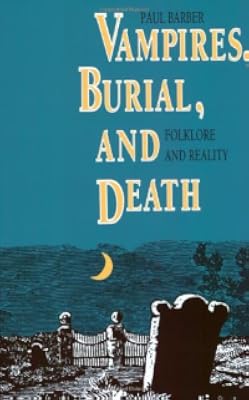
Vampires, Burial, and Death: Folklore and Reality
by Paul Barber
On This Page
Description
In this engrossing book, Paul Barber surveys centuries of folklore about vampires and offers the first scientific explanation for the origins of the vampire legends. From the tale of a sixteenth-century shoemaker from Breslau whose ghost terrorized everyone in the city, to the testimony of a doctor who presided over the exhumation and dissection of a graveyard full of Serbian vampires, his book is fascinating reading. "This study's comprehensiveness and the author's bone-dry wit make this show more compelling reading, not just for folklorists, but for anyone interested in a time when the dead wouldn't stay dead."-Booklist "Barber's inquiry into vampires, fact and fiction, is a gem in the literature of debunking... [and] a convincing exercise in mental archaeology."-Roy Porter, Nature "A splendid book about the undead, illuminated by the findings of morbid anatomy.... The main value of this most interesting book is to remind us how far we have come in our ability to explain the world and how this has released us from at least some terrors."-Anthony Daniels, Spectator "This book is fascinating reading for physicians and anthropologists as well as anyone interested in folklore."-R. Ted Steinbock, M.D., Journal of the American Medical Association "A fascinating and pain-staking (sorry!) thesis, which welds together folklore, epidemic panic, communal stupidity, and forensic and funereal science."-Huw Knight, New Scientist show lessTags
Recommendations









Member Reviews
Anyone with an interest in vampires needs to investigate this marvelous book by Paul Barber, a rare scholarly study that is written with verve, wit, and charm. Barber reminds us that the undead of folklore have precious little in common with Bram Stoker's Dracula or Anne Rice's Lestat -- those are completely modern concoctions. The traditional vampire is, in fact, a corpse. And not a corpse in any too good shape, either! Barber includes more information about the body after death than you could ever have imagined, and yet somehow manages to maintain a jolly tone while he discusses the details of decomposition and other potentially gut-churning subjects. I laughed out loud at lines like these: "However tragic your death may be, it would show more be far more tragic if you were to take me with you." This is a great book! show less
It's been ages since I read this and I think it would get another star if the main thing I didn't remember so very, very clearly was the description of the process of decomposition. Specifically the "liquifaction of the eyeballs." So three stars because I am so annoyingly squeamish. But the book was extremely well sourced and interesting, so I'd definitely recommend it.
Are no sparkly or sexy vampires here; not even any who wear evening dress and travel with coffins of dirt. This nonfiction book explores the very roots of the vampire legend and ties it to the unexpected things that dead bodies can do and how the people of yesterday interpreted those things.
The average corpse does certain things: the face turns pale and waxy, the limbs become rigid, the blood coagulates, and it lays silent and unmoving. But not all corpses follow those rules; depending on how the person died, they may have a red face. After a certain point, rigor leaves and the body becomes limp again. The blood does not always coagulate. A corpse filled with gasses from decay may make sounds when moved or prodded. These things are show more explainable through science today, but weren’t 500 or more years ago.
The book reads like a master’s or doctoral thesis: Barber makes his points clearly and presents well researched proof to back them. While much of his research was in folklore, he has also gone to the experts in dead bodies: coroners and medical examiners. He’s got the facts down cold: the physical signs of bodies that were declared vampires or revenants could all be explained by science. The stories that grew around them, of course, were all human imagination. If a body could groan and move and bleed, why couldn’t it be what was making trouble at night in the village?
I’m not going to say that lovers of vampire novels will like this book (I’m not saying they won’t, either). Lovers of folklore and human nature will. A warning: the descriptions of dead bodies are very graphic, although certainly not sensational. It’s all presented in a dry, just the facts manner, but very interesting. show less
The average corpse does certain things: the face turns pale and waxy, the limbs become rigid, the blood coagulates, and it lays silent and unmoving. But not all corpses follow those rules; depending on how the person died, they may have a red face. After a certain point, rigor leaves and the body becomes limp again. The blood does not always coagulate. A corpse filled with gasses from decay may make sounds when moved or prodded. These things are show more explainable through science today, but weren’t 500 or more years ago.
The book reads like a master’s or doctoral thesis: Barber makes his points clearly and presents well researched proof to back them. While much of his research was in folklore, he has also gone to the experts in dead bodies: coroners and medical examiners. He’s got the facts down cold: the physical signs of bodies that were declared vampires or revenants could all be explained by science. The stories that grew around them, of course, were all human imagination. If a body could groan and move and bleed, why couldn’t it be what was making trouble at night in the village?
I’m not going to say that lovers of vampire novels will like this book (I’m not saying they won’t, either). Lovers of folklore and human nature will. A warning: the descriptions of dead bodies are very graphic, although certainly not sensational. It’s all presented in a dry, just the facts manner, but very interesting. show less
In Vampires, Burial, and Death, Barber differentiates between vampires of folklore and those of popular fiction (with a very strong emphasis on those of folklore). He proposes that the folklore of vampires arose due to people’s fear of dead bodies. He rigorously notes the common traits of folklore vampires (blood at the mouth, bloating, groaning when staked, red face, etc.) and points out that all of these things could occur naturally in a decaying body. The content of this book is very interesting, and Barber’s thesis is quite logical. However, the narrative was a little drier than necessary. I enjoyed learning, but wished it could have been a little more engaging!
An interesting book, but I agree with some of the other reviewers. A lot of the book suffers from repetition. There are no less than 3 extensive discussions about how "vampires" are destroyed in folklore, and all of them contain mostly the same information. It would have really benefited from a good editor with a red pen sitting down with the author to help organize the content better.
A social history of the mythology we have inherited. Enlightening. Not a vampire book, but a book about how we came to have the concept of vampires.
Ratings
Members
- Recently Added By
Lists

Books Cited in Wasteland by W. Scott Poole
120 works; 1 member

In Our Time books
4,934 works; 2 members
Author Information
1 Work 502 Members
Common Knowledge
- Original publication date
- 1988
- People/Characters
- Peter Plogojowitz; Arnod Paole; Pitton de Tournefort; Giure Grando
- First words
- Europeans of the early 1700s showed a great deal of interest in the subject of the vampire.
- Quotations
- I would guess that Giure Grando's cry resulted from the manipulation of the corpse but can really not say much about the matter, since I almost never have occasion to decapitate a corpse with a shove.
- Last words
- (Click to show. Warning: May contain spoilers.)The bare skeleton- in our culture the very symbol of the terror of death- is in other cultures evidencethat the dead body is finally safe and that the living are out of harm's way.
- Blurbers
- Kashgarian, Michael; Oinas, Felix J.
Classifications
- Genres
- Anthropology, Nonfiction, General Nonfiction, History, Religion & Spirituality
- DDC/MDS
- 398.45 — Society, government, & culture Customs, etiquette & folklore Folklore & Folktales Paranatural and legendary phenomena as subjects of folklore Paranormal beings of human and semihuman form
- LCC
- GR830 .V3 .B35 — Geography, Anthropology and Recreation Folklore Folklore By subject Animals, plants, and minerals
- BISAC
Statistics
- Members
- 509
- Popularity
- 59,169
- Reviews
- 6
- Rating
- (3.99)
- Languages
- English, Italian
- Media
- Paper, Ebook
- ISBNs
- 6
- ASINs
- 1