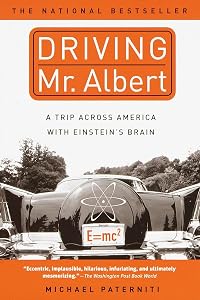
Driving Mr. Albert: A Trip Across America with Einstein's Brain
by Michael Paterniti
On This Page
Description
"Part travelogue, part memoir, part history, part biography, and part meditation," the author recounts his trip form New Jersey to California to return Einstein's brain to his relatives.Tags
Recommendations















Member Reviews
I’m a sucker for the cross-country journey with a twist as my reading of I See By My Outfit proves. This book tells the story of a sensitive young man nearing the end of a long-term relationship who drives across America with an elderly pathologist and Albert Einstein’s brain - or a few chunks of it floating in formaldehyde in Tupperware containers in the trunk. The story of the trip – which includes a visit to William S. Burroughs among other things – is really the story of Dr. Thomas Harvery, of Albert Einstein, and most importantly Einstein’s iconic status in contemporary America.
“I was forever projecting myself forward and backward at the same time, negating the present moment, changing my mind with alarming frequency. show more A master of vicissitudes, … I couldn’t name my longing, and yet it was there, always driving me away from the place where I stood.” P. 14
“As it will happen in this single day, we will live through four seasons. Which can occur if one drives long enough with Einsteins’ brain in the trunk. Time bends, accelerates, and overlaps; it moves backward, vertically, then loops; simultaneity rules.” – p. 109
“’Science without religion is lame,’ Einstein once said, ‘religion without science is blind.’” – p. 126 show less
“I was forever projecting myself forward and backward at the same time, negating the present moment, changing my mind with alarming frequency. show more A master of vicissitudes, … I couldn’t name my longing, and yet it was there, always driving me away from the place where I stood.” P. 14
“As it will happen in this single day, we will live through four seasons. Which can occur if one drives long enough with Einsteins’ brain in the trunk. Time bends, accelerates, and overlaps; it moves backward, vertically, then loops; simultaneity rules.” – p. 109
“’Science without religion is lame,’ Einstein once said, ‘religion without science is blind.’” – p. 126 show less
While there is a certain kitschy charm to this work, I found the story rather uncomfortable. Mostly, I was put off by the author explaining that Einstein and his family didn’t want his remains to be put on a coarse display - yet I cannot see that this work does anything other than that. Not physically, but in every word it is a type of gruesome circus centered on the preserved remains of the greatest mind of our times. While I was incredibly intrigued by the idea of this story-- a man on a road trip with Einstein’s brain… the reality is a little grotesque.
The story is interesting enough to survive Paterniti’s dull prose and outworn pop cultural references. The best bits are a visit to William S. Burroughs at home only months before he died, letters from the National Archive alluding to the pacifist Einstein’s work for the U.S. Navy, a dildo with a handle shaped like Ronald Reagan’s head, and the Einsteinian hero-worship of karaoke singers in Osaka — but since this is an overinflated magazine article, Paterniti’s treatment is superficial. And the brain is just slimy chunks floating in Tupperware.
I read this entire book thinking it was fiction! I just realized it is a true story.
Wow. Well, how I write the review is now going to be a little bit different.
The author took a road trip across the USA in the 90's with Einstein's brain in Tupperware in the trunk. I thought it would be a humorous book (see, I thought it was fiction!) but it's actually a relatively slow-paced story about a rather emo guy chauffeuring an old guy (former pathologist) across the states to give the brain to Einstein's granddaughter.
Now that I know these are true people in this story, I'm blown away. Okay, they really did go see William Burroughs in Lawrence, KS! And I'm so glad the redheaded Sara with green eyes really exists. I'm still trying to process the show more fact that these are real people in the book. This also means the creepy Hollywood lawyer for dead star's likenesses really exists. Yikes.
It's amazing that everyone seemed to know that Dr. Thomas Harvey kept Einstein's brain in his basement for 40 some years and no one really did anything about it. He hadn't broken any laws. He was the guy that did the autopsy on Einstein. Wow. And he is quite a character. (Apparently, not a made up character.) He is hard to figure out. A lot is going on up there in his head. His conversations often make no sense but he seems to be in his right mind. The author, Michael Paterniti, loses patience with him and his odd way of communicating at times, but he toughs it out because, after all, this is really interesting. This is a road trip we would all do if we had the chance, eccentric character be damned.
So! Not the book I was expecting. Still interesting as a road trip novel, circa 1998. It's not edge of your seat exciting, but that's okay once you settle into the pace. show less
Wow. Well, how I write the review is now going to be a little bit different.
The author took a road trip across the USA in the 90's with Einstein's brain in Tupperware in the trunk. I thought it would be a humorous book (see, I thought it was fiction!) but it's actually a relatively slow-paced story about a rather emo guy chauffeuring an old guy (former pathologist) across the states to give the brain to Einstein's granddaughter.
Now that I know these are true people in this story, I'm blown away. Okay, they really did go see William Burroughs in Lawrence, KS! And I'm so glad the redheaded Sara with green eyes really exists. I'm still trying to process the show more fact that these are real people in the book. This also means the creepy Hollywood lawyer for dead star's likenesses really exists. Yikes.
It's amazing that everyone seemed to know that Dr. Thomas Harvey kept Einstein's brain in his basement for 40 some years and no one really did anything about it. He hadn't broken any laws. He was the guy that did the autopsy on Einstein. Wow. And he is quite a character. (Apparently, not a made up character.) He is hard to figure out. A lot is going on up there in his head. His conversations often make no sense but he seems to be in his right mind. The author, Michael Paterniti, loses patience with him and his odd way of communicating at times, but he toughs it out because, after all, this is really interesting. This is a road trip we would all do if we had the chance, eccentric character be damned.
So! Not the book I was expecting. Still interesting as a road trip novel, circa 1998. It's not edge of your seat exciting, but that's okay once you settle into the pace. show less
An entertaining yet insightful story about a trip across country with Einstein's brain in the trunk.
The author meets the brain's keeper, the pathologist Dr. Thomas Harvey, through a casual remark by his landlord, Steven Lowe*, while Paterniti lived in New Mexico. Intrigued by the opportunity to see the brain, Michael later travels to meet Dr. Harvey.
Harvey was the pathologist who conducted the autopsy on Einstein in 1955. As part of that procedure, he removed the brain and took it with him. He insists that he had permission from Einstein's son, by telephone, but the validity of that permission was questioned over the decades Harvey kept the brain.
Paterniti found Harvey to be eccentric and likable. Harvey didn't always answer Paterniti's show more questions fully, so it seemed that he was being a little disingenuous. Nevertheless, the two seemed to take to each other, at least to an extent. When Harvey mentioned he was going to travel from the east coast to the west to visit Albert Einstein's granddaughter Evelyn, Paterniti responded by saying he would drive. The impulsive remark set the whole thing in motion.
Interspersed with odd visits the pair make along the way are details of Einstein's life. Initially I got the impression that Paterniti saw Einstein as a cheerful fellow, a bit absent-minded but well-meaning. From my own reading I knew Einstein was far more complex and not the friendly father-figure we see in the memes. As the book progresses, though, his character is filled in and I became more satisfied with it.
This is the type book that I have generally become tired of - a kind of memoir with a theme. "One year doing X" or "overcoming grief by falconing". It covers a short period in Paterniti's life, all focused on the brain. There is a kind of formula for filling in the blanks in this type memoir. Nevertheless, I liked it. Paterniti has a light touch and is not overly full of himself. His integrity drew me in.
* It happens I knew Steven Lowe. He was a warm, lovely person I met in relation to his purchase of a motel designed by my father. I came to know him better over the short time he operated the motel, until his tragic death. Interestingly, he was a great teller of tales and had lived quite a life. He would be a great subject for a book himself, had he only lasted a bit longer. show less
The author meets the brain's keeper, the pathologist Dr. Thomas Harvey, through a casual remark by his landlord, Steven Lowe*, while Paterniti lived in New Mexico. Intrigued by the opportunity to see the brain, Michael later travels to meet Dr. Harvey.
Harvey was the pathologist who conducted the autopsy on Einstein in 1955. As part of that procedure, he removed the brain and took it with him. He insists that he had permission from Einstein's son, by telephone, but the validity of that permission was questioned over the decades Harvey kept the brain.
Paterniti found Harvey to be eccentric and likable. Harvey didn't always answer Paterniti's show more questions fully, so it seemed that he was being a little disingenuous. Nevertheless, the two seemed to take to each other, at least to an extent. When Harvey mentioned he was going to travel from the east coast to the west to visit Albert Einstein's granddaughter Evelyn, Paterniti responded by saying he would drive. The impulsive remark set the whole thing in motion.
Interspersed with odd visits the pair make along the way are details of Einstein's life. Initially I got the impression that Paterniti saw Einstein as a cheerful fellow, a bit absent-minded but well-meaning. From my own reading I knew Einstein was far more complex and not the friendly father-figure we see in the memes. As the book progresses, though, his character is filled in and I became more satisfied with it.
This is the type book that I have generally become tired of - a kind of memoir with a theme. "One year doing X" or "overcoming grief by falconing". It covers a short period in Paterniti's life, all focused on the brain. There is a kind of formula for filling in the blanks in this type memoir. Nevertheless, I liked it. Paterniti has a light touch and is not overly full of himself. His integrity drew me in.
* It happens I knew Steven Lowe. He was a warm, lovely person I met in relation to his purchase of a motel designed by my father. I came to know him better over the short time he operated the motel, until his tragic death. Interestingly, he was a great teller of tales and had lived quite a life. He would be a great subject for a book himself, had he only lasted a bit longer. show less
Paterniti is a wonderful writer who tells quirky tales. I have read him in magazines and he combines humor and fact beautifully. Here, he combines, travel, the human condition and biography in a charming story. Dr. Harvey is certainly an enigma which makes for good storytelling. Paterniti is also going through a life change and this combination gives the story enough tension to drive the narrative.
Very interesting, engaging, and bizarre read. It seems that everybody in Paternini's world is just a little crazy, and that's a good thing. I learned a lot about Einstein and his postmortem adventures as well...
Members
- Recently Added By
Published Reviews
ThingScore 75
Ein hervorragendes, von der ersten bis zur letzten Zeile unterhaltendes und von Hainer Kober erstklassig übersetztes Buch
added by Indy133
Lists

Biggest Disappointments
606 works; 168 members
Author Information

6+ Works 1,828 Members
Michael Paterniti won the 1998 National Magazine Award for his article "Driving Mr. Albert," which was first published in "Harper's Magazine". A former Executive Editor of "Outside", his work has appeared in "Rolling Stone", "The New York Times Magazine", "Details", & "Esquire" where he is Writer-at-Large. He lives in Portland, Maine, with his show more wife & son. (Bowker Author Biography) show less
Awards and Honors
Common Knowledge
- Original title
- Driving Mr. Albert: A Trip Across America with Einstein's Brain
- Original publication date
- 1998
- People/Characters
- Albert Einstein
- Related movies
- Einstein's Brain (1994) documentary by Kevin Hull (1994)
- Epigraph
- It was a splendid mind. For if thought is like the keyboard of a piano, divided into so many notes, or like the alphabet is ranged in twenty-six letters all in order, then his mind had no difficulty in running over those lett... (show all)ers one by one, firmly, accurately, until it had reached,say, the letter Q. He reached Q ....But after Q ? What comes next ? After Q there are a number of letters the last of which is scarecely visible to mortal eyes, but glimmers red in the distance .... How many men in a thousand million, he asked himself, reach Z after all ? Surely the leader of a forlorn hope may ask himself that, and answer, without treachery to the expedition behind him, "one perhaps." One in a generation.
--Virginia Woolf, To the Lighthouse - Dedication
- For Sara and Leo,
all the days and nights of us yet to come
And in memory of Peggy Fulton Corbett - First words
- To be honest I thought the road trip would be a caper.
- Quotations
- Unthinking respect for authority is the greatest enemy of truth. (Albert Einstein)
Marriage is the unsuccessful attempt to make something out of an incident (Albert Einstein)
Sometimes moments like this don't make any sense when you're in them. It's only later, when you remember back, that they stand as a dividing line between who you were and what you've become. - Last words
- (Click to show. Warning: May contain spoilers.)Even as this old man, Thomas Stoltz Harvey, creeps down the hall to the bedroom and strips naked before his Maker, even as he succumbs to a light snoring spell. driven down to discrete sleep by the moon falling through his window, can you see this old man now, carried by his angels ?
- Blurbers
- Shacochis, Bob
Classifications
Statistics
- Members
- 1,087
- Popularity
- 23,495
- Reviews
- 35
- Rating
- (3.21)
- Languages
- 8 — Danish, Dutch, English, Finnish, German, Hungarian, Italian, Spanish
- Media
- Paper, Audiobook, Ebook
- ISBNs
- 21
- ASINs
- 8