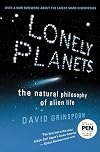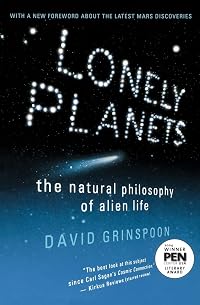
Lonely Planets: The Natural Philosophy of Alien Life
by David Grinspoon
On This Page
Description
It's been nearly four decades since Carl Sagan first addressed the general public from a scientist's perspective, confronting the possibility of extraterrestrial life. David Grinspoon, a planetary scientist who has helped to shape modern planetary exploration, brings the subject to a new generation of readers with his reflections on the most recent developments in astrobiology, including NASA's search for life on Mars. In Lonely Planets, he investigates the big questions: How widespread are show more life and intelligence in the cosmos? Is life on Earth an accident or in some sense the "purpose" of this universe? And how can we, working from the Earth-centric definition of "life," even begin to think about the varieties of life-forms on other planets?Using the topic of extraterrestrial life as a mirror with which to view human beliefs, evolution, history, and aspirations, Grinspoon provides an authoritative scientific narrative of cosmic evolution, along with provocative ruminations on how we fit into the story of the universe. An accessible, lively blend of science, history, philosophy, and personal narrative, Lonely Planets reveals how the search for extraterrestrial life unites our spiritual and scientific quests for connection with the cosmos. show lessTags
Recommendations





















Member Recommendations
Member Reviews
There is about one book a decade that when you finish it you just sit there for 10 minutes and think "Wow!" Trinity by Leon Uris was such a book. As was How Green Was My Valley by Richard Llewellyn. Lonely Planets is another that did that to me. I finished it after reading for an hour and a half in a coffee shop. My coffee was cold. My leg had fallen asleep. And my mind was in some other place. Wow, indeed.
This is a book that was recommended to me by an astronomer who had been reading my book list and thought I would enjoy this book. It is an absolutely honest and unflinching look at planetary science today. (Well, as it was in 2003. As I read the book I kept finding news articles that relate to the story.) This is a book that unsettled show more me because it changed some of my ideas about what I thought I knew and believed. I hope Grinspoon plans a sequel. It will be VERY high on my list! show less
This is a book that was recommended to me by an astronomer who had been reading my book list and thought I would enjoy this book. It is an absolutely honest and unflinching look at planetary science today. (Well, as it was in 2003. As I read the book I kept finding news articles that relate to the story.) This is a book that unsettled show more me because it changed some of my ideas about what I thought I knew and believed. I hope Grinspoon plans a sequel. It will be VERY high on my list! show less
This book was *so* great. A really awesome nutshell history of planetology and astronomy, and a lot of different ideas about alien life to chew on. Grinspoon is a logical, brilliant pop science writer with some of the funniest footnotes I've ever read. He discusses everything from the fanatically logical mathmatical theories behind SETI to thoughts about cosmic consciousness and ufology, all with a rational eye and infinite compassion.
This is a very readable blend of science, history, and sociology focused on the study of life in the universe. Specifically, of life on earth and the possibility of life beyond our planet. Since this was published in 2004, some of the information is outdated, such as Pluto still being classified as a planet, but that doesn't change the big question - is there life out there and how can we detect it if there is? My one complaint is that the images weren't formatted properly in the kindle version.
(posted on my blog: davenichols.net)
Planetary scientist David Grinspoon presents a robust presentation centered on alien life in the universe. An interesting and popular subject, this book was somewhat underwhelming overall, though it had some interesting and enjoyable passages.
While the book presumes to be a "natural philosophy" of the subject, the actual philosophy in the book is largely contained in a few sections of a few chapters. Most of the book describes historical or scientific fundamentals necessary for understanding the alien discussion, including histories of planetary science, alien philosophy, and biology. Except for the history of alien philosophy, which was the best part of the book for me, the history and science show more sections were good but not great. And while it is necessary to understand these basics, Grinspoon takes several hundred pages to get to his "philosophy". By that time, the decent narrative felt overly-drawn out.
Still, the book is a decent read for anyone with an interest in this sort of subject matter. But don't expect too much if you are an experienced reader, Grinspoon doesn't cover a great deal of original ground here, and except for the history of alien theories, I've read much better treatments of the history and science matters. Additionally, SETI dominates much of the discussion in a way which I found a bit off-putting, though I honestly can't say why. I like Grinspoon and love his enthusiasm, but I came away from Lonely Planets with a sense that it needed to be condensed and reorganized significantly. Three stars. show less
Planetary scientist David Grinspoon presents a robust presentation centered on alien life in the universe. An interesting and popular subject, this book was somewhat underwhelming overall, though it had some interesting and enjoyable passages.
While the book presumes to be a "natural philosophy" of the subject, the actual philosophy in the book is largely contained in a few sections of a few chapters. Most of the book describes historical or scientific fundamentals necessary for understanding the alien discussion, including histories of planetary science, alien philosophy, and biology. Except for the history of alien philosophy, which was the best part of the book for me, the history and science show more sections were good but not great. And while it is necessary to understand these basics, Grinspoon takes several hundred pages to get to his "philosophy". By that time, the decent narrative felt overly-drawn out.
Still, the book is a decent read for anyone with an interest in this sort of subject matter. But don't expect too much if you are an experienced reader, Grinspoon doesn't cover a great deal of original ground here, and except for the history of alien theories, I've read much better treatments of the history and science matters. Additionally, SETI dominates much of the discussion in a way which I found a bit off-putting, though I honestly can't say why. I like Grinspoon and love his enthusiasm, but I came away from Lonely Planets with a sense that it needed to be condensed and reorganized significantly. Three stars. show less
Fascinating! This book was obviously thoroughly researched. The author provided lots of insights into the theories involving how life got started on Earth, how it evolved, and the ways it may have evolved on other planets (or moons). He also discussed the possible reasons why we have yet to discover definitive proof of intelligent life elsewhere in the universe. There's even a fun chapter on UFO theories, crop circles, and government conspiracies.
The book was a great read. I'd definitely recommend it to others!
The book was a great read. I'd definitely recommend it to others!
Wow, this was quite a book. I would highly recommend this book to anyone, but definately to anyone who is interested in astrobiology. The author is a great writer, and writes with a sense of humor. I enjoyed the first two sections, History and Scienece, the most with the third section, Belief, only a little bit less. One of the best books I have read in a long time.
440 pages of jaunty (sometimes smartassy) writing. A better astrobiology book than the Ben Bova effort. (www.funkyscience.net)
Members
- Recently Added By
Lists

Books To Get From The Library
115 works; 5 members
Author Information

6 Works 684 Members
David Grinspoon is principal scientist in the Department of Space Studies at the Southwest Research institute, and adjunct professor of Astrophysical and Planetary Sciences at the University of Colorado
Awards and Honors
Awards
Common Knowledge
- Canonical title
- Lonely Planets: The Natural Philosophy of Alien Life
- Original title
- Lonely Planets: The Natural Philosophy of Alien Life
- Original publication date
- 2003
- Epigraph
- Penetrating so many secrets,
we cease to believe in the unknowable.
But there it sits, nevertheless, calmly licking its chops.
-- H. L. Mencken - Dedication
- For my parents Evelyn Betsy Grinspoon and Lester Grinspoon with love and gratitude
- First words
- Foreword: It Came Out of the Sky
On a tranquil late afternoon in early January 2004, the sky split open and an alien ship dropped out.
1. Spirits from the Vasty Deep
It was a dark and stormy night—and already a weird one. My friend Damon and I trudged around through a snowstorm in the Meatpacking District, hunting for a spoken-word/hip-hop/acid-jazz... (show all) event someone had said we had to see, while the wind whipped the streets into soft, majestic canyons. - Last words
- (Click to show. Warning: May contain spoilers.)The vasty deep is thick with spirits. The wise ones are out there waiting for us to join them.
- Original language
- English
Classifications
Statistics
- Members
- 200
- Popularity
- 162,676
- Reviews
- 8
- Rating
- (3.89)
- Languages
- English, Portuguese
- Media
- Paper, Ebook
- ISBNs
- 4
- ASINs
- 3