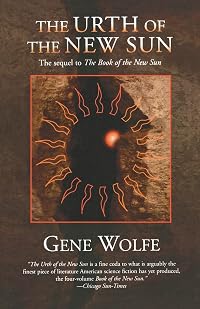
The Urth of the New Sun
by Gene Wolfe
The Book of the New Sun (Coda — Coda), Solar Cycle (5 (New Sun Coda))
On This Page
Description
The long awaited audiobook sequel to Gene Wolfe's four-volume classic, The Book of the New Sun.Listeners return to the world of Severian, now the Autarch of Urth, as he leaves the planet on one of the huge spaceships of the alien Hierodules to travel across time and space to face his greatest test, to become the legendary New Sun or die. The strange, rich, original spaceship scenes give way to travels in time, wherein Severian revisits times and places which fill in parts of the background show more of the four-volume work, that will thrill and intrigue particularly listeners who enjoyed the earlier books. But The Urth of the New Sun is an independent structure all of a piece, an integral masterpiece to shelve beside the classics, one itself.
. show less
Tags
Recommendations








Member Reviews
I bought this book in the twentieth century of the vulgar era, and moved it with my library about eleven times over the succeeding twenty-two years before I finally read it. Somehow that seems fitting. The Urth of the New Sun is the fifth of four volumes in Wolfe's autotheography of Severian the Torturer, a.k.a. Severian the Great, a.k.a. Severian the Lame, Autarch of the Commonwealth, Epitome of Urth, and incarnation of the New Sun. It first recounts his voyage to and from the neighboring universe of Yesod. (Qabalistic Hebrew is strangely conscripted throughout the book.) Then it details his salvific manifestations on Urth and its successor world Ushas.
There are roughly as many plot arcs and riddling enigmas in this book as in the show more four previous ones put together, and there is hardly a person or a place in the earlier stories that is not subjected to some sort of revisitation in the sequel. These seem to assume their "proper" dimensions so that it is difficult to believe that the author did not secretly understand them this way from the beginning. There is less here than in the earlier books in the way of nested narrative and storytelling set-pieces; for a book chock-full of the vagaries of time travel and transcendence of space, the tale is surprisingly linear, keeping to Severian's subjective experience of events.
I did not find this volume as difficult of access as I had its predecessors when I first read them in the 1980s. But there were still bits of it that resisted my full understanding, including the unspecified "plausible speculation" with which Wolfe teases his readers in the afterword on "The Miracle of Apu-Punchau." I expect that a re-read would yield perceptions that were withheld from me on this pass. But my aim is first to proceed on through the seven further volumes of the Solar Cycle. show less
There are roughly as many plot arcs and riddling enigmas in this book as in the show more four previous ones put together, and there is hardly a person or a place in the earlier stories that is not subjected to some sort of revisitation in the sequel. These seem to assume their "proper" dimensions so that it is difficult to believe that the author did not secretly understand them this way from the beginning. There is less here than in the earlier books in the way of nested narrative and storytelling set-pieces; for a book chock-full of the vagaries of time travel and transcendence of space, the tale is surprisingly linear, keeping to Severian's subjective experience of events.
I did not find this volume as difficult of access as I had its predecessors when I first read them in the 1980s. But there were still bits of it that resisted my full understanding, including the unspecified "plausible speculation" with which Wolfe teases his readers in the afterword on "The Miracle of Apu-Punchau." I expect that a re-read would yield perceptions that were withheld from me on this pass. But my aim is first to proceed on through the seven further volumes of the Solar Cycle. show less
This is my second read of this, often referred to as a coda to Wolfe's Book of the New Sun rather than a true fifth volume, and I enjoyed it far more this time. I still think that it isn't quite up to the same level of magnificence as those books, but it is a different creature and great in its own right.
This tale follows Severian - again through his own journals - after he has become the Autarch, the ruler of the empire and (possibly) the rightful although not actual ruler of a fractured planet Urth, with a fractious humanity dwindling under a dying sun, as he travels to the world of Ysod to stand trial for humanity and, if he passes, gain the ability to bring the New Sun to return full life to Urth.
This does contain similarities to show more the previous books - advanced technology, the working of which having been long forgotten, appears as magic, although some still seem to understand it and it is sometimes explained in curious (arguable unnecessarily expositionary) metaphor. It is a picaresque narrative, Severian traveling across space (and time)before returning to journey in his own world, at different times. However, the myth-making aspect that was a lesser part of the earlier books is here far more dominant; this reads often like some future gita or mythic tale explaining how the world came to be what it is, with all the strange metaphor and lack of clarity and occasional confusion you would expect in such a work. It is novel to allow to wash over you like the waters of Ocean, to absorb rather than fully understand. show less
This tale follows Severian - again through his own journals - after he has become the Autarch, the ruler of the empire and (possibly) the rightful although not actual ruler of a fractured planet Urth, with a fractious humanity dwindling under a dying sun, as he travels to the world of Ysod to stand trial for humanity and, if he passes, gain the ability to bring the New Sun to return full life to Urth.
This does contain similarities to show more the previous books - advanced technology, the working of which having been long forgotten, appears as magic, although some still seem to understand it and it is sometimes explained in curious (arguable unnecessarily expositionary) metaphor. It is a picaresque narrative, Severian traveling across space (and time)before returning to journey in his own world, at different times. However, the myth-making aspect that was a lesser part of the earlier books is here far more dominant; this reads often like some future gita or mythic tale explaining how the world came to be what it is, with all the strange metaphor and lack of clarity and occasional confusion you would expect in such a work. It is novel to allow to wash over you like the waters of Ocean, to absorb rather than fully understand. show less
This book is perhaps best thought of as volume five of the four-volume Book of the New Sun. As the book opens, we find Severian, now Autarch of Urth for the past ten years, on board a mighty ship sailing the tides of space (and time) to the planet Yesod, where he will undergo trials to determine if he will finally be the one to bring the New Sun back to Urth and reinvigorate the planet. He has numerous transcendent encounters with himself and others and finally returns to Urth, again through time and space, bringing the White Fountain that will renew the Old Sun.
I first read this book not long after publication. It had been a couple of years since I'd finished the earlier four volumes of The Book of the New Sun, and so had forgotten show more many of the situations and incidental characters. This was a mistake. This book needs to be read as a pendant to the earlier novels, because it references many of the minor - and not so minor - characters of those books and their situations. This time around, I re-read it not long after a re-read of the earlier novels and the events made more sense.
But not much.
Severian's trials on Yesod grant him powers which he will use to turn back time on Urth. This means that the narrative is disjointed and things happen for apparently no good reason. By this time, we are well into the territory of "any sufficiently advanced science will look like magic"; indeed, so well into that territory that the science is pretty much dispensed with. We are left with the writing, which is deep, and baroque, and retains the voice, memories and experiences of Severian, as well as the personalities he has carried within himself since The Claw of the Conciliator.
Wolfe is taking no prisoners here. We became used to time elapsing between the different books in the New Sun cycle, so a ten year gap between Citadel and this book should come as no surprise. (And the intervening period is filled in with a flashback in due course.) But when we get to the last quarter of this book, narrative causality is discarded, and we enter a strange sort of Xeno's Paradox world where the more we read, the further away the ending of the book seems to get, until we suddenly get to it.
Is this book essential to understanding the rest of The Book of the New Sun? I doubt it. I'm about to tackle (for the first time) the following four novels in the Solar Cycle, The Book of the Long Sun . From what I've heard, I doubt this will have been useful for those books, either. But there is so much referencing back to the events of the earlier novels that there have to be insights here to be unearthed (or even unUrthed), if the reader can take the time to find them. Perhaps this was the whole point of the exercise, to provide the reader with a puzzle to solve. It may take me another re-read to get that, though.
Despite all that, I enjoyed this read up to the point where I hit the Xeno's Paradox section in the last 40 or so pages. I started reading science fiction because I found ways that the genre at its best would excite my imagination; understanding was sometimes secondary. And that was certainly the case here. But whatever you do, don't try to read this as a standalone novel! show less
I first read this book not long after publication. It had been a couple of years since I'd finished the earlier four volumes of The Book of the New Sun, and so had forgotten show more many of the situations and incidental characters. This was a mistake. This book needs to be read as a pendant to the earlier novels, because it references many of the minor - and not so minor - characters of those books and their situations. This time around, I re-read it not long after a re-read of the earlier novels and the events made more sense.
But not much.
Severian's trials on Yesod grant him powers which he will use to turn back time on Urth. This means that the narrative is disjointed and things happen for apparently no good reason. By this time, we are well into the territory of "any sufficiently advanced science will look like magic"; indeed, so well into that territory that the science is pretty much dispensed with. We are left with the writing, which is deep, and baroque, and retains the voice, memories and experiences of Severian, as well as the personalities he has carried within himself since The Claw of the Conciliator.
Wolfe is taking no prisoners here. We became used to time elapsing between the different books in the New Sun cycle, so a ten year gap between Citadel and this book should come as no surprise. (And the intervening period is filled in with a flashback in due course.) But when we get to the last quarter of this book, narrative causality is discarded, and we enter a strange sort of Xeno's Paradox world where the more we read, the further away the ending of the book seems to get, until we suddenly get to it.
Is this book essential to understanding the rest of The Book of the New Sun? I doubt it. I'm about to tackle (for the first time) the following four novels in the Solar Cycle, The Book of the Long Sun . From what I've heard, I doubt this will have been useful for those books, either. But there is so much referencing back to the events of the earlier novels that there have to be insights here to be unearthed (or even unUrthed), if the reader can take the time to find them. Perhaps this was the whole point of the exercise, to provide the reader with a puzzle to solve. It may take me another re-read to get that, though.
Despite all that, I enjoyed this read up to the point where I hit the Xeno's Paradox section in the last 40 or so pages. I started reading science fiction because I found ways that the genre at its best would excite my imagination; understanding was sometimes secondary. And that was certainly the case here. But whatever you do, don't try to read this as a standalone novel! show less
The fifth volume of Book of the New Sun (or Coda or sequel) is epic in scope, yet in tying up some loose ends is often dizzying in its convolutions. It refers a lot to past characters, past events and seemingly throwaway moments which are drawn into the cycle as important moments. In the end it becomes its own creation mythology.
Whilst a lot of prior threads are brought together, there are some genuinely mystifying moments which I am sure had greater significance than I could get a handle on. His Trial on the Planet Yezod went beyond my understanding as I read those chapters. Partly because Severian remains the unreliable narrator, although as ever he eschews outright lying to his presumed readers by hiding necessary details until he show more feels ready to reveal them or the correct perspective takes over (those who have read what comes before will understand that better).
It's not until the second half when we return to Urth that it does at least try to draw a close to the saga and Severian's importance, which isn't fully dealt with after the revelations from the end of Sword of the Lictor and throughout Citadel of the Autarch. But even from the start, we get plenty of truly epic scenes on a cosmic scale, a meaning to the incomprehensible play in the main series, a parade of characters old and new and one of science fiction's greatest spaceships. Plus I’m always in awe of his torture Tower being an ancient spaceship (not a spoiler, it’s mentioned early in Shadow of the Torturer).
It's not always satisfactory, but it is breathtaking and engaging; it's bigger reward likely comes in multiple re-reads of all 5 books in quick succession (along with the myriad of shorter works that link to it directly or as meta-fiction). There's a lot to take in and unpacking the various symbolic, mythological and spiritual references and themes is beyond my ability.
For now, The Long Sun beckons! show less
Whilst a lot of prior threads are brought together, there are some genuinely mystifying moments which I am sure had greater significance than I could get a handle on. His Trial on the Planet Yezod went beyond my understanding as I read those chapters. Partly because Severian remains the unreliable narrator, although as ever he eschews outright lying to his presumed readers by hiding necessary details until he show more feels ready to reveal them or the correct perspective takes over (those who have read what comes before will understand that better).
It's not until the second half when we return to Urth that it does at least try to draw a close to the saga and Severian's importance, which isn't fully dealt with after the revelations from the end of Sword of the Lictor and throughout Citadel of the Autarch. But even from the start, we get plenty of truly epic scenes on a cosmic scale, a meaning to the incomprehensible play in the main series, a parade of characters old and new and one of science fiction's greatest spaceships. Plus I’m always in awe of his torture Tower being an ancient spaceship (not a spoiler, it’s mentioned early in Shadow of the Torturer).
It's not always satisfactory, but it is breathtaking and engaging; it's bigger reward likely comes in multiple re-reads of all 5 books in quick succession (along with the myriad of shorter works that link to it directly or as meta-fiction). There's a lot to take in and unpacking the various symbolic, mythological and spiritual references and themes is beyond my ability.
For now, The Long Sun beckons! show less
Severian, the narrator/protagonist of The Book of the New Sun, has been autarch for ten years. He is finally ready to make the trip for which his whole life has been preparing him, to plead as Urth's representative for the coming of the New Sun. He travels on an interstellar (and more) ship to the universe where he will be judged.
Wolfe wraps up some loose ends from TBotNS, but does much more than that. His style, already remarkable in TBotNS, is more assured and platyul; we can almost imagine him laughing with joy as he writes. As always, he does not explain every detail, but invites the reader to participate in fleshing out the story. He gives us scenes from the New Testament, such as the storm on the river, reimagined to fit in with show more Severian's story and Wolfe's cosmology. Severian is not Christ, however, but a bad man striving to become good.
Severian's voice becomes more and more lyrical as he progresses. He has always sought understanding of his world and its events, but now he seeks and achieves appreciation of the world and his place in it.
I will confess to having my doubts about Wolfe revisiting Urth; this sequel has not only calmed my fears but delighted me with how Severian has grown and how Wolfe tells us his story. show less
Wolfe wraps up some loose ends from TBotNS, but does much more than that. His style, already remarkable in TBotNS, is more assured and platyul; we can almost imagine him laughing with joy as he writes. As always, he does not explain every detail, but invites the reader to participate in fleshing out the story. He gives us scenes from the New Testament, such as the storm on the river, reimagined to fit in with show more Severian's story and Wolfe's cosmology. Severian is not Christ, however, but a bad man striving to become good.
Severian's voice becomes more and more lyrical as he progresses. He has always sought understanding of his world and its events, but now he seeks and achieves appreciation of the world and his place in it.
I will confess to having my doubts about Wolfe revisiting Urth; this sequel has not only calmed my fears but delighted me with how Severian has grown and how Wolfe tells us his story. show less
I knew things were going to get interesting the moment we started the book on the spaceship "Yesod", the ninth branch on the tree of life directly above the root, the kingdom, in the Kabbalah. Yesod is the ship that is outside of time and Maya, and the source of the Sun's renewal and the place where Sevarian must make or break his new covenant, the place of the new foundation for humanity.
Nuts? Hell yeah. There's plenty of crazy going on in the whole series, but the fact we start moving up through the branches to Hod, witnessing the splendor of Tzabaoth, kinda sealed the idea for me, and it didn't really matter if these were aliens outside of time who were once on the same road as humanity until we spread throughout the galaxy and did show more horrendous things and broke the covenant. The underlying shape of the story is clear even if it isn't actually Severian dealing with angels. ;)
Things are also a bit more complicated when we move from the flaming swords of Gabriel and return to earth to deal with the personal issue of fractured times and places making Severian deal with the qualities of Glory, Victory, Beauty, Severity, Mercy, Wisdom, and finally the Crown.
Unfortunately for me, I was reading purely for entertainment value, so I didn't actually sit down and track every scene to a branch on the tree, but I picked up on at least 4 or 5 of them, easy. :)
Impressive? Yeah, I think so too, and we've even got the whole feel of Slaughterhouse Five, the coming resurrection, the return of the king, and a lot of other hints, too, but let's face it... the story is very odd. Scenes feel all right by themselves, but they often take very odd directions from one another, and I can't quite tell if it's because it's following the Tree regardless of the natural progression of story, or whether the story is just odd for its own sake.
Having read the previous four, I'd soooo love to say, outright, that it's fundamentally incomprehensible, but no, I think I've actually found a pretty decent roadmap.
I'm impressed, but, not quite engrossed in the tale enough to put in the extra work of truly deciphering it. :) Still! Props.
:) show less
Nuts? Hell yeah. There's plenty of crazy going on in the whole series, but the fact we start moving up through the branches to Hod, witnessing the splendor of Tzabaoth, kinda sealed the idea for me, and it didn't really matter if these were aliens outside of time who were once on the same road as humanity until we spread throughout the galaxy and did show more horrendous things and broke the covenant. The underlying shape of the story is clear even if it isn't actually Severian dealing with angels. ;)
Things are also a bit more complicated when we move from the flaming swords of Gabriel and return to earth to deal with the personal issue of fractured times and places making Severian deal with the qualities of Glory, Victory, Beauty, Severity, Mercy, Wisdom, and finally the Crown.
Unfortunately for me, I was reading purely for entertainment value, so I didn't actually sit down and track every scene to a branch on the tree, but I picked up on at least 4 or 5 of them, easy. :)
Impressive? Yeah, I think so too, and we've even got the whole feel of Slaughterhouse Five, the coming resurrection, the return of the king, and a lot of other hints, too, but let's face it... the story is very odd. Scenes feel all right by themselves, but they often take very odd directions from one another, and I can't quite tell if it's because it's following the Tree regardless of the natural progression of story, or whether the story is just odd for its own sake.
Having read the previous four, I'd soooo love to say, outright, that it's fundamentally incomprehensible, but no, I think I've actually found a pretty decent roadmap.
I'm impressed, but, not quite engrossed in the tale enough to put in the extra work of truly deciphering it. :) Still! Props.
:) show less
This was the last book in the series The Book of the New Sun. For the most part, I really liked it, and I might even have rated it higher than the four stars I’ve consistently given the other books in this series. However, I thought it went off the rails a bit toward the end.
It gave me the answers I was looking for in terms of what happened after the end of the fourth book, and I enjoyed the story it told. Then, without giving anything away, it shed new light on many of the events from those first four books, and gave more meaning to them, and I also really enjoyed that. Some things were spelled out, but others were quite a bit more subtle, and I enjoyed catching the various references.
My problem was that I thought the author went too show more far with it by the end. Just as I was admiring the cleverness, he took things a few steps further. I felt like, in an attempt to keep things twisty and complicated, he robbed it of some of the meaningfulness. Kind of like a cook who can’t stop tweaking his recipe until it doesn’t taste quite right anymore, or a painter who keeps adding “just a bit more” to his design until it’s no longer quite as pleasing to the eye.
A smaller complaint I had with the series in general is that, since the story centers around Severian, there are some characters who play a large role in the series but for whom we don’t get much closure because their paths diverge. There was one character in particular that I really wanted more follow-up on, especially considering how often he was remembered and referenced in Severian’s narrative.
Over all, though, I enjoyed this series quite a lot. I liked that it wasn’t simple or straight forward, and I liked its unique (in my experience) blend of some of the best elements from both science fiction and fantasy. For now, there are many other authors and books I’m interested in trying, but I’d like to cycle back around to give Wolfe another try sometime down the road. show less
It gave me the answers I was looking for in terms of what happened after the end of the fourth book, and I enjoyed the story it told. Then, without giving anything away, it shed new light on many of the events from those first four books, and gave more meaning to them, and I also really enjoyed that. Some things were spelled out, but others were quite a bit more subtle, and I enjoyed catching the various references.
My problem was that I thought the author went too show more far with it by the end. Just as I was admiring the cleverness, he took things a few steps further. I felt like, in an attempt to keep things twisty and complicated, he robbed it of some of the meaningfulness. Kind of like a cook who can’t stop tweaking his recipe until it doesn’t taste quite right anymore, or a painter who keeps adding “just a bit more” to his design until it’s no longer quite as pleasing to the eye.
A smaller complaint I had with the series in general is that, since the story centers around Severian, there are some characters who play a large role in the series but for whom we don’t get much closure because their paths diverge. There was one character in particular that I really wanted more follow-up on, especially considering how often he was remembered and referenced in Severian’s narrative.
Over all, though, I enjoyed this series quite a lot. I liked that it wasn’t simple or straight forward, and I liked its unique (in my experience) blend of some of the best elements from both science fiction and fantasy. For now, there are many other authors and books I’m interested in trying, but I’d like to cycle back around to give Wolfe another try sometime down the road. show less
Members
- Recently Added By
Lists

Books Read in 2002
197 works; 8 members

Character-driven SF
59 works; 1 member

Michael Dirda's Desert Island Books
62 works; 5 members

Books Read in 2026
1,952 works; 66 members
Author Information

314+ Works 43,637 Members
Gene Wolfe was born in New York City on May 7, 1931. He dropped out of Texas A&M University during his junior year and was drafted into the Army to fight in the Korean War. After the war, he received a degree in mechanical engineering from the University of Houston. He worked as an industrial engineer for Procter and Gamble, where he developed the show more machine that cooks the dough used to make Pringles potato chips. He was an editor of the trade journal Plant Engineering from 1972 to 1984 before retiring to become a full-time writer. He wrote more than 30 books during his lifetime including The Fifth Head of Cerberus, Peace, The Book of the New Sun, and The Land Across. He received the Campbell Memorial Award, the Edward E. Smith Memorial Award, the Locus Award four times, and the Nebula Award and the World Fantasy Award two times each. In 1996, he was given the World Fantasy Award for Lifetime Achievement. He was inducted into the Science Fiction Hall of Fame in 2007 and was named a Grand Master by the Science Fiction and Fantasy Writers of America in 2012. He died after a long battle with heart disease on April 14, 2019 at the age of 87. (Bowker Author Biography) show less
Some Editions
Awards and Honors
Awards
Notable Lists
Series


Belongs to Publisher Series
Work Relationships
Is contained in
Common Knowledge
- Canonical title
- The Urth of the New Sun
- Original publication date
- 1987-08
- People/Characters
- Severian; Burgundofara; Ceryx; Zama; Odilo; Pega (show all 18); Thais; Apu-Punchau; Barbatus; Ossipago; Famulimus; Baldanders; Valeria; Tzadkiel; Ymar; Typhon; Sidero; Eata
- Important places
- Urth
- Epigraph
- Awake! for Morning in the Bowl of Night
Has flung the Stone that puts the Stars to Flight:
And Lo! the Hunter of the East has caught
The Sultan's Turret in a Noose of Light.
—Fitzgerald - Dedication
- This book is dedicated to
Elliott and Barbara,
who know why. - First words
- Having cast one manuscript into the seas of time, I now begin again.
- Last words
- (Click to show. Warning: May contain spoilers.)Nothing Severian writes indicates what the opaque body may have been; but the thoughtful reader will find litle difficulty in advancing at least one plausible speculation.
- Blurbers
- Card, Orson Scott; Bear, Greg; Le Guin, Ursula K.
- Original language
- English
Classifications
Statistics
- Members
- 2,034
- Popularity
- 10,274
- Reviews
- 28
- Rating
- (3.94)
- Languages
- 7 — English, French, German, Italian, Polish, Portuguese, Spanish
- Media
- Paper, Audiobook, Ebook
- ISBNs
- 19
- ASINs
- 15