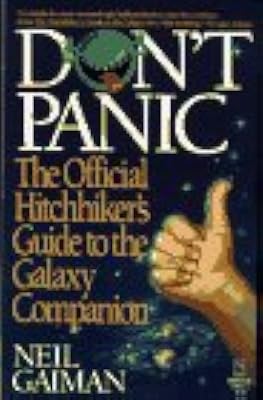
Don't Panic: The Official Hitchhiker's Guide to the Galaxy Companion
by Neil Gaiman
The Hitchhiker's Guide to the Galaxy (Related — Companion)
On This Page
Description
The #1 New York Times–bestselling author's "hilarious . . . idiosyncratic . . . delightful" and definitive companion to a global phenomenon (Publishers Weekly).Douglas Adams's "six-part trilogy," The Hitchhiker's Guide to the Galaxy grew from a blip of a notion into an ever-expanding multimedia universe that amassed an unprecedented cult of followers and became an international sensation. As a young journalist, Neil Gaiman was given complete access to Adams's life, times, gossip, show more unpublished outtakes, and files (and became privy to his writing process, insecurities, disillusionments, challenges, and triumphs). The resulting volume illuminates the unique, funny, dramatic, and improbable chronicle of an idea, an incredibly tall man, and a mind-boggling success story.
In Don't Panic!, Gaiman celebrates everything Hitchhiker: the original radio play, the books, comics, video and computer games, films, television series, record albums, stage musicals, one-man shows, the Great One himself, and towels. And as Douglas Adams himself attested: "It's all absolutely devastatingly true—except the bits that are lies."
Updated several times in the thirty years since its original publication, Don't Panic! is available for the first time in digital form. Part biography, part tell-all parody, part pop-culture history, part guide to a guide, Don't Panic! "deserves as much cult success as the Hitchhiker's books themselves" (Time Out).
. show less
Tags
Recommendations







Member Reviews
The Hitchhiker's Guide to the Galaxy was at one point the most important book in my life. When I was about 11, I reread the whole series monthly. My AIM screename was Zarkology1, after the great Prophet Zarquon and the exclamation 'Zark!'. So I'm only kidding a little when I say that for me, the books approach holy text.
Don't Panic by Neil Gaiman (that Neil Gaiman) is a very different approach to the story behind the story, and the career of Douglas Adams. Adams followed in the wake of a classic tradition of absurdist British humor, most notably PG Wodehouse and Monty Python (though his actual working relationship with the Pythons was minimal). At Cambridge, he was an anti-establishment figure floating around the Footlights comedy show more troupe. Afterwords, he drifted into radio at the BBC, where the idea for Hitchhiker finally landed. The radio show was a cult classic, the first book an international success, and then it was off to the races, with musical theater, TV adaptation, potential movie deals, and high-tech transmedia ventures.
Gaiman keeps it light and breezy, but reading between the lines, there are struggles. Adams' problems with deadlines was legendary, but where is the line between writer's block and chronic depression? The best of Hitchhiker is in the pauses and asides, the words not written, the perfect absurdity and humanity of the gestalt. Hitchhiker touched me, and it touched millions of people, and there's not much of the 'why' or 'how' except "well, Adams mixed Star Wars and Monty Python in a way that was perfect for the times, and totally beyond the ability of studio executives to understand."
It's been 40 years since the first book was published. I don't know much, except that I know I need to find my omnibus collection and reread them for the first time in a decade. show less
Don't Panic by Neil Gaiman (that Neil Gaiman) is a very different approach to the story behind the story, and the career of Douglas Adams. Adams followed in the wake of a classic tradition of absurdist British humor, most notably PG Wodehouse and Monty Python (though his actual working relationship with the Pythons was minimal). At Cambridge, he was an anti-establishment figure floating around the Footlights comedy show more troupe. Afterwords, he drifted into radio at the BBC, where the idea for Hitchhiker finally landed. The radio show was a cult classic, the first book an international success, and then it was off to the races, with musical theater, TV adaptation, potential movie deals, and high-tech transmedia ventures.
Gaiman keeps it light and breezy, but reading between the lines, there are struggles. Adams' problems with deadlines was legendary, but where is the line between writer's block and chronic depression? The best of Hitchhiker is in the pauses and asides, the words not written, the perfect absurdity and humanity of the gestalt. Hitchhiker touched me, and it touched millions of people, and there's not much of the 'why' or 'how' except "well, Adams mixed Star Wars and Monty Python in a way that was perfect for the times, and totally beyond the ability of studio executives to understand."
It's been 40 years since the first book was published. I don't know much, except that I know I need to find my omnibus collection and reread them for the first time in a decade. show less
Over thirty years ago, a young journalist named Neil Gaiman (you may have heard of him since in other contexts) was given access to Douglas Adams, his life, his files, his unpublished outtakes, and many of his friends and coworkers, to write a highly entertaining account of the creation of Hitchhiker's Guide to the Galaxy--the radio show, the six books of the "trilogy," the movie, the games. This is a fascinating look inside how Adams worked, and just how chaotic his creation process was at its best.
Because yes, all his most creative work was done in at atmosphere of chaos and looming deadlines.
And in a time when radio had already become largely a domain of music, news, and talk, he did his best work for radio, and drew in listeners as show more few if any other entertainment writers and creators could do for radio. This included, of course, not just Hitchhiker's Guide, but his wonderful nature program about endangered species, Last Chance to See.
This book is its own wild romp, while also giving due attention to Adams's struggles, depression, and frustrations. It's been updated several times since its origial publication, and access to Adams's files provides considerable insight into his working process. The unpublished outtakes and early versions also give us a view of how Hitchhiker's Guide developed, and the happy disregard for continuity and consistency that might have sunk many other creative works, but but gave life and vitality to the Guide in its many forms.
It's a wonderfully enjoyable and informative book, and I can't really do justice to it. Just read it, okay?
I bought this book. show less
Because yes, all his most creative work was done in at atmosphere of chaos and looming deadlines.
And in a time when radio had already become largely a domain of music, news, and talk, he did his best work for radio, and drew in listeners as show more few if any other entertainment writers and creators could do for radio. This included, of course, not just Hitchhiker's Guide, but his wonderful nature program about endangered species, Last Chance to See.
This book is its own wild romp, while also giving due attention to Adams's struggles, depression, and frustrations. It's been updated several times since its origial publication, and access to Adams's files provides considerable insight into his working process. The unpublished outtakes and early versions also give us a view of how Hitchhiker's Guide developed, and the happy disregard for continuity and consistency that might have sunk many other creative works, but but gave life and vitality to the Guide in its many forms.
It's a wonderfully enjoyable and informative book, and I can't really do justice to it. Just read it, okay?
I bought this book. show less
I am a huge Hitchhiker's Guide fan, having been first introduced to it in my last year of high school (in 1981) by my grade 13 Chemistry teacher, Mr. Delamatter, one of the most influential teachers I had. He'd passed his copy to a buddy of mine in our little group, and it quickly made the rounds of all of us, before getting it back to our teacher.
Since then, I've read it, and all the sequels (yes, even the sixth one) multiple times.
So when I stumbled on this book accidentally in a used book shop...a Hitchhiker's Guide written by Neil Gaiman? Hell yes, I'm in.
And it was pretty much everything I'd hoped for, written in a similarly irreverent style to Adams, delivering quick hits of facts, and little dollops of humour along the way.
It show more really is a great little companion to the series. show less
Since then, I've read it, and all the sequels (yes, even the sixth one) multiple times.
So when I stumbled on this book accidentally in a used book shop...a Hitchhiker's Guide written by Neil Gaiman? Hell yes, I'm in.
And it was pretty much everything I'd hoped for, written in a similarly irreverent style to Adams, delivering quick hits of facts, and little dollops of humour along the way.
It show more really is a great little companion to the series. show less
Written much in the style and humor of the author it honors, Neil Gaiman’s "Don’t Panic: Douglas Adams & The Hitchhiker’s Guide to the Galaxy" is a wonderful treat for fans of “The Hitchhikers Guide to the Galaxy” and its author. The book contains supporting material from Douglas Adams himself, as well as his own words as compiled from Gaiman’s interviews with him, as well as a tireless search of the media.
Adams early aspirations were toward the stage. He saw John Cleese perform while at Cambridge and thought to himself, “I can do that… I’m as tall as he is” (page 7). Gaiman connects for the reader Adams early work with the work that would become The Hitchhiker’s Guide to the Galaxy. While working with Graham show more Chapman after the days on Monty Python’s Flying Circus, Adams amassed ideas he thought either too good to discard or too interesting to forget and they would make up elements of his later masterpiece. The Adams that Gaiman outlines for us very much worked on instinct and inspiration. Douglas said that he “Didn’t so much like writing as having written (Page 7).
"Don’t Panic: Douglas Adams & The Hitchhiker’s Guide to the Galaxy" is a fanboy love letter to an author known and admired. There is, after all, a reason a day is dedicated to this internally best-selling author. “Don’t Panic: Douglas Adams and the Hitchhikers Guide to the Galaxy” is a wonderful reference for any fan of Douglas Adams and gives us a true insight into his process, his insecurities, his challenges and ultimately his success. Written in the light and thought-provoking style of its subject, I am now inspired to go out and snap up everything Nail Gaiman has ever written.
On Page 59, Gaiman lists three opinions of why "The Hitchhiker’s Guide to the Galaxy" was so successful. The consensus seems to be that it’s because it’s not like nothing the reading public had ever seen before. As someone who first read Adams as a teenager and has been searching for like authors for the better part of my life, I believe this perfect style of brilliance and madness is so hard to produce that we’ll see it infrequently as time goes on. Adams is lost to us now. Jasper Fforde remains, and up and coming authors like Ford Forkum as well, but catching the magic in the bottle that was Adams is elusive. "Don’t Panic: Douglas Adams & The Hitchhiker’s Guide to the Galaxy" was a sheer delight to read and to remember the man that was Douglas Adams. show less
Adams early aspirations were toward the stage. He saw John Cleese perform while at Cambridge and thought to himself, “I can do that… I’m as tall as he is” (page 7). Gaiman connects for the reader Adams early work with the work that would become The Hitchhiker’s Guide to the Galaxy. While working with Graham show more Chapman after the days on Monty Python’s Flying Circus, Adams amassed ideas he thought either too good to discard or too interesting to forget and they would make up elements of his later masterpiece. The Adams that Gaiman outlines for us very much worked on instinct and inspiration. Douglas said that he “Didn’t so much like writing as having written (Page 7).
"Don’t Panic: Douglas Adams & The Hitchhiker’s Guide to the Galaxy" is a fanboy love letter to an author known and admired. There is, after all, a reason a day is dedicated to this internally best-selling author. “Don’t Panic: Douglas Adams and the Hitchhikers Guide to the Galaxy” is a wonderful reference for any fan of Douglas Adams and gives us a true insight into his process, his insecurities, his challenges and ultimately his success. Written in the light and thought-provoking style of its subject, I am now inspired to go out and snap up everything Nail Gaiman has ever written.
On Page 59, Gaiman lists three opinions of why "The Hitchhiker’s Guide to the Galaxy" was so successful. The consensus seems to be that it’s because it’s not like nothing the reading public had ever seen before. As someone who first read Adams as a teenager and has been searching for like authors for the better part of my life, I believe this perfect style of brilliance and madness is so hard to produce that we’ll see it infrequently as time goes on. Adams is lost to us now. Jasper Fforde remains, and up and coming authors like Ford Forkum as well, but catching the magic in the bottle that was Adams is elusive. "Don’t Panic: Douglas Adams & The Hitchhiker’s Guide to the Galaxy" was a sheer delight to read and to remember the man that was Douglas Adams. show less
Grab your towel, and whatever you do...Don't Panic! This is the behind-the-scenes history of Douglas Adams' phenomenonally popular Hitchhiker's Guide to the Galaxy. Partly a biography of Adams' early years, Gaiman traces the origins of the HHGG, including all the variant versions of the property -- radio series, books (originally a trilogy, then expanded by Adams into 5 volumes), television series, stage plays, records, film, computer games. etc. Filled with humor, both riotous and wry, this is a must-read for fans of the series. I would also recommend this to fans of fantasist Gaiman, to see what one of his earliest published works is like. I particularly enjoyed seeing all the fragments from original manuscripts, to see how they show more differ from what ultimately made it into the published versions. Highly recommended for both fans and non-fans of HHGG alike! [Note: A completely updated version of this book was published in 2005 as Don't Panic: Douglas Adams and the Hitchhiker's Guide to the Galaxy, which brings readers up-to-date on Adams, through and beyond his 2001 death.]
Originally reviewed for my local library's website: http://www.lincolnlibraries.org/depts/bookguide/srec/staffrec10-09.htm show less
Originally reviewed for my local library's website: http://www.lincolnlibraries.org/depts/bookguide/srec/staffrec10-09.htm show less
The Hitchhiker's Guide to the Galaxy was first broadcast at 22.30 on a Wednesday evening in 1978 where the BBC almost hoped that no one would hear it. Radio programmes in those days almost never got reviews either, so there was a collective dropping of jaws when it turned out that there were two in the papers that weekend praising the show. Word of mouth recommendations meant that this obscure comedy sci-fi series grew to have a cult following very soon and it was to permeate the national culture in ways that Douglas Adams could never have conceived when he had the idea in a field in Innsbruck in 1971.
Don't Panic…
So began a much-loved trilogy that just happened to spread itself across five books. But Douglas Adams created far more show more things than just this. Born in Cambridge in 1952 he moved to London a little while later and after his parents divorced ended up in Essex. He stood out at school, mostly because he was very tall, 6 foot at the age of 12 and finally reached 6' 5", but was also known for his stories that were published in the school paper. University beckoned and he ended up at Cambridge where he tried and failed to join Footlights. He had written material that Footlights wanted to use, but they still didn't want him in it! Post university, the desire to get into TV or radio as a writer. He was fortunate to have his Revue shown on the BBC and this lead to a brief sketch writing with Graham Chapman of Monty Python fame. Then nothing, so a series of odd jobs ensued; was his brief writing career over before it started? Thankfully no, he kept plugging away and suddenly the thing that he had desired the most was happening. The rest is history; or is it the future.
I love deadlines. I love the whooshing noise they make as they go by.
Neil Gaiman in this fondly written biography of Adams, has written a fitting tribute to the man, who was taken from us far too early. whose work has seeped into the British psyche; even my children knew the answer to everything is 42, but they didn't know where it had originated from. This has been corrected now and a second-hand set of the books was acquired and pointed out to them on the shelf and they were strongly advised to read them. The book is crammed full of facts and details such as the asteroid named in his honour was 2001 DA42. It is enough to warm the transistors in the heart of a depressed robot. A touching tribute to an author with an amazing imagination and has one of the most amusing dedications written that I have read in a while. Great stuff. show less
Don't Panic…
So began a much-loved trilogy that just happened to spread itself across five books. But Douglas Adams created far more show more things than just this. Born in Cambridge in 1952 he moved to London a little while later and after his parents divorced ended up in Essex. He stood out at school, mostly because he was very tall, 6 foot at the age of 12 and finally reached 6' 5", but was also known for his stories that were published in the school paper. University beckoned and he ended up at Cambridge where he tried and failed to join Footlights. He had written material that Footlights wanted to use, but they still didn't want him in it! Post university, the desire to get into TV or radio as a writer. He was fortunate to have his Revue shown on the BBC and this lead to a brief sketch writing with Graham Chapman of Monty Python fame. Then nothing, so a series of odd jobs ensued; was his brief writing career over before it started? Thankfully no, he kept plugging away and suddenly the thing that he had desired the most was happening. The rest is history; or is it the future.
I love deadlines. I love the whooshing noise they make as they go by.
Neil Gaiman in this fondly written biography of Adams, has written a fitting tribute to the man, who was taken from us far too early. whose work has seeped into the British psyche; even my children knew the answer to everything is 42, but they didn't know where it had originated from. This has been corrected now and a second-hand set of the books was acquired and pointed out to them on the shelf and they were strongly advised to read them. The book is crammed full of facts and details such as the asteroid named in his honour was 2001 DA42. It is enough to warm the transistors in the heart of a depressed robot. A touching tribute to an author with an amazing imagination and has one of the most amusing dedications written that I have read in a while. Great stuff. show less
Neil Gaiman - "Don't Panic: Douglas Adams & The Hitchhiker's Guide to the Galaxy"
"The lights went out in his eyes for absolutely the last time ever." This quote from "So Long, and Thanks for All the Fish" was posted on the Digital Village website on May 11th, 2002 - the day of Douglas Adams' sudden and unexpected death. It is also the quote with which Neil Gaiman has chosen to end the third edition of "Don't Panic".
In this book about a book about a book, Gaiman tells the story of Douglas Adams, "The Hitchhiker's Guide to the Galaxy" (in its various incarnations) and Adams' other works. It is important to remember that the
greater part of the book was written and published long before Adams' death. In fact, it has been about since 1988, show more with a second edition published in 1993, and had been long out of print prior to the release of this new edition. It thus offers a unique perspective on the life and work of Douglas Adams.
A central part of "Don't Panic" is a series of interviews with Douglas Adams and a number of others who were at one point or another involved in the Hitchhiker's as well as other projects. They include Adams' close friend and co-author of "The Meaning of Liff", John Lloyd; producer of the original Hitchhiker's radio series Geoffrey Perkins; producer of the Hitchhiker's TV series Alan Bell;
co-author of "Last Chance to See" Mark Carwardine and man others. These voices are supplemented by a large number of highlyi mprobable but, given that it's Douglas Adams we're talking about, probably true anecdotes. The reader learns of Adams' chronic case of writer's block and his rather strange relationship with deadlines. We also get a glimpse into his life pre-Hitchhiker's and his obsession with technology and nifty gadgets. Also, if you're anything like me, you will have always wondered just who the hell Paula Nancy Millstone Jennings (the worst poet
in the universe) is. "Don't Panic" provides an answer to that, too. In addition to this, Gaiman quotes countless bits of scripts and books that never made it into the final version of whatever they were meant to
be. All this is rounded off and held together by Gaiman's excellent writing, which alternates between being funny andi nformative where appropriate and staying decently in the background where others have
something to say.
It must be noted that, should Neil Gaiman, ever get fed up with writing, he has a brilliant career in sales and marketing waiting for him. He manages to mention every single bit of Hitchhiker's merchandising that's out there and make you want to own it. At one point, he almost had
me convinced that I wanted a copy of "The Illustrated Hitchhiker's Guide to the Galaxy" (which, under normal circumstances, I think is tacky and should never have seen the light of day). Gaiman does all this in an entirely natural way without forcing anything on the reader.
Another effect "Don't Panic" is likely to have on you is to make you want to re-read Hitchhiker's from front to back to see if it seems any different with the benefit of newly-gained information. It certainly does. For one, you will understand most of the dedications in the books and know who they are meant for. Also, you will look at the
books themselves differently, having found out under what circumstances they were written and that Adams never intended to write a sequel to "The Restaurant at the End of the Universe"; or to "Life, the
Universe and Everything"; or to "So Long, and Thanks for All the Fish".
"Don't Panic" will make you chuckle at times, and it will make you laugh out loud at times. Ultimately, however, it will also make you cry. The book had a cathartic effect on anyone who loved Douglas Adams and for whom his early death came as such a shock. Neil Gaiman pays Adams the necessary respect, and the admiration he holds for the creator of
Hitchhiker's comes through in both his writing and the diligence with which he has conducted his research. Douglas Adams, in life or in death, could not have wished for a better biographer. Several years ago, Gaiman was offered by the BBC to write a third Hitchhiker's radio series (a fact he conveniently chooses to omit in "Don't Panic"). By writing this book, however, he has done Adams a far greater service
than a third radio series could ever have.
The one thing I missed in "Don't Panic" was a personal introduction (or afterword) by Gaiman about his relationship with Adams and why he wrote "Don't Panic" in the first place. I am sure, however, that he had his reasons for this omission and can, to some extent, understand them. Even without this, though, "Don't Panic" is a fantastic book and mandatory for any Douglas Adams fan.
"The lights went out in his eyes for absolutely the last time ever." ----from "So Long, and Thanks for All the Fish"
Douglas Adams, 1952 - 2001, RiP show less
"The lights went out in his eyes for absolutely the last time ever." This quote from "So Long, and Thanks for All the Fish" was posted on the Digital Village website on May 11th, 2002 - the day of Douglas Adams' sudden and unexpected death. It is also the quote with which Neil Gaiman has chosen to end the third edition of "Don't Panic".
In this book about a book about a book, Gaiman tells the story of Douglas Adams, "The Hitchhiker's Guide to the Galaxy" (in its various incarnations) and Adams' other works. It is important to remember that the
greater part of the book was written and published long before Adams' death. In fact, it has been about since 1988, show more with a second edition published in 1993, and had been long out of print prior to the release of this new edition. It thus offers a unique perspective on the life and work of Douglas Adams.
A central part of "Don't Panic" is a series of interviews with Douglas Adams and a number of others who were at one point or another involved in the Hitchhiker's as well as other projects. They include Adams' close friend and co-author of "The Meaning of Liff", John Lloyd; producer of the original Hitchhiker's radio series Geoffrey Perkins; producer of the Hitchhiker's TV series Alan Bell;
co-author of "Last Chance to See" Mark Carwardine and man others. These voices are supplemented by a large number of highlyi mprobable but, given that it's Douglas Adams we're talking about, probably true anecdotes. The reader learns of Adams' chronic case of writer's block and his rather strange relationship with deadlines. We also get a glimpse into his life pre-Hitchhiker's and his obsession with technology and nifty gadgets. Also, if you're anything like me, you will have always wondered just who the hell Paula Nancy Millstone Jennings (the worst poet
in the universe) is. "Don't Panic" provides an answer to that, too. In addition to this, Gaiman quotes countless bits of scripts and books that never made it into the final version of whatever they were meant to
be. All this is rounded off and held together by Gaiman's excellent writing, which alternates between being funny andi nformative where appropriate and staying decently in the background where others have
something to say.
It must be noted that, should Neil Gaiman, ever get fed up with writing, he has a brilliant career in sales and marketing waiting for him. He manages to mention every single bit of Hitchhiker's merchandising that's out there and make you want to own it. At one point, he almost had
me convinced that I wanted a copy of "The Illustrated Hitchhiker's Guide to the Galaxy" (which, under normal circumstances, I think is tacky and should never have seen the light of day). Gaiman does all this in an entirely natural way without forcing anything on the reader.
Another effect "Don't Panic" is likely to have on you is to make you want to re-read Hitchhiker's from front to back to see if it seems any different with the benefit of newly-gained information. It certainly does. For one, you will understand most of the dedications in the books and know who they are meant for. Also, you will look at the
books themselves differently, having found out under what circumstances they were written and that Adams never intended to write a sequel to "The Restaurant at the End of the Universe"; or to "Life, the
Universe and Everything"; or to "So Long, and Thanks for All the Fish".
"Don't Panic" will make you chuckle at times, and it will make you laugh out loud at times. Ultimately, however, it will also make you cry. The book had a cathartic effect on anyone who loved Douglas Adams and for whom his early death came as such a shock. Neil Gaiman pays Adams the necessary respect, and the admiration he holds for the creator of
Hitchhiker's comes through in both his writing and the diligence with which he has conducted his research. Douglas Adams, in life or in death, could not have wished for a better biographer. Several years ago, Gaiman was offered by the BBC to write a third Hitchhiker's radio series (a fact he conveniently chooses to omit in "Don't Panic"). By writing this book, however, he has done Adams a far greater service
than a third radio series could ever have.
The one thing I missed in "Don't Panic" was a personal introduction (or afterword) by Gaiman about his relationship with Adams and why he wrote "Don't Panic" in the first place. I am sure, however, that he had his reasons for this omission and can, to some extent, understand them. Even without this, though, "Don't Panic" is a fantastic book and mandatory for any Douglas Adams fan.
"The lights went out in his eyes for absolutely the last time ever." ----from "So Long, and Thanks for All the Fish"
Douglas Adams, 1952 - 2001, RiP show less
Members
- Recently Added By
Lists

Books Read in 2020
4,379 works; 123 members
Author Information

Neil Gaiman was born in Portchester, England on November 10, 1960. He worked as a journalist and freelance writer for a time, before deciding to try his hand at comic books. Some of his work has appeared in publications such as Time Out, The Sunday Times, Punch, and The Observer. His first comic endeavor was the graphic novel series The Sandman. show more The series has won every major industry award including nine Will Eisner Comic Industry Awards, three Harvey Awards, and the 1991 World Fantasy Award for best short story, making it the first comic ever to win a literary award. He writes both children and adult books. His adult books include The Ocean at the End of the Lane, which won a British National Book Awards, and the Locus Award for Best Fantasy Novel for 2014; Stardust, which won the Mythopoeic Award as best novel for adults in 1999; American Gods, which won the Hugo, Nebula, Bram Stoker, SFX, and Locus awards; Anansi Boys; Trigger Warning: Short Fictions and Disturbances; and The View from the Cheap Seats: Selected Nonfiction, which is a New York Times Bestseller. His children's books include The Day I Swapped My Dad for Two Goldfish; Coraline, which won the Elizabeth Burr/Worzalla, the BSFA, the Hugo, the Nebula, and the Bram Stoker awards; The Wolves in the Walls; Odd and the Frost Giants; The Graveyard Book, which won the Newbery Award in 2009 and The Sandman: Overture which won the 2016 Hugo Awards Best Graphic Story. (Bowker Author Biography) show less
All Editions
Some Editions
Series

Belongs to Publisher Series
Gallimard, Folio SF (171)
Heyne Allgemeine Reihe (13779)
Work Relationships
Is a study of
Common Knowledge
- Canonical title
- Don't Panic: The Official Hitchhiker's Guide to the Galaxy Companion
- Original title
- Don't Panic: The Official Hitchhiker's Guide to the Galaxy Companion
- Alternate titles
- Don't Panic: Douglas Adams & the Hitchhiker's Guide to the Galaxy
- Original publication date
- 1988
- People/Characters
- Douglas Noël Adams; Arthur Dent; Ford Prefect; Tricia "Trillian" McMillan; Zaphod Beeblebrox; Marvin, the Paranoid Android
- Related movies
- The Hitchhiker's Guide to the Galaxy (2005 | IMDb)
- Dedication
- Because she's threatened me with consequences too dreadful even to begin to consider if I don't dedicate a book to her...
And because she's taken to starting every transatlantic conversation with "Have you dedicated a boo... (show all)k to me yet?"...
I would like to dedicate this book to intelligent life forms everywhere.
And to my sister, Claire. - First words
- The idea in question bubbled into Douglas Adams' mind quite spontaneously, in a field in Innsbruck.
- Last words
- (Click to show. Warning: May contain spoilers.)They are knocked senseless...
- Original language
- English
Classifications
Statistics
- Members
- 2,430
- Popularity
- 8,044
- Reviews
- 24
- Rating
- (3.78)
- Languages
- 8 — Czech, English, French, German, Hungarian, Italian, Portuguese, Turkish
- Media
- Paper, Audiobook, Ebook
- ISBNs
- 23
- ASINs
- 8