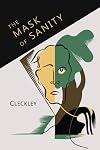
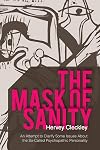
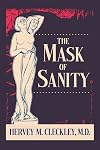
The Mask of Sanity
by Hervey M. Cleckley
On This Page
Description
The classic that has transformed the psychiatric definition of sanity and continues to provide insight on American society and psychological introspection. Although highly controversial, Hervey Cleckley's Mask of Sanity provides one of the most influential clinical descriptions of psychopathy in the twentieth century. At the crux of his argument, Cleckley claims that many psychopathic personalities go undiagnosed because they maintain a social mask that conceals their mental disorder and show more enables them to blend in with society. Furthermore, many of these affected individuals appear to function normally in accordance with standard psychiatric criteria. Intent on detecting and diagnosing the elusive psychopath, Cleckley has compiled an assortment of case studies and offers suggestions for palliative care. This ambitious work aims to define and examine every aspect of this abstract state of being. show lessTags
Recommendations
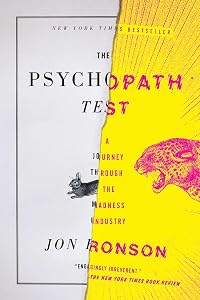
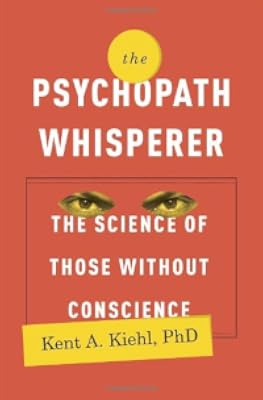

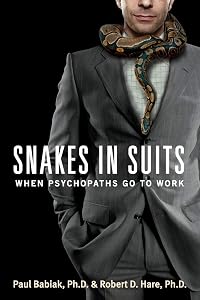
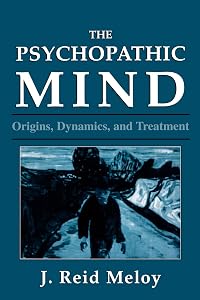






















Member Reviews
Cleckley's book is out of print, so I read a pdf version of a scanned copy made available at http://cassiopaea.org/2011/02/10/the-psychopath-the-mask-of-sanity/
... this online essay is informative if you can handle/ignore the New Age Twilight Zone stuff at the end.
Cleckley provides detailed case histories of psychopaths ... incredible reading if you are interested in stories of dysfunctional people/families.
Medical discussions in Cleckley's book are fascinating from an historical viewpoint ... obviously info is dated.
Consider a spectrum of anxiety, with the psychoneurotic at one endpoint and the psychopath at the other:
"People who suffer from personality disorders which cause them to be anxious, restless, unhappy, and obsessed with show more thoughts they themselves recognize as absurd but who are, in the lay sense, altogether sane have for years been classed as psychoneurotic. They recognize reason in general, often admit that their symptoms arise from emotional conflicts, and are free from delusions and hallucinations.
"....They are often resistant to reasoning but more in the sense of a person with strong prejudices than of one with delusions or with intellectual dilapidation. Sometimes they feel strong fears that they may carry out acts which they dread and which would indeed be tragic or criminal, but they recognize the nature of these acts and do not carry them out. Other acts, all patently senseless but relatively harmless, they do carry out, recognizing the absurdity of feeling that they must do so but becoming anxious if they resist the impulse.
"In general, psychoneurotic people recognize objective reality and try to adapt themselves like most others to the ways of society."
Kindle location 4788-4802
"On the contrary, those called psychopaths are very sharply characterized by the lack of anxiety (remorse, uneasy anticipation, apprehensive scrupulousness, the sense of being under stress or strain) and, less than the average person, show what is widely regarded as basic in the neurotic....
".... the interpretation of the psychopath's behavior as symptomatic 'acting out' against his surroundings, in contrast with the development of anxiety or headache or obsession is, it seems to me, an interesting formulation.... I do not believe that psychopaths should be identified with the psychoneurotic group, for this would imply that they possess full social and legal competency, that they are capable of handling adequately their own affairs, and that they are earnestly seeking relief from unpleasant symptoms.
"There are disorders in which the two diverse types of reaction (developing subjectively unpleasant symptoms versus callously carrying out socially destructive acts) seem to exist in the same symptom. The so-called pyromaniac (and kleptomaniac) often seems motivated by forces similar to the classic obsessive-compulsive patient ....
".... The distinction emphasized by Fenichel between ego-syntonic and ego-alien motivations (compulsive acts of caution versus so-called 'compulsive' antisocial acts) is a fundamental point and brings out a distinction not merely of degree but of quality....."
Kindle 4809-4833
And the bottom line is that psychopaths are BORED:
"If, as we maintain, the big rewards of love, of the hard job well done, of faith kept despite sacrifices, do not enter significantly in the equation, it is not difficult to see that the psychopath is likely to be bored.....
"Apparently blocked from fulfillment at deep levels, the psychopath is not unnaturally pushed toward some sort of divertissement. Even weak impulses, petty and fleeting gratifications, are sufficient to produce in him injudicious, distasteful, and even outlandish misbehavior. Major positive attractions are not present to compete successfully with whims, and the major negative deterrents (hot, persistent shame, profound regret) do not loom ahead to influence him."
Kindle location 7204-7217 show less
... this online essay is informative if you can handle/ignore the New Age Twilight Zone stuff at the end.
Cleckley provides detailed case histories of psychopaths ... incredible reading if you are interested in stories of dysfunctional people/families.
Medical discussions in Cleckley's book are fascinating from an historical viewpoint ... obviously info is dated.
Consider a spectrum of anxiety, with the psychoneurotic at one endpoint and the psychopath at the other:
"People who suffer from personality disorders which cause them to be anxious, restless, unhappy, and obsessed with show more thoughts they themselves recognize as absurd but who are, in the lay sense, altogether sane have for years been classed as psychoneurotic. They recognize reason in general, often admit that their symptoms arise from emotional conflicts, and are free from delusions and hallucinations.
"....They are often resistant to reasoning but more in the sense of a person with strong prejudices than of one with delusions or with intellectual dilapidation. Sometimes they feel strong fears that they may carry out acts which they dread and which would indeed be tragic or criminal, but they recognize the nature of these acts and do not carry them out. Other acts, all patently senseless but relatively harmless, they do carry out, recognizing the absurdity of feeling that they must do so but becoming anxious if they resist the impulse.
"In general, psychoneurotic people recognize objective reality and try to adapt themselves like most others to the ways of society."
Kindle location 4788-4802
"On the contrary, those called psychopaths are very sharply characterized by the lack of anxiety (remorse, uneasy anticipation, apprehensive scrupulousness, the sense of being under stress or strain) and, less than the average person, show what is widely regarded as basic in the neurotic....
".... the interpretation of the psychopath's behavior as symptomatic 'acting out' against his surroundings, in contrast with the development of anxiety or headache or obsession is, it seems to me, an interesting formulation.... I do not believe that psychopaths should be identified with the psychoneurotic group, for this would imply that they possess full social and legal competency, that they are capable of handling adequately their own affairs, and that they are earnestly seeking relief from unpleasant symptoms.
"There are disorders in which the two diverse types of reaction (developing subjectively unpleasant symptoms versus callously carrying out socially destructive acts) seem to exist in the same symptom. The so-called pyromaniac (and kleptomaniac) often seems motivated by forces similar to the classic obsessive-compulsive patient ....
".... The distinction emphasized by Fenichel between ego-syntonic and ego-alien motivations (compulsive acts of caution versus so-called 'compulsive' antisocial acts) is a fundamental point and brings out a distinction not merely of degree but of quality....."
Kindle 4809-4833
And the bottom line is that psychopaths are BORED:
"If, as we maintain, the big rewards of love, of the hard job well done, of faith kept despite sacrifices, do not enter significantly in the equation, it is not difficult to see that the psychopath is likely to be bored.....
"Apparently blocked from fulfillment at deep levels, the psychopath is not unnaturally pushed toward some sort of divertissement. Even weak impulses, petty and fleeting gratifications, are sufficient to produce in him injudicious, distasteful, and even outlandish misbehavior. Major positive attractions are not present to compete successfully with whims, and the major negative deterrents (hot, persistent shame, profound regret) do not loom ahead to influence him."
Kindle location 7204-7217 show less
I came across this book as a result of a recent fascination of personality disorders. I found the "anti-social type" of particular interest and, absorbing all I could about the subject, I read this book in just a few sittings.
My primary goal was to understand more about the behaviour and thought patterns consistent with individuals afflicted with the disorder reviewed here. I also wanted to learn more about the distinctions from other personality disorders from which this disorder contrasts, but is related to.
Almost immediately, the reader's curiosity is satisfied with some 15, or so, personal accounts of the author's dealings with "psychopaths", as Cleckley so liberally, and perhaps callously, refers. These stories were exactly what show more I was looking for. Later in the book, he describes these patients, as our doctors; businessmen; etc...
It wasn't until the very end of the book that I had any clue this book was written in the 40's. Most of the book read just as "fresh as ever". My only clues were it's description of homosexuality as "sexual psychosis", and the author's occasional less-than-politically-correct terminology and references. Although I enjoyed this book thoroughly, I couldn't help myself from asking why it seemed like the author, sometimes, seemed so unrelenting and, in my opinion, aggressive in his discourse.
Even having learned much from this interesting and very well-written book, I felt the need to explore more resources that could offer an account of the disorder from a more, perhaps sympathetic, point of view: something of a different perspective than the one Cleckley so adequately presents. show less
My primary goal was to understand more about the behaviour and thought patterns consistent with individuals afflicted with the disorder reviewed here. I also wanted to learn more about the distinctions from other personality disorders from which this disorder contrasts, but is related to.
Almost immediately, the reader's curiosity is satisfied with some 15, or so, personal accounts of the author's dealings with "psychopaths", as Cleckley so liberally, and perhaps callously, refers. These stories were exactly what show more I was looking for. Later in the book, he describes these patients, as our doctors; businessmen; etc...
It wasn't until the very end of the book that I had any clue this book was written in the 40's. Most of the book read just as "fresh as ever". My only clues were it's description of homosexuality as "sexual psychosis", and the author's occasional less-than-politically-correct terminology and references. Although I enjoyed this book thoroughly, I couldn't help myself from asking why it seemed like the author, sometimes, seemed so unrelenting and, in my opinion, aggressive in his discourse.
Even having learned much from this interesting and very well-written book, I felt the need to explore more resources that could offer an account of the disorder from a more, perhaps sympathetic, point of view: something of a different perspective than the one Cleckley so adequately presents. show less
First published in 1941 and revised numerous times, I read the 5th edition published in 1975.
Whilst updated as time passed, the 5th edition still included the now known to be incorrect hypothesis that homosexuality is a mental disorder. Asides for this the book, although written academically, and as such quite dry, is up to par with the theories of today.
I encoutered mention of this work in Robert D Hare's Without Conscience which noted it was one of the pivotal and first works on psychopathology.
It is an interesting book, yet I found the manner in which it is written made the 596 pages feel more like 1,000. I wouldn't recommend it for recreational reading, however if you have an interest in the topic it is quite the seminal work and show more worthwhile to see where theories and practice came from. show less
Whilst updated as time passed, the 5th edition still included the now known to be incorrect hypothesis that homosexuality is a mental disorder. Asides for this the book, although written academically, and as such quite dry, is up to par with the theories of today.
I encoutered mention of this work in Robert D Hare's Without Conscience which noted it was one of the pivotal and first works on psychopathology.
It is an interesting book, yet I found the manner in which it is written made the 596 pages feel more like 1,000. I wouldn't recommend it for recreational reading, however if you have an interest in the topic it is quite the seminal work and show more worthwhile to see where theories and practice came from. show less
The Mask of Sanity is pioneering text on psychopath (or less accusing terms sociopath, antisocial disorder) from psychiatrist Hervey Cleckley. This book is result of his extensive work with psychopaths, and proposed for first time that psychopaths are anything unlike anything psychiatry theory covers. It is academia oriented book with good scientific form of presenting raw data (cases), processing and presenting the data, building hypothesis and providing arguments in favour of the hypothesis and handling potential criticism. There is excellent arguments put forward, quite often incisive, sometime bordering on to cynicism. But, that is acceptable as the subject was controversial in its time (and it still is), proposition was vastly show more different from earlier psychiatry practices that is highly subjective at best. Some of the ideas may now be outdated, but it is still an excellent read for anyone seriously interested in psychopathy.
This book may be too wordy for general reading. But, it is still pretty good for someone casually interested. An alternative for easier reading is to go for book from Robert D. Hare.
Read the 5th edition or newer as it is extensively revised. The latest one which is easily available has been edited, and some reviewer claim that it loses some of the original ideas from Hervey Cleckley. I went for original 5th Mosby edition, the last edition done by Hervey Cleckley. This hardcover edition costed quite a bit, a cheaper alternative is free online version. show less
This book may be too wordy for general reading. But, it is still pretty good for someone casually interested. An alternative for easier reading is to go for book from Robert D. Hare.
Read the 5th edition or newer as it is extensively revised. The latest one which is easily available has been edited, and some reviewer claim that it loses some of the original ideas from Hervey Cleckley. I went for original 5th Mosby edition, the last edition done by Hervey Cleckley. This hardcover edition costed quite a bit, a cheaper alternative is free online version. show less
The Mask of Sanity: An Attempt to Clarify Some Issues About the So-Called Psychopathic Personality is a book written by American psychiatrist Hervey M. Cleckley, first published in 1941, describing Cleckley's clinical interviews with patients in a locked institution. The text is considered to be a seminal work and the most influential clinical description of psychopathy in the twentieth century. The basic elements of psychopathy outlined by Cleckley are still relevant today.[1] The title refers to the normal "mask" that conceals the mental disorder of the psychopathic person in Cleckley's conceptualization.[2]
Cleckley describes the psychopathic person as outwardly a perfect mimic of a normally functioning person, able to mask or show more disguise the fundamental lack of internal personality structure, an internal chaos that results in repeatedly purposeful destructive behavior, often more self-destructive than destructive to others. Despite the seemingly sincere, intelligent, even charming external presentation, internally the psychopathic person does not have the ability to experience genuine emotions. Cleckley questions whether this mask of sanity is voluntarily assumed to intentionally hide the lack of internal structure, but concludes it hides a serious, but yet imprecisely unidentified, semantic neuropsychiatric defect.[3] Six editions of the book were produced in total, the final shortly after his death. An expanded fifth edition of the book had been published in 1976 and was re-released by his heirs in 1988 for non-profit educational use. show less
Cleckley describes the psychopathic person as outwardly a perfect mimic of a normally functioning person, able to mask or show more disguise the fundamental lack of internal personality structure, an internal chaos that results in repeatedly purposeful destructive behavior, often more self-destructive than destructive to others. Despite the seemingly sincere, intelligent, even charming external presentation, internally the psychopathic person does not have the ability to experience genuine emotions. Cleckley questions whether this mask of sanity is voluntarily assumed to intentionally hide the lack of internal structure, but concludes it hides a serious, but yet imprecisely unidentified, semantic neuropsychiatric defect.[3] Six editions of the book were produced in total, the final shortly after his death. An expanded fifth edition of the book had been published in 1976 and was re-released by his heirs in 1988 for non-profit educational use. show less
Oct 27, 2019Dutch
Ratings
Members
- Recently Added By
Lists

Recovery from Psychopath
127 works; 1 member
Author Information

4+ Works 499 Members
Common Knowledge
- Canonical title
- The Mask of Sanity
- Original publication date
- 1941
Classifications
- Genres
- Nonfiction, General Nonfiction
- DDC/MDS
- 616.8582 — Applied science & technology Medicine & health Diseases, Allergies, Skin Conditions Nervous Disorders: Autism, Anorexia, OCD Miscellaneous Personality, sexual, gender-identity, impulse-control, factitious, developmental, learning disorders; violent behavior; mental retardation Antisocial personality disorders, family violence and abuse
- LCC
- RC555 .C5 — Medicine Internal medicine Internal medicine Neurosciences. Biological psychiatry. Neuropsychiatry Psychiatry Psychopathology Personality disorders. Behavior problems
- BISAC
Statistics
- Members
- 272
- Popularity
- 118,640
- Reviews
- 5
- Rating
- (3.96)
- Languages
- English
- Media
- Paper, Ebook
- ISBNs
- 20
- ASINs
- 9