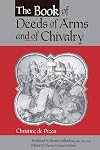
The Book of Deeds of Arms and of Chivalry: by Christine de Pizan
by Christine de Pizan
On This Page
Description
It is unexpected in any era to find a woman writing a book on the art of warfare, but in the fifteenth century it was unbelievable. Not surprisingly, therefore, Christine de Pizan's The Book of Deeds of Arms & of Chivalry, written around 1410, has often been regarded with disdain. Many have assumed that Christine was simply copying or pilfering earlier military manuals. But, as Sumner Willard & Charity Cannon Willard show in this faithful English translation, The Book of Deeds of Arms & of show more Chivalry contains much that is original to Christine. As a military manual it tells us a great deal about the strategy, tactics, & technology of medieval warfare & is one of our most important sources for early gunpowder weapon technology. It also includes a fascinating discussion of Just War. Since the end of the fifteenth century, The Book of Deeds of Arms & of Chivalry has been available primarily through Antoine Verard's imprint of 1488 or William Caxton's 1489 translation, The Book of the Order of Chivalry. Verard even suggested that the work was his own translation of the Roman writer Vegetius, making no mention of Christine's name. Caxton attributed the work to Christine, but it is impossible to identify the manuscript he used for his translation. Moreover, both translations are inaccurate. The Willards correct these inaccuracies in a clear & easy-to-read translation, which they supplement with notes & an introduction that will greatly benefit students, scholars, & enthusiasts alike. Publication of this work should change our perception both of medieval warfare & of Christine de Pizan. Includes information on Frontinus, Hannibal, defense of castles and towns, equipment for assault, sea battles, siege warfare, war machine, Scipio, Vegetius, etc. show lessTags
Recommendations




















Member Reviews
During the late 14th and early 15th century in which Pizan lived, it was not common for women to write book (which she wrote 41) and it was even more unbelievable for a woman to write a manual for warfare, arms, and chivalry., which see did in [b:The Book of Deeds of Arms and of Chivalry|913719|The Book of Deeds of Arms and of Chivalry|Christine de Pizan|https://images.gr-assets.com/books/1369161706s/913719.jpg|898817].
Using prior manuals as reference and also advisers, she discusses such topics as who has the right to declare war, what is a just war, the rules of engagement, and the law surrounding different aspects of war. She give outlines of how to attack and how to protect fortified cities, the weaponry needed, supplies needed and show more more.
My favorite part was the examples of chivalry in prior wars, such as Julius Caesar, Hannibal, Cicero and many others. This was the only part that did not read like a manual. When discussing the laws of war, it is done in a question and answer format. She poses a questions and a legal and rational answer is given for the situation she has outlined.
I learned a bit about history, much about how cities were attacked and how the were defended, and the definition of some terms. A legion was considered 6,666 men.
Very interesting but not a riveting or great read. I do recommend the examples of chivalry (basically bravery, not holding doors open for women) in prior wars. The stories and strategy was funny, amazing, and enlightening. show less
Using prior manuals as reference and also advisers, she discusses such topics as who has the right to declare war, what is a just war, the rules of engagement, and the law surrounding different aspects of war. She give outlines of how to attack and how to protect fortified cities, the weaponry needed, supplies needed and show more more.
My favorite part was the examples of chivalry in prior wars, such as Julius Caesar, Hannibal, Cicero and many others. This was the only part that did not read like a manual. When discussing the laws of war, it is done in a question and answer format. She poses a questions and a legal and rational answer is given for the situation she has outlined.
I learned a bit about history, much about how cities were attacked and how the were defended, and the definition of some terms. A legion was considered 6,666 men.
Very interesting but not a riveting or great read. I do recommend the examples of chivalry (basically bravery, not holding doors open for women) in prior wars. The stories and strategy was funny, amazing, and enlightening. show less
Contemporary accounts and chronicles of certain periods have always fascinated me. Many manuscripts and works are unknown to me and I am always on the lookout for new ones. Most I aquire and read are referenced in others books about that particular mind. That is how I discovered this particular work.
Much is made that a book containing strategic warfare during the Middle Ages was written by a woman. Today, not such a big deal, but at the time groundbreaking and unusual. It seem to me that Ms. Pizan just loved writting and was very prolific with it. After one gets into this work a bit, one sees that it probably was not a mammoth effort on her part to produce this book.
The book begins a little dryly but should be held in the context that show more you are exploring the mindset of someone who lived over 600 years ago, which in itself, lends itself valuable to the study of that period's mindset.
She then begins to recount various strategems and tactics used by the Ancients and Romans during their respective campaigns and battles. By far the most interesting and readable part of the book.
The latter half of the book I found tedious as she imparts upon the reader an imaginary discussion she has with Honore Bonet, the author of The Tree of Battles. If you have read The Tree of Battles, they prepare to read some of it again. It is nearly verbatum and covers no new ground.
I gave this book 3 starts for historical ambiance value and overall counsel. show less
Much is made that a book containing strategic warfare during the Middle Ages was written by a woman. Today, not such a big deal, but at the time groundbreaking and unusual. It seem to me that Ms. Pizan just loved writting and was very prolific with it. After one gets into this work a bit, one sees that it probably was not a mammoth effort on her part to produce this book.
The book begins a little dryly but should be held in the context that show more you are exploring the mindset of someone who lived over 600 years ago, which in itself, lends itself valuable to the study of that period's mindset.
She then begins to recount various strategems and tactics used by the Ancients and Romans during their respective campaigns and battles. By far the most interesting and readable part of the book.
The latter half of the book I found tedious as she imparts upon the reader an imaginary discussion she has with Honore Bonet, the author of The Tree of Battles. If you have read The Tree of Battles, they prepare to read some of it again. It is nearly verbatum and covers no new ground.
I gave this book 3 starts for historical ambiance value and overall counsel. show less
Reprint. Orig. publ. London : Humphrey Milford, Oxford University Press, 1932
Ratings
Members
- Recently Added By
Lists

The Art of Manliness' 100+ Books Every Man Should Read
108 works; 2 members
Author Information

54+ Works 3,427 Members
Awards and Honors
Notable Lists
Common Knowledge
- Original publication date
- cir. 1364-1410
- People/Characters
- Honore Bonet; Vegetius
- First words
- As boldness is essential for great undertakings, and without it nothing should be risked, I think it is proper in this present work to set forth my unworthiness to treat such exalted matter.
- Last words
- (Click to show. Warning: May contain spoilers.)Here ends the book of The Deeds of Arms and Chivalry.
Classifications
Statistics
- Members
- 198
- Popularity
- 165,794
- Reviews
- 3
- Rating
- (3.86)
- Languages
- English, English (Middle)
- Media
- Paper
- ISBNs
- 6
- ASINs
- 1