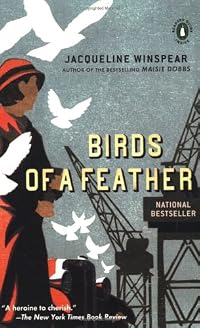
On This Page
Description
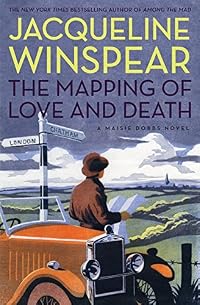
Maisie Dobbs is back and this time she has been hired to find a wealthy grocery magnate's daughter who has fled from home. What seems a simple case at first becomes complicated when Maisie learns of the recent violent deaths of three of the heiress's old friends. Is there a connection between her mysterious disappearance and the murders? Who would kill such charming young women? As Maisie investigates, she discovers that the answers to all her questions lie in the unforgettable agony of The show more Great War. show lessTags
Recommendations




Member Recommendations

Member Reviews
This is a review of both Jacqueline Winspear's Birds of a Feather and Nicole Upson's Angel with Two Faces.
---
Call the Midwife vs Law & Order: SVU.
---
Both books are in between the two world wars, trauma-loaded, woman-led mysteries with the same coy cosy-looking cover art reserved for women authors, but they couldn't be more different.
On one hand, Maisie Dobbs is doing her usual holistic mystery solving and healing. Everything has a positive sheen, everybody is actually good deep down. I did appreciate Waite getting such a rounded characterisation, even if his acceptance of change comes too conveniently quickly.
My third Dobbs and the secret ingredient seem to be centering a lesser-known but emotionally-charged fact about the war. It's show more working for me, but I still feel like the book could be a lot shorter without losing much substance.
While I'm on editing mode, stop writing Billy's speech with all the apostrophes and 'e and wiv! Just say he has a "lower class" accent at the start and write what he's saying like how all the other characters' dialogues are written! If you're so keen to really phonetically capture all your characters' speech, then I'm expecting everyone's to have italics and extra letters and misspellings and grammar mistakes.
---
One the other hand, Josephine Tey is entangled in sex crimes ahoy. What the what! I get the whole ooh dark cliffside small town Broadchurch mystery but this was another level. But as with sexsationalist stories, my furrowed brows binged it in a day and immediately went in search of other reviews for reassurance of how over-the-top this was.
Even if the dialogues with the guilty fully tilt to melodrama, Upson really knows how to describe a landscape and set a mood. While I could do without Winspear giving me details of Dobbs' travels, I could (and did) read hundreds of pages of Upson setting the scene.
---
I'd still pick up more of both authors but there may be a bit more skimming of both. show less
---
Call the Midwife vs Law & Order: SVU.
---
Both books are in between the two world wars, trauma-loaded, woman-led mysteries with the same coy cosy-looking cover art reserved for women authors, but they couldn't be more different.
On one hand, Maisie Dobbs is doing her usual holistic mystery solving and healing. Everything has a positive sheen, everybody is actually good deep down. I did appreciate Waite getting such a rounded characterisation, even if his acceptance of change comes too conveniently quickly.
My third Dobbs and the secret ingredient seem to be centering a lesser-known but emotionally-charged fact about the war. It's show more working for me, but I still feel like the book could be a lot shorter without losing much substance.
While I'm on editing mode, stop writing Billy's speech with all the apostrophes and 'e and wiv! Just say he has a "lower class" accent at the start and write what he's saying like how all the other characters' dialogues are written! If you're so keen to really phonetically capture all your characters' speech, then I'm expecting everyone's to have italics and extra letters and misspellings and grammar mistakes.
---
One the other hand, Josephine Tey is entangled in sex crimes ahoy. What the what! I get the whole ooh dark cliffside small town Broadchurch mystery but this was another level. But as with sexsationalist stories, my furrowed brows binged it in a day and immediately went in search of other reviews for reassurance of how over-the-top this was.
Even if the dialogues with the guilty fully tilt to melodrama, Upson really knows how to describe a landscape and set a mood. While I could do without Winspear giving me details of Dobbs' travels, I could (and did) read hundreds of pages of Upson setting the scene.
---
I'd still pick up more of both authors but there may be a bit more skimming of both. show less
This was very good in evoking a sense of place and time - England after the 'Great War' - and I thoroughly enjoyed the characters and Maisie's relationships with them. But the mystery itself, not so much. To me, a mystery's like a puzzle where the satisfaction is as much in finding the pieces as it is in fitting them together to come up with a solution. I don't get that sense of satisfaction when the pieces are found through hunches, drawing on feelings, and coincidences. There are other cozy-mystery series out there I'm interested in and I think I'll try them instead of continuing with this one.
Birds of a Feather by Jacqueline Winspear is the second in the Maisie Dodds series about a young woman, who nursed during WW I and now has become a private detective. I enjoyed this book a little more than the first, but I am still on the fence as to whether I will continue with this series or not. While I enjoyed the story, I found Maisie relies on her hunches and inner feelings a little too often and would rather see more actual detecting and less intuition used.
Maisie’s private life is a sad one, having her fiance in a coma and living out his years in a nursing home. She is constantly haunted by memories of the brutality of war and this particular case brings up issues that harken back to wartime. Her assistant is also a reminder show more as he suffers the after-affects of the wounds that he sustained during the war. However I did find the characters to be likeable and by the end of the book I was curious to see where Maisie’s life is heading next. show less
Maisie’s private life is a sad one, having her fiance in a coma and living out his years in a nursing home. She is constantly haunted by memories of the brutality of war and this particular case brings up issues that harken back to wartime. Her assistant is also a reminder show more as he suffers the after-affects of the wounds that he sustained during the war. However I did find the characters to be likeable and by the end of the book I was curious to see where Maisie’s life is heading next. show less
Birds of a Feather, is the second book in the Maisie Dobbs series. It's a wonderful cozy , engaging, well written read.
In post WW1 Britain, in 1930, Maisie Dobbs and her assistant , Billy Beale ( not a romantic connection ) are called on to investigate the disappearance of an heiress. Charlotte Waite is in her early thirties and has lived at home with her very fierce and controlling father, Joseph , and he wants her found and returned home. Has she run away , as her father suspects, or is there more to the story? As three of Charlotte's old friends turn up dead, the case become more complex. Meanwhile Billy Beale seems to be having both mood and physical problems as he deals with the his amputated leg, a legacy of WW1. Could the answer show more to the missing woman be in some way connected with WW1?
Maisie employs her wonderful powers of intuition, knowledge and resourceful thinking in her capacity as a Private Sleuth . I really enjoy the time period and the fascinating side characters in the series. 4 stars. show less
In post WW1 Britain, in 1930, Maisie Dobbs and her assistant , Billy Beale ( not a romantic connection ) are called on to investigate the disappearance of an heiress. Charlotte Waite is in her early thirties and has lived at home with her very fierce and controlling father, Joseph , and he wants her found and returned home. Has she run away , as her father suspects, or is there more to the story? As three of Charlotte's old friends turn up dead, the case become more complex. Meanwhile Billy Beale seems to be having both mood and physical problems as he deals with the his amputated leg, a legacy of WW1. Could the answer show more to the missing woman be in some way connected with WW1?
Maisie employs her wonderful powers of intuition, knowledge and resourceful thinking in her capacity as a Private Sleuth . I really enjoy the time period and the fascinating side characters in the series. 4 stars. show less
Maisie Dobbs is hired by grocery magnate Joseph Waite to find and return his runaway, adult daughter, Charlotte. However, it quickly becomes clear that Charlotte's disappearance has some sort of tie to the recent well-publicized murder of another woman in London. Now Maisie must not only find Charlotte but determine what binds her to the murdered woman.
This second entry in the Maisie Dobbs series is a sedately paced mystery. Winspear does an excellent job of setting the scene in London in 1930 and makes the world seem very real immediately. The mystery is well-crafted, even if I had the murderer figured out before the big reveal (although not too far in advance so I mostly felt smug rather than bored). However, there are some scenes show more that feel a bit... mystical and it's unclear whether Maisie is finding some clues because of her Buddhist training, her woman's intuition, or some other slightly beyond the normal ability. But it feels a bit out of place in this otherwise logical mystery series which otherwise feels reminiscent of Agatha Christie's and Arthur Conan Doyle's more deductive detectives. Enjoyable enough that I plan to continue with the series. show less
This second entry in the Maisie Dobbs series is a sedately paced mystery. Winspear does an excellent job of setting the scene in London in 1930 and makes the world seem very real immediately. The mystery is well-crafted, even if I had the murderer figured out before the big reveal (although not too far in advance so I mostly felt smug rather than bored). However, there are some scenes show more that feel a bit... mystical and it's unclear whether Maisie is finding some clues because of her Buddhist training, her woman's intuition, or some other slightly beyond the normal ability. But it feels a bit out of place in this otherwise logical mystery series which otherwise feels reminiscent of Agatha Christie's and Arthur Conan Doyle's more deductive detectives. Enjoyable enough that I plan to continue with the series. show less
I read this aloud to/with a friend who has cancer. We’d read book one and moved on to book two. This series is delightful and clever.It takes us a long time to get through these books but we both love them. They’re so much fun. Great humor. Great pathos. Great psychological insight. Absolutely wonderful, lovable, captivating and memorable characters and interesting relationships. Good mysteries too. This series reminds me a bit of the Ruth Galloway series by Elly Griffiths and that is high praise. I do appreciate how all of the recurring characters are basically good and that even the villains are humanized and shown sympathetically. Read 2020/05/25-2020/07/04. The author does a good enough job with her characters that it was rare I show more got confused despite taking so long to read this book. It’s an enjoyable read aloud book. I know I would like it anyway but it’s even more entertaining to read it aloud/read it with someone else. Very sweet acknowledgments page at the end of the book where her dog and her cat are mentioned. Read a borrowed e-copy from my public library due to the pandemic. 4-1/2 stars show less
I have a bit of an obsession with reading series books in order. In fact, I'm rather a stickler about it. Add in that I am not a regular reader of mysteries, and it should come as no surprise that when I heard that Winspear was coming out with another book in her Maisie Dobbs series, I knew I would be a long time in getting to it despite having read and quite enjoyed the eponymously named debut of the series. But the release of the tenth (!) novel in the series spurred me to finally pick up the second and revisit the indomitable and fascinating Maisie Dobbs, former nurse in the Great War, now successful and intuitive private investigator in London. And coward though I am, there's just something about Maisie Dobbs that captures my show more imagination and allows me to overlook the fact that there are murders contained within the pages of these books.
As this second book in the popular series opens, Maisie Dobbs is hired by a self-made wealthy man, Joseph Waite, to find and return his unmarried daughter Charlotte to his home without involving the police. It seems a fairly straightforward case until one of Charlotte Waite's friends is found murdered immediately after Maisie's assistant Billy questions her. And when the murder is further connected to the murder of another woman who was once in the same social circle as Charlotte Waite and Lydia Fisher, the need to find Charlotte Waite and to uncover the connection between the women becomes imperative. As she searches for Charlotte and investigates the murders of Lydia Fisher and Philippa Sedgewick, there are many other things going on in Maisie's personal life as well. Her father has a terrible accident and she is forced to face his aging and mortality and to examine the state of their relationship. Her assistant Billy Beale, normally a cheery sort when not in pain from his lingering war wound, has changed and is causing Maisie worry. To top it off, Joseph Waite is being most impatient for the resolution of the case for which he's hired Maisie even as he's not being entirely truthful with her.
As in the first novel, Maisie uses non-traditional methods of deduction to give her insight into both Charlotte's dsappearance and the murders she was not hired to investigate. She relies on intuition, meditation, and deeply reflective thinking in addition to the careful attention to minute detail that one might expect. She is also quite well versed in psychology and the mental damage caused by the war. Her background both in service and in the war as a nurse serve her well as she works towards uncovering the murderer and perhaps more importantly than the murderer, the motive behind the killings. She herself is a symbol of the rapidly changing economy and social structure in the wake of the Great War, a herald of people and things to come. Maisie Dobbs is an intelligent woman and a likable character. The mystery itself was less interesting to me than her personal story and the motive behind the murders was in fact fairly easily discovered by anyone with any knowledge of World War I. But it in general it was a quite enjoyable read and I will look forward to further time spent with the insightful Miss Dobbs. show less
As this second book in the popular series opens, Maisie Dobbs is hired by a self-made wealthy man, Joseph Waite, to find and return his unmarried daughter Charlotte to his home without involving the police. It seems a fairly straightforward case until one of Charlotte Waite's friends is found murdered immediately after Maisie's assistant Billy questions her. And when the murder is further connected to the murder of another woman who was once in the same social circle as Charlotte Waite and Lydia Fisher, the need to find Charlotte Waite and to uncover the connection between the women becomes imperative. As she searches for Charlotte and investigates the murders of Lydia Fisher and Philippa Sedgewick, there are many other things going on in Maisie's personal life as well. Her father has a terrible accident and she is forced to face his aging and mortality and to examine the state of their relationship. Her assistant Billy Beale, normally a cheery sort when not in pain from his lingering war wound, has changed and is causing Maisie worry. To top it off, Joseph Waite is being most impatient for the resolution of the case for which he's hired Maisie even as he's not being entirely truthful with her.
As in the first novel, Maisie uses non-traditional methods of deduction to give her insight into both Charlotte's dsappearance and the murders she was not hired to investigate. She relies on intuition, meditation, and deeply reflective thinking in addition to the careful attention to minute detail that one might expect. She is also quite well versed in psychology and the mental damage caused by the war. Her background both in service and in the war as a nurse serve her well as she works towards uncovering the murderer and perhaps more importantly than the murderer, the motive behind the killings. She herself is a symbol of the rapidly changing economy and social structure in the wake of the Great War, a herald of people and things to come. Maisie Dobbs is an intelligent woman and a likable character. The mystery itself was less interesting to me than her personal story and the motive behind the murders was in fact fairly easily discovered by anyone with any knowledge of World War I. But it in general it was a quite enjoyable read and I will look forward to further time spent with the insightful Miss Dobbs. show less
Members
- Recently Added By
Published Reviews
ThingScore 100
...Maisie makes it her business to help the speechless survivors of war -- the women who silently visit the graves, the fathers who cannot speak their sons' names, even those broken souls who hope that murdering the living might bring back the dead. That sensibility makes her a heroine to cherish.
Not that Maisie is some glum, humorless missionary. Well, humorless, yes, but glum, not at all.
Not that Maisie is some glum, humorless missionary. Well, humorless, yes, but glum, not at all.
added by y2pk
Lists

Survey of Mysteries and Crime Fiction
96 works; 17 members

Historical Fiction
889 works; 91 members

World War I Fiction
94 works; 15 members

Books about World War I
80 works; 14 members

Books Read in 2016
4,666 works; 197 members

Books Read in 2011
684 works; 20 members

Books Read in 2020
4,379 works; 123 members

BIRDS IN FICTION & NON-FICTION
17 works; 1 member
Author Information

32+ Works 32,718 Members
Jacqueline Winspear was born in the county of Kent, England. She was educated at the University of London's Institute of Education. After graduation, she worked in academic publishing, in higher education, and in marketing communications in the UK. In 1990, she emigrated to the United States. She was working in business and as a show more personal/professional coach when she decided to try writing. Her first novel, Maisie Dobbs, won the Agatha Award for Best First novel, the Macavity Award for Best First Novel, and the Alex Award. She is the author of the Maisie Dobbs Mystery series. She has also won the Agatha Award for Best Novel, the inaugural Sue Feder/Macavity Award for Best Historical Mystery, and the Bruce Alexander Award for Best Historical Mystery. Her title, A Dangerous Place, made The New York Times High Profile titles list. Journey to Munich, a book in the Maisie Dobbs Series, made the New York Times bestseller list in 2016. (Bowker Author Biography) show less
Some Editions
Awards and Honors
Awards
Notable Lists
Series

Work Relationships
Common Knowledge
- Canonical title
- Birds of a Feather
- Original title
- Birds of a Feather
- Original publication date
- 2004-01-12
- People/Characters
- Maisie Dobbs; Billy Beale; Charlotte Waite; Joseph Waite; Detective Inspector Richard Stratton; Lydia Fisher (show all 13); Francis "Frankie" Dobbs; Magnus Fisher; Lady Rowan Compton; Maurice Blanche; John Sedgewick; Dr. Andrew Dene; Mrs. Wilson
- Important places
- London, England, UK
- Important events
- The Great War
- Epigraph
- How will you fare, sonny, how will you fare
In the far off winter night
When you sit by the fire in the old man's chair
And your neighbours talk of the fight?
Will you slink away, as it were from a blow,
Y... (show all)our old head shamed and bent?
Or say, "I was not the first to go,
But I went, thank God, I went"?
-- from the song "Fall In" by Harold Begbie, 1914 - Dedication
- To Kenneth Leech
1919-2002
During my childhood I was lucky to have Ken Leech as my teacher. In the years of my growing up and into adulthood, I was privileged to count him among my friends. - First words
- Maisie Dobbs shuffled the papers on her desk into a neat pile and placed them in a manila folder.
- Quotations
- "I think people are trying to forget the war, don't you, miss? I mean, who wants to be reminded? My cousin—not the one what died over there, but the one who came home wounded from Loos—he said that it was one thing to be ... (show all)remembered and quite another to be reminded every day. He didn't mind people remembering what he'd done, you know, over there. But he didn't want to be reminded of it. He said that it was hard because something happened to remind him every day."
Perhaps she was ready for change. Not outwardly, though she knew that exterior transformation was a signal of inner change, but in what she envisioned for her future.
As Maisie settled back into the pillows, she thought of the fine line between remembrance and reminder, and how a constant reminder could drive a person to the edge of sanity.
Maisie smiled, noting the change of address again, from "M'um" to "Miss." Maisie felt like a citizen of two countries, neither here nor there, but always somewhere in the middle.
If Lydia Fisher chose alcohol, and Billy narcotics to beat back the tide of daily reminder, then what did she do to dull the pain? And as she considered her question, the terrible thought came to her that perhaps she w... (show all)orked hard at her own isolation, along with the demands of her business. - Last words
- (Click to show. Warning: May contain spoilers.)"And talking of powers of deduction, I've just taken on an interesting new case."
- Blurbers
- Todd, Charles
Classifications
Statistics
- Members
- 2,978
- Popularity
- 5,957
- Reviews
- 130
- Rating
- (3.87)
- Languages
- 9 — Dutch, English, Finnish, French, Italian, Norwegian (Bokmål), Portuguese, Spanish, Swedish
- Media
- Paper, Audiobook, Ebook
- ISBNs
- 44
- ASINs
- 15