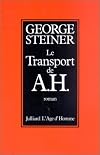
The Portage to San Cristobal of A.H.
by George Steiner
On This Page
Description
"In 1977, deep in the Amazon jungle, exhausted Israeli Nazi-hunters find a silent old man - Adolph Hitler - and decide to carry him to San Cristobal, where he will stand trial. Their harrowing story explores the nature of guilt, vengeance, pain, and the power of language. In his new Afterword, George Steiner responds to the controversy the novel inspired when it first came out and was adapted for the stage."--BOOK JACKET.Tags
Recommendations








































Member Reviews
Another example of intelligent people making dumb decisions. Whatever possessed Steiner to publish this? It ought to have been a back-of-the-napkin thought experiment, but instead it's out and about, doing no good to anyone.
The premise of the novel(la) is that a trio of Israeli commandos find Hitler alive, well, and ancient, in some corner of South America so remote they have to bring him out literally on their backs and arms, crossing swamps and rivers on foot. Their ultimate goal is to take him to court. Other national and political factions who got wind of this are monitoring the situation and may act to foil them, for no clear reason (there are only some short and utterly clichéd snapshots of various American, Soviet, French, show more British high-ups remarking cryptically on the scheme). The jungle trek exhausts everyone but Hitler, who seems to be getting stronger as they get closer to the pick up point.
And that's it, that's the story. However, the point isn't the story, but the horrible last pages Steiner gives over to Hitler's self-exonerating speech. It's the usual well-trodden litany of antisemitic thought since the late 19th century, as ever blaming the victims as perpetrators and piling on every possible insult to the injuries on record.
The effect is awful. Steiner may have hoped people would know (or be?) better, but considering that exactly the same reasoning still thrives and spreads around, he achieved nothing; or, even worse, he appears to leave Hitler in the "winning" position.
Fwiw, there's a section about the middle of the book when one of the men carrying Hitler is recalling a long list of crimes against Jewish individuals and wondering what sort of punishment could begin to expiate for a single one--I would have had that at the end, because it speaks for itself, because it is real and unanswerable. show less
The premise of the novel(la) is that a trio of Israeli commandos find Hitler alive, well, and ancient, in some corner of South America so remote they have to bring him out literally on their backs and arms, crossing swamps and rivers on foot. Their ultimate goal is to take him to court. Other national and political factions who got wind of this are monitoring the situation and may act to foil them, for no clear reason (there are only some short and utterly clichéd snapshots of various American, Soviet, French, show more British high-ups remarking cryptically on the scheme). The jungle trek exhausts everyone but Hitler, who seems to be getting stronger as they get closer to the pick up point.
And that's it, that's the story. However, the point isn't the story, but the horrible last pages Steiner gives over to Hitler's self-exonerating speech. It's the usual well-trodden litany of antisemitic thought since the late 19th century, as ever blaming the victims as perpetrators and piling on every possible insult to the injuries on record.
The effect is awful. Steiner may have hoped people would know (or be?) better, but considering that exactly the same reasoning still thrives and spreads around, he achieved nothing; or, even worse, he appears to leave Hitler in the "winning" position.
Fwiw, there's a section about the middle of the book when one of the men carrying Hitler is recalling a long list of crimes against Jewish individuals and wondering what sort of punishment could begin to expiate for a single one--I would have had that at the end, because it speaks for itself, because it is real and unanswerable. show less
This is a novella written around the premise that Hitler had faked his own death, and now, as a weakened old man, he has finally been caught. As people learn of his capture, controversies arise as what exactly to *do* with him now that we have him. To paraphrase one of the characters, even if Hitler were dipped in boiling oil six million times, still none of the dead would sit up in their graves and brush the dirt from their bodies.
This could have been a very excellent book, but sadly it plodded along through all of the scenes that didn't have Hitler in them (he was, strangely, a very compelling character) and too much of the story was simply unfocused. The end, where Hitler finally gets to say his piece in his defense, goes creepily show more uncontested and, it felt, tried to raise sympathies where there really shouldn't be any. Very strange book that raised many interesting questions, but failed to answer most of them show less
This could have been a very excellent book, but sadly it plodded along through all of the scenes that didn't have Hitler in them (he was, strangely, a very compelling character) and too much of the story was simply unfocused. The end, where Hitler finally gets to say his piece in his defense, goes creepily show more uncontested and, it felt, tried to raise sympathies where there really shouldn't be any. Very strange book that raised many interesting questions, but failed to answer most of them show less
Ratings
Members
- Recently Added By
Lists

Pen/Faulkner Winners and Finalists
178 works; 9 members
Author Information

82+ Works 7,411 Members
George Steiner was born in 1929 in Paris, but also lived in Vienna and New York. Steiner was a critic, novelist, philosopher, translator, and educator. Currently, he is a professor at Cambridge University and the University of Geneva. He has written for the New Yorker for over thirty years and has published the books No Passion Spent, Errata: An show more Examined Life, and Martin Heidegger: With a New Introduction. George Steiner died in Cambridge, England on February 3, 2020, at the age of 90. (Bowker Author Biography) show less
Some Editions
Awards and Honors
Awards
Distinctions
Common Knowledge
- Canonical title
- The Portage to San Cristobal of A.H.
- Original title
- The Portage to San Cristobal of A.H.
- Original publication date
- 1979 (Kenyon Review) (Kenyon Review)
- People/Characters
- Adolf Hitler
- Original language*
- Engels
*Some information comes from Common Knowledge in other languages. Click "Edit" for more information.
Classifications
Statistics
- Members
- 286
- Popularity
- 112,940
- Reviews
- 2
- Rating
- (3.73)
- Languages
- 8 — Dutch, English, Finnish, French, Polish, Portuguese, Spanish, Swedish
- Media
- Paper, Ebook
- ISBNs
- 17
- ASINs
- 4