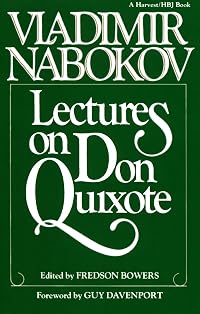
Lectures on Don Quixote
by Vladimir Nabokov
On This Page
Description
A fastidiously shaped series of lectures based on a chapter-by-chapter synopsis of the Spanish classic. Rejecting the common interpretation of Don Quixote as a warm satire, Nabokov perceives the work as a catalog of cruelty through which the gaunt knight passes. Edited and with a Preface by Fredson Bowers.Tags
Recommendations














Member Reviews
in which our vladi starts off thinking The Quioxte is terrible, goes over it with a fine tooth comb (sometimes missing the forest for the trees) and comes out the other side with a begrudging admiration. ok yeah i strongly disagree with him, but that's kinda the point.
I hate to say this, but I recommend reading this over actually reading Cervantes' Don Quixote (which admittedly I could not finish). Don Quixote is probably one of those books that should be talked about but not read. Nabokov's account and criticisms are enjoyable enough, and it saves you the pain of plodding through Cervantes' original work.
A good accompaniment to Don Quixote, marred only by Nabokov's less-than-complete love for the novel. It is six lectures he gave at Harvard that ranges from more conventional discussion to more novel presentations, like a scorecard that goes through the 40 "battles" in the book, classifies them into different types, and calls each one a win or a loss. Turns out the final score was 20-20.
Nabokov might be right that the novel would have been even better if Don Quixote's final combat was with the false Don Quixote from the false Part Two that wasn't written by Cervantes. Oh well.
Nabokov might be right that the novel would have been even better if Don Quixote's final combat was with the false Don Quixote from the false Part Two that wasn't written by Cervantes. Oh well.
A good accompaniment to Don Quixote, marred only by Nabokov's less-than-complete love for the novel. It is six lectures he gave at Harvard that ranges from more conventional discussion to more novel presentations, like a scorecard that goes through the 40 "battles" in the book, classifies them into different types, and calls each one a win or a loss. Turns out the final score was 20-20.
Nabokov might be right that the novel would have been even better if Don Quixote's final combat was with the false Don Quixote from the false Part Two that wasn't written by Cervantes. Oh well.
Nabokov might be right that the novel would have been even better if Don Quixote's final combat was with the false Don Quixote from the false Part Two that wasn't written by Cervantes. Oh well.
От издателя
Книга содержит впервые переведенный на русский язык полный курс лекций о романе Сервантеса, прочитанный В.Набоковым в Гарвардском университете в 1951-1952 годах. Замечательное свойство литературоведческих работ Набокова - в сочетании его писательского дара с вдумчивостью благодарного читателя. Суровый и нежный, невыносимо пристрастный, но никогда не скучный, Набоков по-новому осмысливает show more шедевр Сервантеса - он шутит и грустит, сопровождая своих студентов, а ныне и читателей, в странный, хотя и кажущийся таким знакомым мир `Дон Кихота`. Текст дополняют подробные комментарии профессора Фредсона Бауэрса, американского библиографа, собравшего и отредактировавшего этот том лекций по набоковским рукописям. show less
Книга содержит впервые переведенный на русский язык полный курс лекций о романе Сервантеса, прочитанный В.Набоковым в Гарвардском университете в 1951-1952 годах. Замечательное свойство литературоведческих работ Набокова - в сочетании его писательского дара с вдумчивостью благодарного читателя. Суровый и нежный, невыносимо пристрастный, но никогда не скучный, Набоков по-новому осмысливает show more шедевр Сервантеса - он шутит и грустит, сопровождая своих студентов, а ныне и читателей, в странный, хотя и кажущийся таким знакомым мир `Дон Кихота`. Текст дополняют подробные комментарии профессора Фредсона Бауэрса, американского библиографа, собравшего и отредактировавшего этот том лекций по набоковским рукописям. show less
Oct 16, 2008Russian
Ratings
Members
- Recently Added By
Published Reviews
ThingScore 100
Without his habit of thorough preparation, his dash, his delight in mischief, prejudice, and the cheerfully perverse, Vladimir Nabokov’s lectures would have been no more than pepper and salt. He was an extraordinary preparer. When he came to deliver his course on Don Quixote at Harvard in 1951 —2 he had, for example, gone to the length of writing a summary of the events in this enormous show more novel, chapter by chapter, so making an invaluable crib...
What is Nabokov’s final judgment? That the book is more important in its eccentric diffusion than in its own intrinsic value. Sancho is a bore, his proverbs lose their piquancy in English, but he is most interesting when he himself catches the infection of enchantment. The Don, on the other hand, undergoes a multiplication. He is enlarged by the ingenuity and subtlety of his madness. He embodies the mystery of reality and illusion. He is courageous to a degree. show less
What is Nabokov’s final judgment? That the book is more important in its eccentric diffusion than in its own intrinsic value. Sancho is a bore, his proverbs lose their piquancy in English, but he is most interesting when he himself catches the infection of enchantment. The Don, on the other hand, undergoes a multiplication. He is enlarged by the ingenuity and subtlety of his madness. He embodies the mystery of reality and illusion. He is courageous to a degree. show less
added by SnootyBaronet
Author Information

431+ Works 96,054 Members
Vladimir Vladimirovich Nobokov was born April 22, 1899 in St. Petersburg, Russia to a wealthy family. He attended Trinity College, Cambridge. When he left Russia, he moved to Paris and eventually to the United States in 1940. He taught at Wellesley College and Cornell University. Nobokov is revered as one of the great American novelists of the show more 20th Century. Before he moved to the United States, he wrote under the pseudonym Vladimir Serin. Among those titles, were Mashenka, his first novel and Invitation to a Beheading. The first book he wrote in English was The Real Life of Sebastian Knight. He is best know for his work Lolita which was made into a movie in 1962. In addition to novels, he also wrote poetry and short stories. He was a finalist for the National Book Award for Fiction seven times, but never won it. Nabokov died July 2, 1977. show less
All Editions
Some Editions
Work Relationships
Is a study of
Common Knowledge
- Canonical title
- Lectures on Don Quixote
- Original publication date
- 1983
- People/Characters
- Miguel de Cervantes
- First words
- Editor’s Preface
by Fredson Bowers When Vladimir Nabokov entered the United States in 1940 to begin his new life in this country, he brought with him, according to his own account,* a number of lectures for the academic... (show all) career that faced him.
Foreword
by Guy Davenport ‘I remember with delight,’ Vladimir Nabokov said in 1966 to Herbert Gold, who had traveled to Montreux to interview him, “tearing apart Don Quixote, a cruel and crude old book, before six h... (show all)undred students in Memorial Hall, much to the horror and embarrassment of some of my more conservative colleagues.”
We shall do our best to avoid the fatal error of looking for so-called “real life” in novels. - Quotations
- Sancho’s cracks and proverbs are not very mirth provoking either in themselves or in their repetitious accumulation. The corniest modern gag is funnier. Nor do the horseplay scenes in our book really convulse modern diaphra... (show all)gms.
- Last words
- (Click to show. Warning: May contain spoilers.)We do not laugh at him any longer. His blazon is pity, his banner is beauty. He stands for everything that is gentle, forlorn, pure, unselfish, and gallant. The parody has become a paragon.
Classifications
- Genres
- Literature Studies and Criticism, Nonfiction
- DDC/MDS
- 863.3 — Literature & rhetoric Spanish Literature Spanish fiction Spanish Golden Age (1499-1681)
- LCC
- PQ6352 .N25 — Language and Literature French, Italian, Spanish and Portuguese literatures Spanish literature Individual authors and works to 1700
- BISAC
Statistics
- Members
- 410
- Popularity
- 75,597
- Reviews
- 5
- Rating
- (3.85)
- Languages
- 10 — Dutch, English, French, German, Italian, Polish, Portuguese, Russian, Spanish, Turkish
- Media
- Paper, Ebook
- ISBNs
- 30
- ASINs
- 5