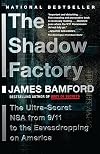
The Shadow Factory: The Ultra-Secret NSA from 9/11 to the Eavesdropping on America
by James Bamford
On This Page
Description
Journalist Bamford exposed the existence of the top-secret National Security Agency in The Puzzle Palace and continued to probe into its workings in his follow-up Body of Secrets. Now Bamford discloses inside, often shocking information about the transformation of the NSA in the aftermath of the terrorist attacks of 2001. He shows how the NSA's failure to detect the presence of two of the 9/11 hijackers inside the United States led the NSA to abandon its long-held policy of spying only on show more enemies outside the country. Instead, after 9/11 it turned its almost limitless ability to listen in on friend and foe alike over to the Bush Administration to use as a weapon in the war on terror. Bamford details how the agency has conducted domestic surveillance without court approval, and he frames it in the context of the NSA's ongoing hunt for information about today's elusive enemies.--From publisher description. show lessTags
Recommendations

























Member Recommendations

Member Reviews
From the very first page this account rips out of the starting gate like a bull at a rodeo with the story of terrorist surveillance leading up to 9/11. Using FBI reports obtained through the Freedom of Information Act and other sources, if fills in a hugely important part of the story completely missing from the 9/11 Commission report -- the NSA part.
After that, every chapter builds on the prior and brings a certain amount of logical understanding to how things got to this point. It's painful to read but not because it isn't well written. It's so well written that you're not thinking about the words, you're watching the replay, and seeing why things played out like they did. And that's what hurts. But if we are only as sick as our show more secrets, books like this are an important part of getting better.
For anyone else who lived through this period and tried to make sense of the bits and pieces of information we were getting at the time, this book fills in a lot of the blanks. Hindsight and all that...
This is an old book by now. So much so, I purchased my well-worn copy after it was taken out of circulation by the Brooklyn Public Library and sold to raise funds for newer books, which made it all the more meaningful to me. Thank you, Brooklyn. I dedicate this to you, and everyone in your calling circles. ❤️ show less
After that, every chapter builds on the prior and brings a certain amount of logical understanding to how things got to this point. It's painful to read but not because it isn't well written. It's so well written that you're not thinking about the words, you're watching the replay, and seeing why things played out like they did. And that's what hurts. But if we are only as sick as our show more secrets, books like this are an important part of getting better.
For anyone else who lived through this period and tried to make sense of the bits and pieces of information we were getting at the time, this book fills in a lot of the blanks. Hindsight and all that...
This is an old book by now. So much so, I purchased my well-worn copy after it was taken out of circulation by the Brooklyn Public Library and sold to raise funds for newer books, which made it all the more meaningful to me. Thank you, Brooklyn. I dedicate this to you, and everyone in your calling circles. ❤️ show less
Intelligence journalism is an odd trade, writing on people who would prefer to keep everything classified forever. And this book from 2008, prior to Edward Snowden's revelations, is very much a peace of history, that while dated is still worth reading.
Bamford tracks three major threads. The first is the absolute failure of the NSA to connect the dots on 9/11. Various parts of the US intelligence apparatus knew something was coming, but despite copious intercepts, they were unable to figure out that these terrorists were inside the United States and communicating with an Al Qaeda safehouse in Yemen. Most startling to me was how Tom Wilshire, a CIA liaison to the FBI, halted alerts on the 9/11 plots several times in the months prior.
The show more planes hit the towers, and the NSA went to war. This is the second thread, an effort spearheaded by the Bush administration and Dick Cheney to void legal protections against arbitrary wiretapping that had been set up in the 70s. The careful charade of FISA warrants was cast aside in terms of national security letters and persons of interest. Now the NSA could listen in for almost any reason, justified retroactively. Thousands of rapidly surged analysts and translators spent hours a day in complexes in Georgia, listening to every phone call in Iraq. The first Bush-Cheney system almost went down due to the surprising resistance of a senior FBI agent named James Comey (famous later for other reason), but a Democratic congress eventually passed a national security wishlist, for fear of looking weak on terrorism.
The third challenge is technical. The NSA's job used to be very easy when signals moved over radio or electrical cables. With the internet and fiber optic boom in the 90s, what the NSA could eavesdrop on fell precipitously, until they invested in a series of expensive public-private partnerships to design high capacity splitters and place them in major internet nodes, essentially suctioning everything transmitted across the internet into a shadow realm of NSA data centers for analysis. The NSA was big data before big data was hip. But the NSA was drowning in data, unable to turn even an infinitesimal bit of into actionable intelligence. This is where a host of Orwellian programs to develop a digital analyst come into play: Trailblazer, Turbulence, Total Information Awareness. But America's cyber spooks were hamstrung by more mundane concerns. When the book was written, the master 'No Fly' list was kept on an Oracle database, and due to interoperability problems, names had to be printed off and retyped on secondary systems. I've worked with some janky software, but nothing that bad.
The pieces of information in this book are fascinating, if obsolete, but where this book falls short is in analysis. The NSA is tremendously expensive, a multibillion dollar agency with deep pockets. Yet it's hard to point to successes, terrorist plots stopped and lives saved. Similarly, the ability of the NSA to listen in on everybody is a shotgun pointed at the head of American democracy, but the harms also seem pretty theoretical. This is 2020, we ask our wiretaps for pancake recipes, take selfies in front of blazing police cars, and run for political office while espousing conspiracy gibberish about satanic cabals of child murderers. What could the NSA do that isn't "seen it already?".
Don't answer that. I've read Stross' The Laundry series. show less
Bamford tracks three major threads. The first is the absolute failure of the NSA to connect the dots on 9/11. Various parts of the US intelligence apparatus knew something was coming, but despite copious intercepts, they were unable to figure out that these terrorists were inside the United States and communicating with an Al Qaeda safehouse in Yemen. Most startling to me was how Tom Wilshire, a CIA liaison to the FBI, halted alerts on the 9/11 plots several times in the months prior.
The show more planes hit the towers, and the NSA went to war. This is the second thread, an effort spearheaded by the Bush administration and Dick Cheney to void legal protections against arbitrary wiretapping that had been set up in the 70s. The careful charade of FISA warrants was cast aside in terms of national security letters and persons of interest. Now the NSA could listen in for almost any reason, justified retroactively. Thousands of rapidly surged analysts and translators spent hours a day in complexes in Georgia, listening to every phone call in Iraq. The first Bush-Cheney system almost went down due to the surprising resistance of a senior FBI agent named James Comey (famous later for other reason), but a Democratic congress eventually passed a national security wishlist, for fear of looking weak on terrorism.
The third challenge is technical. The NSA's job used to be very easy when signals moved over radio or electrical cables. With the internet and fiber optic boom in the 90s, what the NSA could eavesdrop on fell precipitously, until they invested in a series of expensive public-private partnerships to design high capacity splitters and place them in major internet nodes, essentially suctioning everything transmitted across the internet into a shadow realm of NSA data centers for analysis. The NSA was big data before big data was hip. But the NSA was drowning in data, unable to turn even an infinitesimal bit of into actionable intelligence. This is where a host of Orwellian programs to develop a digital analyst come into play: Trailblazer, Turbulence, Total Information Awareness. But America's cyber spooks were hamstrung by more mundane concerns. When the book was written, the master 'No Fly' list was kept on an Oracle database, and due to interoperability problems, names had to be printed off and retyped on secondary systems. I've worked with some janky software, but nothing that bad.
The pieces of information in this book are fascinating, if obsolete, but where this book falls short is in analysis. The NSA is tremendously expensive, a multibillion dollar agency with deep pockets. Yet it's hard to point to successes, terrorist plots stopped and lives saved. Similarly, the ability of the NSA to listen in on everybody is a shotgun pointed at the head of American democracy, but the harms also seem pretty theoretical. This is 2020, we ask our wiretaps for pancake recipes, take selfies in front of blazing police cars, and run for political office while espousing conspiracy gibberish about satanic cabals of child murderers. What could the NSA do that isn't "seen it already?".
Don't answer that. I've read Stross' The Laundry series. show less
A great account of the NSA (and the overall technical signals surveillance ecosystem, including other agencies and private companies). The one big missing area was TAO and some of the offensive cyber private contractors (covered somewhat, but not in depth).
By far the best is the account of the 9/11 hijacking, the NSA/CIA/FBI role in collecting and fucking that up, and then pushing for broad powers in response to their own failures, when extant law and systems would have been fine if properly applied at the time.
Michael Hayden comes off as possibly the worst possible NSA Director — he was too cautious in applying powers, due to legitimate fear of the Church committee and backlash against spying, but in being overly cautious he actually show more approved programs which were both less effective and more invasive (trailblazer vs thinthread). I wouldn’t judge anyone harshly for merely selecting a different point on the privacy/security efficient frontier, and sliding to the security side after 9/11, but he consistently picked choices far off the frontier. And after 9/11 they clearly overcorrected and went way overboard on claiming authority to do things (without legislative or judicial approval) for Cheney-driven reasons about asserting executive power, too, even when explicit authorization by Congress would have been both better and easier.
Also amazing the degree to which bureaucracy, politics, and just general incompetence limited access to collections (and resulting product) in places like Baghdad.
(One book I’d love to read is an account of Special Collection Service and NSA field ops, along with ISA/Orange, but that book probably would never be written.) show less
By far the best is the account of the 9/11 hijacking, the NSA/CIA/FBI role in collecting and fucking that up, and then pushing for broad powers in response to their own failures, when extant law and systems would have been fine if properly applied at the time.
Michael Hayden comes off as possibly the worst possible NSA Director — he was too cautious in applying powers, due to legitimate fear of the Church committee and backlash against spying, but in being overly cautious he actually show more approved programs which were both less effective and more invasive (trailblazer vs thinthread). I wouldn’t judge anyone harshly for merely selecting a different point on the privacy/security efficient frontier, and sliding to the security side after 9/11, but he consistently picked choices far off the frontier. And after 9/11 they clearly overcorrected and went way overboard on claiming authority to do things (without legislative or judicial approval) for Cheney-driven reasons about asserting executive power, too, even when explicit authorization by Congress would have been both better and easier.
Also amazing the degree to which bureaucracy, politics, and just general incompetence limited access to collections (and resulting product) in places like Baghdad.
(One book I’d love to read is an account of Special Collection Service and NSA field ops, along with ISA/Orange, but that book probably would never be written.) show less
Bamford has made a career of writing about the NSA. In this volume he recounts the events of 9/11 from the NSA's viewpoint, showing how they screwed up, refused to acknowledge it, and proceeded to ask for -- and get, tons of money to increase their surveillance capabilities. As he tells it, with the cooperation of the telcoms, the NSA now simply copies the Internet globally and mines the data. And who are the corporations who help it? Israeli companies founded by and staffed by former Israeli intelligence operatives or administrators.
Recent events about Snowden's revelations are old news in light of this 2008 book. What is clear is that the NSA is out of control, and the federal government does not want the NSA to be reigned in. Let's show more hope Congress will. show less
Recent events about Snowden's revelations are old news in light of this 2008 book. What is clear is that the NSA is out of control, and the federal government does not want the NSA to be reigned in. Let's show more hope Congress will. show less
I thought it was prudent to read this well-resarched, detailed NSA revelation/expose in our post-Snowden, post-Patriot Act world. There seems to be a real pattern of war and violence leading to overly invasive wiretapping with at pendulum pushed back and tragedies and malfeasance happening in both cases: American shamed, terorrists undetected, etc. This work lays out the government spying that led to the FISA firewall and how Bush's "warrantless wiretapping" basically took the teeth out of that, all tracking back to Michael Hayden. Lots of the tech is here including the immense power costs required for this type of computing and the geographical solutions to this, the Hawaii station I imagine Snowden was at, and the Israeli locus for show more spying technological development. show less
It is a very interesting history of the NSA from pre 9/11 through 2007. He portrays Michael Hayden as power-hungry and somewhat incompetent. The power of the NSA is rather frightening, and somewhat comforting, when threats abound.
I expected this to have had been made obsolete by (now not so) recent findings but was surprised how much was already widely known even then. Somehow that's not how I remembered it but there it is. Even the book makes comparisons with older scandals - this is a never-ending cycle. All of it seems laughably tame compared to the current situation. Well written, well researched book, still worth a read.
Members
- Recently Added By
Author Information

7+ Works 3,318 Members
Awards and Honors
Awards
Distinctions
Work Relationships
Classifications
- Genres
- Nonfiction, Politics and Government, General Nonfiction, History
- DDC/MDS
- 327.1273 — Society, government, & culture Political science International Relations: Spies Foreign policy and specific topics in international relations Espionage and subversion North America United States
- LCC
- UB256 .U6 .B38 — Military Science Military administration Military administration Intelligence
- BISAC
Statistics
- Members
- 556
- Popularity
- 53,210
- Reviews
- 15
- Rating
- (3.73)
- Languages
- English
- Media
- Paper, Audiobook, Ebook
- ISBNs
- 6
- ASINs
- 6