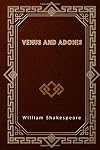
Venus and Adonis
by William Shakespeare
On This Page
Description
In one of William Shakespeare's most popular poems, Venus spies the young and beautiful Adonis as he prepares for a hunt. She passionately kisses and attempts to seduce him, but Adonis is young and more interested in his hunt, and so he leaves Venus, only to find his own tragic end. Known as "The Bard of Avon," William Shakespeare is arguably the greatest English-language writer known. Enormously popular during his life, Shakespeare's works continue to resonate more than three centuries show more after his death, as has his influence on theatre and literature. Shakespeare's innovative use of character, language, and experimentation with romance as tragedy served as a foundation for later playwrights and dramatists, and some of his most famous lines of dialogue have become part of everyday speech. HarperPerennial Classics brings great works of literature to life in digital format, upholding the highest standards in ebook production and celebrating reading in all its forms. Look for more titles in the HarperPerennial Classics collection to build your digital library. show lessTags
Recommendations




























Member Reviews
Maybe it's just the ancient studies of that far-off teenage years that was calling out to me, but I had this insane urge to reread this classic poem of lust. It contrasts nicely with the recent romance novels that I've had the dubious enjoyment of reading. It's particularly nice to see a strong-headed woman who feels no issue with chasing after a man who would rather spear a boar than her. I wonder if Adonis was actually Scottish? Maybe West-Virginian? Alas, alak, would he rather swive a swine than appeal to Aphrodite? Wait. Am I talking about romance novels or Shakespeare? Damn... nothing is ever clear-cut.
According to Crispin Elsted, of the Barbarian Press, Venus & Adonis is one of two lengthy narrative poems written by Shakespeare early in his career, when plague forced the closure of the theatres and he took the opportunity to write something non-theatrical. This poem, The Rape of Lucrece, and probably the sonnets – or at least a good many of them – date from the early 1590s.
Having recently read Lysistrata, I was struck by the two different approaches taken by the women in these two books. In Lysistrata, the women refuse to have sex with the men until they end a senseless war (Hmmmm...are you reading this Mrs. Bush and Mrs. Cheney?); while in Venus & Adonis the heroine tries to keep Adonis from dangerous boar hunting with all that show more her love can offer. It worked for Lysistrata but not for Venus.
I love Shakespeare's use of natural imagery in the verse:
Fondling, she saith, since I have hemd thee here
Within the circuit of this ivorie pale,
Ile be a parke, and thou shalt be my deare:
Feed where thou wilt, on mountaine, or in dale;
Graze on my lips, and if those hils be drie,
Stray lower, where the pleasant fountaines lie.
As for this edition from Barbarian Press, it is out of this world. The illustrations by Andy English are absolutely beautiful. The setting and choice of type and the binding make the book a joy to hold and read. This was my first book from the Barbarian Press and I highly recommend a look by those interested in small private presses. The proprietor's are delightful and knowledgeable as well.
Venus & Adonis was shortlisted for the first Gregynog Prize for Letterpress Book Design, Oxford, 2005. show less
Having recently read Lysistrata, I was struck by the two different approaches taken by the women in these two books. In Lysistrata, the women refuse to have sex with the men until they end a senseless war (Hmmmm...are you reading this Mrs. Bush and Mrs. Cheney?); while in Venus & Adonis the heroine tries to keep Adonis from dangerous boar hunting with all that show more her love can offer. It worked for Lysistrata but not for Venus.
I love Shakespeare's use of natural imagery in the verse:
Fondling, she saith, since I have hemd thee here
Within the circuit of this ivorie pale,
Ile be a parke, and thou shalt be my deare:
Feed where thou wilt, on mountaine, or in dale;
Graze on my lips, and if those hils be drie,
Stray lower, where the pleasant fountaines lie.
As for this edition from Barbarian Press, it is out of this world. The illustrations by Andy English are absolutely beautiful. The setting and choice of type and the binding make the book a joy to hold and read. This was my first book from the Barbarian Press and I highly recommend a look by those interested in small private presses. The proprietor's are delightful and knowledgeable as well.
Venus & Adonis was shortlisted for the first Gregynog Prize for Letterpress Book Design, Oxford, 2005. show less
Good poem, dedicated to the Earl of Southampton. Shakespeare regarded it as his first publication, and that statement necessarily excluded his dramatic work. Th poem is not a retelling of any Greek or Roman work, but a love story using the names the readers would find common enough to set the matter of the poem firmly in their minds without descending to the gritty particulars. It was quite popular during the playwright's lifetime. It bears up well under rereading.
Try as she might, the Lusty Venus doesn't succeed in seducing Adonis. Unfortunately for her, he's more interested in hunting boars which proves to be his downfall.
One of Shakespeare's narrative poems. It's been about a year and a half since I read it, but I remember really enjoying it at the time. It's beautifully written. One thing I found entertaining was the fact that Venus was so lustful and domineering over Adonis. I would definitely recommend this to anyone who enjoys Shakespeare's plays.
poetry of love and lust
Ratings
Members
- Recently Added By
Lists

Favorite Literary Love Stories
182 works; 100 members
Author Information

6,186+ Works 444,779 Members
William Shakespeare, 1564 - 1616 Although there are many myths and mysteries surrounding William Shakespeare, a great deal is actually known about his life. He was born in Stratford-Upon-Avon, son of John Shakespeare, a prosperous merchant and local politician and Mary Arden, who had the wealth to send their oldest son to Stratford Grammar School. show more At 18, Shakespeare married Anne Hathaway, the 27-year-old daughter of a local farmer, and they had their first daughter six months later. He probably developed an interest in theatre by watching plays performed by traveling players in Stratford while still in his youth. Some time before 1592, he left his family to take up residence in London, where he began acting and writing plays and poetry. By 1594 Shakespeare had become a member and part owner of an acting company called The Lord Chamberlain's Men, where he soon became the company's principal playwright. His plays enjoyed great popularity and high critical acclaim in the newly built Globe Theatre. It was through his popularity that the troupe gained the attention of the new king, James I, who appointed them the King's Players in 1603. Before retiring to Stratford in 1613, after the Globe burned down, he wrote more than three dozen plays (that we are sure of) and more than 150 sonnets. He was celebrated by Ben Jonson, one of the leading playwrights of the day, as a writer who would be "not for an age, but for all time," a prediction that has proved to be true. Today, Shakespeare towers over all other English writers and has few rivals in any language. His genius and creativity continue to astound scholars, and his plays continue to delight audiences. Many have served as the basis for operas, ballets, musical compositions, and films. While Jonson and other writers labored over their plays, Shakespeare seems to have had the ability to turn out work of exceptionally high caliber at an amazing speed. At the height of his career, he wrote an average of two plays a year as well as dozens of poems, songs, and possibly even verses for tombstones and heraldic shields, all while he continued to act in the plays performed by the Lord Chamberlain's Men. This staggering output is even more impressive when one considers its variety. Except for the English history plays, he never wrote the same kind of play twice. He seems to have had a good deal of fun in trying his hand at every kind of play. Shakespeare wrote 154 sonnets, all published on 1609, most of which were dedicated to his patron Henry Wriothsley, The Earl of Southhampton. He also wrote 13 comedies, 13 histories, 6 tragedies, and 4 tragecomedies. He died at Stratford-upon-Avon April 23, 1616, and was buried two days later on the grounds of Holy Trinity Church in Stratford. His cause of death was unknown, but it is surmised that he knew he was dying. (Bowker Author Biography) show less
Some Editions
Awards and Honors
Awards
Series
Belongs to Publisher Series
Work Relationships
Is contained in
The Works of William Shakespeare: The Henry Irving Shakespeare: Volume 14: Sonnets and Poems, Shakespeare-land by William Shakespeare (indirect)
Was inspired by
Has as a student's study guide
Common Knowledge
- Canonical title
- Venus and Adonis
- Original publication date
- 1593
- People/Characters
- Venus; Adonis
- Important places
- Ancient Greece
- Important events
- Classical Antiquity
- Dedication
- to Tonia, who showed me another side of love
- First words
- Even as the sun with purple-colored face
Had taken his last leave of the weeping morn,
Rose-cheeked Adonis tried him to the chase.
Hunting he loved, but love—he laughed to scorn;
Sick-thoughted Venus makes amain... (show all) unto him,
And like a bold-faced suitor begins to woo him. - Quotations
- Here I prophesy,
Sorrow on love hereafter shall attend.
It shall be waited on with jealousy,
Find sweet beginning, but unsavory end;
Never settled equally, but high or low;
That all love’s pleasure shall not ... (show all)match his woe.
O strange excuse!
When reason is the bawd to lust’s abuse.
O! you did kill me; kill me once again. - Last words
- (Click to show. Warning: May contain spoilers.)Thus weary of the world, away she hies,
And yokes her silver doves; by whose swift aid
Their mistress, mounted, through the empty skies
In her light chariot quickly is conveyed;
Holding their course to Paphos, where their queen
Means to immure herself and not be seen.
Classifications
Statistics
- Members
- 280
- Popularity
- 115,766
- Reviews
- 6
- Rating
- (3.61)
- Languages
- 11 — Catalan, Chinese, Dutch, English, French, German, Italian, Multiple languages, Norwegian, Portuguese, Spanish
- Media
- Paper, Audiobook, Ebook
- ISBNs
- 58
- ASINs
- 20