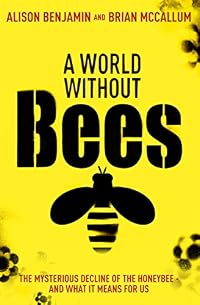
A World Without Bees
by Alison Benjamin, Brian McCallum
On This Page
Description
Writers and beekeepers Benjamin and McCallum have traveled across Europe and North America investigating the plight of the honeybee, which is disappearing across the globe at an alarming rate, addressing different causes for this growing catastrophe (dubbed colony collapse disorder or CCD), including viruses, parasites, pesticides, climate change, and the demands of commercial beekeeping.Tags
Recommendations















Member Reviews
Bees being the crucial pollinators to half of the plants on the planet, it's easy to guess the sad disaster that would ensues should they go extinct - from our food industry to clothing, and, even, the pharmaceutical industry. Well, starting in 2006 (though the authors report similar cases, even at local scales only, going as far back as the 19th century) honeybees seem to be doing just that: going extinct. It's on the back cover:
-In America, one in three hives was left lifeless at the beginning of 2008;
-In France, the death rate was more than 60%;
-In Britain, a government minister warned that honeybees could be extinct within a decade.
Colony Collapse Disorders (CCD), whereas entire hives are mysteriously left empty (bees just show more vanishing, or left dead) is indeed a truly worrying phenomenon. What cause it?
The authors are a couple -she is a journalist, he is a geography teacher, both are amateur beekeepers. Their book is therefore very accessible, but read more like a reportage than a thorough scientific essay. Some will find this is its strength, others its weakness. I, for one, just wanted an overview of the issue, so I found it very engrossing and educative.
They start by describing bees from an entomologist perspective - their biology, their behaviour, the importance of natural selection in their survival. It's fascinating (gosh! such amazing little creatures!). It is, above all, a massive eye-opener when it comes to show how, by messing up with nature, we are responsible for their dying out:
'the selection process practised by commercial beekeepers has traditionally tried to produce bees that are docile, for the amateur beekeeper, and productive, for the honey producer, and build up rapidly in the spring to exploit early honey flow, for the commercial pollinator. This has unavoidably led to a reduction of genetic diversity... By breeding a gentle, efficient honey-maker, we have made bees much more susceptible to disease than they would be if natural selection had played a role.'
It's not only genetic diversity which was swept for demands (the more genetic diversity the fittest). It's also the stress coming with a industrial handling of bees which, beyond honey (they particularly focus on the almond industry in the USA) are bumped-trucked around for thousand of miles, with no respect whatsoever for their natural cycles; a treatment that can only weaken them even more when not contributing to the spread of more diseases. Here's the thing: fragile and equipped with a poor immune system, no wonder bees are succumbing to a wild array of parasites, virus, fungi...
To prevent that, pesticides may of course appear as the easy answer; yet they also are an easy target and root of the problem. The authors are not patronising. They actually perfectly recognise the catch-22 side of the situation:
'...don't use chemical and risk seeing your bees dying of varroa infestation (which has claimed more colonies across the world than CCD); do use them and risk the chemical build-up damaging the bees in the long-term.'
There is indeed no easy answer, and this is why this book is so engrossing: it leaves you racking your brain as much as the authors, and the people involved in the field. France, after all, banned Gaucho - with no effect whatsoever on the situation. And, if some are quick to point to GMO crops (eg a specific variety of corn, supposedly source of a toxic fungi for bees) the evidence doesn't support such claims.
So there we are. Here's an accessible book on an intricate issue, reading like watching a documentary, and, if it doesn't bring clear-cut answers to the question it asks (what is behind bees dying out?) it will, at least, bring to the fore an extremely important argument: it's never a good idea to mess up with natural cycle of our fellow creatures (no matter how tiny) as, respecting biodiversity is more than enjoying nature's beauty - it's the world as we know it which is at stake. An important read. show less
-In America, one in three hives was left lifeless at the beginning of 2008;
-In France, the death rate was more than 60%;
-In Britain, a government minister warned that honeybees could be extinct within a decade.
Colony Collapse Disorders (CCD), whereas entire hives are mysteriously left empty (bees just show more vanishing, or left dead) is indeed a truly worrying phenomenon. What cause it?
The authors are a couple -she is a journalist, he is a geography teacher, both are amateur beekeepers. Their book is therefore very accessible, but read more like a reportage than a thorough scientific essay. Some will find this is its strength, others its weakness. I, for one, just wanted an overview of the issue, so I found it very engrossing and educative.
They start by describing bees from an entomologist perspective - their biology, their behaviour, the importance of natural selection in their survival. It's fascinating (gosh! such amazing little creatures!). It is, above all, a massive eye-opener when it comes to show how, by messing up with nature, we are responsible for their dying out:
'the selection process practised by commercial beekeepers has traditionally tried to produce bees that are docile, for the amateur beekeeper, and productive, for the honey producer, and build up rapidly in the spring to exploit early honey flow, for the commercial pollinator. This has unavoidably led to a reduction of genetic diversity... By breeding a gentle, efficient honey-maker, we have made bees much more susceptible to disease than they would be if natural selection had played a role.'
It's not only genetic diversity which was swept for demands (the more genetic diversity the fittest). It's also the stress coming with a industrial handling of bees which, beyond honey (they particularly focus on the almond industry in the USA) are bumped-trucked around for thousand of miles, with no respect whatsoever for their natural cycles; a treatment that can only weaken them even more when not contributing to the spread of more diseases. Here's the thing: fragile and equipped with a poor immune system, no wonder bees are succumbing to a wild array of parasites, virus, fungi...
To prevent that, pesticides may of course appear as the easy answer; yet they also are an easy target and root of the problem. The authors are not patronising. They actually perfectly recognise the catch-22 side of the situation:
'...don't use chemical and risk seeing your bees dying of varroa infestation (which has claimed more colonies across the world than CCD); do use them and risk the chemical build-up damaging the bees in the long-term.'
There is indeed no easy answer, and this is why this book is so engrossing: it leaves you racking your brain as much as the authors, and the people involved in the field. France, after all, banned Gaucho - with no effect whatsoever on the situation. And, if some are quick to point to GMO crops (eg a specific variety of corn, supposedly source of a toxic fungi for bees) the evidence doesn't support such claims.
So there we are. Here's an accessible book on an intricate issue, reading like watching a documentary, and, if it doesn't bring clear-cut answers to the question it asks (what is behind bees dying out?) it will, at least, bring to the fore an extremely important argument: it's never a good idea to mess up with natural cycle of our fellow creatures (no matter how tiny) as, respecting biodiversity is more than enjoying nature's beauty - it's the world as we know it which is at stake. An important read. show less
An interesting look at Colony Collapse Disorder and many of the possible causes. I was amused to learn that honeybees are actually not indigenous to North America. Honeybees suffer some terrible conditions and I would argue that they are essentially factory farmed. If anything, this book made me even firmer in my organic, anti-monoculture leanings. Treating insects like machines to do our bidding in factory like, unnatural settings is obviously not sustainable.
A World Without Bees is a fascinating and timely book exploring the possible reasons behind the massive decline of the western honeybee over recent years. Every spring beekeepers are opening their overwintered hives and finding that a huge percentage of them have only the queen and a handful of dead bees left inside. Where have the rest of the bees gone – and what is causing this mass destruction, now known as ‘Colony Collapse Disorder’ or CCD?
Benjamin and McCallum, amateur beekeepers with a keen interest in their charges, take the reader on a whistle-stop tour of the potential offenders and key theories in the CCD mystery, offering up a devastating menu of the ways in which humanity is slowly destroying one of the most important show more creatures on the planet. They also offer a comprehensive look at bee viruses, pests and pathogens that could be contributing to their downfall, and the ways in which beekeepers and scientists are attempting to fight back. Without honeybees, agriculture would collapse, and many of the foods and other natural products that we take for granted, including fruits and vegetables, meat, dairy products and cotton, would become far harder to produce and thus much more rare and expensive. And yet we continue to bombard our master pollinators with pesticides and fungicides, truck them long distances throughout the year, and work them harder than ever before, thus denying them the proper nutrition, time to rest and strength to fight off disease that they need to survive.
This is definitely an important book, and well worth reading. It’s very accessible, though occasionally repetitive, and gives a good overview of the current bee populations, issues and research from various countries across the globe. There is a note of hope by the end - that all is not lost and that the honeybee can be saved - but I would have liked to have seen a more extensive account of what the world would be like without honeybee products and pollination services (it is the title of the book, after all) and a longer section on the most up-to-date research, potential solutions and ways to help. Most of these are covered very quickly at the end, in a kind of updated add-on to the first edition, which felt a bit rushed and not particularly satisfying. But hey, read it anyway; it’s a big issue and not one that most people probably think about all that much. Our bees deserve better! show less
Benjamin and McCallum, amateur beekeepers with a keen interest in their charges, take the reader on a whistle-stop tour of the potential offenders and key theories in the CCD mystery, offering up a devastating menu of the ways in which humanity is slowly destroying one of the most important show more creatures on the planet. They also offer a comprehensive look at bee viruses, pests and pathogens that could be contributing to their downfall, and the ways in which beekeepers and scientists are attempting to fight back. Without honeybees, agriculture would collapse, and many of the foods and other natural products that we take for granted, including fruits and vegetables, meat, dairy products and cotton, would become far harder to produce and thus much more rare and expensive. And yet we continue to bombard our master pollinators with pesticides and fungicides, truck them long distances throughout the year, and work them harder than ever before, thus denying them the proper nutrition, time to rest and strength to fight off disease that they need to survive.
This is definitely an important book, and well worth reading. It’s very accessible, though occasionally repetitive, and gives a good overview of the current bee populations, issues and research from various countries across the globe. There is a note of hope by the end - that all is not lost and that the honeybee can be saved - but I would have liked to have seen a more extensive account of what the world would be like without honeybee products and pollination services (it is the title of the book, after all) and a longer section on the most up-to-date research, potential solutions and ways to help. Most of these are covered very quickly at the end, in a kind of updated add-on to the first edition, which felt a bit rushed and not particularly satisfying. But hey, read it anyway; it’s a big issue and not one that most people probably think about all that much. Our bees deserve better! show less
Fills in a lot of the technical details not covered in all of the film documentaries about Colony Collapse Disorder. I wonder if there is a counterpart publication which picked up and carried the ball forward to the present.
Even handed towards all data.
Even handed towards all data.
Book written in 2008 by 2 British amateur beekeepers about Colony Collapse Disorder, why bees have been disappearing, pesticide poisoning, GM foods, EU pesticide regulations
Ratings
Members
- Recently Added By
Author Information

6 Works 280 Members
8 Works 279 Members
Common Knowledge
- Canonical title
- A World Without Bees
- Original publication date
- 2009
Classifications
Statistics
- Members
- 135
- Popularity
- 241,345
- Reviews
- 5
- Rating
- (3.57)
- Languages
- English, German
- Media
- Paper, Ebook
- ISBNs
- 6
- ASINs
- 5