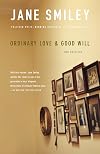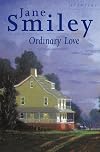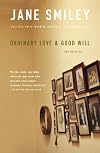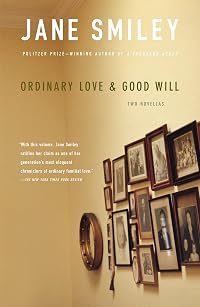
Ordinary Love and Good Will
by Jane Smiley
On This Page
Description
These exquisite twin novellas chronicle the difficult choices that reshape the lives of two very different families. In Ordinary Love, Smiley focuses on a woman's infidelity and the lasting, indelible effects it leaves on her children long after her departure. Good Will portrays a father who realizes how his son has been affected by his decision to lead a counterculture life and move his family to a farm. As both stories unfold, Smiley gracefully raises the questions that confront all show more families with the characteristic style and insight that has marked all of her work. show lessTags
Recommendations









Member Reviews
Hace muy poco descubrí a Jane Smiley con La edad del desconsuelo y me gustó mucho, sobretodo porque la voz narrativa era la de un papá totalmente comprometido con la crianza compartida (personaje masculino creíble) y por eso, en cuanto vi disponible “Un Amor Cualquiera”, no dudé en leerlo.
Me gustó todavía más este libro. También es una novela corta sobre una familia: la vemos un fin de semana, escuchamos sus conversaciones, cómo se relacionan, participamos en sus encuentros, memorias, nostalgias y pronto también, en sus heridas.
El papá Kinsella, en un arranque de reproche, odio y violencia, vendió la casa y se llevó a los 5 hijos al extranjero sin avisarle a Rachel, la madre. Ella pensó que los había perdido para show more siempre y que nunca podría recuperarse de ese dolor, de sus culpas, etc. Pero 20 años después, sus hijos ya adultos, están cerca de ella y cada uno a su manera han ido creciendo y adaptándose al mundo; sin embargo, también ya tienen oídos y ojos adultos para compartirse mutuamente confesiones sobre lo que aquella ruptura dejó en ellos y dejarle ver cosas que ella se perdió.
Una novela de amores comunes y corrientes, de errores, desamores y de las huellas que todo esto, deja en nuestras vidas. Sin darte cuenta siquiera, vives con ellos sus dolores, ves cómo han cicatrizado las heridas y te vuelves parte de la familia❣️
*Le he dado a mis hijos los dos regalos más crueles: la experiencia de una felicidad familiar perfecta y la absoluta certeza de que tarde o temprano se acaba.
*Tengo 52 años, que es la edad en la que, al parecer, tus hijos y los amigos de tus hijos de pronto quieren usurpar toda la sabiduría y experiencia que, en su día, no creyeron que tuvieras...
*Tiene Lo mismo que podría haber conseguido con una inteligencia normal y corriente: 2 esposas, 9 hijos y la sensación de que falta algo...
*Siempre que la gente se va, es como si algo se desprendiese de ti. show less
Novellas are almost a lost art these days - authors either go for the longer form and end up writing novels or stay on the shorter format and stay in the short stories realm. So when I saw a book with two novellas and the description did not sound half bad, I had to get it.
Jane Smiley is a new author for me and her plain prose takes a little while to get used to. But once you get into the story, it starts working a lot better (even if some passages were almost making me stop reading). But don't expect any action in any of the stories - there is plot in both but they are more portrayals of the families than real plot driven stories - the family descriptions and dynamics are much more important than anything that really happens
Ordinary show more Love opens the slim volume with the story of a woman that had an affair 20 years earlier and that ruined her family - the husband took the 5 kinds to England, the lover did not stay either. Now one of the her children lives with her, another lives close by, a third is coming back from 2 years in India (and he just happens to be a twin of the first one) and the other 2 seem to be calling all the time. Using the returning son, we get a glimpse of the family; using the mother as a narrator we get the back-story. And when you don't expect to learn more, some conversations shift to the past present and the real story of the days past comes crashing - everyone keeps secrets and some of them are hard enough. It's a story about choices and consequences - and as such it works. It was readable and I wanted to see where it goes and it actually did not just end as so many of those stories.
The second novella, Good Will, is about a family again - but it could not have been more different. Years ago the narrator and his wife had decided to forget about the present and to move to the country and live a simple life - no electricity, no cars, no civilization. Having a child and bringing it up in that environment seems to be a great choice - until the differences start showing up and their nice world is almost shattered by the kid's actions. The story has a framing sequences - the book writer that interviews the family at the beginning and the book that the family reads at the end - and between the interview and the book publishing is the whole agony of the changes.
The summary of that story is given by one of the counselors toward the end of the novella - the son is so used to being the different one that when someone more different comes to school, he acts as any boy. And because he lacks the civilization norms that we all grow up with, the reaction is violent. But in the process he also learns that you can be different in a lot of ways... and he start longing for things he could never have; things that any other kid has. The end of the novella is heartbreaking and can be seen in two ways - either as the society winning over the small man or as yet another proof of the fact that the man is a social animal and needs society. Any of the ways would be right.... and any of them on its own will be wrong.
And after finishing the book, i realized that I liked it a lot more than I expected. It is not my usual type of reading and I found some of the prose to be heavy going... but I liked it. I should probably check some of the other works by the author. show less
Jane Smiley is a new author for me and her plain prose takes a little while to get used to. But once you get into the story, it starts working a lot better (even if some passages were almost making me stop reading). But don't expect any action in any of the stories - there is plot in both but they are more portrayals of the families than real plot driven stories - the family descriptions and dynamics are much more important than anything that really happens
Ordinary show more Love opens the slim volume with the story of a woman that had an affair 20 years earlier and that ruined her family - the husband took the 5 kinds to England, the lover did not stay either. Now one of the her children lives with her, another lives close by, a third is coming back from 2 years in India (and he just happens to be a twin of the first one) and the other 2 seem to be calling all the time. Using the returning son, we get a glimpse of the family; using the mother as a narrator we get the back-story. And when you don't expect to learn more, some conversations shift to the past present and the real story of the days past comes crashing - everyone keeps secrets and some of them are hard enough. It's a story about choices and consequences - and as such it works. It was readable and I wanted to see where it goes and it actually did not just end as so many of those stories.
The second novella, Good Will, is about a family again - but it could not have been more different. Years ago the narrator and his wife had decided to forget about the present and to move to the country and live a simple life - no electricity, no cars, no civilization. Having a child and bringing it up in that environment seems to be a great choice - until the differences start showing up and their nice world is almost shattered by the kid's actions. The story has a framing sequences - the book writer that interviews the family at the beginning and the book that the family reads at the end - and between the interview and the book publishing is the whole agony of the changes.
The summary of that story is given by one of the counselors toward the end of the novella - the son is so used to being the different one that when someone more different comes to school, he acts as any boy. And because he lacks the civilization norms that we all grow up with, the reaction is violent. But in the process he also learns that you can be different in a lot of ways... and he start longing for things he could never have; things that any other kid has. The end of the novella is heartbreaking and can be seen in two ways - either as the society winning over the small man or as yet another proof of the fact that the man is a social animal and needs society. Any of the ways would be right.... and any of them on its own will be wrong.
And after finishing the book, i realized that I liked it a lot more than I expected. It is not my usual type of reading and I found some of the prose to be heavy going... but I liked it. I should probably check some of the other works by the author. show less
The two novellas demonstrate the price children pay for their parents' mistakes.
Ordinary Love: The mother’s obsession over her children makes sense because she hasn’t seen them in years. But it reminded me a bit of my mom, always watching and analyzing what I’m doing, which is very annoying. Eventually though, her children come to respect her for leaving an overbearing husband and making it on her own. Smiley captures the nuances of a dysfunctional family - sometimes you like the characters, sometimes you don’t – and that’s how I felt about this story.
Good Will: Did not like this one. Although a desire to revert to a preindustrial era might have benefits, a total rejection of technology is ridiculous. The father's show more obsession to maintain an exaggeratedly simple, self-sufficient lifestyle proves to be especially ill advised, given the psychological problems that his son develops. The ending, returning to “modern” life, is anticlimactic in light of the chaos that his earlier choices created. All too reminiscent of the Luddites, but no longer feasible in this day and age. show less
Ordinary Love: The mother’s obsession over her children makes sense because she hasn’t seen them in years. But it reminded me a bit of my mom, always watching and analyzing what I’m doing, which is very annoying. Eventually though, her children come to respect her for leaving an overbearing husband and making it on her own. Smiley captures the nuances of a dysfunctional family - sometimes you like the characters, sometimes you don’t – and that’s how I felt about this story.
Good Will: Did not like this one. Although a desire to revert to a preindustrial era might have benefits, a total rejection of technology is ridiculous. The father's show more obsession to maintain an exaggeratedly simple, self-sufficient lifestyle proves to be especially ill advised, given the psychological problems that his son develops. The ending, returning to “modern” life, is anticlimactic in light of the chaos that his earlier choices created. All too reminiscent of the Luddites, but no longer feasible in this day and age. show less
I almost didn't read the part of this book that turned out to be my favorite. I didn't know what I was getting into, with this one. I thought the title was all one piece, and it wasn't until I started reading that I found it's actually two novellas, the first called Ordinary Love and the second, Good Will.
Ordinary Love just failed to catch my interest. It's written from the viewpoint of a mother of five grown children; two of her sons are twins. One is returning home from a recent trip to Korea. The others gather and lots of talk happens. Apparently there's quite a bit of discussion between them all about the parents' divorce. I really didn't get far enough to feel that out. I quit after about thirty pages. I just wasn't following what show more was going on or even which character was talking at one point. Not working for me.
That was going to be the end. But then I glanced at someone's review of the book on Library Thing and noticed it mentioned that Good Will was about a small family trying to run a self-sufficient homestead outside an ordinary suburban town. That sounded interesting to me. So I picked up the book again and read the second half, totally captivated. It's about a couple and their young son, who live on a farm. They grow or gather almost everything they eat, and barter for most belongings, make their own clothing and such. Hardly have twenty bucks between them all at any one time. The husband is good at carpentry and figuring things out, he makes all the furniture, builds the house, creates a fantastic compost system, etc. It's so impressive a writer comes out to interview them to be included in a book she's writing. This writer's presence eclipses the story; she's there at the beginning first learning about them, and at the end they receive the manuscript and shortly after the book to read what she's said about them- at the point when things are no longer the same. And it's not because their efforts failed, the couple were perfectly happy and content with their way of life, even though others viewed it as poverty. But the son, who went to public school and compared his life to other kids', was not as happy. Father and mother both viewed their son's actions from a divergent angle, and they each failed to realized what was going on until it was too late and they had to abandon their farm, because of the son's actions... I can't say more without saying too much. Read the story! It's good!
from the Dogear Diary show less
Ordinary Love just failed to catch my interest. It's written from the viewpoint of a mother of five grown children; two of her sons are twins. One is returning home from a recent trip to Korea. The others gather and lots of talk happens. Apparently there's quite a bit of discussion between them all about the parents' divorce. I really didn't get far enough to feel that out. I quit after about thirty pages. I just wasn't following what show more was going on or even which character was talking at one point. Not working for me.
That was going to be the end. But then I glanced at someone's review of the book on Library Thing and noticed it mentioned that Good Will was about a small family trying to run a self-sufficient homestead outside an ordinary suburban town. That sounded interesting to me. So I picked up the book again and read the second half, totally captivated. It's about a couple and their young son, who live on a farm. They grow or gather almost everything they eat, and barter for most belongings, make their own clothing and such. Hardly have twenty bucks between them all at any one time. The husband is good at carpentry and figuring things out, he makes all the furniture, builds the house, creates a fantastic compost system, etc. It's so impressive a writer comes out to interview them to be included in a book she's writing. This writer's presence eclipses the story; she's there at the beginning first learning about them, and at the end they receive the manuscript and shortly after the book to read what she's said about them- at the point when things are no longer the same. And it's not because their efforts failed, the couple were perfectly happy and content with their way of life, even though others viewed it as poverty. But the son, who went to public school and compared his life to other kids', was not as happy. Father and mother both viewed their son's actions from a divergent angle, and they each failed to realized what was going on until it was too late and they had to abandon their farm, because of the son's actions... I can't say more without saying too much. Read the story! It's good!
from the Dogear Diary show less
I have been blown away by both of the Smiley books I've read. I may have to make a point of reading everything she has written. This one is two novellas, one, a mother and grown children in Wisconsin coming to terms with the divorce that happened many years earlier. The second a couple with one son homesteading in rural Pennsylvania. Both are exceptional, but "Good Will" struck very close to home since we spent about 5 years trying to live the lifestyle described. Smiley has a great way of making me feel like I am living with her characters which helps to get me very involved with the story.
"Ordinary Love" is perhaps my favorite Jane Smiley. Well, maybe "favorite" isn't the word but an absolutely devastating story. Jane Smiley is so wise. I can feel the mother's pain, the ceaseless reverberations. I'm writing this many years after reading the book and "Good Will" didn't stick with me at all.
Two long short stories, or short novels, by Jane Smiley
This is the place to see how Jane Smiley crafts her fiction. Plain sentences. Grounded details. And waiting in the wings, horrible surprises, which the characters have earned through a long series of confident, well-meaning, subtly bad choices.
This is the place to see how Jane Smiley crafts her fiction. Plain sentences. Grounded details. And waiting in the wings, horrible surprises, which the characters have earned through a long series of confident, well-meaning, subtly bad choices.
Members
- Recently Added By
Lists

to get
244 works; 2 members
Author Information

50+ Works 25,543 Members
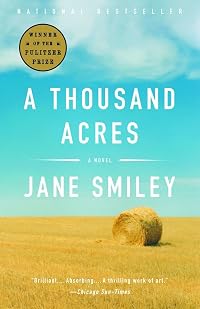
Jane Smiley was born in Los Angeles, California on September 26, 1949. She received a B. A. from Vassar College in 1971 and an M.F.A. and a Ph.D from the University of Iowa. From 1981 to 1996, she taught undergraduate and graduate creative writing workshops at Iowa State University. Her books include The Age of Grief, The Greenlanders, Moo, Horse show more Heaven, Ordinary Love and Good Will, Some Luck, and Early Warning. In 1985, she won an O. Henry Award for her short story Lily, which was published in The Atlantic Monthly. A Thousand Acres received both the National Book Critics Circle Award and the Pulitzer Prize. (Bowker Author Biography) show less
Awards and Honors
Classifications
Statistics
- Members
- 535
- Popularity
- 55,793
- Reviews
- 15
- Rating
- (3.73)
- Languages
- English, German, Spanish
- Media
- Paper, Audiobook, Ebook
- ISBNs
- 17
- ASINs
- 10