Quite Early One Morning
by Dylan Thomas
On This Page
Description
"In England and America Dylan Thomas made his art and personality widely known through public readings, radio broadcasts and recordings. Many of the 25 short stories, autobiographical sketches and essays in Quite Early One Morning, a volume planned by Thomas shortly before his death, were read by him on such occasions. They are alive with his verbal magic, his intense perception of life, his gargantuan humor and with the very ring of his voice."--Page 4 of coverTags
Recommendations


















Member Recommendations
Member Reviews
10/10
Quite early one morning in the winter in Wales, by the sea that was lying down still and green as grass after a night of tar-black howling and rolling, I went out of the house, where I had come to stay for a cold unseasonable holiday, to see if it was raining still, if the outhouse had been blown away, potatoes, shears, rat-killer, shrimpnets, and tins of rusty nails aloft on the wind, and if all the cliffs were left. It had been such a ferocious night that someone in the smoky ship-pictured bar had said he could feel his tombstone shaking even though he was not dead yet or, at least, was moving; but the morning shone as clear and calm as one always imagines tomorrow will shine.
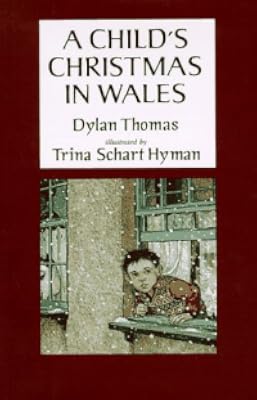
Quite possibly one of the best beginnings to any show more story; unless of course it's the beginning to [b:A Child's Christmas in Wales|563820|A Child's Christmas in Wales|Dylan Thomas|https://i.gr-assets.com/images/S/compressed.photo.goodreads.com/books/1348381389l/563820._SX50_.jpg|809138].
This is a perfect collection of Thomas's work, short stories and essays alike, that I've re-read often over the years, and that often coincides with my re-reading of [b:A Child's Christmas in Wales|563820|A Child's Christmas in Wales|Dylan Thomas|https://i.gr-assets.com/images/S/compressed.photo.goodreads.com/books/1348381389l/563820._SX50_.jpg|809138] at this season.
It brings such hope with it. Such boundless joy.
One of the best essays (tribute more than essay) that ever was written about Wilfred Owen lies hidden in the very heart of this volume; lies nestled in the core of it, to make its own statement as to what matters in life; what should matter most of all, are the words of a dead poet reaching out from beyond the grave. None has written it so eloquently as Owen; none has recognized it so viscerally as Thomas.
This is one slim volume in which I find myself again and again, time after time; where I find jewels hidden that once were lost; where, even after 25 years of reading, I find new meaning, new magic.
Not every story is a poem, but every thought is an act of poetry; some that are simply reminiscences, observations, commentary, on the more mundane aspects of literature become gush-worthy examinations of the most astute and biting:
And see too, in that linguacious stream, the tall monocled men, smelling of saddle soap and club armchairs, their breath a nice blending of whisky and fox's blood, with big protruding upper-class tusks and county mustaches, presumably invented in England and sent abroad to advertise "Punch", who lecture to women's clubs on such unlikely subjects as "The History of Etching in The Shetland Islands"; and the brassy-bossy men-women, with corrugated-iron perms, and hippo hides, who come, self-announced, as "ordinary British housewives", to talk to rich minked chunks of American matronhood about the iniquity of the Health Services, the criminal sloth of miners, the visible tail and horns of Mr. Aneurin Bevan, and the fear of everyone in England to go out alone at night because of the organised legions of coshboys against whom the police are powerless owing to the refusal of those in power to equip them with revolvers and to flog to ribbons every adolescent offender on any charge at all.
Such a superb collection which paints a perfect arc of Thomas's talent, magic, wisdom, life. show less
Quite early one morning in the winter in Wales, by the sea that was lying down still and green as grass after a night of tar-black howling and rolling, I went out of the house, where I had come to stay for a cold unseasonable holiday, to see if it was raining still, if the outhouse had been blown away, potatoes, shears, rat-killer, shrimpnets, and tins of rusty nails aloft on the wind, and if all the cliffs were left. It had been such a ferocious night that someone in the smoky ship-pictured bar had said he could feel his tombstone shaking even though he was not dead yet or, at least, was moving; but the morning shone as clear and calm as one always imagines tomorrow will shine.
Quite possibly one of the best beginnings to any show more story; unless of course it's the beginning to [b:A Child's Christmas in Wales|563820|A Child's Christmas in Wales|Dylan Thomas|https://i.gr-assets.com/images/S/compressed.photo.goodreads.com/books/1348381389l/563820._SX50_.jpg|809138].
This is a perfect collection of Thomas's work, short stories and essays alike, that I've re-read often over the years, and that often coincides with my re-reading of [b:A Child's Christmas in Wales|563820|A Child's Christmas in Wales|Dylan Thomas|https://i.gr-assets.com/images/S/compressed.photo.goodreads.com/books/1348381389l/563820._SX50_.jpg|809138] at this season.
It brings such hope with it. Such boundless joy.
One of the best essays (tribute more than essay) that ever was written about Wilfred Owen lies hidden in the very heart of this volume; lies nestled in the core of it, to make its own statement as to what matters in life; what should matter most of all, are the words of a dead poet reaching out from beyond the grave. None has written it so eloquently as Owen; none has recognized it so viscerally as Thomas.
This is one slim volume in which I find myself again and again, time after time; where I find jewels hidden that once were lost; where, even after 25 years of reading, I find new meaning, new magic.
Not every story is a poem, but every thought is an act of poetry; some that are simply reminiscences, observations, commentary, on the more mundane aspects of literature become gush-worthy examinations of the most astute and biting:
And see too, in that linguacious stream, the tall monocled men, smelling of saddle soap and club armchairs, their breath a nice blending of whisky and fox's blood, with big protruding upper-class tusks and county mustaches, presumably invented in England and sent abroad to advertise "Punch", who lecture to women's clubs on such unlikely subjects as "The History of Etching in The Shetland Islands"; and the brassy-bossy men-women, with corrugated-iron perms, and hippo hides, who come, self-announced, as "ordinary British housewives", to talk to rich minked chunks of American matronhood about the iniquity of the Health Services, the criminal sloth of miners, the visible tail and horns of Mr. Aneurin Bevan, and the fear of everyone in England to go out alone at night because of the organised legions of coshboys against whom the police are powerless owing to the refusal of those in power to equip them with revolvers and to flog to ribbons every adolescent offender on any charge at all.
Such a superb collection which paints a perfect arc of Thomas's talent, magic, wisdom, life. show less
Thomas's prose, like his poetry, requires, from me at least, immense concentration. Usually I don't have it. When, sometimes in the morning after two cups of coffee, I do find myself blessed with it, I am able to see, and feel, and appreciate why he's considered so great a poet. When I don't have that concentration available to me, his work is mostly frustrating.
Good writing. Sometimes becomes the Welsh equivalent of what he termed "Professional Irishmen: very leprecorny."
Droll humor and serious essays by a shortlived wordsmith in his prime.
A collection of stories by Dylan Thomas. I have owned and loved this book for more than fifty years. Acquired January, 1972 (Tenth Grade) at The Mountain School in Vershire, Vermont.
Ratings
Members
- Recently Added By
Author Information

274+ Works 15,823 Members
The most important Welsh poet of the twentieth century, Thomas was born in Swansea, about which he remembered unkindly "the smug darkness of a provincial town." He attended Swansea Grammar School but received his real education in the extensive library of his father, a disappointed schoolteacher with higher ambitions. Refusing university study in show more favor of immediately becoming a professional writer, Thomas worked first in Swansea and then in London at a variety of literary jobs, which included journalism and, eventually, filmscripts and radio plays. In 1936 he began the satisfying but stormy marriage to the bohemian writer and dancer Caitlin MacNamara that would endure for the rest of his career. His life fell into a pattern of oscillation between work and dissipation in London and recovery and relaxation in a rural retreat, usually in Wales. Thomas worked in a documentary film unit during the war. Besides his poetry, he wrote plays and fiction. In the early 1950s, he gave three celebrated poetry-reading tours of the United States, during which his outrageous behavior vied with his superb reading ability for public attention. Aggravated by chronic alcoholism, his health collapsed during the last tour, and he died in a New York City hospital. In his poetry, Thomas embraced an exuberant romanticism in the encounter between self and world and a joyous riot in the lushness of language. His work falls into three periods---an early "womb-tomb" phase during which he produced a notebook, which he later mined for further poems, a middle one troubled by marriage and war, and a final acceptance of the human condition. The exuberant rhetoric of his work belies an equally strong devotion to artistry, what he once called "my craft or sullen art." His great "Fern Hill," for example, builds its imagery of the rejoicing innocence of childhood on a strict and demanding syllabic count. A recollection of boyhood holidays on the farm of his aunt and uncle, that poem places its emotion within an Edenic framework typical of Thomas's work. The impressive sonnet sequence "Altarwise by Owl-Light" (1936) combines the internal quest of romanticism with a more elaborate religious outlook in tracing the birth and spiritual autobiography of a poet. Almost at the end of his career he produced the moving elegy "Do Not Go Gentle into That Good Night" (1952), written during the final illness of his father. Despite his periods of doubt and dissipation, Thomas celebrated the fullness of life. As he wrote in a note to his Collected Poems (1952), "These poems, with all their crudities, doubts, and confusion, are written for the love of Man and in praise of God, and I'd be a damn fool if they weren't." (Bowker Author Biography) show less
Series
Belongs to Publisher Series
Aldine paperback (no. 65)
Work Relationships
Contains
Common Knowledge
- Original publication date
- 1954
Classifications
- Genres
- Poetry, Fiction and Literature
- DDC/MDS
- 828.91 — Literature & rhetoric English & Old English literatures English miscellaneous writings English miscellaneous writings 1900- English miscellaneous writings 1900-1999
- LCC
- PR6039 .H52 .A6 — Language and Literature English English Literature 1900-1960
- BISAC
Statistics
- Members
- 548
- Popularity
- 54,233
- Reviews
- 5
- Rating
- (4.08)
- Languages
- Czech, English, German, Italian
- Media
- Paper, Audiobook
- ISBNs
- 12
- ASINs
- 21