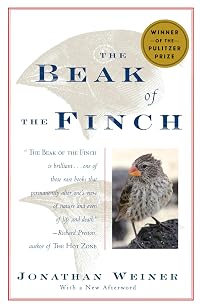
The Beak of the Finch: A Story of Evolution in Our Time
by Jonathan Weiner
On This Page
Description
On a desert island in the heart of the Galapagos archipelago, where Darwin received his first inklings of the theory of evolution, two scientists, Peter and Rosemary Grant, have spent twenty years proving that Darwin did not know the strength of his own theory. For among the finches of Daphne Major, natural selection is neither rare nor slow: it is taking place by the hour, and we can watch. In this dramatic story of groundbreaking scientific research, Jonathan Weiner follows these show more scientists as they watch Darwin's finches and come up with a new understanding of life itself.--From publisher description. show lessTags
Recommendations






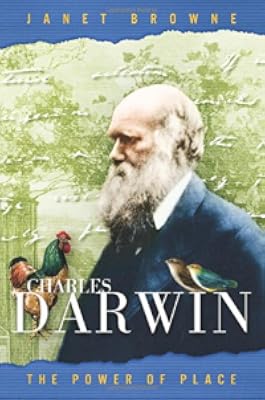

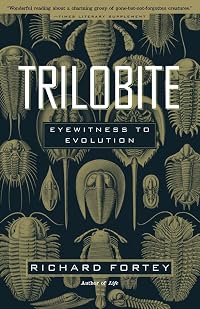
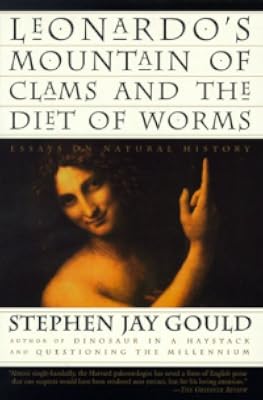
Member Recommendations
Sandydog1 If interested in the source, try Darwin's masterpiece.
20
Member Reviews
I vaguely recall reading this in college (maybe?) or before I went to grad school? The information (like in the book about pigeons...) all felt familiar. Considering I've had a lifelong goal to understand evolution, it would not surprise me that I've read this. before. I don't recall how I used to keep track of what I read before Goodreads...I'm terrible at lists. Or journaling (I definitely don't keep them, all in the garbage). Or being consistent...
But this book is excellent and consistent. It updated the masses on where we were with evolutionary thought in a time (the 1990s) when creationist ideas were EVERYWHERE (at least in my life) and evolution was most definitely not taught (wait...was evolution our generations critical race show more theory?). I'm not sure why the two ideas (evolution, creationists) have to be separate. If there is a Creator, why would any human think they could say "no, the Creator is not smart enough to have created species to evolve." I'm more of the mind-set that evolution and intelligent design go hand-in-hand because if I were an all-powerful being and I liked to build worlds, I would sometimes want to have control over everything they do (The Sims) and other times I would want to control the infrastructure (SimCity). Sometimes I might want to mess around and see what happens if I set it on hyper-speed and let those creatures do what they do (umm..the game in Oryx & Crake?). I mean, when you're an all powerful being, you get to do whatever you want and as a lowly human I can't comprehend all that an APB would come up with. show less
But this book is excellent and consistent. It updated the masses on where we were with evolutionary thought in a time (the 1990s) when creationist ideas were EVERYWHERE (at least in my life) and evolution was most definitely not taught (wait...was evolution our generations critical race show more theory?). I'm not sure why the two ideas (evolution, creationists) have to be separate. If there is a Creator, why would any human think they could say "no, the Creator is not smart enough to have created species to evolve." I'm more of the mind-set that evolution and intelligent design go hand-in-hand because if I were an all-powerful being and I liked to build worlds, I would sometimes want to have control over everything they do (The Sims) and other times I would want to control the infrastructure (SimCity). Sometimes I might want to mess around and see what happens if I set it on hyper-speed and let those creatures do what they do (umm..the game in Oryx & Crake?). I mean, when you're an all powerful being, you get to do whatever you want and as a lowly human I can't comprehend all that an APB would come up with. show less
Islands are the perfect laboratory for studying a species. In the case of the Galapagos archipelago, the islands are isolated like a fortress; no one can easily arrive or depart. Princeton University biologists Peter and Rosemary Grant, along with their daughters, take a small group of scientists to help them investigate Darwin's finches. By the beak of the finch they are able to track an evolutionary journey through time. Beak of the Finch is an extraordinary account of survival of the fittest as it happened then; as it is happening right now. Our world is constantly evolving and adapting and we aren't done yet.
Word to the wise - listen to this on audio. John McDonough does a fantastic job. Weiner's writing may be approachable science, show more but McDonough's reading makes it all the more enjoyable.
As an aside, I love books I like to describe as "rabbit holes." They take me to knowledge I never would have learned otherwise. I think people describe the internet that way sometimes. In this case, I learned that when a finch is ready to mate its beak turns black. Who knew? show less
Word to the wise - listen to this on audio. John McDonough does a fantastic job. Weiner's writing may be approachable science, show more but McDonough's reading makes it all the more enjoyable.
As an aside, I love books I like to describe as "rabbit holes." They take me to knowledge I never would have learned otherwise. I think people describe the internet that way sometimes. In this case, I learned that when a finch is ready to mate its beak turns black. Who knew? show less
Five years ago I realized a life-long dream with a trip to the Galapagos Islands. It was a wonderful trip and we met a great group of people who we have stayed friends with ever since. They had read this book before they came and recommended it.
A team of evolutionary biologists, headed by Peter and Rosemary Grant, spent up to six months a year on the isolated island of Daphne Major studying the finches who live there. The differences between the species were noticed by Charles Darwin when the Beagle spent time in the Galapagos Islands. His theory of selection was, in part, based upon these birds. So they seemed a natural population for the Grants to study. During the time they were on the island there was one year of severe drought and show more one year of excessive rain. During the drought years the smaller beaked finches had trouble finding seeds to eat and many died out. Subsequently, larger beaked birds were observed on the island. Then when the rainy year came, the smaller beaked finches were able to get the softer seeds more quickly and they thrived. Based on their studies the Grants derived three main observations:
1. Natural selection is a variable and constantly changing process
2. It can be a quite rapid process, not taking millennia as Darwin thought.
3. Selection can change over time.
Jonathan Weiner explains the Grants' studies in clear language. He also extrapolates from their findings to those of other researchers that support and add to the studies. I learned so much about evolution and natural selection by reading this book.
The Grants are now based in Princeton University but they met at the University of British Columbia and they both worked at McGill University in the 1970s when they started their studies of the Galapagos finches. It seems that Canada lost out by not supporting their work enough. (Note: Weiner only associates them with Princeton; I learned about their Canadian connection from Wikipedia.) show less
A team of evolutionary biologists, headed by Peter and Rosemary Grant, spent up to six months a year on the isolated island of Daphne Major studying the finches who live there. The differences between the species were noticed by Charles Darwin when the Beagle spent time in the Galapagos Islands. His theory of selection was, in part, based upon these birds. So they seemed a natural population for the Grants to study. During the time they were on the island there was one year of severe drought and show more one year of excessive rain. During the drought years the smaller beaked finches had trouble finding seeds to eat and many died out. Subsequently, larger beaked birds were observed on the island. Then when the rainy year came, the smaller beaked finches were able to get the softer seeds more quickly and they thrived. Based on their studies the Grants derived three main observations:
1. Natural selection is a variable and constantly changing process
2. It can be a quite rapid process, not taking millennia as Darwin thought.
3. Selection can change over time.
Jonathan Weiner explains the Grants' studies in clear language. He also extrapolates from their findings to those of other researchers that support and add to the studies. I learned so much about evolution and natural selection by reading this book.
The Grants are now based in Princeton University but they met at the University of British Columbia and they both worked at McGill University in the 1970s when they started their studies of the Galapagos finches. It seems that Canada lost out by not supporting their work enough. (Note: Weiner only associates them with Princeton; I learned about their Canadian connection from Wikipedia.) show less
I enjoyed this book and it had a lot of great insights, but I think it think it could greatly benefit from either a forward or an afterward about the changes that have taken place since it was written (1994). For example, the book includes a discussion of climate change and how it may affect the rate of evolution, but back then these ideas were much more speculative. There is also a discussion of the hole in the ozone layer, and how it is affecting the mutation rate of the species of algae that passed beneath it, but in 1994 the Montreal Protocol was only seven years old and its effectiveness was yet to be known. Twenty-three years later, there is evidence the ozone layer is beginning to self-heal and the hole is becoming smaller.
The show more context of 2017 also makes this quote all the more poignant: "We are altering the terms of the struggle for existence: changing the conditions of life for every species that is coeval with our own. Never before was such havoc caused by the expansion of a single species. Never before was the leading actor aware of the action, concerned about the consequences, conscious of guilt. For better and for worse, this may be one of the most dramatic moments to observe evolution in action since evolution began." (page 277). show less
The show more context of 2017 also makes this quote all the more poignant: "We are altering the terms of the struggle for existence: changing the conditions of life for every species that is coeval with our own. Never before was such havoc caused by the expansion of a single species. Never before was the leading actor aware of the action, concerned about the consequences, conscious of guilt. For better and for worse, this may be one of the most dramatic moments to observe evolution in action since evolution began." (page 277). show less
I found this book to be absolutely fascinating most of the time. Not being a natural scientist, I was only generally aware of Darwin's theory of evolution. It makes sense to me. However, I'd never heard of Darwin's finches. I appreciate the story of the slow changes, generation to generation, of the variation of the finches' beaks. I followed well as variations of other species, over time, was discussed. I was mesmerized by the discussion of the evolution of chemical resistant species of bacteria, viruses and pests that impact our bodies, our animals and our crops. And I was intrigued by the realization that these changes, when reported in mass media, are referred to as "mutated" rather than "evolved". And I wonder if the journalists show more realize they are playing a word game. Some probably do.
I was enchanted by the view that creation of a new species requires the availability of a unique niche for a new species. They must have some available arena to inhabit and thrive. It reminds me of the saying "Nature hates a vacuum." Weiner touched a bit on the impact of humans in many environments resulting not in the creation of new niches but in the destruction of existing niches, the significant lowering of biodiversity. It brought me back to the ideas from another Pulitzer winner I had read, The Sixth Extinction: An Unnatural History by Elizabeth Kolbert.
All in all, reading this book was time well spent and I deeply appreciate all I learned that I hadn't realized before. show less
I was enchanted by the view that creation of a new species requires the availability of a unique niche for a new species. They must have some available arena to inhabit and thrive. It reminds me of the saying "Nature hates a vacuum." Weiner touched a bit on the impact of humans in many environments resulting not in the creation of new niches but in the destruction of existing niches, the significant lowering of biodiversity. It brought me back to the ideas from another Pulitzer winner I had read, The Sixth Extinction: An Unnatural History by Elizabeth Kolbert.
All in all, reading this book was time well spent and I deeply appreciate all I learned that I hadn't realized before. show less
This book was simply phenomenal. The only thing stopping me from making it five stars is that some parts of it were filler content, which is largely unavoidable. However, it was incredibly interesting.
The book follows researchers in the Galapagos who are studying Darwin's finches. The excellent writing style breaks down complex research of evolutionary biology into something a 19 year old (me) can understand. This book completely changes the perspective on nature and the idea of a species: showing evolution not as a linear change over time, but as a constant adaptation to a cruel world. Something as simple as a finch's beak can waver back and forth in size as these islands go between droughts and storms every couple of years. The show more progression of any given animal is not a straight line in a specific direction, but rather a wiggling line that might move a certain direction as a long term trend, but also is constantly changing.
Anybody who wants to know more about Darwin's research and how it's still being expanded upon today, this book is worthy of the Pullitzer Prize that it won. If this review was a turn-off for you, then the book wouldn't be your kind of entertainment. But overall I definitely recommend this. Any book can make you learn, but not many books can truly stimulate you to think about something you'd never considered. show less
The book follows researchers in the Galapagos who are studying Darwin's finches. The excellent writing style breaks down complex research of evolutionary biology into something a 19 year old (me) can understand. This book completely changes the perspective on nature and the idea of a species: showing evolution not as a linear change over time, but as a constant adaptation to a cruel world. Something as simple as a finch's beak can waver back and forth in size as these islands go between droughts and storms every couple of years. The show more progression of any given animal is not a straight line in a specific direction, but rather a wiggling line that might move a certain direction as a long term trend, but also is constantly changing.
Anybody who wants to know more about Darwin's research and how it's still being expanded upon today, this book is worthy of the Pullitzer Prize that it won. If this review was a turn-off for you, then the book wouldn't be your kind of entertainment. But overall I definitely recommend this. Any book can make you learn, but not many books can truly stimulate you to think about something you'd never considered. show less
An interesting view of the Grants' study of finches in the Galapagos - and some fascinating implications, continuations, and conclusions drawn from the same. The first two-thirds of the book is a quite detailed description, including quotes and first-person reports, of the twenty-plus year (as of 1994, when the book was published) study of the finches on Daphne Major and other islands in the Galapagos; the methods used to determine variation (beak measurements, mostly), the results of odd weather - drought and flood - on the finches and their variation, and the interim conclusions drawn from analysis of this data. Then it goes on to discuss other analyses, revealing similar (though less visible, and overlooked until they knew what to show more look for) patterns of variation in response to events in other populations. Throughout, it's related back to Darwin's perception of evolution as slow, with the data contradicting that. Evolution happens constantly - it just, usually, flickers back and forth on a continuum, so looking at a distance there's no great change. When situations continue to lean one way, changes become stronger, more widespread and more permanent...for a limited definition of permanent, since the flicker of changes continues. I spotted the link to diseases half a chapter before it was directly discussed, but once it was mentioned it was covered quite thoroughly. All in all, a fascinating book, that makes sense out of a good many things I knew but didn't see patterns in. This is one that will permanently change my view of the world. show less
Members
- Recently Added By
Lists

Best Science Books for Non-Scientists
113 works; 57 members

Recommended Nature Writing
346 works; 180 members

Nature Writing
33 works; 3 members

Books about Animals
86 works; 4 members

The r/AskScience Reading List
159 works; 3 members

Favorite Animal Non-Fiction
293 works; 144 members

Books That Changed Our Perspective
423 works; 168 members

Books Read in 2022
5,226 works; 112 members
Author Information

9+ Works 3,820 Members
Jonathan Weiner's books have won the Pulitzer Prize, the National Book Critics Circle Award, and the Los Angeles Times Book Prize. He is the author of The Beak of the Finch; Time, Love, Memory; His Brother's Keeper; and other books. He lives in New York, where he teaches science writing at Columbia University's Graduate School of Journalism.
Awards and Honors
Awards
Distinctions
Common Knowledge
- Canonical title
- The Beak of the Finch: A Story of Evolution in Our Time
- Original title
- The Beak of the Finch. A Story of Evolution in Our Time
- Original publication date
- 1994
- People/Characters
- Rosemary Grant; Peter Grant
- Important places
- Galápagos Islands, Ecuador
- Epigraph
- And where is the place of understanding?
It is hid from the eyes of all living;
And concealed from the birds of the air.
-Job 28:20-21 - Dedication
- For Deborah
- First words
- Half past seven on Daphne Major.
- Quotations
- As Peter and Rosemary Grant put it, natural selection takes place within a generation, but evolution takes place across generations. (p. 79)
...the Finch Unit had seen natural selection in action. ... they saw evolution in action...
After that, the watchers on Daphne Major had to keep watching. (p. 81)
...on the rim of Daphne Major the skies were low, black, loud, and flickering, and just beneath them the seas were high, and hurled green and white breakers up the cliffs. The island rode into the new year like a ship into a ... (show all)storm. (p. 100)
[the unbanded finch] He's been there for years. A terrible place, really horrible. everyone has tried to catch him. He's right up here," she says, pointing to the spot on a map of the island. "It's very steep, going down into... (show all) the crater. Impossible to put a net there. Also he FLIES. He's a VERY difficult bird." (p 120)
The Grants have carried the island home in their pockets. [to Princeton, for analysis] (p. 120)
...the evolutionist George Williams writes: "I believe that modern opposition, ... to natural selection, still derives from the same sources that led to the now discredited theories of the nineteenth century. The opposition a... (show all)rises, as Darwin himself observed, not from what reason dictates but from the limits of what the imagination can accept." (p. 131
Darwin complains [about his experiments] ..."all nature is perverse & will not do as I wish it." (p. 136)
[FitzRoy] prided himself on his ability to judge the character of his men by their skull bumps. FirtzRoy felt sure that he was looking at the nose of a lazy man. He almost sent Darwin home. We might have lost the Origin and T... (show all)he Descent of Man. The whole face of human thought was almost changed by Darwin's beak. (p. 172)
I was of three minds
Like a tree
In which there are three blackbirds.
-Wallace Stevens, "Thirteen Ways of Looking at a Blackbird" - Last words
- (Click to show. Warning: May contain spoilers.)Darwin's finches will keep their covenant with Darwin's islands, witnessed by a heap of stones.
- Original language
- English
Classifications
Statistics
- Members
- 1,950
- Popularity
- 10,941
- Reviews
- 41
- Rating
- (4.19)
- Languages
- 9 — Chinese, Dutch, English, Finnish, German, Italian, Polish, Portuguese, Spanish
- Media
- Paper, Audiobook, Ebook
- ISBNs
- 21
- UPCs
- 1
- ASINs
- 11