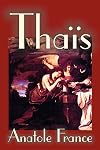
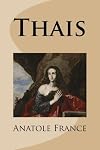
Thaïs
by Anatole France
On This Page
Description
In what some critics and fans regard as Anatole France's most accomplished novel, the writer revisits the classic struggle between spiritual faith and sensual pleasures. The story revolves around Thais, a renowned entertainer and confirmed hedonist, and Paphnutius, a zealous prophet who undertakes an arduous journey with the aim of saving Thais' soul and setting her on a path toward righteousness -- only to find his own faith shaken to the core.Tags
Recommendations










































Member Reviews
There were at least two very different women in history who bore this name. The better-known of the two was a “companion” to Alexander the Great. Her life seems to have been interesting but the other Thaïs is the one whom France relied upon for this novel. She is sometimes called Saint Thaïs. She is said to have lived in Egypt in the fourth century and, in the delightful words of Wikipedia, was a “repentant courtesan.” In fact, her repentance could be said to be what the whole novel is about. But that would sell France (and the novel) a bit short. His writing, as always, is a pleasure for me. I enjoy his satire and his wry reflections on a variety of topics. The book only tells the story of Thaïs’s life (and repentance) as show more a contrast to the longer more substantial life of Paphnutius, the “Abbot of Antinoë,” who is responsible in France’s telling, for rescuing her from a wasted life. Paphnutius is based upon a possibly real person, said to be a disciple of Saint Anthony and a member of the First Council of Nicaea. Through him, France ridicules religious hypocrisy—a favorite theme—and savages religious belief even more effectively than in The Revolt of the Angels. All in all, the novel is a lengthier work than it need be but France must have very much enjoyed writing it. Had it been a bit shorter, I might even have enjoyed reading it as much. show less
Paphnutius is a Christian monk living a secluded life in 4th century Egypt. He is regarded as one of the most holy of the hermits living in the area, and the demons that arrive each night are unable to enter his shack. One day as he is meditating on his sins, he remembers his lust for Thais, a beautiful actress he saw as a young man in Alexandria. He is inspired (either by God or by the devil) to go to the city and convince her to enter a nunnery and devote the rest of her life to God. Throughout his quest, his faith is tested by many different philosophers and sceptics who all have an opinion on the Christian faith. Thais was later granted sainthood.
This short novel was divided into three sections. I thought the first section was very show more interesting, the second section was tedious, and the third section was a mix of the first two. I found quite a few quotes that stood out in one way or another, and I liked that the novel could be interpreted in multiple different ways. It would definitely generate a lot of discussion. show less
This short novel was divided into three sections. I thought the first section was very show more interesting, the second section was tedious, and the third section was a mix of the first two. I found quite a few quotes that stood out in one way or another, and I liked that the novel could be interpreted in multiple different ways. It would definitely generate a lot of discussion. show less
An interesting book to listen to. Not sure if I'd finushed it if I would have met it in print. Religion, deception, love, philosophy, all are part of this book, woven into a story of all times.
Fair condition. Ex-library book. Dust jacket remnant is tucked inside. Writing inside front and back covers. Foxing along bottom edge and in front and back sections of pages. Rest of pages clean. Binding is still strong.
En el relato, la cortesana Thaïs inspira erotismo y lujuria desenfrenada en la población, pero el asceta Pafnucio decide dejar el desierto en donde vivía su vida de anacoreta, a efectos de redimir a esa mujer y transformarla en una súbdita dedicada totalmente a la adoración de Dios. En su desarrollo la novela presenta la evolución de los personajes y reflexiona sobre la vida, el placer, la muerte, la trascendencia y la religiosidad. La transformación de los personajes hace de esta obra una metáfora acerca de lo real y de lo imaginario, del mundo de lo aparente, de lo superficial; y un mundo profundo, ligado a las mayores verdades.
Nov 4, 2022Spanish
En esta novela, Anatole France nos recrea la historia de Thaïs, una irresistible cortesana que logró un enorme poder gracias a la atracción poderosísima que su cuerpo perfecto y su voz encantadora, lograban ejercer sobre todos los hombres y un joven monje que no puede evitar tan grande tentación. Thaïs es hermosa y sensualidad. Pafnucio, un monje que se obsesiona desde que la ve por vez primera y decide que sacará a Thaïs de su vida de pecado y la convertirá en una mujer piadosa. Sin embargo, todos los hombres de Alejandría saben el poder que ejerce Thaïs sobre ellos, el embrujo en que caen. Cuando Pafnucio le pregunta a su amigo Nicias, quién es Thaïs, Nicias le dice:
Nov 28, 2010Spanish
Ratings
Members
- Recently Added By
Lists

1001 Books You Must Read Before You Die
1,448 works; 1,134 members

Lamont's Hundred Best Novels (1947)
100 works; 4 members

Harold Bloom - The Western Canon: D. The Chaotic Age
833 works; 24 members

Trinity College Booklist (1951): Class Nine, Foreign Literatures
161 works; 3 members

My TBR
371 works; 3 members
Author Information

Anatole France was the pen name of Jacques Anatole Francois Thibault, who was born in Paris in 1844. The son of a bookseller, Thibault had a lifelong interest in literature. He worked as a schoolteacher, as a reader and editor for publishing houses, and as an assistant librarian in Paris' Senate Library, in addition to writing fiction, plays, show more poetry, criticism, and autobiographical stories. In his lifetime, Thibault was considered one of France's most beloved authors, and he received the Nobel Prize for literature in 1921. France's first novel was The Famished Cat, published in 1879. France's best-known novels include Monsieur Bergeret in Paris, The Crime of Sylvestre Bonnard, Member of the Institute (for which he received an award from the French Academy in 1881), At the Sign of the Reine Pedauque, Penguin Island, Thais (which became the basis for an opera), The Gods Are Athirst, and The Revolt of the Angels. During the late 1890s Thibault became very involved in political and social issues. He was especially committed to socialism and to the fight against anti-Semitism, mainly as a result of the Dreyfuss affair. This new awareness was reflected in his writing, particularly in books such as Penguin Island, which criticized contemporary French society, and The Revolt of the Angels, which parodied the Catholic Church. He also became the literary advisor to l'Humanitie, an influential socialist newspaper, and frequently contributed articles to it until, dissatisfied with the Communist party that had eventually evolved, he renounced all political ties to the left just before his death in 1924. (Bowker Author Biography) show less
Some Editions
Awards and Honors
Series
Belongs to Publisher Series
Modern Library (67.1)
Work Relationships
Is contained in
Has the adaptation
Is abridged in
Common Knowledge
- Canonical title
- Thaïs
- Original title
- Thaïs
- Original publication date
- 1890
- People/Characters
- Thaïs; Paphnutius
- Important places
- Egypt
- Related movies
- Thaïs (1914 | IMDb); Thaïs (1917 | IMDb | Hugo Ballin); Thaïs (1984 | IMDb); Thaïs (2004 | IMDb)
- First words
- In those days there were many hermits living in the desert.
- Original language
- French
Classifications
- Genres
- General Fiction, Fiction and Literature, Historical Fiction
- DDC/MDS
- 843.8 — Literature & rhetoric French Literature French fiction Later 19th century 1848–1900
- LCC
- PQ2254 .T4 .E6 — Language and Literature French, Italian, Spanish and Portuguese literatures French literature Modern literature 19th century
- BISAC
Statistics
- Members
- 476
- Popularity
- 64,056
- Reviews
- 6
- Rating
- (3.73)
- Languages
- 9 — English, French, Greek, Hungarian, Italian, Portuguese, Spanish, Swedish, Turkish
- Media
- Paper, Ebook
- ISBNs
- 68
- ASINs
- 46