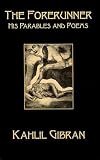
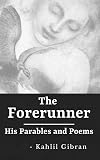
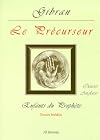
The Forerunner: His Parables and Poems
by Kahlil Gibran
On This Page
Description
Readers who found meaning and beauty in Kahlil Gibran's The Prophet will appreciate this engaging volume of the author's poetry, aphorisms, thoughts, and observations. Published a few years before The Prophet, The Forerunner traces the trajectory of Gibran's development as an artist and thinker..
Tags
Recommendations



























Member Reviews
I didn't find this book as immediately moving as I did Sand and Foam, but it's a slim volume which I will read again to see if things become clearer.
Update: Second read through and I'm finding a lot more to this book. Gibran certainly rewards re-visiting. I still didn't find it as emotionally moving as the other books of his that I've read, but plenty of food for thought. Increased rating from 3 to 4 stars.
Update: Second read through and I'm finding a lot more to this book. Gibran certainly rewards re-visiting. I still didn't find it as emotionally moving as the other books of his that I've read, but plenty of food for thought. Increased rating from 3 to 4 stars.
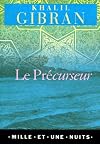
> Babelio : https://www.babelio.com/livres/Gibran-Le-Precurseur/397955
> Un petit livre peu connu, je l'ai acheté par hasard à Alexandrie dans le centre culturel français. Un bijou pour qui en demande encore de monsieur Gibran.
—Danieljean (Babelio)
> Scribd : https://fr.scribd.com/document/384174364/Precurseur-gibran-khalil-gibran
> Un petit livre peu connu, je l'ai acheté par hasard à Alexandrie dans le centre culturel français. Un bijou pour qui en demande encore de monsieur Gibran.
—Danieljean (Babelio)
> Scribd : https://fr.scribd.com/document/384174364/Precurseur-gibran-khalil-gibran
Feb 11, 2021 (Edited)French
Ratings
Members
- Recently Added By
Lists

Books Read in 2014
2,344 works; 89 members
Author Information

745+ Works 29,473 Members
Khalil Gibran, also known as Kahlil Gibran, was born on January 6, 1883 in Northern Lebanon. As a result of his family's poverty, he received no formal education as a small child but had regular visits from the local priest who taught him about the Bible as well as the Syrian and Arabic languages. After his father was imprisoned for embezzlement show more and his family's property was confiscated by the authorities, his mother decided to emigrate to the United States in 1895. They settled in Boston's South End. He attended public school and art school, where he was introduced to the artist, photographer, and publisher Fred Holland Day. A publisher used some of Gibran's drawings for book covers in 1898. His family forced him to return to Lebanon to complete his education and learn the Arabic language. He enrolled in Madrasat-al-Hikmah, a Maronite-founded school, which offered a nationalistic curriculum partial to church writings, history and liturgy. He learned Arabic, French, and exceled in poetry. He returned to the United States in 1902. In 1904, he hosted his first art exhibit, which featured his allegorical and symbolic charcoal drawings. During this exhibition, he met Mary Elizabeth Haskell, who would go on to fund Gibran's artistic development for nearly his entire life. Not only was he an artist, but he also wrote poetry and other works including The Madman, The Prophet, and Sand and Foam. He died of cirrhosis of the liver and tuberculosis on April 10, 1931. (Bowker Author Biography) show less
Common Knowledge
- Original publication date
- 1920
- Important places
- Sharia; Ishana
- First words
- You are your own forerunner, and the towers you have builded are but the foundation of your giant-self.
- Last words
- (Click to show. Warning: May contain spoilers.)And it shall laugh in the sun, and it shall be deathless.
Classifications
Statistics
- Members
- 172
- Popularity
- 190,951
- Reviews
- 2
- Rating
- (3.74)
- Languages
- 6 — Dutch, English, Finnish, French, German, Italian
- Media
- Paper, Audiobook, Ebook
- ISBNs
- 32
- UPCs
- 1
- ASINs
- 14