On This Page
Description
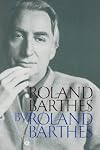
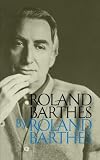
First published in 1977,Roland Barthes by Roland Barthesis the great literary theorist's most original work--a brilliant and playful text, gracefully combining the personal and the theoretical to reveal Roland Barthes's tastes, his childhood, his education, his passions and regrets.Tags
Recommendations



Member Recommendations
wiwidun brilliant!
Member Reviews
Well, it wouldn't be a dull, conventional memoir, would it? Writing about himself, Barthes limits the hard biographical facts to a few briefly annotated family photos from his childhood in Bayonne and a two-page CV, and in between them he gives us a couple of hundred index-card sized fragments talking about his "real" life, which of course revolves around ideas and writings rather than boring things like dates, places and people. None of the fragments is much more than a paragraph or two long, with the only slightly longer pieces being a catalogue of books he might have written but didn't, and a discussion (you can see where this is going...) of the pleasures of the very short form.
In between times, we get cartoons, photos, sample exam show more questions, and a couple of examples of Barthes's painting — my favourite was an abstract doodle in the middle of a sheet of Sorbonne notepaper, titled "Gaspillage" (wasting paper). As if that wasn't enough, we also get the sheet music for a song he composed — I haven't tried to play that. He was obviously the Richard Feynman of semiotics.
You probably need at least a little bit of tolerance for French semioticians to enjoy this, and it's obviously more of a bedside book to dip into than a book you should read in one go, but if you like that sort of thing... show less
In between times, we get cartoons, photos, sample exam show more questions, and a couple of examples of Barthes's painting — my favourite was an abstract doodle in the middle of a sheet of Sorbonne notepaper, titled "Gaspillage" (wasting paper). As if that wasn't enough, we also get the sheet music for a song he composed — I haven't tried to play that. He was obviously the Richard Feynman of semiotics.
You probably need at least a little bit of tolerance for French semioticians to enjoy this, and it's obviously more of a bedside book to dip into than a book you should read in one go, but if you like that sort of thing... show less
didn't expect to zoom through this so fast, but it was such a joy to read.
a few hundred or so small fragments of writing containing musings on barthes' life, his writings, and sundry other things.
barthes doesn't always come off as a terribly rigorous writer, but here, at his loosest and most casual stylistically, he cuts a really impressive figure.
a few hundred or so small fragments of writing containing musings on barthes' life, his writings, and sundry other things.
barthes doesn't always come off as a terribly rigorous writer, but here, at his loosest and most casual stylistically, he cuts a really impressive figure.
Tr. Richard Howard. A post-modern autobiography, combining Barthes' perspectives on his own life through the lens of Barthes' critical apparatus.
The list of books he would like to write are the best part of this book.
Un gioco metaletterario condotto con straordinaria raffinatezza. Barthes sceglie di tracciare un itinerario autobiografico costruendolo non secondo tradizione, preferendo collocare i pezzi di un'esistenza fatti da foto, pillole di memoria, stringhe di testo lapidarie per descrivere un fatto, un frammento, una reminiscenza. Sospeso tra autenticità e immaginario, è un libro che dimostra la possibilità di guardare al passato con un occhio visionario.
Aug 29, 2013Italian
Un livre qui fait date dans l'histoire littéraire du genre autobiographique : juxtaposition de fragments et d'images, alternance du " je" et du "il", considérations sur le langage, l'esthétique, etc...
Roland Barthes n'offre " ni un texte de vanité, ni un texte de lucidité, mais un texte aux guillemets incertains, aux parenthèses flottantes (ne jamais fermer les parenthèses c’est très exactement: dériver)”.
Le livre est précédé d’une prémisse: "Tout ceci doit être considéré comme écrit par un personnage de roman". L’anamnèse est brève, non composée, simplement notée. (L’anamnèse, pour Roland Barthes, est l' "action – mélange de jouissance et d’effort – que mène le sujet pour retrouver, sans show more l’agrandir ni le faire vibrer, une ténuité du souvenir").
L’anamnèse est brève, non composée, simplement notée. (L’anamnèse, pour Roland Barthes, est l' "action – mélange de jouissance et d’effort – que mène le sujet pour retrouver, sans l’agrandir ni le faire vibrer, une ténuité du souvenir"). show less
Roland Barthes n'offre " ni un texte de vanité, ni un texte de lucidité, mais un texte aux guillemets incertains, aux parenthèses flottantes (ne jamais fermer les parenthèses c’est très exactement: dériver)”.
Le livre est précédé d’une prémisse: "Tout ceci doit être considéré comme écrit par un personnage de roman". L’anamnèse est brève, non composée, simplement notée. (L’anamnèse, pour Roland Barthes, est l' "action – mélange de jouissance et d’effort – que mène le sujet pour retrouver, sans show more l’agrandir ni le faire vibrer, une ténuité du souvenir").
L’anamnèse est brève, non composée, simplement notée. (L’anamnèse, pour Roland Barthes, est l' "action – mélange de jouissance et d’effort – que mène le sujet pour retrouver, sans l’agrandir ni le faire vibrer, une ténuité du souvenir"). show less
Dec 26, 2013 (Edited)French
Ratings
Members
- Recently Added By
Author Information

196+ Works 22,377 Members
Roland Barthes (1915-1980), a French critic and intellectual, was a seminal figure in late twentieth-century literary criticism. Barthes's primary theory is that language is not simply words, but a series of indicators of a given society's assumptions. He derived his critical method from structuralism, which studies the rules behind language, and show more semiotics, which analyzes culture through signs and holds that meaning results from social conventions. Barthes believed that such techniques permit the reader to participate in the work of art under study, rather than merely react to it. Barthes's first books, Writing Degree Zero (1953), and Mythologies (1957), introduced his ideas to a European audience. During the 1960s his work began to appear in the United States in translation and became a strong influence on a generation of American literary critics and theorists. Other important works by Barthes are Elements of Semiology (1968), Critical Essays (1972), The Pleasure of the Text (1973), and The Empire of Signs (1982). The Barthes Reader (1983), edited by Susan Sontag, contains a wide selection of the critic's work in English translation. (Bowker Author Biography) show less
Series

Belongs to Publisher Series
Common Knowledge
- Canonical title*
- Ролан Барт о Ролане Барте
- Original title
- Roland Barthes par Roland Barthes
- Original publication date
- 1975
- People/Characters
- Roland Barthes
- Epigraph
- It must all be considered as if spoken by a character in a novel.
- Original language
- French
*Some information comes from Common Knowledge in other languages. Click "Edit" for more information.
Classifications
Statistics
- Members
- 534
- Popularity
- 56,113
- Reviews
- 6
- Rating
- (3.97)
- Languages
- 12 — Danish, Dutch, English, French, German, Italian, Japanese, Polish, Portuguese, Russian, Spanish, Turkish
- Media
- Paper, Ebook
- ISBNs
- 34
- ASINs
- 5