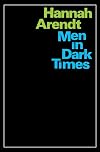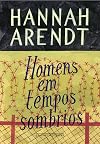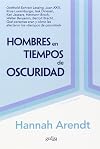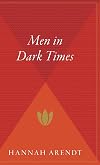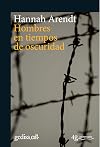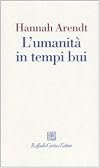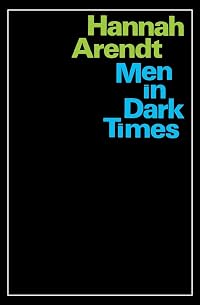
Men in Dark Times
by Hannah Arendt 
On This Page
Description
Essays on Karl Jaspers, Rosa Luxemburg, Pope John XXIII, Isak Dinesen, Bertolt Brecht, Randall Jarrell, and others whose lives and work illuminated the early part of the century. Index.Tags
Recommendations



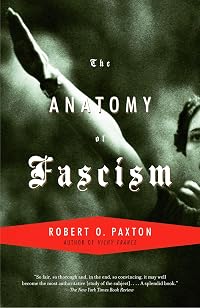
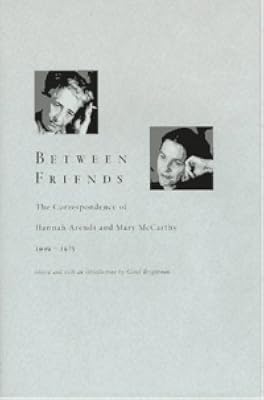


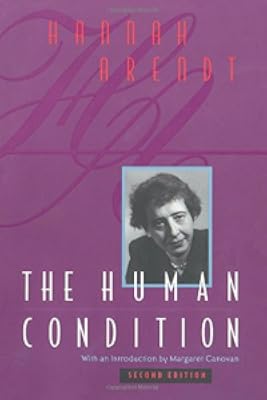












Member Recommendations
Member Reviews
We humanize what is going on in the world and in ourselves only by speaking of it, and in the course of speaking of it we learn to be human.
This was a splendid book to tackle on a holiday. I had read the section on Walter Benjamin before and it was a treat t confront it again. The sections on Rosa Luxemburg and Bertolt Brecht were my favorites, though the piece on the poet Randall Jarrell was unexpectedly moving. Each of these portraits illuminate or fuel Arendt's notion of the public; the limits of this thought become uneasily befogged in practice where one must consider the point Brecht made: it is more important to do good, to make the world a better place than to simply be a good person. The anecdote is related that once Brecht was show more dining with Sidney Hooks and when asked about the Moscow Show Trial Brecht responded that if they were innocent of the charges then of course they should die. Ponder that, will you. show less
This was a splendid book to tackle on a holiday. I had read the section on Walter Benjamin before and it was a treat t confront it again. The sections on Rosa Luxemburg and Bertolt Brecht were my favorites, though the piece on the poet Randall Jarrell was unexpectedly moving. Each of these portraits illuminate or fuel Arendt's notion of the public; the limits of this thought become uneasily befogged in practice where one must consider the point Brecht made: it is more important to do good, to make the world a better place than to simply be a good person. The anecdote is related that once Brecht was show more dining with Sidney Hooks and when asked about the Moscow Show Trial Brecht responded that if they were innocent of the charges then of course they should die. Ponder that, will you. show less
Significant individuals' lives who have attempted to shed light on the "dark times" of the twentieth century. In the twenty-first century, reading this book is instructive and serves as a cautionary tale. This reader is constantly inspired by Arendt's exquisite prose.
I picked this up for the essay on Karl Jaspers cited in another book. That one was a heavy lift and I didn’t finish it after getting the reference I needed. Biographical essays on Rosa Luxemburg, Pope John XXIII, Bertolt Brecht, and Randall Jarrell were better.
No philosophy, no analysis, no aphorism, be it ever so profound, can compare in intensity and richness of meaning with a properly narrated story.
Fantastic book.
Ratings
Members
- Recently Added By
Lists

Take Four Books
130 works; 1 member
Author Information

260+ Works 26,244 Members
Born in Hanover, Germany, Hannah Arendt received her doctorate from Heidelberg University in 1928. A victim of naziism, she fled Germany in 1933 for France, where she helped with the resettlement of Jewish children in Palestine. In 1941, she emigrated to the United States. Ten years later she became an American citizen. Arendt held numerous show more positions in her new country---research director of the Conference on Jewish Relations, chief editor of Schocken Books, and executive director of Jewish Cultural Reconstruction in New York City. A visiting professor at several universities, including the University of California, Columbia, and the University of Chicago, and university professor on the graduate faculty of the New School for Social Research, in 1959 she became the first woman appointed to a full professorship at Princeton. She also won a number of grants and fellowships. In 1967 she received the Sigmund Freud Prize of the German Akademie fur Sprache und Dichtung for her fine scholarly writing. Arendt was well equipped to write her superb The Origins of Totalitarianism (1951) which David Riesman called "an achievement in historiography." In his view, "such an experience in understanding our times as this book provides is itself a social force not to be underestimated." Arendt's study of Adolf Eichmann at his trial---Eichmann in Jerusalem (1963)---part of which appeared originally in The New Yorker, was a painfully searching investigation into what made the Nazi persecutor tick. In it, she states that the trial of this Nazi illustrates the "banality of evil." In 1968, she published Men in Dark Times, which includes essays on Hermann Broch, Walter Benjamin, and Bertolt Brecht (see Vol. 2), as well as an interesting characterization of Pope John XXIII. (Bowker Author Biography) show less
Hannah Arendt has a Legacy Library. Legacy libraries are the personal libraries of famous readers, entered by LibraryThing members from the Legacy Libraries group.
All Editions
Some Editions
Awards and Honors
Awards
Common Knowledge
- Original title
- Men in Dark Times
- Original publication date
- 1968
- Original language
- English
Classifications
- Genres
- Nonfiction, Philosophy, General Nonfiction, Biography & Memoir, History, Politics and Government
- DDC/MDS
- 920.02 — History & geography Biographies, Genealogy, Healdry Biographies General and collective by localities World Leaders
- LCC
- CT120 .A7 — Auxiliary Sciences of History Biography Biography General collective biography
- BISAC
Statistics
- Members
- 546
- Popularity
- 54,363
- Reviews
- 5
- Rating
- (4.02)
- Languages
- 8 — Chinese, English, German, Italian, Polish, Portuguese, Serbian, Spanish
- Media
- Paper, Ebook
- ISBNs
- 25
- ASINs
- 4