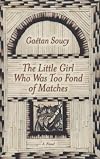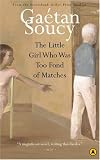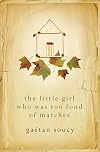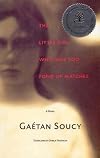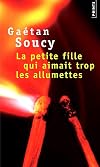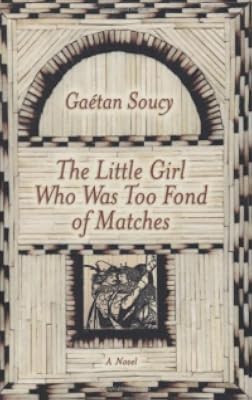
The Little Girl Who Was Too Fond of Matches
by Gaétan Soucy
On This Page
Description
The Little Girl Who Was Too Fond of Matches, originally published in French as La Petite Fille qui Aimait Trop les Alumettes, dominated the bestseller lists and captured major media attention when it appeared in Quebec. It was the first novel published in Quebec ever to be nominated -- let alone become a finalist -- for France's prestigious Prix Renaudot. It is a magic-realist story of a boy and girl who grow up isolated (except through books and fairy tales) from the outside world and who show more must confront it together upon their father's suicide. Soucy's signature playfulness, surprising twists, and fascination with guilt, cruelty, and violence make The Little Girl Who Was Too Fond of Matches a triumph. show lessTags
Recommendations









Member Recommendations

Member Reviews
Wow! This book is written in the voice of Alice, the ultimate unreliable narrator. Alice and her "kid brother" live an isolated life with their father. She has a unique view of the world, which she has pieced together as best as possible from old books and her father's deranged teachings. This is a disturbing book, about becoming "martyrs to hope", which Alice notes "can happen in the best of families".
Oh, what a strange, disturbing little book! The narrator and her brother have spent their whole lives cloistered on their father's estate with no contact with the real world. The story begins with their discovery of his dead body, which leads to their exposure to the outside world and a slow revealing of what reality is to them. The two siblings are almost feral children, so ill-prepared are they to be in society. The narrator has a highly-peculiar way of speaking and thinking ("I rememoried in bits and pieces") which I found very interesting but also distracting (I kept thinking "what word did the author use for that in the French version?"). The unusual language builds a mystery that the reader has to pull apart and what really makes show more the book interesting, but also makes it more work than I had expected. It's the kind of book that I'd like to reread because the second reading would be a completely different--but just as interesting-- an experience.
Recommended for: readers who like unusual--and somewhat creepy--books. show less
Recommended for: readers who like unusual--and somewhat creepy--books. show less
This is quite possibly the strangest book I've ever read. I can barely believe that it exists, that someone could write this. It's also possibly a five-star book, but I'd have to read it again to really make that judgment, because I know that I did not understand it 100%.
This is a first-person last will and testament of a young person of indeterminate age. This person is probably at least 15 and might be a full adult. I'm guessing late teens or early twenties, but all I can say for sure is that this person is post-puberty and pre-menopause.
The narrator is female, but has been raised to believe she is male. She doesn't really know the difference between the genders.
She and her brother (older or younger? I don't know) were raised on a show more remote farm by their father and have scarcely interacted with another person in their whole lives. I think they might live in a castle. Their father is an extremely wealthy owner of a mine, not that the narrator knows what a "mine" is. He's a former priest, authoritarian, violent, and likes for his offspring to tie him up and beat him with wet rags. His childrens' only exposure to the world is books about Medival times, and they think they live in those times. They believe in magic. They've never seen a car. All you can learn about these people and their situation comes from a narrator that has not been exposed to modern reality.
At the beginning of the book, the narrator and her brother find their father, the center of their universe (and, they think, the entire universe), dead by hanging. They have to go into town to get him a coffin, but town is someplace they've never been. They have no frame of reference for what is about to happen to them, and the townspeople are going to have no idea what in the hell to do with these kids (or adults?).
The narrator uses a lot of words wrong, so it takes awhile to understand what s/he's talking about. S/he refers to children as "bambinos," women as "sluts" or "blessed virgins," books as "dictionaries."
As each page goes by, the reader discovers another awful detail about the impossible way these two were raised. Seeing the world through the narrator's eyes is extremely uncomfortable. Would I recommend it? Holy God, yes. Too bad I had to interlibrary loan it. Maybe I'll buy a copy, because this seems like a book I'll never forget. show less
This is a first-person last will and testament of a young person of indeterminate age. This person is probably at least 15 and might be a full adult. I'm guessing late teens or early twenties, but all I can say for sure is that this person is post-puberty and pre-menopause.
The narrator is female, but has been raised to believe she is male. She doesn't really know the difference between the genders.
She and her brother (older or younger? I don't know) were raised on a show more remote farm by their father and have scarcely interacted with another person in their whole lives. I think they might live in a castle. Their father is an extremely wealthy owner of a mine, not that the narrator knows what a "mine" is. He's a former priest, authoritarian, violent, and likes for his offspring to tie him up and beat him with wet rags. His childrens' only exposure to the world is books about Medival times, and they think they live in those times. They believe in magic. They've never seen a car. All you can learn about these people and their situation comes from a narrator that has not been exposed to modern reality.
At the beginning of the book, the narrator and her brother find their father, the center of their universe (and, they think, the entire universe), dead by hanging. They have to go into town to get him a coffin, but town is someplace they've never been. They have no frame of reference for what is about to happen to them, and the townspeople are going to have no idea what in the hell to do with these kids (or adults?).
The narrator uses a lot of words wrong, so it takes awhile to understand what s/he's talking about. S/he refers to children as "bambinos," women as "sluts" or "blessed virgins," books as "dictionaries."
As each page goes by, the reader discovers another awful detail about the impossible way these two were raised. Seeing the world through the narrator's eyes is extremely uncomfortable. Would I recommend it? Holy God, yes. Too bad I had to interlibrary loan it. Maybe I'll buy a copy, because this seems like a book I'll never forget. show less
Soucy's slim novel, at a mere 138 pages, packs quite the suspenseful wallop. A finalist for France's Prix Renaudot and told in narrative form, the story is focused on two siblings that have been raised on an immense country estate completely isolated from the outside world by their authoritarian father. Any education they have received has either been gleamed from the pages of books, such as Spinoza ethics and fairy tales, or passed down through their father's neo-Biblical vocabulary and views. Life takes an interesting turn for the siblings at the start of the story when they wake up one morning to discover that their father has committed suicide and the narrator decides that they must go to the village for the first time in their show more lives to announce the death and obtain a coffin.
This 'first contact' with the outside world presents the reader to the start of what quickly becomes a growing series of startling revelations about the siblings, their family and how the universe as they know it is so divergent from that of the world outside of the confines of their crumbling family estate. The narrator, in an effort to try and make sense of what is transpiring, writes down a testament of the events and it is this scrawling testament that draws the reader into its clutches as the suspense builds to a shocking crescendo.
All I can say beyond this is - Wow - and I am now on the hunt for more novels by Gaétan Soucy. show less
This 'first contact' with the outside world presents the reader to the start of what quickly becomes a growing series of startling revelations about the siblings, their family and how the universe as they know it is so divergent from that of the world outside of the confines of their crumbling family estate. The narrator, in an effort to try and make sense of what is transpiring, writes down a testament of the events and it is this scrawling testament that draws the reader into its clutches as the suspense builds to a shocking crescendo.
All I can say beyond this is - Wow - and I am now on the hunt for more novels by Gaétan Soucy. show less
Quel improbable livre. Son histoire, sa narration, ses personnages. C'est cru, violent, improbable (quoique...). L'histoire se dévoile lentement, inexorablement, on pense que nooon? Hé ben si. Et vlan je t'en rajoute même une louche pour faire bonne mesure.
Je ne sais si j'aime ou pas, ça penche plutôt vers le j'aime, a priori. J'ai en tout cas bien bien accroché à l'écriture, comme venue un peu de nulle part, au vocabulaire improbable, toujours un peu bancal, à la limite du contre-sens et du n'importe quoi, j'adore!
Je ne sais si j'aime ou pas, ça penche plutôt vers le j'aime, a priori. J'ai en tout cas bien bien accroché à l'écriture, comme venue un peu de nulle part, au vocabulaire improbable, toujours un peu bancal, à la limite du contre-sens et du n'importe quoi, j'adore!
An exquisite, Gothic fairytale with a narrator who has her own wondrous language (kudos here also belong to the translator):
"But I wasn't there to bless my neighbours, so once my tears had run dry I set out farther along the village road. I don't know where this audacity came from. I think I was sustained by my feeling of duty towards father. What reasons had I had before to address any neighbours when my late father was there, but now that he was no longer around to defend himself, someone was going to have to take on the job, as well as find him a pine suit, and that put the wind into every one of my sails. I noticed moreover that, having disobeyed papa by stepping outside the enclosure of the estate, once that boundary had been show more crossed I could pass through the others as easily as I passed, in summertime, in the little woods, through the spiderwebs set with silver droplets that stayed in my hair like morning stars, so there." show less
"But I wasn't there to bless my neighbours, so once my tears had run dry I set out farther along the village road. I don't know where this audacity came from. I think I was sustained by my feeling of duty towards father. What reasons had I had before to address any neighbours when my late father was there, but now that he was no longer around to defend himself, someone was going to have to take on the job, as well as find him a pine suit, and that put the wind into every one of my sails. I noticed moreover that, having disobeyed papa by stepping outside the enclosure of the estate, once that boundary had been show more crossed I could pass through the others as easily as I passed, in summertime, in the little woods, through the spiderwebs set with silver droplets that stayed in my hair like morning stars, so there." show less
The reality Soucy has created seems to progress on a swift timeline from fascinating, and strangely compelling, to downright disturbing in the last third of the book. In this, the author has definitely mastered suspense. However, because of the swift progression the novel can appear, at times, to move too fast, but that's a minor criticism.
I don't think it's necessarily fair to say that the children 'discover the truth' of the outside world when they're forced to come into contact with it, and this is perhaps the key adventure to the novel - truths and immutable facts that we as readers know have to be suspended. The children are completely unable to reconcile what they encounter to any form of 'truth' that we know, and the reader is show more forced into viewing the world through their eyes, and sharing their experiences by way of a first person narrative.
The writing itself is masterful and is often lyrical, even when describing horrors. There are no excess words, or fillers, or unnecessary descriptions. So, while not an easy read, it is a pleasure to read partly because of the writer's skill.
I'd recommend this to anyone who wants to take a look at the world through very different eyes, and who can stomach the unpleasant moments. show less
I don't think it's necessarily fair to say that the children 'discover the truth' of the outside world when they're forced to come into contact with it, and this is perhaps the key adventure to the novel - truths and immutable facts that we as readers know have to be suspended. The children are completely unable to reconcile what they encounter to any form of 'truth' that we know, and the reader is show more forced into viewing the world through their eyes, and sharing their experiences by way of a first person narrative.
The writing itself is masterful and is often lyrical, even when describing horrors. There are no excess words, or fillers, or unnecessary descriptions. So, while not an easy read, it is a pleasure to read partly because of the writer's skill.
I'd recommend this to anyone who wants to take a look at the world through very different eyes, and who can stomach the unpleasant moments. show less
Members
- Recently Added By
Lists

CBC Books - Canada's 100 (+ bonus 10): Which have you read?
110 works; 23 members
Author Information

8+ Works 638 Members
Gaétan Soucy was born in Montreal, Quebec on October 21, 1958. He studied physics at Université de Montréal, completed a Master's degree in philosophy, and studied Japanese language and literature at McGill University. His first novel, L'Immaculee Conception (The Immaculate Conception), was nominated for the 2006 Giller Prize. His other works show more include L'Acquittement (Atonement), La Petite Fille Qui Aimait Trop les Allumettes (The Little Girl Who Was Too Fond of Matches) and Music-Hall! (Vaudeville!). He taught philosophy at a college near Montreal. He died of a heart attack on July 9, 2013 at the age of 54. (Bowker Author Biography) show less
Some Editions
Awards and Honors
Series
Belongs to Publisher Series
Work Relationships
Has the adaptation
Common Knowledge
- Canonical title
- The Little Girl Who Was Too Fond of Matches
- Original title
- La petite fille qui aimait trop les allumettes
- Alternate titles*
- The Little Girl Who Was Too Fond of Matches
- Original publication date
- 1998 (original French) (original French); 1998; 2000 (English translation) (English translation)
- People/Characters
- Alice; Brother
- Important places*
- Saint-Aldor, Québec, Canada
- Epigraph
- The experience of feeling pain is not that a person 'I' has something. I distinguish an intensity, a location, etc. in the pain, but not an answer. What sort of a thing would a pain be that no one has? Pain belonging to n... (show all)o one at all? Pain is represented as something we can perceive in the sense in which we perceive a matchbox. - LUDWIG WITTGENSTEIN
- Dedication
- For Isabelle
- First words
- We had to take the universe in hand, my brother and I, for one morning just before dawn papa gave up the ghost without a by-your-leave.
- Last words
- (Click to show. Warning: May contain spoilers.)They're like thoughts that are too sweet, too beautiful for us to keep cozily inside our chests in anticipation of the long winter months, we must resign ourselves to the fact that they leave us in one go, as a swarm, like those that rise up inside me when I think about the blessed fruit of my womb, thoghts that lure my heart and terrify me with joy and that I must drive away from my bosom, for already there's no time left for dreams of paradise, I can feel within me, from the dike that's about to burst, that soon I shall be in the grip of deliverance, and I know from experience that my imaginings have never brought me anything good, any more than my memories, in fact, and now I have less desire than ever to go mad like a flaming partridge stuck through my hat, all smeared with the blood of their religion, and to end up devasted from having waited too long here below, a martyr to hope, which can happen in the best of families.
- Original language*
- Français (Canada) (Canada)
*Some information comes from Common Knowledge in other languages. Click "Edit" for more information.
Classifications
- Genres
- Fiction and Literature, General Fiction
- DDC/MDS
- 843.914 — Literature & rhetoric French Literature French fiction 1900- 20th Century 1945-1999
- LCC
- PQ3919.2 .S655 .P4713 — Language and Literature French, Italian, Spanish and Portuguese literatures French literature Provincial, local, colonial, etc.
- BISAC
Statistics
- Members
- 435
- Popularity
- 70,754
- Reviews
- 22
- Rating
- (3.76)
- Languages
- 14 — Czech, Danish, Dutch, English, Estonian, Finnish, French, German, Italian, Lithuanian, Norwegian (Bokmål), Russian, Slovak, Spanish
- Media
- Paper, Audiobook, Ebook
- ISBNs
- 29
- ASINs
- 5