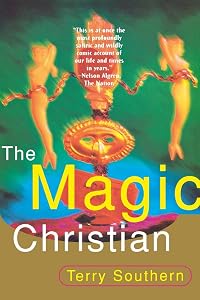
The Magic Christian
by Terry Southern
On This Page
Description
The New York Times-bestselling author's cult classic skewers America's obsession with money, fame, guns, and sex--"A satirical gem" (John Berendt). Guy Grand, an eccentric billionaire prankster, is rich enough to do whatever he likes. And what he likes is to carefully execute projects where he can cauterize by ridicule what the rest of the world ignores: complacency, greed, corruption, and idiocy. Determined to "make it hot for people," Grand spends his billions staging a series of show more hilarious, sometimes bewildering stunts, lampooning along the way the American holy cows of money, status, power, beauty, media, and stardom. Concocting deliciously perverse mayhem, he throws a million one-hundred-dollar bills into an enormous vat of steaming offal, proving just what people will do for money, and he promotes a new silky shampoo that turns hair to wire and a deodorant that becomes a time-released stench-bomb. He inserts subliminally suggestive and perverse images into well-loved classic films, takes a howitzer on safari, and brings a panther to a kennel club dog show. His most elaborate adventure is an ultra-exclusive cruise aboard the S.S. Magic Christian, where elite passengers are treated to a series of madcap indignities. The Magic Christian is a hilarious and savagely satiric view of American commercialism, rich in Southern's deft handling of detail, dialogue, and delightful deviancy. This ebook features an illustrated biography of Terry Southern including rare photos and never-before-seen documents from the author's estate. show lessTags
Recommendations
























Member Reviews
I adore this tiny book. Not because it's a great book (it isn't) but because it's impurely and simply a book comprised of pranks. Beautiful, elaborate, socially conscious, inspired pranks. Mostly lowbrow Borat or Bruno style prank vignettes a la Monty Python, but intelligently, artfully executed nonetheless. It's Punk'D meets a strange, stiff brew of Airplane! and Dr. Strangelove: or, How I Learned to Stop Worrying and Love the Bomb. Absurd, often politically incorrect, ridiculosities. And funny I should mention Dr. Strangelove, as a certain Terry Southern co-wrote the screenplay.
As I earlier alluded, Southern's style in The Magic Christian is nothing to write home about. Which was okay for me since its plot equals pranks and nothing show more but pranks, and my resulting laughter, since I'm a silly, arguably infantile sucker for pranks, overrode concerning myself too much with Southern's slack style. But I will say that if Pynchon were The Sun all pomo'ers revolve around, Southern, stylistically, would be inhabiting Pluto thereabouts (or mysterious Planet X maybe), assuming of course that David Foster Wallace inhabits Mercury; Don Delillo, Venus; Richard Powers, Mars; and so on and so forth.
I'd never heard of Terry Southern until I saw his name dropped in a book review I don't recall, mentioning him alongside the usual pomo suspects inevitably referenced whenever the next great postmodern alleged masterpiece nears its long anticipated, over-hyped release date, which typically and swiftly metastisizes into a pathetically sad day in the publishing world when all is said and done, a tragic day indeed, involving much unavoidable anti-climax. Not to name names, but The Brief & Wondrous Life of Oscar Who? To me, it meant nada, muchas gracias. In fact, I haven't personally experienced such an embarassing anti-climactic episode since my lovely, well intentioned wife, suggested I try weening myself off Cialis. But I digress. Oops.
So, I saw what was for me at the time the unknown name of Terry Southern listed in the same paragraph with Thomas Pynchon in whatever book review that was, and think, wow(!), holy Shiiite Muslim, how can I not seek out a copy of The Magic Christian? And I'm glad I did. However, since the experience of reading the book differs little from sitting in a movie theatre and watching mostly funny comedy previews one right after the other, I'd hate to reveal the pranks here one by one and thus potentially spoil the best scenes. So, go see it, er, read it. (Actually you could go see it I suppose, the film version starring one of cinema's master thespians, Ringo Starr). Find The Magic Christian used somewhere cheap. Plop down your buck fifty like I did, drive home, or bicycle (think green!) open the first page, and laugh your lowbrow ass off. show less
As I earlier alluded, Southern's style in The Magic Christian is nothing to write home about. Which was okay for me since its plot equals pranks and nothing show more but pranks, and my resulting laughter, since I'm a silly, arguably infantile sucker for pranks, overrode concerning myself too much with Southern's slack style. But I will say that if Pynchon were The Sun all pomo'ers revolve around, Southern, stylistically, would be inhabiting Pluto thereabouts (or mysterious Planet X maybe), assuming of course that David Foster Wallace inhabits Mercury; Don Delillo, Venus; Richard Powers, Mars; and so on and so forth.
I'd never heard of Terry Southern until I saw his name dropped in a book review I don't recall, mentioning him alongside the usual pomo suspects inevitably referenced whenever the next great postmodern alleged masterpiece nears its long anticipated, over-hyped release date, which typically and swiftly metastisizes into a pathetically sad day in the publishing world when all is said and done, a tragic day indeed, involving much unavoidable anti-climax. Not to name names, but The Brief & Wondrous Life of Oscar Who? To me, it meant nada, muchas gracias. In fact, I haven't personally experienced such an embarassing anti-climactic episode since my lovely, well intentioned wife, suggested I try weening myself off Cialis. But I digress. Oops.
So, I saw what was for me at the time the unknown name of Terry Southern listed in the same paragraph with Thomas Pynchon in whatever book review that was, and think, wow(!), holy Shiiite Muslim, how can I not seek out a copy of The Magic Christian? And I'm glad I did. However, since the experience of reading the book differs little from sitting in a movie theatre and watching mostly funny comedy previews one right after the other, I'd hate to reveal the pranks here one by one and thus potentially spoil the best scenes. So, go see it, er, read it. (Actually you could go see it I suppose, the film version starring one of cinema's master thespians, Ringo Starr). Find The Magic Christian used somewhere cheap. Plop down your buck fifty like I did, drive home, or bicycle (think green!) open the first page, and laugh your lowbrow ass off. show less
I had never read any of Terry Southern’s work, but heard that this was his masterpiece and since it looked to be a short, quick read, I picked it up. I’m glad that I did too – it should have been called The Magic Discordian.
Guy Grand is a billionaire but, unlike most of his ilk, he likes using it to create chaos and disorder all around him with cruel practical jokes and ecentric pranks. No price is too high or degradation too low for Guy to pay somebody to partake in it. Simplistically, the book is about how money influences people.
He purchases a New York ad agency so that he can install a pygmy dwarf as its president – and instructs him to act as erratically as he can:
"An account executive, for example, might be entertaining an show more extremely important client in his own office, a little tete-a-tete of the very first seriousness… when the door would burst open and in would fly the president, scrambling across the room and under the desk, shrieking pure gibberish, and then he’d go out again, scuttling over the carpet, teeth and eyes blazing.
"'What in God’s name was that?' the client would ask, looking slowly about, his face pocked with a terrible frown.
"'Why that... that...' But the a.e. could not bring himself to tell, not after the first few times anyway. Evidently it was a matter of pride."
Guy fills a vat full of feces and urine, then throws thousand dollar bills into it and stands back, waiting to see if anyone will go in after it. He subtly doctors film at a cinema he buys to totally change the meaning of the film. He pays a pair of boxers to act effeminate in the ring, resulting in The Champ cowering in the corner, shrieking like a little girl. These are just some of the more memorable pranks he pulls, and every one of them is as inventive and disruptive as these are.
From a Discordian perspective, it’s hard to classify Guy. Is he the epitome of the capitalist pig who can throw around his money to satisfy his every whim? Is he an emissary of the Goddess sent to sow entropy and Disorder in the funniest possible way? Is he attacking the pretentious and the conspicuous consumer? Yes, yes, and yes. Depending on the part of the story you are at, you will be either disgusted, amazed, delighted or shocked at Guy’s hubris – but you will have a reaction. Because of its undisguised cruelty, it greatly resembles Toole’s Confederacy of Dunces in tone. This is not the kind of book you can read and then blithely ignore – you will remember some of the images Southern’s slim volume evokes for a long time.
That is assuming, of course, that you have not seen the movie starring Peter Sellers, Ringo Star, Richard Attenborough, John Cleese, Christopher Lee, Roman Polanski, Yul Brynner and Raquel Welch. Somehow, I have managed to live my life without seeing it (this will soon be rectified) but according to the reviews on Amazon the movie is fairly close to the book.
I can’t recommend The Magic Christian strongly enough. It is maddeningly short, but I doubt Terry Southern could have kept up the rate of hilarity and preposterousness he had achieved here for very much longer. It’s better to have a brief book where every chapter shines than a thick one padded with unnecessary and unfunny scenes to achieve a word count. show less
Guy Grand is a billionaire but, unlike most of his ilk, he likes using it to create chaos and disorder all around him with cruel practical jokes and ecentric pranks. No price is too high or degradation too low for Guy to pay somebody to partake in it. Simplistically, the book is about how money influences people.
He purchases a New York ad agency so that he can install a pygmy dwarf as its president – and instructs him to act as erratically as he can:
"An account executive, for example, might be entertaining an show more extremely important client in his own office, a little tete-a-tete of the very first seriousness… when the door would burst open and in would fly the president, scrambling across the room and under the desk, shrieking pure gibberish, and then he’d go out again, scuttling over the carpet, teeth and eyes blazing.
"'What in God’s name was that?' the client would ask, looking slowly about, his face pocked with a terrible frown.
"'Why that... that...' But the a.e. could not bring himself to tell, not after the first few times anyway. Evidently it was a matter of pride."
Guy fills a vat full of feces and urine, then throws thousand dollar bills into it and stands back, waiting to see if anyone will go in after it. He subtly doctors film at a cinema he buys to totally change the meaning of the film. He pays a pair of boxers to act effeminate in the ring, resulting in The Champ cowering in the corner, shrieking like a little girl. These are just some of the more memorable pranks he pulls, and every one of them is as inventive and disruptive as these are.
From a Discordian perspective, it’s hard to classify Guy. Is he the epitome of the capitalist pig who can throw around his money to satisfy his every whim? Is he an emissary of the Goddess sent to sow entropy and Disorder in the funniest possible way? Is he attacking the pretentious and the conspicuous consumer? Yes, yes, and yes. Depending on the part of the story you are at, you will be either disgusted, amazed, delighted or shocked at Guy’s hubris – but you will have a reaction. Because of its undisguised cruelty, it greatly resembles Toole’s Confederacy of Dunces in tone. This is not the kind of book you can read and then blithely ignore – you will remember some of the images Southern’s slim volume evokes for a long time.
That is assuming, of course, that you have not seen the movie starring Peter Sellers, Ringo Star, Richard Attenborough, John Cleese, Christopher Lee, Roman Polanski, Yul Brynner and Raquel Welch. Somehow, I have managed to live my life without seeing it (this will soon be rectified) but according to the reviews on Amazon the movie is fairly close to the book.
I can’t recommend The Magic Christian strongly enough. It is maddeningly short, but I doubt Terry Southern could have kept up the rate of hilarity and preposterousness he had achieved here for very much longer. It’s better to have a brief book where every chapter shines than a thick one padded with unnecessary and unfunny scenes to achieve a word count. show less
Guy Grand--"Grand" Guy Grand--is a billionaire, and the dubious protagonist of The Magic Christian, Terry Southern's satire of American culture. Grand Guy is a master of the elaborate, all-out, over-the-top practical joke, a mean-spirited prankster who believes that everyone has his price and who is willing to go any length (and pay any amount of money) to find that price. He thinks of this as "making it hot for people."
Grand Guy's pranks can be ranked on a sliding scale. There is the relatively innocuous--say, offering thousands of dollars to a stranger on the street to eat Grand's parking ticket. There is the grotesque--building a giant vat on a busy Chicago street, filling it with manure and urine from the stockyards (heated, so as show more to literally "make it hot for people"), stirring in tens of thousands of dollars and posting a sign advertising free money, then sitting back to watch the fun. There are the behavioral--paying off actors in a live television drama to break away during a climactic scene, address the camera directly, then walk off stage, or paying off both parties in a boxing match--the Champ to take a fall in an excessively effeminate manner and his challenger to win in an effeminate manner as well. It's not always clear who or what Southern is sending up--boxing? the people who watch the sport? boxers? gays?--and the pranks are more likely to cause one to squirm uncomfortably than to laugh out loud.
But Grand Guy's most expensive, most elaborate, most unfathomable prank is that which gives title to the book. The Magic Christian is a giant cruise ship which Guy Grand has purchased, refitted as the ultimate in luxury, taken out on her maiden voyage, then orchestrated to...well, one doesn't want to be a spoiler. Suffice to say, it's a voyage that doesn't end well.
Although it's more bizarre than wonderful, more anxiety-producing than hilarious, still, Terry Southern gets the American psyche, both in 1959 when this book was published and possibly even more so now, in this age of Fear Factor and Survivor. The Magic Christian isn't as funny--and certainly not as delightful--as Candy, which Southern co-wrote with the poet Mason Hoffenberg. Still, it's worth a read. And, if you get the chance, check out the movie version, a truly bizarre experience. It stars Peter Sellers as Guy Grand, co-stars Ringo Starr as his adopted son Youngman Grand (a character created for the movie). The screenplay was co-written by Southern, and then re-written by Graham Chapman and John Cleese. show less
Grand Guy's pranks can be ranked on a sliding scale. There is the relatively innocuous--say, offering thousands of dollars to a stranger on the street to eat Grand's parking ticket. There is the grotesque--building a giant vat on a busy Chicago street, filling it with manure and urine from the stockyards (heated, so as show more to literally "make it hot for people"), stirring in tens of thousands of dollars and posting a sign advertising free money, then sitting back to watch the fun. There are the behavioral--paying off actors in a live television drama to break away during a climactic scene, address the camera directly, then walk off stage, or paying off both parties in a boxing match--the Champ to take a fall in an excessively effeminate manner and his challenger to win in an effeminate manner as well. It's not always clear who or what Southern is sending up--boxing? the people who watch the sport? boxers? gays?--and the pranks are more likely to cause one to squirm uncomfortably than to laugh out loud.
But Grand Guy's most expensive, most elaborate, most unfathomable prank is that which gives title to the book. The Magic Christian is a giant cruise ship which Guy Grand has purchased, refitted as the ultimate in luxury, taken out on her maiden voyage, then orchestrated to...well, one doesn't want to be a spoiler. Suffice to say, it's a voyage that doesn't end well.
Although it's more bizarre than wonderful, more anxiety-producing than hilarious, still, Terry Southern gets the American psyche, both in 1959 when this book was published and possibly even more so now, in this age of Fear Factor and Survivor. The Magic Christian isn't as funny--and certainly not as delightful--as Candy, which Southern co-wrote with the poet Mason Hoffenberg. Still, it's worth a read. And, if you get the chance, check out the movie version, a truly bizarre experience. It stars Peter Sellers as Guy Grand, co-stars Ringo Starr as his adopted son Youngman Grand (a character created for the movie). The screenplay was co-written by Southern, and then re-written by Graham Chapman and John Cleese. show less
This prankish satire was probably a little subversive when it was written in 1959, but some of the sting has been lost, now that all of American public life (mass media, business, professional sports, politics) feels like bad parody. Southern’s best pieces are still brilliant, though. A newspaper dispenses with editorials, comics, and ads and prints only facts, resulting in riots between aggrieved ethnic, religious and socio-economic factions. The bit with quizzical, gawking crowds surrounding a stranger smashing crackers with a sledgehammer is a dead-on metaphor for American culture.
Foolproof Golden Ale
Ithaca Flower Power IPA
Foolproof Golden Ale
Ithaca Flower Power IPA
Completely over the top satire and parody of wealth - especially American wealth.
Guy Grand has enough money to waste, in lavish, over the top, foolish ways.
The book was funny in part, but mostly crass and ugly - part of the satire, but so far over the top, it was like satire of satire.
Guy Grand has enough money to waste, in lavish, over the top, foolish ways.
The book was funny in part, but mostly crass and ugly - part of the satire, but so far over the top, it was like satire of satire.
Short book, at times so funny that I audibly laughed.
Can’t rate it much higher as it really isn’t a book, as much as a collection of comedy pieces - uneven at times.
I’d recommend it to anyone who loves the idea of an eccentric billionaire who spends lots money to make people miserable in simple to elaborate setups.
Can’t rate it much higher as it really isn’t a book, as much as a collection of comedy pieces - uneven at times.
I’d recommend it to anyone who loves the idea of an eccentric billionaire who spends lots money to make people miserable in simple to elaborate setups.
Man, what a waste. This book was neither funny nor entertaining. It was like a cruel and unfunny Wodehouse. I'll stick with Bertie and Jeeves.
Members
- Recently Added By
Lists

McMurtry's Texas Literature
27 works; 1 member

The Torchlight List
95 works; 1 member
Author Information

29+ Works 3,449 Members
Some Editions
Awards and Honors
Notable Lists
Torchlight List (#20)
Work Relationships
Is contained in
Has the adaptation
Common Knowledge
- Canonical title*
- Ihmekristitty
- Original title
- The magic Christian
- Related movies
- The Magic Christian (1969 | IMDb)
- Epigraph
- Little man beat a big man everytime, if the little man's in the right and keeps a'comin'. Motto of the Texas Rangers.
- Dedication
- To Henry and Dig
- First words
- When not tending New York holdings, Guy Grand was generally, as he expressed it, "on the go."
- Last words
- (Click to show. Warning: May contain spoilers.)And some say it does, in fact, still go on--they say it accounts for the strange searching haste which can be seen in the faces, and expecially the eyes, of people in the cities, every evening, just about the time now it starts really getting dark.
*Some information comes from Common Knowledge in other languages. Click "Edit" for more information.
Classifications
Statistics
- Members
- 473
- Popularity
- 64,468
- Reviews
- 8
- Rating
- (3.48)
- Languages
- English, Finnish, Italian, Spanish
- Media
- Paper, Audiobook, Ebook
- ISBNs
- 17
- ASINs
- 13