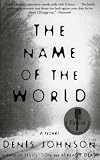
The Name of the World
by Denis Johnson
On This Page
Description
The acclaimed author of Jesus' Son and Already Dead returns with a beautiful, haunting, and darkly comic novel. The Name of the World is a mesmerizing portrait of a professor at a Midwestern university who has been patient in his grief after an accident takes the lives of his wife and child and has permitted that grief to enlarge him. Michael Reed is living a posthumous life. In spite of outward appearances -- he holds a respectable university teaching position; he is an articulate and show more attractive addition to local social life -- he's a dead man walking. Nothing can touch Reed, nothing can move him, although he observes with a mordant clarity the lives whirling vigorously around him. Of his recent bereavement, nearly four years earlier, he observes, "I'm speaking as I'd speak of a change in the earth's climate, or the recent war." Facing the unwelcome end of his temporary stint at the university, Reed finds himself forced "to act like somebody who cares what happens to him. " Tentatively he begins to let himself make contact with a host of characters in this small academic town, souls who seem to have in common a tentativeness of their own. In this atmosphere characterized, as he says, "by cynicism, occasional brilliance, and small, polite terror," he manages, against all his expectations, to find people to light his way through his private labyrinth. Elegant and incisively observed, The Name of the World is Johnson at his best: poignant yet unsentimental, replete with the visionary imaginative detail for which his work is known. Here is a tour de force by one of the most astonishing writers at work today. show lessTags
Recommendations












































Member Reviews
At a pivotal moment toward the end of this novella, the protagonist, a college professor in the Midwest of the U.S., writes and underlines, “The name of the world” on the back of his business card and gives it to Flower Cannon, a young woman. This occurs in an abandoned, off-limits bunker where Flower lives, during a kind of fortune-telling session that she holds for him.
This scene transitions professor Michael Reed from his living coma (suffered because of the deaths of his wife and daughter five years prior) to an engagement with life. This scene feels like he’s asking the identity of the universe he’s about to re-enter, but author Denis Johnson might mean something a lot deeper, I haven’t figured it out. At story’s show more outset, Professor Reed watches his life in a detached way, seeing things as though from a distance and feeling nothing about them. However, he stumbles into an art classroom and seeing the model, who is not motionless or passive, snaps him out of his funk immediately.
He begins to live again, but he needs more lessons, a stamp of approval, and of course this must come from Flower. Reed knows that his life will now head in unpredictable directions, but although intimacy with Flower seems possible, that doesn’t turn out to be the point. Flower is a portal of another kind. She lives in a Spartan, featureless bunker, but is surrounded by her art and her quirky collection of mundane objects. It serves as the anteroom for the rest of his life, and contains some suggested materials for it. Flower has “… bits of glass and shards of mirrors, strips and patches of astronomical and topographical maps, nautical charts … She kept glass jars of buttons and boxes of marbles. Here was the lid of a large box like a tray holding multicolored strings and yarns, the silvery, papery bark of a birch tree, small chrome and plastic emblems …” These raw materials share the space with easels turned toward the wall, works ready to be considered as art, or as not art. It’s all potentiality at this point.
Their conversation brings out the amazing fact that Flower has two sisters (Professor Reed: “Sisters! There are more of you? What a world.”), one of whom her hippie parents named Kali, the Hindu god of destruction and rebirth. From the Hindu Tridevi, or Three Goddesses, Flower herself evokes Saraswati, the goddess of knowledge, music, art, and dance. She also encompasses the cosmic consciousness, and so some sense can be made of Prof. Reed’s “request” of her, for the name of the world. This is the story of a quest, or rather the prelude to a quest, because it climaxes at the quest’s beginning.
Mr. Johnson tells this sympathetic story in a short, powerful burst, and the novella form serves him so perfectly. Of contemporary American writers, no one serves up the same combination of straight-ahead muscular prose and challenging symbolic construct as National Book Award-winning Denis Johnson. This is superb, a gem.
http://bassoprofundo1.blogspot.com/2013/07/the-name-of-world-by-denis-johnson.ht... show less
This scene transitions professor Michael Reed from his living coma (suffered because of the deaths of his wife and daughter five years prior) to an engagement with life. This scene feels like he’s asking the identity of the universe he’s about to re-enter, but author Denis Johnson might mean something a lot deeper, I haven’t figured it out. At story’s show more outset, Professor Reed watches his life in a detached way, seeing things as though from a distance and feeling nothing about them. However, he stumbles into an art classroom and seeing the model, who is not motionless or passive, snaps him out of his funk immediately.
He begins to live again, but he needs more lessons, a stamp of approval, and of course this must come from Flower. Reed knows that his life will now head in unpredictable directions, but although intimacy with Flower seems possible, that doesn’t turn out to be the point. Flower is a portal of another kind. She lives in a Spartan, featureless bunker, but is surrounded by her art and her quirky collection of mundane objects. It serves as the anteroom for the rest of his life, and contains some suggested materials for it. Flower has “… bits of glass and shards of mirrors, strips and patches of astronomical and topographical maps, nautical charts … She kept glass jars of buttons and boxes of marbles. Here was the lid of a large box like a tray holding multicolored strings and yarns, the silvery, papery bark of a birch tree, small chrome and plastic emblems …” These raw materials share the space with easels turned toward the wall, works ready to be considered as art, or as not art. It’s all potentiality at this point.
Their conversation brings out the amazing fact that Flower has two sisters (Professor Reed: “Sisters! There are more of you? What a world.”), one of whom her hippie parents named Kali, the Hindu god of destruction and rebirth. From the Hindu Tridevi, or Three Goddesses, Flower herself evokes Saraswati, the goddess of knowledge, music, art, and dance. She also encompasses the cosmic consciousness, and so some sense can be made of Prof. Reed’s “request” of her, for the name of the world. This is the story of a quest, or rather the prelude to a quest, because it climaxes at the quest’s beginning.
Mr. Johnson tells this sympathetic story in a short, powerful burst, and the novella form serves him so perfectly. Of contemporary American writers, no one serves up the same combination of straight-ahead muscular prose and challenging symbolic construct as National Book Award-winning Denis Johnson. This is superb, a gem.
http://bassoprofundo1.blogspot.com/2013/07/the-name-of-world-by-denis-johnson.ht... show less
Short novel isn't what you might expect if you've read lots of other Denis Johnson. A college professor, who lost his wife and young daughter in a car accident four years before, struggles to find direction or a sense of purpose. The scenes of his encounters with others, including other teachers, and most importantly a cellist/performance artist/stripper are all engrossing. And of course it's very well written. Just give it a chance.
I'm quite conflicted over this novel. The character of Flower Cannon is intriguing, but for me spoilt in the hands of this narrator. If it hadn't have been so short it would have been a DNF, which would have been a shame as Flower's character is fleshed out more near the end of the book.
This is the second Johnson I have read, and I loved 'Train Dreams' which so far I've read three times.
This is the second Johnson I have read, and I loved 'Train Dreams' which so far I've read three times.
An academic drifts in grief after the death of his wife and daughter, and eventually finds something like healing. Although nothing is resolved, this is a compelling and engaging story that stays with you afterward.
Geen makkelijk boek. Er zit niet echt een verhaal in, maar het is erg goed geschreven. De hoofdpersoon heeft vier jaar eerder zijn vrouw en dochtertje verloren bij een auto ongeluk. Hij rouwt zonder het te weten. Hij wordt ontslagen bij de universiteit en beweegt zich als een zombie door het leven. Zijn belangstelling wordt gewekt door Flower, een ruige jonge vrouw, maar uiteindelijk leidt dat tot niets.
Second read was a must. 3 stars to 5. Goddamn Denis Johnson was a genius.
Eh, I didn't really get it. Nice writing of course, but I think the plot would have worked better as a short story rather than novella.
Members
- Recently Added By
Lists

Pen/Faulkner Winners and Finalists
178 works; 9 members
Author Information

36+ Works 14,335 Members
Denis Johnson was born in Munich, Germany on July 1, 1949. He received a bachelor's degree and a master's degree from the University of Iowa. He published his first book of poetry, The Man Among the Seals, at the age of 19. However, addictions to alcohol and drugs derailed him and he was in a psychiatric ward at the age of 21. He was sober by the show more early 1980s. Along with writing several volumes of poetry, Johnson wrote short stories for The New Yorker, Atlantic Monthly, Esquire, Paris Review, and Best American Short Stories. His novels included Angels, Jesus' Son, Resuscitation of a Hanged Man, Already Dead, Nobody Move, Train Dreams, and The Laughing Monsters. He won the National Book Award in 2007 for Tree of Smoke. He also received the Award for Literature from the American Academy of Arts, the Robert Frost Award, and the Library of Congress Prize for American Fiction. He died of liver cancer on May 24, 2017 at the age of 67. (Bowker Author Biography) show less
Awards and Honors
Awards
Common Knowledge
- Canonical title
- The Name of the World
- Original publication date
- 2000
Classifications
Statistics
- Members
- 567
- Popularity
- 51,954
- Reviews
- 9
- Rating
- (3.40)
- Languages
- 5 — Dutch, English, French, German, Spanish
- Media
- Paper, Audiobook, Ebook
- ISBNs
- 15
- ASINs
- 4