On This Page
Description
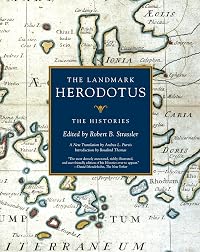
"Herodotus was a Greek historian living in Ionia during the fifth century B.C.E. He traveled extensively through the lands of the Mediterranean and the Black Sea and collected stories, and then recounted his experiences with the varied people and cultures he encountered. Cicero called him "the father of history," and his only work, The Histories, is considered the first true piece of historical writing in Western literature. With lucid prose that harks back to the time of oral tradition, show more Herodotus set a standard for narrative nonfiction that continues to this day." "In The Histories, Herodotus chronicles the rise of the Persian Empire and its dramatic war with the Greek city-states. Within that story he includes rich veins of anthropology, ethnography, geology, and geography, pioneering these fields of study, and explores such universal themes as the nature of freedom, the role of religion, the human costs of war, and the dangers of absolute power." "Ten years in the making, The Landmark Herodotus gives us a new translation by Andrea L. Purvis that makes this work of literature more accessible than ever before. Illustrated, annotated, and filled with maps, this edition also includes an introduction by Rosalind Thomas and twenty-one appendices written by scholars at the top of their fields, covering such topics as Athenian government, Egypt, Scythia, Persian arms and tactics, the Spartan state, oracles, religion, tyranny, and women."--BOOK JACKET. show lessTags
Recommendations




Member Reviews
Cicero called him the father of history, Plutarch the father of lies. But to me he's more like an affable uncle who's been around and knows what's up and what's gone down. If I could pour a libation out with any Ancient Greek, Herodotus would be the guy. "So," I'd say, hefting the krater in the direction of his goblet, "is it really true that there are Indians who kill no living creature at all? And that their semen is black like that of the Ethiopians?" And H would smile broadly under his resplendent beard and say "I did not see this for myself; this is only what I have heard reported — make of it what you will". And then we'd talk and talk and he'd change the subject by saying things like "so much for the snakes and how the Arabians show more obtain their frankincense..." and he'd relate how there are three kinds of mice in Libya, and how Peisistratos was brought down by wifely buttsex, and how the Greeks got their alphabet from the Phoenicians... And some of it would be true stories, and some would just be stories, but it wouldn't matter because he wouldn't pretend to be dealing in immutable verities, because nothing unquestionable is very interesting.
And his talk would be full of his favourite words, "amazing", "incredible", "marvel", "astonishment", because those are the words that come closest to capturing the amazing, incredible, marvelous, astonishing heterodoxy of his world and ours. I love the assiduous recording of which rivers the Persian army completely drinks dry (or more pertinently, which ones it doesn't). Was it really 1.7 million men plus several million more camp followers? Of course it bloody wasn't, but that's not the point; the point is, it was an absolute unit of a fighting force. The exaggerations are part of the story. But the father of lies is no fool. I'm an atheist, so I'll never get, like Croesus did, VIP status at Delphi ("priority in oracular consultation and exemption from fees, along with front-row places at their festivals") — but I get the impression from passages like this that my unbelief wouldn't set me entirely apart from old polytheistic H:
Herodotus's theme is inexorable Fate and how we try and make sense of it — or at least not lose our goddamn minds at how unfair it is — through stories. History for him is very properly a story, instructive and compelling in the way that only stories can be. Truth isn't just subjective, it's peripheral to his project. Of course he's Hellenocentric — what else could a Greek (albeit one from the periphery of the Greek project) be? But the stories he tells us, about how people of all nations tell themselves and each other stories to bring order to their chaotic world, are universal. What goes around in Herodotus always comes around; his Greek mind, like his understanding of rivers and continents, is balanced, symmetrical. Comeuppance might take generations, but up it'll inevitably come. In the speeches, and in particular in the arguments of the Persians Otanes, Megabyzos, and Darius for democracy, oligarchy, and monarchy/tyranny respectively, we get a foretaste of the exquisitely balanced rhetoric of Thucydides. H has his ear to ground still being trampled today. There are also moments of great immediacy, like when we're told about the oars getting tangled in corpses and wreckage at Aphetai, and epic shit like when the Greeks summon Boreas to wreck the Persian fleet, and the fire beacons being lit, and the general large-scale summoning of allies in a Lord of the Rings fashion.
But it's Herodotus the ethnographer who'll always have my ear. Whether he's telling us about the Arabian sheep with trolleys for their massive tails, or Neurian lycanthropy, or the women of the Gindanes and their ankle bracelets ("they put on one of these for every man with whom they have had intercourse, and the woman who wears the most is considered to be the best"), or how the Scythians are "awed and elated by the vapor" of hemp seeds and their women love mud baths, his curiosity and delight in the "the drunkenness of things being various", as MacNeice put it, is what I come to books for. The Persian practice of considering everything once drunk and once sober before deciding has served me well, as has the remark of Artabanos that dreams, contrary to what everyone else in the book thinks, rather than being god-given visions, "tend to be what one is thinking about during the day". The Egyptian Amasis coins for us the phrase "tightly strung". We get an ancient account of the live-burial of children to consecrate a bridge, a rite reported in Medieval times in Andric's "The Bridge Over the Drina". We get 700 Thespians going into battle, and of course ample Lesbians too. And we get it all in the maximalist, thoroughly Herodotean Landmark edition, which gives uncle H the amazing, incredible, marvelous, astonishing widescreen presentation he deserves. show less
And his talk would be full of his favourite words, "amazing", "incredible", "marvel", "astonishment", because those are the words that come closest to capturing the amazing, incredible, marvelous, astonishing heterodoxy of his world and ours. I love the assiduous recording of which rivers the Persian army completely drinks dry (or more pertinently, which ones it doesn't). Was it really 1.7 million men plus several million more camp followers? Of course it bloody wasn't, but that's not the point; the point is, it was an absolute unit of a fighting force. The exaggerations are part of the story. But the father of lies is no fool. I'm an atheist, so I'll never get, like Croesus did, VIP status at Delphi ("priority in oracular consultation and exemption from fees, along with front-row places at their festivals") — but I get the impression from passages like this that my unbelief wouldn't set me entirely apart from old polytheistic H:
...at last the Magi, by offering sacrificial victims and singing incantations to the wind in addition to performing sacrifices to Thetis and the Nereids, brought about an end to the storm on the fourth day — or perhaps it abated of its own accord.Add the ironic "perhaps" to that list of useful words.
Herodotus's theme is inexorable Fate and how we try and make sense of it — or at least not lose our goddamn minds at how unfair it is — through stories. History for him is very properly a story, instructive and compelling in the way that only stories can be. Truth isn't just subjective, it's peripheral to his project. Of course he's Hellenocentric — what else could a Greek (albeit one from the periphery of the Greek project) be? But the stories he tells us, about how people of all nations tell themselves and each other stories to bring order to their chaotic world, are universal. What goes around in Herodotus always comes around; his Greek mind, like his understanding of rivers and continents, is balanced, symmetrical. Comeuppance might take generations, but up it'll inevitably come. In the speeches, and in particular in the arguments of the Persians Otanes, Megabyzos, and Darius for democracy, oligarchy, and monarchy/tyranny respectively, we get a foretaste of the exquisitely balanced rhetoric of Thucydides. H has his ear to ground still being trampled today. There are also moments of great immediacy, like when we're told about the oars getting tangled in corpses and wreckage at Aphetai, and epic shit like when the Greeks summon Boreas to wreck the Persian fleet, and the fire beacons being lit, and the general large-scale summoning of allies in a Lord of the Rings fashion.
But it's Herodotus the ethnographer who'll always have my ear. Whether he's telling us about the Arabian sheep with trolleys for their massive tails, or Neurian lycanthropy, or the women of the Gindanes and their ankle bracelets ("they put on one of these for every man with whom they have had intercourse, and the woman who wears the most is considered to be the best"), or how the Scythians are "awed and elated by the vapor" of hemp seeds and their women love mud baths, his curiosity and delight in the "the drunkenness of things being various", as MacNeice put it, is what I come to books for. The Persian practice of considering everything once drunk and once sober before deciding has served me well, as has the remark of Artabanos that dreams, contrary to what everyone else in the book thinks, rather than being god-given visions, "tend to be what one is thinking about during the day". The Egyptian Amasis coins for us the phrase "tightly strung". We get an ancient account of the live-burial of children to consecrate a bridge, a rite reported in Medieval times in Andric's "The Bridge Over the Drina". We get 700 Thespians going into battle, and of course ample Lesbians too. And we get it all in the maximalist, thoroughly Herodotean Landmark edition, which gives uncle H the amazing, incredible, marvelous, astonishing widescreen presentation he deserves. show less
A storm of incomprehensible might is gathering. The Persian empire, the greatest ever known, is on the march. Persian armies are unstoppable. Persian kings exert absolute power over each soul enslaved to their throne. Persian arms have crushed every civilized realm in Asia and Libya (Africa). Now, in defiance of gods and men, the great King of Persia assembles the warriors of forty-three nations to extend his lust for power toward Europe. Only one nation stands in his way: the colonies and city-states of Hellas, united in Greek language and culture but divided by generations of strife. Rarely has a Greek alliance lasted more than a generation or two. Never have the Greeks united in their entirety. And if these last battered outposts of show more liberty fall, so falls the entire world into unending despotic darkness.
"I may be obliged to tell what is said," writes Herodotus, "but I am not at all obliged to believe it." With these words, our ancient chronicler of the great Persian War neatly summarizes why he is known to our own day as the Father of History. Herodotus is our earliest example of an author who sought to do more than transcribe an unaltered and inviolate tradition of recent events. Rather, he sought to dissect, evaluate, categorize, and interpret competing oral and written traditions according to the best lights of Greek rationalism. That's not to say we can or should accept everything he says at face value. For example, Herodotus estimates that over 5 million Persians descended into the narrow confines of Greece. As a point of comparison, the modern industrial state of Nazi Germany only fielded a paltry 3 million Germans along the entire front of its invasion of the Soviet Union.
Still, our very critiques and corrections of Herodotus are backhanded compliments to the man himself. His method of collecting data from as many sources as possible, and then subjecting that data to critical appraisal, is the very method that allows us to subject Herodotus himself to critical appraisal. The profound influence of his method is felt in his immediate successor Thucydides, whose "sequel" to Herodotus's work (i.e., the record of the Peloponnesian Wars that grew directly from the Persian conflict) both built on and criticized Herodotus's ground-breaking work.
Historiographical method aside, perhaps the greatest testament to Herodotus's skill is the fact that his magnum opus survived when so many other did not. Even today, his work is highly readable, often entertaining, and consistently fascinating in its reflection of an educated ancient man grappling with the enormity of the world that came knocking on Greece's door in a most violent fashion. I highly recommend this Landmark edition of Herodotus's work, as it comes packaged with maps, photographs, and marginal notes that help orient we moderns to the stage of Herodotus's world-historic drama. The intrepid reader who picks up this work, undaunted by its length or antiquity, will not regret this expedition into a world that no longer exists, but is as familiar in its human drama as it is exotic in all its vanished glory. show less
"I may be obliged to tell what is said," writes Herodotus, "but I am not at all obliged to believe it." With these words, our ancient chronicler of the great Persian War neatly summarizes why he is known to our own day as the Father of History. Herodotus is our earliest example of an author who sought to do more than transcribe an unaltered and inviolate tradition of recent events. Rather, he sought to dissect, evaluate, categorize, and interpret competing oral and written traditions according to the best lights of Greek rationalism. That's not to say we can or should accept everything he says at face value. For example, Herodotus estimates that over 5 million Persians descended into the narrow confines of Greece. As a point of comparison, the modern industrial state of Nazi Germany only fielded a paltry 3 million Germans along the entire front of its invasion of the Soviet Union.
Still, our very critiques and corrections of Herodotus are backhanded compliments to the man himself. His method of collecting data from as many sources as possible, and then subjecting that data to critical appraisal, is the very method that allows us to subject Herodotus himself to critical appraisal. The profound influence of his method is felt in his immediate successor Thucydides, whose "sequel" to Herodotus's work (i.e., the record of the Peloponnesian Wars that grew directly from the Persian conflict) both built on and criticized Herodotus's ground-breaking work.
Historiographical method aside, perhaps the greatest testament to Herodotus's skill is the fact that his magnum opus survived when so many other did not. Even today, his work is highly readable, often entertaining, and consistently fascinating in its reflection of an educated ancient man grappling with the enormity of the world that came knocking on Greece's door in a most violent fashion. I highly recommend this Landmark edition of Herodotus's work, as it comes packaged with maps, photographs, and marginal notes that help orient we moderns to the stage of Herodotus's world-historic drama. The intrepid reader who picks up this work, undaunted by its length or antiquity, will not regret this expedition into a world that no longer exists, but is as familiar in its human drama as it is exotic in all its vanished glory. show less
For me, this was one of those books you read a teenager that has a big impact on you. I've always been interested in ancient history and I remember when I picked up the Penguin edition at a library when I was seventeen. I was immediately enthralled.
H creates a kaleidoscopic world full of unreliable information and myths. It's a world full of parables of divine retribution, weed smoking warrior queens, and gold eating ants. The book is called a history, and there are definitely historical aspects, much of the information is even correct, but it is a world distorted by the lens of an alien culture, yet also recognizable for the mere sake that Herodotus is also another human being despite the trappings of time. I would recommend this to show more any fan of LOTR or ASOIAF, which is what I read directly before this.
A mix of history, speculative geography, anthropology, and mythic poetry. It is probably the most colorful book I've ever read. It's a miracle because it seems to be the first work this colorful that was written, at least in the west. In fact, this book in some ways created the west through the framing of the story of "greeks and barbarians" and what led to their conflict. There are gorgeous sections like Xerxes' lament about the fleeting nature of life. This is a book, that because it became before genres, it manages to completely transcend them and provide the reader with a great story. show less
H creates a kaleidoscopic world full of unreliable information and myths. It's a world full of parables of divine retribution, weed smoking warrior queens, and gold eating ants. The book is called a history, and there are definitely historical aspects, much of the information is even correct, but it is a world distorted by the lens of an alien culture, yet also recognizable for the mere sake that Herodotus is also another human being despite the trappings of time. I would recommend this to show more any fan of LOTR or ASOIAF, which is what I read directly before this.
A mix of history, speculative geography, anthropology, and mythic poetry. It is probably the most colorful book I've ever read. It's a miracle because it seems to be the first work this colorful that was written, at least in the west. In fact, this book in some ways created the west through the framing of the story of "greeks and barbarians" and what led to their conflict. There are gorgeous sections like Xerxes' lament about the fleeting nature of life. This is a book, that because it became before genres, it manages to completely transcend them and provide the reader with a great story. show less
If one must begin somewhere, they might as well begin at the beginning. The first true work of history, Herodotus’ Histories has been poured over more times than anything in the West but the Bible, the Iliad and the Odyssey. Works like these can stand multiple re-readings, each time finding a gem left undiscovered prior, or reinterpreting something already known. So hats off to Herodotus for getting it so right the first time out of the gate.
It’s easy to picture Herodotus, perhaps at Thurii, late in life, reading from his Histories in the Agora-striding around, gesturing theatrically, slyly delivering asides to his audience, in stark contrast to his dour successor Thucydides, who I imagine delivering his work from a podium, serious show more as death. To me, at least, Herodotus’ personality emerges from his work. He must have been a gregarious man, insatiably curious about things, something apparent time and time again in his work. As he reports, he traveled widely all over the Near East and North Africa to research his work. What he was doing for a living during these times is something he never makes clear, but perhaps he was a merchant or agent of one, which would explain his wide travels.
The Histories are ostensibly about the Persian Wars, but famously includes numerous digressions on geography, culture, and religions of whatever seems to have caught his attention, most famous being those on Egypt and Scythia. Interesting as well, are the areas not mentioned. He only mentions Carthage in passing and Italy as it pertains to the Persian War, and doesn’t mention at all the Jews, only recently returned from captivity in Babylonia. As he gets further from the eastern Mediterranean basin and the Near East, he gets less reliable, but always interesting. He reports on what he’s heard, sometimes on multiple versions of the stories he’s heard, and sometimes is wildly wrong (like the flying serpents) or is wrong for the right reasons (like his account of the Phoenician circumnavigation of Africa). His digressions on the ways and mores of foreign lands are sympathetic, particularly in respect to Egypt, which he sees as the font of all Greek religion.
Herodotus most defiantly is a believer (maybe the founder) of the “great man” theory of history. In his work, the motivations for the actions of the great powers, like Lydia or Persia, are the personal quibbles or grudges of their leaders, wonderfully drawn characters like the haughty-then-humbled and wise Croesus, or the tyrannical Xerxes. He is a proud and patriotic Greek, but with a cosmopolitan world-view, probably due to his being half-Carian (a native of Halicarnassus).
As for the central (oft broken) narrative theme of his history, Herodotus lays the blame for this on that most Greek of concepts “hubris”, be it Croesus’ overarching pride causing him to foolishly misinterpret the Oracle at Delphi’s warning that if he fought the Persians, a great empire would fall, or Xerxes having the Hellespont shackled and scourged. The putative cause of the war was retaliation by the Persians for Greek support of the Ionian Revolt (an account curiously muddled by Herodotus, considering his origin in the region). Darius felt that he had to punish the Greeks behind this (especially the Athenians), leading to the failed invasion of Attica and the battle of Marathon. His son, Xerxes, set out to avenge this defeat with an enormous expeditionary force, bridging the Hellespont and driving into Greece proper. Here we have all the epic battles, Thermopylae, Salamis and Plataea and the legendary leaders, Leonidas, Themistocles and Pausanias. The story is well known, but this is where it’s all from.
What makes the History bear repeated re-readings are the wonderful stories. Amasis II and his breaking wind in response to a demand of Pharaoh Apries to surrender, Solon telling Croesus who the happiest man he ever heard of was-to Croesus’ dismay, Darius and the other Persian plotters discussing the virtues of monarchy, oligarchy and democracy, or Dienekes cavalierly declaring that when the Persian arrows blot out the sun that the Spartans can fight in the shade. It reminds me of nothing more than the Bible in that way. Therefore, it becomes difficult to review.
This was the second of the “Landmark” series of editions of ancient texts, edited by Robert Strassler and I can’t recommend it highly enough. The translation by Andrea Purvis is very clear and flowing, capturing, for instance, the vagueness of the utterances of the Pythia, or the direct address of Herodotus to the reader. For the first time in my life, I am entirely satisfied; perhaps overjoyed is a better term, at the maps provided in the text. There is a map every few pages, which identifies the locales referenced in the surrounding text. It is sometimes repetitive, but that would be wonderful for students only dipping into parts of the text. The added appendices (there are 21) range from merely interesting to extremely helpful, covering topics from Geography to what Herodotus got right or wrong about Egypt. I would like to one day see Strassler give this treatment to all the great ancient historians. Frankly, I think that in Elysium, old Herodotus is quite happy with what Mr. Strassler has done with his work, and there can be no higher praise than that. show less
It’s easy to picture Herodotus, perhaps at Thurii, late in life, reading from his Histories in the Agora-striding around, gesturing theatrically, slyly delivering asides to his audience, in stark contrast to his dour successor Thucydides, who I imagine delivering his work from a podium, serious show more as death. To me, at least, Herodotus’ personality emerges from his work. He must have been a gregarious man, insatiably curious about things, something apparent time and time again in his work. As he reports, he traveled widely all over the Near East and North Africa to research his work. What he was doing for a living during these times is something he never makes clear, but perhaps he was a merchant or agent of one, which would explain his wide travels.
The Histories are ostensibly about the Persian Wars, but famously includes numerous digressions on geography, culture, and religions of whatever seems to have caught his attention, most famous being those on Egypt and Scythia. Interesting as well, are the areas not mentioned. He only mentions Carthage in passing and Italy as it pertains to the Persian War, and doesn’t mention at all the Jews, only recently returned from captivity in Babylonia. As he gets further from the eastern Mediterranean basin and the Near East, he gets less reliable, but always interesting. He reports on what he’s heard, sometimes on multiple versions of the stories he’s heard, and sometimes is wildly wrong (like the flying serpents) or is wrong for the right reasons (like his account of the Phoenician circumnavigation of Africa). His digressions on the ways and mores of foreign lands are sympathetic, particularly in respect to Egypt, which he sees as the font of all Greek religion.
Herodotus most defiantly is a believer (maybe the founder) of the “great man” theory of history. In his work, the motivations for the actions of the great powers, like Lydia or Persia, are the personal quibbles or grudges of their leaders, wonderfully drawn characters like the haughty-then-humbled and wise Croesus, or the tyrannical Xerxes. He is a proud and patriotic Greek, but with a cosmopolitan world-view, probably due to his being half-Carian (a native of Halicarnassus).
As for the central (oft broken) narrative theme of his history, Herodotus lays the blame for this on that most Greek of concepts “hubris”, be it Croesus’ overarching pride causing him to foolishly misinterpret the Oracle at Delphi’s warning that if he fought the Persians, a great empire would fall, or Xerxes having the Hellespont shackled and scourged. The putative cause of the war was retaliation by the Persians for Greek support of the Ionian Revolt (an account curiously muddled by Herodotus, considering his origin in the region). Darius felt that he had to punish the Greeks behind this (especially the Athenians), leading to the failed invasion of Attica and the battle of Marathon. His son, Xerxes, set out to avenge this defeat with an enormous expeditionary force, bridging the Hellespont and driving into Greece proper. Here we have all the epic battles, Thermopylae, Salamis and Plataea and the legendary leaders, Leonidas, Themistocles and Pausanias. The story is well known, but this is where it’s all from.
What makes the History bear repeated re-readings are the wonderful stories. Amasis II and his breaking wind in response to a demand of Pharaoh Apries to surrender, Solon telling Croesus who the happiest man he ever heard of was-to Croesus’ dismay, Darius and the other Persian plotters discussing the virtues of monarchy, oligarchy and democracy, or Dienekes cavalierly declaring that when the Persian arrows blot out the sun that the Spartans can fight in the shade. It reminds me of nothing more than the Bible in that way. Therefore, it becomes difficult to review.
This was the second of the “Landmark” series of editions of ancient texts, edited by Robert Strassler and I can’t recommend it highly enough. The translation by Andrea Purvis is very clear and flowing, capturing, for instance, the vagueness of the utterances of the Pythia, or the direct address of Herodotus to the reader. For the first time in my life, I am entirely satisfied; perhaps overjoyed is a better term, at the maps provided in the text. There is a map every few pages, which identifies the locales referenced in the surrounding text. It is sometimes repetitive, but that would be wonderful for students only dipping into parts of the text. The added appendices (there are 21) range from merely interesting to extremely helpful, covering topics from Geography to what Herodotus got right or wrong about Egypt. I would like to one day see Strassler give this treatment to all the great ancient historians. Frankly, I think that in Elysium, old Herodotus is quite happy with what Mr. Strassler has done with his work, and there can be no higher praise than that. show less
To read Herodotus or not to read him: That is the question. The answer for most people will be a resounding no! And I am certainly not going to sit here and say that everybody should. In the immortal words of Hilary Clinton, "What difference does it make?" Frankly, after the passage of 2500 years, who even cares? Admittedly, not many.
However, I am one of the happy few who decided to take the plunge. I ended up making a project out of it. My curiosity about The Histories was stirred when, as a young teenager, I happened to open a copy of The Histories to a description of Egyptian embalming methods! This was a wholly new concept and I was ghoulish enough to want to keep reading. But I soon gave up because there were too many strange names show more and places and I had no background to really understand the whole of Herodotus' massive work which was primarily concerned with the history of the conflict between the Greeks and Persians during the 5th century BC.
Herodotus was the first historian. No one before him had attempted a prose account of important events, and certainly not anything close to the scale of The Histories. In the course of reading I learned many reasons why a nonspecialist might want to undertake the project of plowing through the nine books of The Histories, some from Herodotus himself and some from various commentators'. It was those commentators that made all the difference. More about them later.
First of all, it is interesting to see an ancient mind at work, attempting to assemble enough facts and stories and geographical descriptions — all based on oral tradition and first, second and even third-hand accounts —to paint a complete picture of the whys and wherefores of the wars between Persia and Greece. This indeed is the focus of The Histories, even though it is easy to get lost in the minutiae and forget that this is Herodotus' purpose. After all, what could Egyptian embalming practices have to do with the Persian wars?
We see the seeds of the great man theory of history being sown by Herodotus, the theory that dominated historical discourse right down to the beginnings of the 20th century. Herodotus always tells us that individuals are the causes of events. We see how much Herodotus' approach to rhetoric and style and the structural considerations of The Histories influenced later writers of not only history, but travel writing, ethnographical studies, philosophy and even fiction. Indeed, some detractors — not the least of which was Plutarch — have called The Histories a tissue of lies.
To get a proper perspective, think of someone in the year 2000 attempting to write a history of World War II — sixty years previous — based on nothing but interviews and personal observations and no documentary evidence! Herodotus was a boy at the time of the final battles between the Greeks and Persians, and his later reportage was more dependable than when he was reporting about three, four and five generations before his time. Yes, the work is filled with inaccuracies, as what oral history wouldn't be, yet even if it were entirely a work of fiction it would still be worth reading because a certain amount of "truth" is to be gleaned from even the most prosaic novel. And there is a lot of truth in The Histories.
As mentioned above, I chose to make a project out of reading Herodotus. First of all, the edition one chooses is very important. Preferably, pick one with at least a good introduction and copious notes. The edition I chose was The Landmark Herodotus, which constitutes the equivalent of a college course. Not only does it have an introduction, but possibly — as the Austrian Emperor declared in Amadeus — it contains too many notes! It assumes that the reader has opened the book at random to any page and if a location is mentioned as recently as the previous page, a footnote cites a relevant map.
The Landmark Herodotus contains 125 pages of maps. One can be found at the turn of every two to three leaves on average. And each map contains only what you need to see for the related discussion. There is a set of reference maps at the end, complete with gazetteer, which contain nearly everything.
In addition to the introduction, notes and maps, The Landmark edition provides twenty-plus appendices which flesh out subjects too complex for footnotes. These appendices are short essays on subjects like Herodotus' geography; Athenian and Spartan government; the truth or fiction of Herodotus' account of Egypt; hoplite warfare and trireme warfare; converting Greek measurements into modern feet, miles, etc.; and many more. These appendices are written by scholars other than the general editor Robert B. Strassler. A chapter by chapter time line precedes the text.
Taken altogether, The Landmark Herodotus is a treasure house. But like I said, I made a project out of this. Before I was finished, I had listened to a Teaching Company course (24 half-hour lectures) on Herodotus, and I had consulted the Oxford World Classics edition of Herodotus, which contains a wholly different approach than that contained in the Landmark edition both in the introduction and the notes. Both editions are extremely interesting, helpful and all-consuming.
This project took up about two months of my life. I did read other books along the way as a respite from all this, and taken altogether, it was a very rewarding journey, one that I am almost certain to enjoy even more in retrospect. For many reasons, I have to give this whole effort five stars.
I hope that I have given enough fair warning. But for readers who enjoy this sort of thing, you are in for a memorable experience. show less
However, I am one of the happy few who decided to take the plunge. I ended up making a project out of it. My curiosity about The Histories was stirred when, as a young teenager, I happened to open a copy of The Histories to a description of Egyptian embalming methods! This was a wholly new concept and I was ghoulish enough to want to keep reading. But I soon gave up because there were too many strange names show more and places and I had no background to really understand the whole of Herodotus' massive work which was primarily concerned with the history of the conflict between the Greeks and Persians during the 5th century BC.
Herodotus was the first historian. No one before him had attempted a prose account of important events, and certainly not anything close to the scale of The Histories. In the course of reading I learned many reasons why a nonspecialist might want to undertake the project of plowing through the nine books of The Histories, some from Herodotus himself and some from various commentators'. It was those commentators that made all the difference. More about them later.
First of all, it is interesting to see an ancient mind at work, attempting to assemble enough facts and stories and geographical descriptions — all based on oral tradition and first, second and even third-hand accounts —to paint a complete picture of the whys and wherefores of the wars between Persia and Greece. This indeed is the focus of The Histories, even though it is easy to get lost in the minutiae and forget that this is Herodotus' purpose. After all, what could Egyptian embalming practices have to do with the Persian wars?
We see the seeds of the great man theory of history being sown by Herodotus, the theory that dominated historical discourse right down to the beginnings of the 20th century. Herodotus always tells us that individuals are the causes of events. We see how much Herodotus' approach to rhetoric and style and the structural considerations of The Histories influenced later writers of not only history, but travel writing, ethnographical studies, philosophy and even fiction. Indeed, some detractors — not the least of which was Plutarch — have called The Histories a tissue of lies.
To get a proper perspective, think of someone in the year 2000 attempting to write a history of World War II — sixty years previous — based on nothing but interviews and personal observations and no documentary evidence! Herodotus was a boy at the time of the final battles between the Greeks and Persians, and his later reportage was more dependable than when he was reporting about three, four and five generations before his time. Yes, the work is filled with inaccuracies, as what oral history wouldn't be, yet even if it were entirely a work of fiction it would still be worth reading because a certain amount of "truth" is to be gleaned from even the most prosaic novel. And there is a lot of truth in The Histories.
As mentioned above, I chose to make a project out of reading Herodotus. First of all, the edition one chooses is very important. Preferably, pick one with at least a good introduction and copious notes. The edition I chose was The Landmark Herodotus, which constitutes the equivalent of a college course. Not only does it have an introduction, but possibly — as the Austrian Emperor declared in Amadeus — it contains too many notes! It assumes that the reader has opened the book at random to any page and if a location is mentioned as recently as the previous page, a footnote cites a relevant map.
The Landmark Herodotus contains 125 pages of maps. One can be found at the turn of every two to three leaves on average. And each map contains only what you need to see for the related discussion. There is a set of reference maps at the end, complete with gazetteer, which contain nearly everything.
In addition to the introduction, notes and maps, The Landmark edition provides twenty-plus appendices which flesh out subjects too complex for footnotes. These appendices are short essays on subjects like Herodotus' geography; Athenian and Spartan government; the truth or fiction of Herodotus' account of Egypt; hoplite warfare and trireme warfare; converting Greek measurements into modern feet, miles, etc.; and many more. These appendices are written by scholars other than the general editor Robert B. Strassler. A chapter by chapter time line precedes the text.
Taken altogether, The Landmark Herodotus is a treasure house. But like I said, I made a project out of this. Before I was finished, I had listened to a Teaching Company course (24 half-hour lectures) on Herodotus, and I had consulted the Oxford World Classics edition of Herodotus, which contains a wholly different approach than that contained in the Landmark edition both in the introduction and the notes. Both editions are extremely interesting, helpful and all-consuming.
This project took up about two months of my life. I did read other books along the way as a respite from all this, and taken altogether, it was a very rewarding journey, one that I am almost certain to enjoy even more in retrospect. For many reasons, I have to give this whole effort five stars.
I hope that I have given enough fair warning. But for readers who enjoy this sort of thing, you are in for a memorable experience. show less
I read this once before, 40 years ago, in a Dutch translation. Now I have picked up the English Landmark edition. It offers a new translation by the classicist Andrea L. Purvis; I cannot judge its accuracy, but it is certainly accessible and fluent. Still, I was a bit underwhelmed by this edition. For me, the supporting information in the footnotes places a little too much emphasis on geographical places, and this is further reinforced by the very numerous maps. I missed more substantive background explanation for specific passages. Naturally, some of this is covered in the introduction and in the essays included after the translation, but I would have preferred it with specific passages. The photos are a total letdown for me: they are show more not only very outdated but also of very poor quality. Consequently, this edition does not really live up to Landmark's reputation.
But then, of course, there is the old text itself. And that is downright delightful and fascinating. I am still very impressed by Herodotus’s unbridled curiosity, the incredible effort he made to gather his information, and to organize it. For do not forget, not only was it written at a time when there were no computers or other information carriers, but the ‘books’ of that time—if they were available at all—were particularly unwieldy scrolls to use. How on earth did he manage to keep track of and organize all the data and notes? Granted, in the culture of that time memory was of greater importance and much more trained, but even so, it is quite an achievement, and for such an infinite diversity of subjects at that.
As for the latter, one can safely attribute encyclopedic qualities to this book: the Histories excel not only in historical information, but equally in geographical, ethnographic, anthropological, and cultural information. Moreover, the bulk of it is presented in narrative form. I know, people sometimes scoff at that, but what Herodotus offers here is nothing less than a narrative treasure trove. The comparison is, of course, not entirely accurate, but at a certain point while reading, I was reminded of The Tales of 1001 Nights: stories are strung together in an ingenious manner that, taken together, provide a magnificent picture of a specific time and region. With that narrative aspect, I naturally arrive at the historiographical side of this book, more specifically Herodotus’s dual reputation as the ‘father of history’ and as an arch-liar. A definitive judgment on this is not possible. In my History account on Goodreads, I venture to provide some further explanation; see https://www.goodreads.com/review/show/2155021160. show less
But then, of course, there is the old text itself. And that is downright delightful and fascinating. I am still very impressed by Herodotus’s unbridled curiosity, the incredible effort he made to gather his information, and to organize it. For do not forget, not only was it written at a time when there were no computers or other information carriers, but the ‘books’ of that time—if they were available at all—were particularly unwieldy scrolls to use. How on earth did he manage to keep track of and organize all the data and notes? Granted, in the culture of that time memory was of greater importance and much more trained, but even so, it is quite an achievement, and for such an infinite diversity of subjects at that.
As for the latter, one can safely attribute encyclopedic qualities to this book: the Histories excel not only in historical information, but equally in geographical, ethnographic, anthropological, and cultural information. Moreover, the bulk of it is presented in narrative form. I know, people sometimes scoff at that, but what Herodotus offers here is nothing less than a narrative treasure trove. The comparison is, of course, not entirely accurate, but at a certain point while reading, I was reminded of The Tales of 1001 Nights: stories are strung together in an ingenious manner that, taken together, provide a magnificent picture of a specific time and region. With that narrative aspect, I naturally arrive at the historiographical side of this book, more specifically Herodotus’s dual reputation as the ‘father of history’ and as an arch-liar. A definitive judgment on this is not possible. In my History account on Goodreads, I venture to provide some further explanation; see https://www.goodreads.com/review/show/2155021160. show less
Herodotus, author of the first major surviving written accounts that look something like historical narrative. Oft credited as the Father of History, he is also derided as the Father of Lying: brilliant insight like the quote above is often followed immediately by descriptions of winged serpents and goat-footed giants.
We can watch as Western Civilization of the 5th century BC grapples with the nature of fact. Passages from plausible military accounts fade into mythological metaphor—it is beyond Herodotus' limits to consider outcomes untouched by the hands of gods and fates. And so, in this world, Athene did give the victory to a favored warrior, or a profaned sacrificial rite led to the downfall of a great city. Omens and portents show more are considered causal.
One can roughly sort Herodotus' story arcs into about three ragged categories: travelogue, military history and a sort of synthesis of what he has observed or heard. The most rollicking parts are his notes on the customs of far-flung societies: this accidental sociologist gives living glimpses into the rites of obscure tribes. Both these accounts and his renditions of military campaigns are highly geographic—it is hard to imagine that there ever was an edition not stuffed full of maps. The number of place names and human groups listed off by Herodotus are staggering; sometimes chunks of several pages go by that are just lists of the names of groups of people. One learns to let those flow by a bit; it would be madness (or a lifetime's devotion) to try to absorb and recall every detail.
Indeed, the edition. It has been well received, critically, and has been lauded as a ambitious undertaking. The New York Times notes that some of the intimidation of Herodotus is relieved (albeit concomitant with the loss of some of the work's mystique) by its comprehensive explanation and glossing of its subject matter. The footnotes and maps do, indeed, add a wealth of context and information.
The footnotes come at a bit of a cost, however. The footnoting system is precise to the point of confusion: arcane fusions of numbers, letters, and sometimes Greek symbols seem somewhat over-designed for the task. Although there are rarely more than three or four discrete passages per page, sometimes the precision seems like a burden. Additionally, all footnotes are grouped together and given equal precedence. Thus, the footnotes for Athens (the location of which you probably already know, and by Book 2 of Herodotus, you certainly know) and Sparta (ditto) and the Nile are given as much weight as far more interesting asides about linguistics, archaeology, or historical background. Thus time is lost (and reading comprehension suffers) by jumping between text and footnotes and back again. It is not uncommon for a single page to have over a dozen footnotes. Probably this glut (my opinion) is someone else's treasure trove of data. It depends on how comprehensive you really want to be.
A wonderful touch: each passage is briefly summarized and dated in the margin. This is utterly useful.
Of the subject matter: Entire academic careers are based on making heads or tails of Herodotus' tales. I can barely feel that I should add even a peep to the existing cacophony. All I can offer is opinion: it is mine that the stories of Egypt, the stories of customs, the stories of the geography of the then-known world far outshine (in terms of page-turning) the stomp and pomp of the military showdowns. Yes, we get splendid tapestries of Marathon and Plataea and Thermopylae and Mycale (and this really builds one's crossword-clue arsenal, let me tell you!) but, honestly, bleh, I cannot stand military history. This is not the fault of our man from Halicarnassus. It just is. So it leaves me wary of The Landmark Thucydides.
Rating this is difficult—Am I rating the literary skill of a man writing so long ago that his frame of reference is out of my reach? Am I rating the clarity or the apparent accuracy of the accounts? Am I rating the footnoting and mapping structure of the Landmark edition? I don't know. All I can do is chart my own experience here. show less
We can watch as Western Civilization of the 5th century BC grapples with the nature of fact. Passages from plausible military accounts fade into mythological metaphor—it is beyond Herodotus' limits to consider outcomes untouched by the hands of gods and fates. And so, in this world, Athene did give the victory to a favored warrior, or a profaned sacrificial rite led to the downfall of a great city. Omens and portents show more are considered causal.
One can roughly sort Herodotus' story arcs into about three ragged categories: travelogue, military history and a sort of synthesis of what he has observed or heard. The most rollicking parts are his notes on the customs of far-flung societies: this accidental sociologist gives living glimpses into the rites of obscure tribes. Both these accounts and his renditions of military campaigns are highly geographic—it is hard to imagine that there ever was an edition not stuffed full of maps. The number of place names and human groups listed off by Herodotus are staggering; sometimes chunks of several pages go by that are just lists of the names of groups of people. One learns to let those flow by a bit; it would be madness (or a lifetime's devotion) to try to absorb and recall every detail.
Indeed, the edition. It has been well received, critically, and has been lauded as a ambitious undertaking. The New York Times notes that some of the intimidation of Herodotus is relieved (albeit concomitant with the loss of some of the work's mystique) by its comprehensive explanation and glossing of its subject matter. The footnotes and maps do, indeed, add a wealth of context and information.
The footnotes come at a bit of a cost, however. The footnoting system is precise to the point of confusion: arcane fusions of numbers, letters, and sometimes Greek symbols seem somewhat over-designed for the task. Although there are rarely more than three or four discrete passages per page, sometimes the precision seems like a burden. Additionally, all footnotes are grouped together and given equal precedence. Thus, the footnotes for Athens (the location of which you probably already know, and by Book 2 of Herodotus, you certainly know) and Sparta (ditto) and the Nile are given as much weight as far more interesting asides about linguistics, archaeology, or historical background. Thus time is lost (and reading comprehension suffers) by jumping between text and footnotes and back again. It is not uncommon for a single page to have over a dozen footnotes. Probably this glut (my opinion) is someone else's treasure trove of data. It depends on how comprehensive you really want to be.
A wonderful touch: each passage is briefly summarized and dated in the margin. This is utterly useful.
Of the subject matter: Entire academic careers are based on making heads or tails of Herodotus' tales. I can barely feel that I should add even a peep to the existing cacophony. All I can offer is opinion: it is mine that the stories of Egypt, the stories of customs, the stories of the geography of the then-known world far outshine (in terms of page-turning) the stomp and pomp of the military showdowns. Yes, we get splendid tapestries of Marathon and Plataea and Thermopylae and Mycale (and this really builds one's crossword-clue arsenal, let me tell you!) but, honestly, bleh, I cannot stand military history. This is not the fault of our man from Halicarnassus. It just is. So it leaves me wary of The Landmark Thucydides.
Rating this is difficult—Am I rating the literary skill of a man writing so long ago that his frame of reference is out of my reach? Am I rating the clarity or the apparent accuracy of the accounts? Am I rating the footnoting and mapping structure of the Landmark edition? I don't know. All I can do is chart my own experience here. show less
Members
- Recently Added By
Lists

Top Five Books of 2018
802 works; 265 members

In Our Time books
4,934 works; 2 members
Author Information

719+ Works 19,799 Members
Herodotus was the inventor of universal history. Often called the Father of History, his histories are divided into nine books named after the nine muses. A native of Halicarnassus on the coast of Asia Minor (modern Bodrum, Turkey), he traveled extensively, writing lively descriptions of the lands he saw and the peoples he encountered. Herodotus show more set out to relate the story of the conflict of the Greeks of his own time against the "barbarian" Asiatic empire of Achaemenid Persia. His long narrative, titled by modern convention The Histories, begins with the earliest traditions he believed reliable. It ends with a highly colored account of the defeat of the Persian emperor Xerxes and his immense army of slaves by a much smaller number of Greeks fighting to preserve their freedom. Herodotus wrote history, but his methods and assumptions were not those of a modern historian, and his work was unjustly rejected by his successor Thucydides as factually highly unreliable and full of inappropriate romance. By his own admission, Herodotus retold the stories of other peoples without necessarily believing them all. This allowed him total artistic freedom and control to create a picture of the world that corresponded entirely to his own view of it. The result is a picture of Herodotus's world that is also a picture of his mind and, therefore, of many other Greek minds during the period known as "late Archaic." During this period, the Greek mind was dominated by reason, the domain of the first philosophers and the observant and thoughtful medical theorists of the Hippocratic school. Traditional beliefs in the gods of Homer and in their Oracles, especially the Oracle at Delphi, also dominated during this period. The literary genius of Herodotus consisted in the art of the storyteller. The stories he chose to tell, and the order in which he told them, provide his readers with a total view of his world and the way in which the will of the gods and the ambitions of humans interacted to produce what is known as history. For this reason the ancient critic Longinus justly called Herodotus "the most Homeric of all authors." Like Homer, Herodotus strove to understand the world theologically---a goal that makes his work difficult for the reader to understand at first. But, in place of Homer's divine inspiration, Herodotus used his eyes and ears and wrote not poetry but prose. Rejecting what is commonly known as myth, he accepted instead "oral tradition" about remembered events. For example, although he believed that the Trojan War had been fought, he could not investigate it beyond what the poets had said. In his view this "ancient history" of the Greeks and the peoples of Asia was not like contemporary history, because the heroes of old who had created it were beings of a different and superior order who had had a different, direct, and personal relationship with the gods. In recognizing this distinction, Herodotus defined for all time the limits of the historian's discipline. (Bowker Author Biography) show less
All Editions
Some Editions
Series

Work Relationships
Contains
Reference guide/companion to
Common Knowledge
- Canonical title
- The Landmark Herodotus: The Histories
- Original title
- The Landmark Herodotus: The Histories
- Alternate titles
- The Histories
- Original publication date
- ca. 440 BC
- People/Characters
- Croesus; Solon; Gyges of Lydia; Astyages; Darius the Great; Xerxes I (show all 52); Aristagoras; Histiaeus; Cimon; Miltiades; Themistocles; Cleobis; Biton; Pisistratus; Herodotus; Leonidas I of Sparta; Io; Europa; Medea; Paris of Troy (Alexandros); Priam; Helen of Troy; Kandaules (or Myrsilos); Tomyris; Cyrus the Great; Alexander I of Macedon; Amyntas I of Macedon; Gorgo of Sparta; Artemisia I of Caria; Cleisthenes of Sicyon; Kleomenes I of Sparta; Anaxandridas II of Sparta; Amasis II; Apries; Nitetis; Cambyses II; Psamtik III (Psammeticus); Ladice of Cyrene; Rhodopis; Doricha; Phanes of Halicarnassus; Archidike; Iadmon; Polycrates of Samos; Charaxus; Sappho; Aesop (c.620-564 BC); Chilon; Atossa; Artystone; Cassandane (wife of Cyrus the Great); Democedes
- Important places
- Athens, Greece; Sparta, Greece; Sardis; Mytilene, Lesbos, Greece; Halicarnassus; Marathon, Greece (show all 15); Phoenicia; Argos, Greece; Lydia; Thrace; Macedon; Egypt; Babylon; Persian Empire; Persia
- Important events
- Trojan War; Greco-Persian Wars; Battle of Marathon; Battle of Thermopylae; Reign of Amasis II; Reign of Cambyses II (show all 7); Twenty-Sixth Dynasty of Egypt
- Dedication
- TO
GEORGE L. CAWKWELL - First words
- Herodotus of Halicarnassuss here presents his research so that human events do not fade with time.
- Last words
- (Click to show. Warning: May contain spoilers.)They had lost the argument with Cyrus, and chose to dwell in a poor land rather than to be slaves to others and to cultivate the plains.
- Publisher's editor
- Kastenmeier, Edward; Jerome, Chris; Gianetti, Candy; Karper, Altie; Buechler, Lydia; Hughes, Andy (show all 8); Fluck, Avery; Sainsbury, Jonathan
- Blurbers
- Kagan, Donald
- Disambiguation notice
- This Landmark edition contains original annotations and appendices. Please do not combine with other editions.
Classifications
Statistics
- Members
- 2,039
- Popularity
- 10,268
- Reviews
- 25
- Rating
- (4.48)
- Languages
- English
- Media
- Paper, Ebook
- ISBNs
- 4
- ASINs
- 5