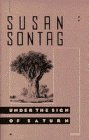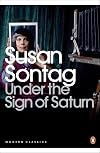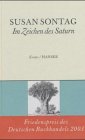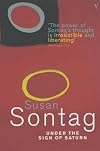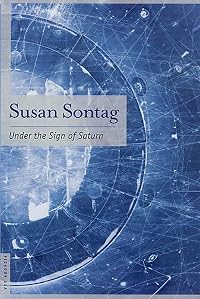
Under the Sign of Saturn
by Susan Sontag 
On This Page
Description
A collection of Susan Sontag's most important critical writings from 1972 to 1980. One of America's leading essayists, Sontag's writings are commentaries on the relation between moral and aesthetic ideas, discussing the works of Antonin Artaud, Leni Riefenstahl, Elias Canetti, Walter Benjamin, and others.Tags
Recommendations
























Member Reviews
I read these essays because Susan Sontag is famous, and I wanted to see what all the fuss was about. They turned out to be much closer to my current preoccupations than I had expected, which I found by turns exhilarating, ominous, disappointing and disturbing. Lately I've been almost obsessively troubled by the relation between power and aesthetics and so, it seems, was she.
"Riefenstahl's current de-Nazification and vindication as indomitable priestess of the beautiful—as a filmmaker and, now, as a photographer—do not augur well for the keenness of current abilities to detect the fascist longings in our midst."
"Somewhere, of course, everyone knows that more than beauty is at stake in art like Riefenstahl's. And so people hedge their show more bets—admiring this kind of art, for its undoubted beauty, and patronizing it, for its sanctimonious promotion of the beautiful."
"The end to which all sexual experience tends, as Bataille insisted in a lifetime of writing, is defilement, blasphemy. To be 'nice,' as to be civilized, means being alienated from this savage experience—which is entirely staged."
-"Fascinating Fascism"
"There was something sad in all this talk about pleasure..." -"Remembering Barthes"
...to covet, to thirst, to long for-these are passionate but also acquisitive relations to knowledge and truth..."
The very last passage in this book I found beautiful: "The last achievement of the serious admirer is to stop immediately putting to work the energies aroused by, filling up the space opened by, what is admired. Thereby talented admirers give themselves permission to go beyond avidity; to identify with something beyond achievement, beyond the gathering of power."
It is such a strange and yet maybe fitting ending, because this is exactly what Sontag seems not to do. She is avid, she achieves, and she gathers power, but she doesn't go beyond. She has a wonderful capacity for lucid prose and logical argument, but these very capacities take on a sinister quality when they are placed so insistently in the forefront, while the subjects she proposes to champion: troubled, mad, and mostly dead, recede. I am thinking in particular here of Artaud and Benjamin. I have never read any Artaud and don't plan to, but what I gathered in her essay about him was exactly that it shouldn't have been written. What does it mean to break down a theater of cruelty for the readers of the New Yorker? One has a sense of her sense of herself as serving her subjects by bringing them out of obscurity. But when their power, as she acknowledges and dwells on, is intrinsically related to their obscurity, then there is something troubling about her attempt to disseminate it. Again back to Artaud, she seems at times to be approaching an argument in favor of madness, then draws back for a distinction between identification and appreciation. And, ok, I thought it was gross. Get in or get out, sister. As it stands, I just can't get past those New Yorker readers, and the sense in her writing that she is performing for them, showing off how edgy she is while remaining palatable. show less
"Riefenstahl's current de-Nazification and vindication as indomitable priestess of the beautiful—as a filmmaker and, now, as a photographer—do not augur well for the keenness of current abilities to detect the fascist longings in our midst."
"Somewhere, of course, everyone knows that more than beauty is at stake in art like Riefenstahl's. And so people hedge their show more bets—admiring this kind of art, for its undoubted beauty, and patronizing it, for its sanctimonious promotion of the beautiful."
"The end to which all sexual experience tends, as Bataille insisted in a lifetime of writing, is defilement, blasphemy. To be 'nice,' as to be civilized, means being alienated from this savage experience—which is entirely staged."
-"Fascinating Fascism"
"There was something sad in all this talk about pleasure..." -"Remembering Barthes"
...to covet, to thirst, to long for-these are passionate but also acquisitive relations to knowledge and truth..."
The very last passage in this book I found beautiful: "The last achievement of the serious admirer is to stop immediately putting to work the energies aroused by, filling up the space opened by, what is admired. Thereby talented admirers give themselves permission to go beyond avidity; to identify with something beyond achievement, beyond the gathering of power."
It is such a strange and yet maybe fitting ending, because this is exactly what Sontag seems not to do. She is avid, she achieves, and she gathers power, but she doesn't go beyond. She has a wonderful capacity for lucid prose and logical argument, but these very capacities take on a sinister quality when they are placed so insistently in the forefront, while the subjects she proposes to champion: troubled, mad, and mostly dead, recede. I am thinking in particular here of Artaud and Benjamin. I have never read any Artaud and don't plan to, but what I gathered in her essay about him was exactly that it shouldn't have been written. What does it mean to break down a theater of cruelty for the readers of the New Yorker? One has a sense of her sense of herself as serving her subjects by bringing them out of obscurity. But when their power, as she acknowledges and dwells on, is intrinsically related to their obscurity, then there is something troubling about her attempt to disseminate it. Again back to Artaud, she seems at times to be approaching an argument in favor of madness, then draws back for a distinction between identification and appreciation. And, ok, I thought it was gross. Get in or get out, sister. As it stands, I just can't get past those New Yorker readers, and the sense in her writing that she is performing for them, showing off how edgy she is while remaining palatable. show less
Sontag has once again compiled an intelligent collection of essays on widely varying aesthetic topics. Though she begins with a rather artificial and patronizing obituary for the late man of letters Paul Goodman, whose body of work she is evidently less than enthused with, though she feels obliged to compare him to Sartre. The essay rings of false piety.
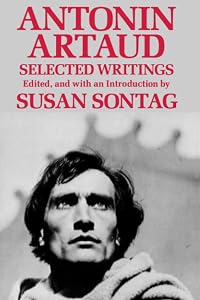
She moves into an expansive and favorable essay on Antonin Artaud, the great playwright and artist of the avant-garde movement. Sontag reviews the developments of his great career within the context of moralistic philosophic aesthetics, liking him with Nietzsche, then Sade, then Breton.
Yet the most impressive essay in Under the Sign is titled `Fascinating Fascism,' and it is truly show more fascinating. In it, Sontag overviews the work of filmmaker, actress, and photographer Leni Riefenstahl, the Nazi propagandist whose body of work includes the esteemed documentaries Triumph of the Will, and Olympia, the latter about the 1936 Olympic games. Sontag reviews Riefenstahl's book of photography on the Nuba tribe in Sudan, which is apparently breathtaking. Sontag concludes that Reifenstahl, despite her `de-Nazification' and renunciation of her political past is still enamored with a fascist ideal, valuing the masculine strength of the male Nuba and placing their bodies in the foreground, while the women remain vulnerable and tucked away in shadowy corners. The essay is highly provocative.
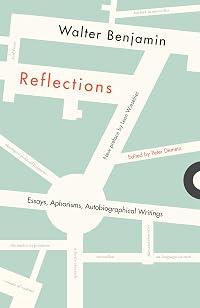
The title essay is about the great philosopher and literary critic Walter Benjamin, whom she reviews favorably. This essay provides some interesting tidbits of information that Hannah Arendt neglects to include in her introduction, such as Benjamin's apparent hatred for Heidegger's philosophy.
Also included in this volume is an excellent and terse review of Roland Barthes, and the fine novelist Elias Canetti, whom she holds in great esteem. show less
She moves into an expansive and favorable essay on Antonin Artaud, the great playwright and artist of the avant-garde movement. Sontag reviews the developments of his great career within the context of moralistic philosophic aesthetics, liking him with Nietzsche, then Sade, then Breton.
Yet the most impressive essay in Under the Sign is titled `Fascinating Fascism,' and it is truly show more fascinating. In it, Sontag overviews the work of filmmaker, actress, and photographer Leni Riefenstahl, the Nazi propagandist whose body of work includes the esteemed documentaries Triumph of the Will, and Olympia, the latter about the 1936 Olympic games. Sontag reviews Riefenstahl's book of photography on the Nuba tribe in Sudan, which is apparently breathtaking. Sontag concludes that Reifenstahl, despite her `de-Nazification' and renunciation of her political past is still enamored with a fascist ideal, valuing the masculine strength of the male Nuba and placing their bodies in the foreground, while the women remain vulnerable and tucked away in shadowy corners. The essay is highly provocative.
The title essay is about the great philosopher and literary critic Walter Benjamin, whom she reviews favorably. This essay provides some interesting tidbits of information that Hannah Arendt neglects to include in her introduction, such as Benjamin's apparent hatred for Heidegger's philosophy.
Also included in this volume is an excellent and terse review of Roland Barthes, and the fine novelist Elias Canetti, whom she holds in great esteem. show less
Time does not give one much leeway: it thrusts us forward from behind, blows us through the narrow tunnel of the present into the future. But space is broad, teeming with possibilities, positions, intersections, passages, detours, U-turns, dead-ends, one-way streets.
This is an important collection of essays. One which quickly afforded me acquaintance with an unknown figure (Paul Goodman) and then continued with intriguing approaches to figures which have occupied my personal pantheon for decades: Artaud, Canetti, Benjamin and Barthes. Today is my best friend Joel's birthday and when I told him earlier he should use the Fascinating Fascism essay for his classes, he shot back that he was curious about Sontag on Bataille. Well, apparently show more this occurred at least twice. These essays were written throughout the 1970s and there is a sobriety in effect. The risks of extremism have be calculated and are to be avoided.
My one concern was in her measured approach to My Hitler: A Film From Germany she didn't mention Fassbinder. I do agree with her on the point that despite the hubris of the director's claim: we haven't been exorcised of Der Führer. show less
This is an important collection of essays. One which quickly afforded me acquaintance with an unknown figure (Paul Goodman) and then continued with intriguing approaches to figures which have occupied my personal pantheon for decades: Artaud, Canetti, Benjamin and Barthes. Today is my best friend Joel's birthday and when I told him earlier he should use the Fascinating Fascism essay for his classes, he shot back that he was curious about Sontag on Bataille. Well, apparently show more this occurred at least twice. These essays were written throughout the 1970s and there is a sobriety in effect. The risks of extremism have be calculated and are to be avoided.
My one concern was in her measured approach to My Hitler: A Film From Germany she didn't mention Fassbinder. I do agree with her on the point that despite the hubris of the director's claim: we haven't been exorcised of Der Führer. show less
If you like reading a quality newspaper, and particularly like reading the longer contributions about art, and cultural background, then the essays collected in Under the sign of Saturn by Susan Sontag will probably interest you.
Susan Sontag's essays are characterized by a very broad spectrum erudition. The essays in Under the sign of Saturn mainly focus on France and Germany, the two countries Sontag has a particular interest in. Sontag lived in Paris for two years, where she studied at the University of Paris, and, although she did not speak German, Sontag was a German Studies expert and wrote many essays on various German authors, and German history and culture. The first, short essay, reminiscences on Sontag's time in Paris where show more she knew Paul Goodman.
Whether a reader will enjoy reading Under the sign of Saturn seems to depend on the interest in the topic of the essays and the ability to maintain an interest in reading them all the way through. Thus, the second essay introduces the relatively unknown French author Antonin Artaud in an essays of 57 pages.
The third essay is on Leni Riefenstahl, but rather than discussing the artistic merits of Riefenstahl's cinematographic works during the Nazi period, the essay's main focus is on a book of photographs, The Last of the Nuba, in which Riefenstahl apparently persists celebrating the fascist aesthetic ideals, suggesting she never came clear of fascism.
The most fascinating essays is the title essay "Under the Sign of Saturn" about Walter Benjamin. The essay is a superb synthesis of the cultural world just before the Second World War in Vienna and Paris, as Benjamin sought a way to escape the doom of fascism that was increasingly asserting itself. The essays describes various authors and painters in the surroundings of Walter Benjamin, including references to Paul Klee's painting "Angelus Novus".
The next essays, from 1979, is a review of Hans-Jürgen Syberberg's film Hitler, a Film from Germany.
These three essays, make Under the sign of Saturn an essay collection of particular interest to readers in German history and culture during the 1930s - 1940s, and the reception of its digest.
They are followed by an essays remembering Roland Barthes and an essay about Elias Canetti. show less
Susan Sontag's essays are characterized by a very broad spectrum erudition. The essays in Under the sign of Saturn mainly focus on France and Germany, the two countries Sontag has a particular interest in. Sontag lived in Paris for two years, where she studied at the University of Paris, and, although she did not speak German, Sontag was a German Studies expert and wrote many essays on various German authors, and German history and culture. The first, short essay, reminiscences on Sontag's time in Paris where show more she knew Paul Goodman.
Whether a reader will enjoy reading Under the sign of Saturn seems to depend on the interest in the topic of the essays and the ability to maintain an interest in reading them all the way through. Thus, the second essay introduces the relatively unknown French author Antonin Artaud in an essays of 57 pages.
The third essay is on Leni Riefenstahl, but rather than discussing the artistic merits of Riefenstahl's cinematographic works during the Nazi period, the essay's main focus is on a book of photographs, The Last of the Nuba, in which Riefenstahl apparently persists celebrating the fascist aesthetic ideals, suggesting she never came clear of fascism.
The most fascinating essays is the title essay "Under the Sign of Saturn" about Walter Benjamin. The essay is a superb synthesis of the cultural world just before the Second World War in Vienna and Paris, as Benjamin sought a way to escape the doom of fascism that was increasingly asserting itself. The essays describes various authors and painters in the surroundings of Walter Benjamin, including references to Paul Klee's painting "Angelus Novus".
The next essays, from 1979, is a review of Hans-Jürgen Syberberg's film Hitler, a Film from Germany.
These three essays, make Under the sign of Saturn an essay collection of particular interest to readers in German history and culture during the 1930s - 1940s, and the reception of its digest.
They are followed by an essays remembering Roland Barthes and an essay about Elias Canetti. show less
hard to review this as i don't know the people she writes about. the only one i'm familiar with is leni riefenstahl. i also am suspicious of riefenstahl but i found this essay not very objective. she's not the only photographer to have ignored women or glorified beauty. i also am confused about appraising someone's art when you think the artist is evil. so many male artists/writers are so misogynist.
The essays that weren't on the erotic appeal of fascism were not as good.
Contains "Fascinating Fascism" - reproduced here: http://www.history.ucsb.edu/faculty/marcuse/classes/33d/33dTexts/SontagFascinFas...
Members
- Recently Added By
Author Information

113+ Works 21,466 Members
Susan Sontag was born in New York City on January 16, 1933. She received a B.A. from the University of Chicago and did graduate work in philosophy, literature and theology at Harvard University and Saint Anne's College, Oxford University. She was the author of 17 books including four novels, a collection of short stories, several plays, and eight show more works of nonfiction. Her novels are The Benefactor, Death Kit, The Volcano Lover, and In America, which won the 2000 National Book Award for fiction. On Photography received the 1978 National Book Critics Circle Award. Her stories and essays have appeared in numerous magazines including The New Yorker, The New York Review of Books, The Times Literary Supplement, and Art in America. She also wrote and directed four feature films and stage plays in the United States and Europe. She died from leukemia on December 28, 2004 at the age of 71. (Bowker Author Biography) show less
Susan Sontag has a Legacy Library. Legacy libraries are the personal libraries of famous readers, entered by LibraryThing members from the Legacy Libraries group.
Awards and Honors
Notable Lists
Common Knowledge
- Canonical title
- Under the Sign of Saturn
- Original title
- Under the Sign of Saturn
Classifications
Statistics
- Members
- 641
- Popularity
- 45,533
- Reviews
- 7
- Rating
- (3.70)
- Languages
- 12 — Chinese, Dutch, English, French, German, Hungarian, Italian, Polish, Portuguese (Portugal), Spanish, Swedish, Turkish
- Media
- Paper, Audiobook, Ebook
- ISBNs
- 37
- ASINs
- 9