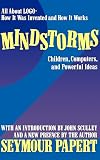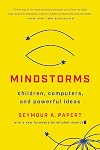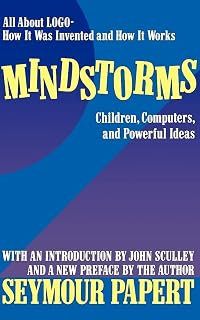
Mindstorms: Children, Computers, And Powerful Ideas
by Seymour Papert
On This Page
Description
A compassionate, reassuring resource for families affected by this ?silent epidemic."Tags
Recommendations











Member Reviews
This book has some five star parts and some four star parts.
The five star parts are where Papert gets into the philosophy that drove the creation of LOGO - his thoughts about how learning occurs, why it's important to empower children to think about their own thinking, and his vision for a "learning society." It reads like a manifesto and goes so much past "hey, let's put computers in schools, it'll be great." He also showed me the power of thinking about environments as sources of "raw materials" for learning. There's certainly a lot more to chew on in these parts, and I need to think more and read it again.
The four star parts, for me, are anecdotes about how LOGO works towards reaching his goals. They're fun but not so inspirational.
The five star parts are where Papert gets into the philosophy that drove the creation of LOGO - his thoughts about how learning occurs, why it's important to empower children to think about their own thinking, and his vision for a "learning society." It reads like a manifesto and goes so much past "hey, let's put computers in schools, it'll be great." He also showed me the power of thinking about environments as sources of "raw materials" for learning. There's certainly a lot more to chew on in these parts, and I need to think more and read it again.
The four star parts, for me, are anecdotes about how LOGO works towards reaching his goals. They're fun but not so inspirational.
After reading the intro, you'll think this was written in 2010 - not 1980! Why and how did these ideas get lost? Why don't school incorporate these ideas as we launch computer science to all US schools? "Why?," I ask.
Interesting ideas about how computers could be used to help children learn math the way they learn to speak. Computers "speak" math natively, and also provide models for thinking about thinking.
Ratings
Members
- Recently Added By
Lists

Bret Victor's Five-Star List
46 works; 5 members

Alan Kay's Reading List
103 works; 3 members

Mind Expanding Books by hackerkid
581 works; 8 members
Author Information

15+ Works 987 Members
Seymour Aubrey Papert was born in Pretoria, South Africa on February 29, 1928. He received doctorates from the University of the Witwatersrand in South Africa and the University of Cambridge in England. After his doctoral work, he spent four years at the University of Geneva exploring both mathematics and children's learning as a researcher for show more Jean Piaget. In 1964, he joined the Massachusetts Institute of Technology faculty and immediately delved into artificial intelligence research with Marvin Minsky. He was a co-director of the renowned Artificial Intelligence Laboratory at the Massachusetts Institute of Technology. Papert and Minsky published Perceptrons: An Introduction to Computational Geometry in 1969. Papert foresaw children using computers as instruments for learning and enhancing creativity well before the advent of the personal computer. In the late 1960's, he created a computer programming language, called Logo, to teach children how to use computers. He wrote several other books including Mindstorms: Children, Computers and Powerful Ideas and Constructionism written with Idit Harel. Papert retired from the faculty at M.I.T. in 1996, but continued to work there as a lecturer and consultant to doctoral students. He died from complications of a series of kidney and bladder infections on July 31, 2016 at the age of 88. (Bowker Author Biography) show less
All Editions
Common Knowledge
- Canonical title*
- Mindstorms: bambini, computers e creatività
- Original title
- Mindstorms: children, computers, and powerful ideas
- Alternate titles*
- I bambini e il computer
- Original publication date
- 1990
- Original language
- English
*Some information comes from Common Knowledge in other languages. Click "Edit" for more information.
Classifications
Statistics
- Members
- 594
- Popularity
- 49,660
- Reviews
- 4
- Rating
- (4.29)
- Languages
- 8 — Dutch, English, Finnish, French, German, Italian, Spanish, Swedish
- Media
- Paper, Ebook
- ISBNs
- 20
- ASINs
- 7