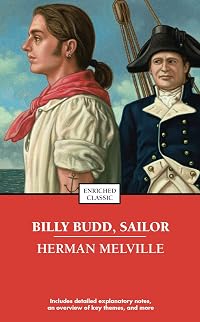
Billy Budd
by Herman Melville 
There is 1 current discussion about this work.
On This Page
Description
In 1797, young Billy Budd is impressed into naval service. It is a perilous time for a British Royal Navy still reeling from mutinies and marauding French ships. When Billy is forcibly transferred to HMS Bellipotent, he evokes the wrath of John Claggart, the ship's Master-at-arms. Claggart falsely accuses Billy of conspiracy to mutiny, a charge that will have a profound effect on the fates of both seamen.Tags
Recommendations















Member Recommendations
Member Reviews
When a friend of mine from high school couldn't sell this book back at the end of the year and threatened to throw it out instead, I happily offered to take it off of his hands and save it from the bin. I mean, I have always been a fan of free books and I prided myself on being able to read and enjoy literature that frustrated and bored others. It turns out I should have let him throw the book in the trash can no matter how free it was. If Ahab had been real (and yes, I know that this is not Moby-Dick, which I, in fact, read long ago, and Ahab plays no part here), I would have begged him to take off his wooden leg and beat Melville around the head until he was too insensible to write any more of his dreadfully boring and tormenting show more works. In case I'm being too subtle, this is a roundabout way of admitting that I loathed this novella and short story collection and it took me well over a year to work my way through it, forcing myself all the way, unwilling to let it defeat me.
The longest section of the book is the novella, Billy Budd. The story of a sweet, comely, exceedingly strong, and perfect sailor who in a moment of passion, accidently kills his accuser and therefore must be condemned to hang as per naval law, the tale is full of digressions and philosophical weavings and quite honestly, I was ready to hang this paragon of virtue myself by the end of it all just to be finished. Interpreting Billy as Adam, sinning through no fault of his own but doomed to be punished heavily for that sin or as a Christ figure, making the ultimate sacrifice in order that goodness might triumph over evil, did nothing to make the story more appealing or enjoyable. Perhaps I just don't like allegories, having had this visceral reaction to others as well. But the other stories in the collection were almost as tedious as Billy Budd with the slight advantage that they were shorter. And while I fully appreciate Melville's place in the American literature canon, I'd be happy to be the one to light the fuse and blow him away over the yardarm. (And yes, before any smug and pretentious defenders of literature come out of the woodwork, I do know the difference between canon and cannon and made a deliberate choice here.) show less
The longest section of the book is the novella, Billy Budd. The story of a sweet, comely, exceedingly strong, and perfect sailor who in a moment of passion, accidently kills his accuser and therefore must be condemned to hang as per naval law, the tale is full of digressions and philosophical weavings and quite honestly, I was ready to hang this paragon of virtue myself by the end of it all just to be finished. Interpreting Billy as Adam, sinning through no fault of his own but doomed to be punished heavily for that sin or as a Christ figure, making the ultimate sacrifice in order that goodness might triumph over evil, did nothing to make the story more appealing or enjoyable. Perhaps I just don't like allegories, having had this visceral reaction to others as well. But the other stories in the collection were almost as tedious as Billy Budd with the slight advantage that they were shorter. And while I fully appreciate Melville's place in the American literature canon, I'd be happy to be the one to light the fuse and blow him away over the yardarm. (And yes, before any smug and pretentious defenders of literature come out of the woodwork, I do know the difference between canon and cannon and made a deliberate choice here.) show less
I haven’t read Melville since struggling through Moby Dick in university, and was quite pleasantly surprised to find an interesting collection of short stories with humour, extraordinary characters, exuberant language and psychological analysis.
The approach is certainly not modern, with leisurely and sometimes convoluted sentences that make me think of Henry James. But the irony and comic exaggerations take Melville beyond James to, in places, a style more like that of Charles Dickens. And the variety of tales in this collection was unexpected, from the metaphorical character studies in Billy Budd and Bartleby, to the horror of Benito Cereno, the Encantadas travelogue and then the comical Lightning-Rod Man.
With the great variety, show more the one relative constant is the joy that Melville seems to have in the written language and the pleasure it brought me as a reader. He plays with words and language, even in a sombre story like Billy Budd, in a way that suggests he wants to entertain the reader on more than one level. A reader in the late nineteenth and early twentieth centuries, of course, with a smaller publishing output and fewer activities competing for entertainment time, could take the time for literary games. I won’t say that I stopped to work out the allusions in every sentence, but I did enjoy slowing down and reading the book of the pleasure of the prose. I don’t want it to sound like the stories are tediously dense; it is merely that they reward a slower contemplative read.
Melville brings an interesting variety of social themes into his stories. Billy Budd, for example, is an allegory of innocence destroyed by war. Billy is set up by a superior officer on a British ship that is technically in a war zone. Because of a stutter, he is unable to defend himself, and naval regulations require his hanging. Melville points out that he could have been saved, but the ship’s captain, while reluctant, feels he has to carry out the regulations to the letter to impose crew discipline. This is absurd and horrific as everyone can see, but Billy becomes an innocent victim of the logic of war. It’s also a touching story of a sympathetic character and Melville leaves the reader with a sense of loss.
The Encantadas series is also an interesting read, an exotic travelogue with atmospheric descriptions of the islands and the stories of its few inhabitants. It’s curious that Melville never went to the islands, but simply rewrote stories he found in other publications, although he writes very convincingly in the first person. It appears that he was less interested in inventing stories than in putting them to language and engaging the reader. As a meditation on the hard struggles to survive in the islands, Melville reflects that we are all in an existential struggle – a theme that remains relevant for modern readers.
Benito Cereno runs as a horror story of its time, like a movie about unsuspecting travellers checking into a murderous town. Set on a ship in an isolated cove, I imagine the story would be quite chilling for nineteenth century readers who could see themselves defenceless at sea and becoming increasingly fearful as they slowly come to realize that they are facing a vicious opponent. Unfortunately, for a modern reader, the grotesque racist characterizations of the African crew they are facing make it hard to empathize. In fact, my sympathies tended to be with the Africans, which I think is not what Melville intended.
Next to these, the smaller pieces, The Piazza, The Lightning-Rod Man and The Bell Tower, are a bit lighter although equally enjoyable. The Lightening Rod Man is quite funny, reminding me of a parody advertisement of a television huckster, had Melville known what such a thing is. All in all, this was an enjoyable collection, and a reminder to slow down and just enjoy the prose even if the story line itself is far from anything we would encounter in modern life. show less
The approach is certainly not modern, with leisurely and sometimes convoluted sentences that make me think of Henry James. But the irony and comic exaggerations take Melville beyond James to, in places, a style more like that of Charles Dickens. And the variety of tales in this collection was unexpected, from the metaphorical character studies in Billy Budd and Bartleby, to the horror of Benito Cereno, the Encantadas travelogue and then the comical Lightning-Rod Man.
With the great variety, show more the one relative constant is the joy that Melville seems to have in the written language and the pleasure it brought me as a reader. He plays with words and language, even in a sombre story like Billy Budd, in a way that suggests he wants to entertain the reader on more than one level. A reader in the late nineteenth and early twentieth centuries, of course, with a smaller publishing output and fewer activities competing for entertainment time, could take the time for literary games. I won’t say that I stopped to work out the allusions in every sentence, but I did enjoy slowing down and reading the book of the pleasure of the prose. I don’t want it to sound like the stories are tediously dense; it is merely that they reward a slower contemplative read.
Melville brings an interesting variety of social themes into his stories. Billy Budd, for example, is an allegory of innocence destroyed by war. Billy is set up by a superior officer on a British ship that is technically in a war zone. Because of a stutter, he is unable to defend himself, and naval regulations require his hanging. Melville points out that he could have been saved, but the ship’s captain, while reluctant, feels he has to carry out the regulations to the letter to impose crew discipline. This is absurd and horrific as everyone can see, but Billy becomes an innocent victim of the logic of war. It’s also a touching story of a sympathetic character and Melville leaves the reader with a sense of loss.
The Encantadas series is also an interesting read, an exotic travelogue with atmospheric descriptions of the islands and the stories of its few inhabitants. It’s curious that Melville never went to the islands, but simply rewrote stories he found in other publications, although he writes very convincingly in the first person. It appears that he was less interested in inventing stories than in putting them to language and engaging the reader. As a meditation on the hard struggles to survive in the islands, Melville reflects that we are all in an existential struggle – a theme that remains relevant for modern readers.
Benito Cereno runs as a horror story of its time, like a movie about unsuspecting travellers checking into a murderous town. Set on a ship in an isolated cove, I imagine the story would be quite chilling for nineteenth century readers who could see themselves defenceless at sea and becoming increasingly fearful as they slowly come to realize that they are facing a vicious opponent. Unfortunately, for a modern reader, the grotesque racist characterizations of the African crew they are facing make it hard to empathize. In fact, my sympathies tended to be with the Africans, which I think is not what Melville intended.
Next to these, the smaller pieces, The Piazza, The Lightning-Rod Man and The Bell Tower, are a bit lighter although equally enjoyable. The Lightening Rod Man is quite funny, reminding me of a parody advertisement of a television huckster, had Melville known what such a thing is. All in all, this was an enjoyable collection, and a reminder to slow down and just enjoy the prose even if the story line itself is far from anything we would encounter in modern life. show less
I went into this one blind other than suspecting that it would have something to do with ships and sailing, and what I got was that, but also a story about the unfairness of Rules, the power of rumor, and a fantastic character study. And Melville could craft a sentence.
I like this book though, like "Lord Jim", that I recently read, I had to get used to the writing style all over again. The sentences are long, and need concentration in order to understand. Yet, in this book, they convey an almost lyrical, poetic quality to the story, and you feel the emotion and the atmosphere of the scenes that Melville creates.
The tragedy of Billy Budd does stay on - an abandoned child, illiterate, good-looking, almost innocent in his persona, condemned to death for one mistake made in panic, over a charge that was patently false, and made with malicious intent.
Is this an allegory on life as well? As an old coach once said, 'Life is not fair. Neither is it fair. It is what it is'.
Having said that, innocent die and show more the world forgets those who are not in positions of power. This is clearly demonstrated in the epilogue.
The book could have been written in a style that is angry and bitter. Yet, the lyrical quality of the writing makes the tale even more poignant. show less
The tragedy of Billy Budd does stay on - an abandoned child, illiterate, good-looking, almost innocent in his persona, condemned to death for one mistake made in panic, over a charge that was patently false, and made with malicious intent.
Is this an allegory on life as well? As an old coach once said, 'Life is not fair. Neither is it fair. It is what it is'.
Having said that, innocent die and show more the world forgets those who are not in positions of power. This is clearly demonstrated in the epilogue.
The book could have been written in a style that is angry and bitter. Yet, the lyrical quality of the writing makes the tale even more poignant. show less
A good friend introduced me to an alternative reading of this novel, in which the narrator is obsessed with upholding the heroic myth of Billy Budd. Every incident is spun out by the narrator to show Billy in the most positive light possible, and Claggart as his evil opposite. If you look closely at the text for the 'facts' of the story though there's not a shred of evidence to support this romantic view of Billy.
In fact, reading between the lines, it's possible to read Claggart as a basically decent man stuck in an impossible situation, and Billy as a charismatic psychopath with a tyrannical grip on his shipmates.
A benefit of this interpretation is that it makes sense of the circumlocutions of the narrator's dialogue, as he turns show more somersaults trying to maintain the myth of The Handsome Sailor.
It's also an appropriately cynical response from an author near the end of his life, looking back at the success of his earlier, more romantic, adventure stories. show less
In fact, reading between the lines, it's possible to read Claggart as a basically decent man stuck in an impossible situation, and Billy as a charismatic psychopath with a tyrannical grip on his shipmates.
A benefit of this interpretation is that it makes sense of the circumlocutions of the narrator's dialogue, as he turns show more somersaults trying to maintain the myth of The Handsome Sailor.
It's also an appropriately cynical response from an author near the end of his life, looking back at the success of his earlier, more romantic, adventure stories. show less
I just read Billy Budd for the first time since college. Budd, the protagonist of this novella, is a symbol of innocence, and makes a better symbol than a character. His retains his innocence and simplicity (he is also illiterate and uneducated) throughout the story, and that naturally makes him lack any complexity. Assuming we're meant to take Budd's innocence completely seriously, as a Christian reader I find Budd a chimerical figure because I know no one in this sinful world is ever innocent. This story is supposed to be a parable, but parables should reflect reality.
All other aspects of the story are much less problematic. John Claggart and Captain Vere are
Melville's novel, for being a story of the sea, is far from an action story. It is, instead a psychological character sketch of three men: Billy Budd, Captain Vere, and Claggert. While Melville makes many biblical references, I wonder at his theology and appropriateness of his allusions at times. I would like to know what his knowledge of the Bible was and from what perspective he saw the story of the garden (it seems he deems it a myth) as well as Abraham and ultimately Jesus. Clearly Billy is a Christ-figure or else Melville is clumsy.
No doubt, it is a hard read, but the moral dilemma facing Vere and the others is one that all humanity needs to wrestle with: what is justice and what is its role in the midst of a moral quagmire? A show more highly enjoyable and short novel that can be read in a day but mulled over for much, much longer. show less
No doubt, it is a hard read, but the moral dilemma facing Vere and the others is one that all humanity needs to wrestle with: what is justice and what is its role in the midst of a moral quagmire? A show more highly enjoyable and short novel that can be read in a day but mulled over for much, much longer. show less
Members
- Recently Added By
Lists

1001 Books You Must Read Before You Die
1,448 works; 1,134 members

Classics you know you should have read but probably haven't
421 works; 409 members

water on the brain: maritime fiction
74 works; 18 members

Pre-1969 LGBTQ Literature
182 works; 69 members

Harold Bloom - The Western Canon: C. The Democratic Age
336 works; 15 members

Best Sea Stories
33 works; 5 members

Lithub: 50 Great Classic Novels Under 200 pages
50 works; 10 members

Western World's Greatest Books - Project Gutenberg
295 works; 15 members

Short and Sweet
246 works; 24 members

1920s
141 works; 6 members

Books Read in 2023
5,638 works; 147 members

Top 10 Dodgy Lawyers in Literature
10 works; 2 members

Short Stories, Tales and Novellas
31 works; 1 member

100 World Classics
99 works; 15 members

Shaykh Hamza's Book Recommendations
439 works; 3 members

How to Read a Book's Recommended Reading List
309 works; 10 members

End of Your Life Book Club
134 works; 4 members

Greatest Books, allegedly
484 works; 9 members

AP Lit
363 works; 6 members

GreatBooks Worldview Academy Lists
133 works; 4 members

Read
293 works; 4 members
Recommended Reading : 600 Classics Reviewed, Editors of Salem Press, 2015
634 works; 6 members

Books in The Club Dumas
72 works; 1 member

Books Read in 2025
4,128 works; 98 members

Fiction with Men's Given Names in the Title
302 works; 11 members
Talk Discussions
Current Discussions
Pennyroyal Press "Billy Budd" in Fine Press Forum (December 2025)
Past Discussions
Billy Budd in Fine Press Forum (March 2022)
Author Information

658+ Works 78,576 Members
Herman Melville (August 1, 1819 - September 28, 1891) was born into a seemingly secure, prosperous world, a descendant of prominent Dutch and English families long established in New York State. That security vanished when first, the family business failed, and then, two years later, in young Melville's thirteenth year, his father died. Without show more enough money to gain the formal education that professions required, Melville was thrown on his own resources and in 1841 sailed off on a whaling ship bound for the South Seas. His experiences at sea during the next four years were to form in part the basis of his best fiction. Melville's first two books, Typee (1846) and Omoo (1847), were partly romance and partly autobiographical travel books set in the South Seas. Both were popular successes, particularly Typee, which included a stay among cannibals and a romance with a South Sea maiden. During the next several years, Melville published three more romances that drew upon his experiences at sea: Redburn (1849) and White-Jacket (1850), both fairly realistic accounts of the sailor's life and depicting the loss of innocence of central characters; and Mardi (1849), which, like the other two books, began as a romance of adventure but turned into an allegorical critique of contemporary American civilization. Moby Dick (1851) also began as an adventure story, based on Melville's experiences aboard the whaling ship. However, in the writing of it inspired in part by conversations with his friend and neighbor Hawthorne and partly by his own irrepressible imagination and reading of Shakespeare and other Renaissance dramatists Melville turned the book into something so strange that, when it appeared in print, many of his readers and critics were dumbfounded, even outraged. By the mid-1850s, Melville's literary reputation was all but destroyed, and he was obliged to live the rest of his life taking whatever jobs he could find and borrowing money from relatives, who fortunately were always in a position to help him. He continued to write, however, and published some marvelous short fiction pieces Benito Cereno" (1855) and "Bartleby, the Scrivener" (1853) are the best. He also published several volumes of poetry, the most important of which was Battle Pieces and Aspects of the War (1866), poems of occasionally great power that were written in response to the moral challenge of the Civil War. His posthumously published work, Billy Budd (1924), on which he worked up until the time of his death, became Melville's last significant literary work, a brilliant short novel that movingly describes a young sailor's imprisonment and death. Melville's reputation, however, rests most solidly on his great epic romance, Moby Dick. It is a difficult as well as a brilliant book, and many critics have offered interpretations of its complicated ambiguous symbolism. Darrel Abel briefly summed up Moby Dick as "the story of an attempt to search the unsearchable ways of God," although the book has historical, political, and moral implications as well. Melville died at his home in New York City early on the morning of September 28, 1891, at age 72. The doctor listed "cardiac dilation" on the death certificate. He was interred in the Woodlawn Cemetery in The Bronx, New York, along with his wife, Elizabeth Shaw Melville. (Bowker Author Biography) show less
Herman Melville has a Legacy Library. Legacy libraries are the personal libraries of famous readers, entered by LibraryThing members from the Legacy Libraries group.
All Editions
Some Editions
Awards and Honors
Series
Belongs to Publisher Series
Work Relationships
Is contained in
Pierre, Israel Potter, The Piazza Tales, The Confidence-Man, Uncollected Prose, Billy Budd by Herman Melville
Four Classic American Novels (The Scarlet Letter / The Adventures of Huckleberry Finn / The Red Badge of Courage / Billy Budd) by Willard Thorp
Herman Melville: Moby Dick, Billy Budd and Other Writings (Library of America College Editions) by Herman Melville
Has the adaptation
Is abridged in
Is expanded in
Inspired
Has as a reference guide/companion
Has as a study
Twentieth Century Interpretations of Billy Budd (Twentieth Century Interpretations) by Howard Paton Vincent
The Exceptionalist State and the State of Exception : Herman Melville's Billy Budd, Sailor by William V. Spanos
Has as a supplement
Has as a commentary on the text
Has as a student's study guide
Common Knowledge
- Canonical title
- Billy Budd
- Original title
- Billy Budd, Foretopman
- Alternate titles
- Billy Budd, Sailor (an inside narrative) (an inside narrative)
- Original publication date
- 1924
- People/Characters
- Billy Budd; Lieutenant Ratcliffe; Captain Graveling; Captain Edward Fairfax Vere; John Claggart
- Important places
- Liverpool, England, UK
- Important events
- Nore Mutiny (1797 | the Great Mutiny)
- Related movies
- Billy Budd (1962 | IMDb); Billy Budd (1980 | IMDb); Billy Budd (1988 | IMDb); Billy Budd (1998 | IMDb)
- Dedication
- Dedicated
to
JACK CHASE
Englishman
Wherever that great heart may now be
Here on Earth or harbored in Paradise
Captain of the Maintop
in the year 1843
in the U.S. Frigate
United States... (show all) - First words
- In the time before steamships, or then more frequently than now, a stroller along the docks of any considerable seaport would occasionally have his attention arrested by a group of bronzed mariners, man-of-war's men or mercha... (show all)nt sailors in holiday attire, ashore on liberty.
- Quotations
- The Chaplain is the minister of the Prince of Peace, serving in the host of the God of War - Ares.
Forty years after a battle it is easy for a noncombatant to reason about how it ought to have been fought. It is another thing personally and under fire to have to direct the fighting while involved in the obscuring smoke of ... (show all)it. - Last words
- (Click to show. Warning: May contain spoilers.)I am sleepy, and the oozy weeds about me twist.
- Original language
- English
Classifications
Statistics
- Members
- 3,014
- Popularity
- 5,917
- Reviews
- 60
- Rating
- (3.36)
- Languages
- 18 — Catalan, Chinese, Danish, Dutch, English, Estonian, Finnish, French, German, Galician, Greek, Italian, Polish, Portuguese, Slovenian, Spanish, Swedish, Turkish
- Media
- Paper, Audiobook, Ebook
- ISBNs
- 225
- UPCs
- 3
- ASINs
- 85