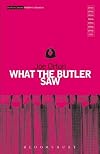
What the Butler Saw
by Joe Orton
On This Page
Description
Orton's final and most accomplished play, completed in July 1967 but which he was never to see performed, is considered a comedy classic. In it a couple each succeed in private seductions, and then frantically try to hide their prizes from each other and the inspector.Tags
Recommendations






















Member Reviews
Reminiscent of a French farce or an extended Monty Python sketch... I found it hilarious but some may find the jokes about rape in poor taste. Since no one was actually raped, it didn't bother me.
Reminiscent of a French farce or an extended Monty Python sketch... I found it hilarious but some may find the jokes about rape in poor taste. Since no one was actually raped, it didn't bother me.
Farce leaves me cold, even when it's turned on its head.
After rereading Loot earlier in the week I couldn't resisit Orton's masterpiece, the funniest play in the language.
Ratings
Members
- Recently Added By
Lists

Hulk's Essential Reading List
38 works; 1 member

My Play Collection
769 works; 3 members
Author Information

30+ Works 2,179 Members
Born in Leicester, Orton trained as an actor but soon turned to writing plays instead. Before his career had barely begun, however, he was murdered by his homosexual lover, apparently in a fit of jealousy over his success. Orton's shocking murder is too easily made the biographical focus for discussion of his plays, devoted as they are to the show more grotesque, the perverse, and the violent. A more relevant landmark in the playwright's life might be the jail term he served for the bizarre crime of defacing library books, replacing illustrations with uproarious collages, and rewriting jacket blurbs in "mildly obscene" parodies of journalistic cliche. Assaulting the cultural consumer by transposing familiar icons and vocabulary was the key to Orton's theatrical method. But it was supplemented by a growing verbal power and stage imagery with aspirations to myth. As Orton's literary powers grew, so did the outrage of social response. The Pinterian ambiance and language of his first works, Entertaining Mr. Sloan (1964) and the radio play The Ruffian on the Stair (1966), were well received. Sloane was chosen best new British play of 1964 and won the blessing of Terence Rattigan himself. But Loot, joking with death, religion, sex, and family, proved more disturbing (it involves a slapstick charade centered on a corpse and a coffin). The first production, directed by Peter Wood, closed on tour without reaching London. It was not until 1966 that the play was staged, to acclaim, in Charles Marowitz's fringe theater. In 1969, What the Butler Saw failed in the West End, despite a cast of many famous names, including Ralph Richardson. Only the Royal Court revival of 1975 gave Orton's undoubted masterpiece its due. But by then the playwright had been dead for eight years. In the phallic epiphany with which Butler ends, as in his version of Euripides' Bacchae, The Erpingham Camp (1965), Orton calls attention to his Dionysian ambitions, his serious use of farce as a means of disruption and liberation. His last plays, in which violent animal spirits subvert dialogue of extreme, even Victorian, formality and outrageous authority figures, represent probably the greatest comic achievement of contemporary British drama. show less
Series
Belongs to Publisher Series
Modern Plays {Methuen} (Orton)
Work Relationships
Is contained in
Has as a student's study guide
Classifications
Statistics
- Members
- 195
- Popularity
- 168,119
- Reviews
- 5
- Rating
- (3.63)
- Languages
- Bable, English
- Media
- Paper, Ebook
- ISBNs
- 9
- ASINs
- 4