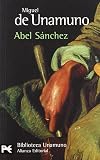
Abel Sánchez
by Miguel de Unamuno
On This Page
Description
"Miguel de Unamuno (1864-1936) is the towering intellectual giant of early twentieth-century Spain. He wrote novels, plays, poetry and many essays, but is best remembered for his fictional works and for his major philosophical meditation on the nature of existence. Abel Sanchez was published in 1917 and is perhaps Unamuno's most harrowing novel. Consisting mainly of dialogue it narrates the life of one man, Abel Sanchez, and his problematical relationship with his friend, Joaquin. Abel show more becomes more sucessful than Joaquin and is happier, and parallels are drawn between the Biblical story of Cain and Abel. At the end of the novel after a lifetime of torment Joaquin grabs Abel, who has a weak heart, by the throat and he dies; Joaquin himself dies shortly afterwards. In its concentration on issues of identity, personality and the insecurities of existence, it stands out amoung Unamuno's works as a profoundly unsettling account of man's existence and his relationship to other people. John Macklin's edition provides a new English translation alongside the Spanish text, together with a substantial introduction." --Book Jacket. show lessTags
Recommendations































Member Recommendations


CGlanovsky The story of Cain and Abel reimagined in a more modern setting
Member Reviews
X
La envidia de la virtud
hizo a Caín criminal.
¡Gloria a Caín! Hoy el vicio
es lo que se envidia más.
Antonio Machado
(Proverbios y Cantares.
Campos de Castilla)
Recreación e interpretación del mito de Caín y Abel. Reflexiones propias de la obra unamuniana: el libre albedrío, Dios, la religión, la eternidad, el amor, la misantropía, el arrepentimiento, la moral, las convenciones sociales,… Pero el tema principal de la obra es la envidia. La envidia como acicate y motor para la vida pero también como tortuoso freno de una vida plena, o al menos con aspiraciones de ser dichosa.
En las historias piadosas se ha ensalzado a Abel frente al malvado Caín, pero ha sido éste último el que a lo largo de la historia ha interesado y show more subyugado a pintores y escritores. Algo así debió suceder a Unamuno pese al engañoso título; siendo el protagonista de la obra el amigo y adversario de Abel Sánchez, esto es Joaquín Montenegro. Aunque a través de la emociones de éste el autor analice la idiosincrasia de Abel. Una mirada profunda acerca de las atormentadas motivaciones de Joaquín-Caín, de su grandeza en su miseria, de su pasión insana.
La novela va creciendo capítulo a capítulo en torno a un mismo leitmotiv, la envidia, diversificándose la trama psicólogica gracias a la aparición de personajes que giran siempre alrededor del protagonista, aunque para éste nunca nada es suficiente pues los celos, la envidia le corroen: «una especie de personaje trágico, de ánimo torturado de hondas pasiones. “¡Si se pudiera pintar el alma de Joaquín!”.» (Cap. XXV) show less
I could not find anything really captivating or enlightening about this text, and I do not suppose that the topic was more engaging a hundred years ago. To make the reader work hard to get at the core of the presented problem, a book has to offer more than a vapid case study.
Also, what I perceived as a mixture of fairy tale / fable style with the biblical narrative got on my nerves quite quickly.
I will allow though that I may have missed much of what made this book lacking the necessary Sprachgefühl and context. So, go on, click on it.
UPGRADE:
Some context going in:
"It could be said, then, that when composing Abel Sánchez Miguel de Unamuno is already in possession of a (extremely) personal novelistic style, crystallized in what he show more called “nivolas:” novels which escape 19th-century realism by suppressing almost completely any reference to specific spaces and times; by creating deliberately flat characters defined by a chosen set of qualities and who maintain them throughout the whole novel; and by giving more importance to the development of an idea, than to the aesthetic form or narrative structure through which that idea is developed." (A Spanish incarnation of ‘Cain’: Miguel de Unamuno’s Abel Sánchez, Pérez Isasi, Santiago (2011), in "Villains and Villainy", I.D.Press (eBook).
So, yes, flat characters as personification of ideas, ideas over narrative structure and aesthetic form: at this stage we are incompatible. I don't like ideas thus transmitted. show less
Also, what I perceived as a mixture of fairy tale / fable style with the biblical narrative got on my nerves quite quickly.
I will allow though that I may have missed much of what made this book lacking the necessary Sprachgefühl and context. So, go on, click on it.
UPGRADE:
Some context going in:
"It could be said, then, that when composing Abel Sánchez Miguel de Unamuno is already in possession of a (extremely) personal novelistic style, crystallized in what he show more called “nivolas:” novels which escape 19th-century realism by suppressing almost completely any reference to specific spaces and times; by creating deliberately flat characters defined by a chosen set of qualities and who maintain them throughout the whole novel; and by giving more importance to the development of an idea, than to the aesthetic form or narrative structure through which that idea is developed." (A Spanish incarnation of ‘Cain’: Miguel de Unamuno’s Abel Sánchez, Pérez Isasi, Santiago (2011), in "Villains and Villainy", I.D.Press (eBook).
So, yes, flat characters as personification of ideas, ideas over narrative structure and aesthetic form: at this stage we are incompatible. I don't like ideas thus transmitted. show less
Aquí, Unamuno expone y se extiende en sus dudas sobre el odio. Abel Sánchez le levanta la novia a su amigo de toda la vida Joaquín Monegro. Esto hará que Monegro cultive en su interior un rencor que le entenebrecerá el alma durante toda su vida y que se extenderá a casi todo lo que toque, incluyendo su mujer, su hija y su nieto, que lo será también del propio Abel Sánchez ya que el mismo Monegro planea la boda de su hija con el hijo de Sánchez al que, para más inri, hace su discípulo (Monegro es médico, y Sánchez pintor). Como de costumbre, desde el plan general de la novela hasta el último de sus diálogos, todo está enfocado a las reflexiones del autor bilbaino, en este caso sobre el odio humano, y también sobre la show more envidia, hasta el punto de que Monegro, que es el personaje a través del cual se nos cuenta la historia, no puede distinguir una de otro. Es una historia muy triste, negra, que mueve a reflexión aunque, también como es usual, Unamuno no acaba de dar ninguna respuesta. Desde luego, en este caso no hay respuesta que dar, porque no sabemos de dónde viene el odio. show less
Dec 18, 2010Spanish
El autor escoge en este libro el tema de la envidia y el odio. Insiste en que Abel Sánchez no es una historia libresca, sino que está sacada de la vida social que siente y sufre en torno suyo.
Mar 30, 2014Spanish
Es la historia de dos hombres, hermanos de crianza situada en España de principios de siglo. Las miserias humanas expuestas en una relación marcada por la envidia y el odio pintan el cuadro de situación general que se vivía previo a la Guerra Civil.
Apr 16, 2016Spanish
Santi Conclusión: El primer asesinato, el de Abel por Caín, fue inducido por AAbel, incluso envidiado y buscado por él. El bueno es CAÍN.
Dec 13, 2021Catalan
Members
- Recently Added By
Lists

First published in 1917
132 works; 3 members

Canon de la narrativa universal del s. XX (cicutadry)
499 works; 3 members
Author Information

371+ Works 7,408 Members
Miguel de Unamuno y Jugo was born in Bilbao, Spain on September 29, 1864. He received a doctorate in philosophy and letters from the University of Madrid in 1884. He became a professor of Greek language and literature at the University of Salamanca in 1891. Although he also wrote poetry and plays, Unamuno was primarily known as an essayist and show more novelist. His works include The Life of Don Quixote and Sancho, The Tragic Sense of Life, and The Agony of Christianity. His novels include Peace in War, Mist, and Abel Sanchez. He took a controversial, vocal stance on political and social issues. He was removed as rector of the University of Salamanca in 1914 after publicly espousing the Allied cause in World War I. He was forced into exiled in 1924 because of his opposition to General Miguel Primo de Rivera's rule in Spain. When Primo de Rivera's dictatorship fell, Unamuno returned to the University of Salamanca and was reelected rector of the university in 1931. He was removed again in October 1936 after he denounced General Francisco Franco's Falangists and was placed under house arrest. He died of a heart attack on December 31, 1936. (Bowker Author Biography) show less
Some Editions
Awards and Honors
Series
Belongs to Publisher Series
Work Relationships
Is contained in
Common Knowledge
- Canonical title*
- Abel Sánchez. Una historia de pasión
- Original title
- Abel Sánchez. Una historia de pasión
- Original publication date
- 1917
- Blurbers
- Valdes, Mario J.
- Original language*
- Español
*Some information comes from Common Knowledge in other languages. Click "Edit" for more information.
Classifications
- Genres
- Fiction and Literature, General Fiction
- DDC/MDS
- 868.6209 — Literature & rhetoric Spanish Literature Spanish miscellaneous writings 20th Century 1900-1945
- LCC
- PQ6639 .N3 .A7 — Language and Literature French, Italian, Spanish and Portuguese literatures Spanish literature Individual authors, 1868-1960
- BISAC
Statistics
- Members
- 328
- Popularity
- 96,850
- Reviews
- 9
- Rating
- (3.85)
- Languages
- 13 — Basque, Czech, Danish, Dutch, English, Estonian, French, German, Polish, Portuguese, Russian, Spanish, Swedish
- Media
- Paper, Ebook
- ISBNs
- 68
- UPCs
- 2
- ASINs
- 10