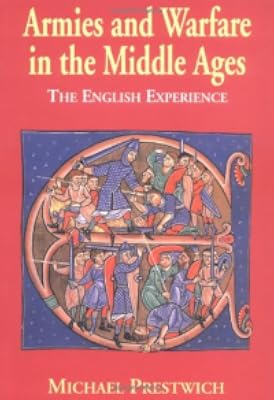
Armies and Warfare in the Middle Ages: The English Experience
by Michael Prestwich
On This Page
Description
Medieval warfare was hard, gruelling and often unrewarding. While military life in this era is sometimes pictured in terms of knights resplendent in armour and bearing colourful standards and coats of arms, the reality more often consisted of men struggling against cold, damp and hunger, pressing elusive foes who refused to do battle. In this fascinating book, Michael Prestwich re-creates the real experience of medieval warfare, examining how men of all ranks of society were recruited, how show more troops were fed, supplied, and deployed, the development of new weapons, and the structures of military command. Michael Prestwich challenges many common assumptions about medieval warfare. He shows that medieval commanders were capable of far more sophisticated strategy than is usually assumed: spies were an important part of the machinery of war, and the destruction of crops and burning of villages were part of a deliberate plan to force a foe to negotiate, rather than an indication of lack of discipline. Sieges, often lengthy and expensive, were more prevalent than physical battles. And in actual engagement the mounted knight was never as dominant as is often supposed: even in the twelfth century, many battles were won by unmounted men. Medieval warfare was not, on the whole, any more chivalric than warfare of other periods, although there were many instances of individual heroism, particularly during the Hundred Years War, that brought glory and renown to those who performed them. show lessTags
Recommendations









Member Reviews
I finished reading this last night and found it to be a fascinating look at the nature of warfare in England during the Middle Ages. Prestwich focuses on he how-to's of war, rather than actual combat, though there is some space devoted to that as well.
Prestwich gives most attention to the question of whether there is a period of "revolution" in the history of warfare, and particularly whether that occurs during the Medieval period. He questions the premises of historians that preceded him, and concludes that though there was some change in warfare in the Middle Ages, it was not always for the best, and indeed not revolutionary.
Prestwich gives most attention to the question of whether there is a period of "revolution" in the history of warfare, and particularly whether that occurs during the Medieval period. He questions the premises of historians that preceded him, and concludes that though there was some change in warfare in the Middle Ages, it was not always for the best, and indeed not revolutionary.
This is an excellent and enlightening look on English Medieval warfare. Prestwich has definitely done his research on his subject. The work challenges myths and assumtions that many modern readers have about warfare in the Middle Ages. Prestwich gives good detail about the logistics of armies, such as recruitment, supplying and feeding, and tactics. The ideas of chivalric knights in shining armor at jousts and tournaments that some people might envision is replaced by cold, hard data and some contemporary statistics of daily operations of armies in the field.
Ratings
Members
- Recently Added By
Author Information

18+ Works 1,124 Members
Michael Prestwich is Emeritus Professor of History at Durham University.
Common Knowledge
- Original publication date
- 1996
- People/Characters
- Edward I, King of England; Edward II, King of England; Edward III, King of England; Edward the Black Prince; John of Gaunt, Duke of Lancaster; Henry of Grosmont, duke of Lancaster (show all 18); Henry II, King of England; Henry III, King of England; Henry V, King of England; John, King of England; Robert Knolles; Henry de Lacy, Earl of Lincoln; William Marshal, 1st Earl of Pembroke; Simon de Montfort; Richard I, King of England; Robert I Bruce, king of Scotland; Stephen, King of England; William the Conqueror
- Important places
- England, UK; Berwick-upon-Tweed, Northumberland, England, UK; Flanders, Belgium; Lincoln, Lincolnshire, England, UK; Normandy, France; Weardale, County Durham, England, UK
- Important events
- Battle of Agincourt; Battle of Bannockburn; Siege of Calais; Battle of Crécy; Battle of Evesham; Battle of Falkirk, 1298 (show all 7); Battle of Poitiers
- First words
- Preface
The history of the medieval army is very different from that of more modern forces.
It is not easy to recapture the reality of medieval war. - Blurbers
- Palmer, J. J. N.; Keen, Maurice
- Original language
- English
Classifications
- Genres
- History, Nonfiction, General Nonfiction
- DDC/MDS
- 355.3 — Society, government, & culture Public administration & military science The Military - Land, Air & Sea / Warfare Organization and personnel of military forces
- LCC
- UA647 .P69 — Military Science Armies: Organization, distribution, military situation Armies: Organization, distribution, military situation By region or country
- BISAC
Statistics
- Members
- 163
- Popularity
- 201,692
- Reviews
- 2
- Rating
- (3.61)
- Languages
- English
- Media
- Paper, Ebook
- ISBNs
- 3
- ASINs
- 3