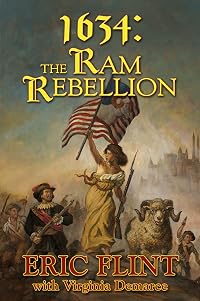
1634: The Ram Rebellion
by Eric Flint
Assiti Shards (4), Ring of Fire reading order / per Eric Flint (8)
On This Page
Description
The Thirty Years War continues to ravage 17th century Europe, but a new force is gathering power and influence: the Confederated Principalities of Europe, an alliance between Gustavus Adolphus, King of Sweden, and the West Virginians from the 20th century led by Mike Stearns who were hurled centuries into the past by a mysterious cosmic accident. Inspired by the example of American freedom and justice, a movement in Franconia among the peasants, who have revolted several times even before show more the arrival from the future of the town of Grantville, an independent revolutionary movement has arisen, flying the banner of the head of a ram. The West Virginians fully approve of liberating the peasants from the nobility, but they are also aware of how revolutionary movements can lead to bloodbaths. And avoiding that deadly possibility will require all of their future knowledge and all their plain old American horse-trading diplomacy... show lessTags
Recommendations

Member Reviews
Originally posted at Forest Azuaron.
The most important thing to know about The Ram Rebellion is that it isn't a novel, but a series of short stories on the same topic (The Ram Rebellion) that culminate into a novella, and these shorts are not written by the same authors. The result is that the story quality is incredibly uneven; some are quite good, and some are quite bad.
The second most important thing to know is that the rebellion doesn't actually occur until half-way through the ending novella; or, to put it another way, 600 pages into a 700 page mass market paperback.
To be perfectly upfront, I'm not a short story guy. If they're good, then I would have liked to spend more time with them. If they're bad, well, then they're bad. Which show more makes my interest in the Ring of Fire series unfortunate, since they are more short stories far outnumber the novels--I've lost count of Grantville Gazettes and Ring of Fire anthologies that have been published. Then, to open up what I expected to be a novel and find short stories instead...
Now that I've exposed my own biases, let's move on to actually reviewing the book. It's divided into four parts (three sets of shorts, followed by the novella), so I'll divide my review accordingly.
Part One: Recipes for Revolution
There's two stories of note in this part: Birdie's Farm and Birdie's Village, both by Gorg Huff and Paula Goodlett. The other three (all by Eric Flint) are connective tissue that tie the stories into the larger context of Grantville and the Ram Rebellion. The Birdie stories are pretty good, and provide important context for the rebellion, assuming you're interested in 17th century property ownership, tenantship, and legal minutia, which I am, but I assume I'm in the minority on that.
Part Two: Enter the Ram
The first three stories, all by some combination of Paula Goodlett, Virginia DeMarce, Stanley Leghorn, Rick Boatright, Kerryn Offord, and Laura Runkle, deal with the eponymous ram, which at this stage of the story is a literal ram. While I understand where they ultimately went with it, and the symbology that grew out of the ram, the stories about the ram are a dull slog.
The fourth and final story (A Night at the Ballet by Kerryn Offord) might be interesting to ballet aficionados, particularly if they like reading stories written from a first-person perspective that's devoid of all character. All in all, I wish I'd skipped part 2; I don't think I'd have missed anything.
Part Three: The Trouble in Franconia
Finally, we get to the region where a rebellion will occur. There's a lot less cohesion across stories than there is in Parts 1 and 2, but not to the detriment of the whole. If I were to read this book again, I'd probably just read parts 3 and 4, and be happier for it, since this is where we finally get to the root causes and reactions for and against the rebellion. In particular, The Suhl Incident by Eric Flint and John Zeek is probably the best story in the book, a smart combination of political maneuvering and hard action.
Part Four: The Ram Rebellion
Finally, we get to the rebellion! Apparently. Wait, when's this rebellion start? Apparently not for another hundred pages. A few things become clear upon reading part four.
First, that the novella was written independently of the rest of the stories; it stands complete, and can, therefore, be read independently of the rest without losing much.
Second, since it's independent and comes at the "end" of the book, none of the rest of the stories can actually be about the rebellion, but must remain as part of the build-up to the rebellion. This is, quite simply, poor story structure. For quite obvious reasons, the build-up of a story usually shouldn't take more than the first third. If it takes longer, it not only drags on beyond the reader's interest, but forces the compression of the action and pay off, thus reducing their impact.
Third, since it stands complete, the first half is dedicated to, you guessed it, more build-up. Which, if you're reading just The Ram Rebellion, is probably a good thing. But if you've just read the previous 500 pages only to come to the end and get even more build-up...
Overall
I can't recommend The Ram Rebellion. Several of the stories are just plain bad, and even the good ones are stuck amidst a disappointing overall arc. show less
The most important thing to know about The Ram Rebellion is that it isn't a novel, but a series of short stories on the same topic (The Ram Rebellion) that culminate into a novella, and these shorts are not written by the same authors. The result is that the story quality is incredibly uneven; some are quite good, and some are quite bad.
The second most important thing to know is that the rebellion doesn't actually occur until half-way through the ending novella; or, to put it another way, 600 pages into a 700 page mass market paperback.
To be perfectly upfront, I'm not a short story guy. If they're good, then I would have liked to spend more time with them. If they're bad, well, then they're bad. Which show more makes my interest in the Ring of Fire series unfortunate, since they are more short stories far outnumber the novels--I've lost count of Grantville Gazettes and Ring of Fire anthologies that have been published. Then, to open up what I expected to be a novel and find short stories instead...
Now that I've exposed my own biases, let's move on to actually reviewing the book. It's divided into four parts (three sets of shorts, followed by the novella), so I'll divide my review accordingly.
Part One: Recipes for Revolution
There's two stories of note in this part: Birdie's Farm and Birdie's Village, both by Gorg Huff and Paula Goodlett. The other three (all by Eric Flint) are connective tissue that tie the stories into the larger context of Grantville and the Ram Rebellion. The Birdie stories are pretty good, and provide important context for the rebellion, assuming you're interested in 17th century property ownership, tenantship, and legal minutia, which I am, but I assume I'm in the minority on that.
Part Two: Enter the Ram
The first three stories, all by some combination of Paula Goodlett, Virginia DeMarce, Stanley Leghorn, Rick Boatright, Kerryn Offord, and Laura Runkle, deal with the eponymous ram, which at this stage of the story is a literal ram. While I understand where they ultimately went with it, and the symbology that grew out of the ram, the stories about the ram are a dull slog.
The fourth and final story (A Night at the Ballet by Kerryn Offord) might be interesting to ballet aficionados, particularly if they like reading stories written from a first-person perspective that's devoid of all character. All in all, I wish I'd skipped part 2; I don't think I'd have missed anything.
Part Three: The Trouble in Franconia
Finally, we get to the region where a rebellion will occur. There's a lot less cohesion across stories than there is in Parts 1 and 2, but not to the detriment of the whole. If I were to read this book again, I'd probably just read parts 3 and 4, and be happier for it, since this is where we finally get to the root causes and reactions for and against the rebellion. In particular, The Suhl Incident by Eric Flint and John Zeek is probably the best story in the book, a smart combination of political maneuvering and hard action.
Part Four: The Ram Rebellion
Finally, we get to the rebellion! Apparently. Wait, when's this rebellion start? Apparently not for another hundred pages. A few things become clear upon reading part four.
First, that the novella was written independently of the rest of the stories; it stands complete, and can, therefore, be read independently of the rest without losing much.
Second, since it's independent and comes at the "end" of the book, none of the rest of the stories can actually be about the rebellion, but must remain as part of the build-up to the rebellion. This is, quite simply, poor story structure. For quite obvious reasons, the build-up of a story usually shouldn't take more than the first third. If it takes longer, it not only drags on beyond the reader's interest, but forces the compression of the action and pay off, thus reducing their impact.
Third, since it stands complete, the first half is dedicated to, you guessed it, more build-up. Which, if you're reading just The Ram Rebellion, is probably a good thing. But if you've just read the previous 500 pages only to come to the end and get even more build-up...
Overall
I can't recommend The Ram Rebellion. Several of the stories are just plain bad, and even the good ones are stuck amidst a disappointing overall arc. show less
I liked The Ram Rebellion on its own merits - I'm not at all sure I believe 17th-century European peasants would have successfully overthrown the aristocracy had they only had good printing presses, but whatever - but it's primarily interesting because of its structure. It's basically a set of short stories written around a theme - the aforementioned peasant rebellion - with framing sections interspersed to give it something like a narrative flow. The individual sections are a trifle uneven, but it works surprisingly well.
As Eric Flint says himself, this is an odd novel. It's a novel with short stories included. The book starts in 1631, shortly after the ring of fire and goes all the way to 1634. There you get to follow various people in the Grantville vicinity when they try to build a new life. A new life as auditor, ballet instructor or sheep farmer.
It is interesting in a different way than the books that try to describe the big picture and I like the book, but I missed a few thread endings. Maybe they are in a different book, but as this feel like an odd bird I am not so sure about that.
It is interesting in a different way than the books that try to describe the big picture and I like the book, but I missed a few thread endings. Maybe they are in a different book, but as this feel like an odd bird I am not so sure about that.
The Thirty Years War continues to ravage 17th century Europe, but a new force is gathering power and influence: the Confederated Principalities of Europe, an alliance between Gustavus Adolphus, King of Sweden, and the West Virginians from the 20th century led by Mike Stearns who were hurled centuries into the past by a mysterious cosmic accident. Inspired by the example of American freedom and justice, a movement in Franconia among the peasants, who have revolted several times even before the arrival from the future of the town of Grantville, an independent revolutionary movement has arisen, flying the banner of the head of a ram. The West Virginians fully approve of liberating the peasants from the nobility, but they are also aware of show more how revolutionary movements can lead to bloodbaths. And avoiding that deadly possibility will require all of their future knowledge and all their plain old American horse-trading diplomacy. . . . show less
The Ram Rebellion can be thought of or viewed in three different ways, with different results. It is an anthology of related fiction, containing eighteen short stories and the novella which shares the book name; in which case the quality is quite mixed, for the individual pieces range from excellent to somewhat poor. A second view might be that of a continuation of the alternate history contained in other parts of the 1632 series; but this means it is one of the lesser works in that series, and does not match the quality of several others.
The third view is that of something new in fantasy or fictional universes. It is a sort of novel, created in a consistent universe by the collaboration of a number of authors who vary in skills, show more experience, and background knowledge. This makes it a different experiment than the ‘Grantsville Gazette’ series. Rating it as a novel, it would get only an average review due to the same inconsistencies noted above. But I’m inclined to give it higher marks since it seems to be the first work of its kind, and the genre certainly bears promise. A part of its limits can be circumvented by reading it in its place, after the first works in the series. Fans will enjoy it, but don’t read this one first or you may lose the chance to become a fan. show less
The third view is that of something new in fantasy or fictional universes. It is a sort of novel, created in a consistent universe by the collaboration of a number of authors who vary in skills, show more experience, and background knowledge. This makes it a different experiment than the ‘Grantsville Gazette’ series. Rating it as a novel, it would get only an average review due to the same inconsistencies noted above. But I’m inclined to give it higher marks since it seems to be the first work of its kind, and the genre certainly bears promise. A part of its limits can be circumvented by reading it in its place, after the first works in the series. Fans will enjoy it, but don’t read this one first or you may lose the chance to become a fan. show less
A collection of short stories from various contributers which hang together to create a novel. The overall writing was not as engaging as others in the Assiti Shards series because of the disjoint nature of the presentation. We see vignettes of a 'Committee' tasked to bring the Franconian--a pre-German area where villagdes and areas are under a mishmash of Imperial Knights, landlords, and other variations of ownership and land useage rights--together under the USE poilitical body. The Committee is a group of bureaucrats trying to introduce a concept ot individual rights which recognized both the peasant and the noblility, including the minor land barons. The tension of the main plot lines is based on the peasant wars of the era and area show more where the common farmers, villages, and minor craftsmen were on the verge of rebellion. The problem for the Grantsville uptimers was to make the revolution coming a relatively peaceful transition of working accepting govemment of the people by the people under the USE rather than another power grab by the winners in the coming conflict. show less
This was a disappointment. It's short stories tied together, not a coherent novel, so the writing is very uneven. Some of the stories were good, and relevant, which is the reason it gets 3 stars, but much of the work was substandard. I'm a bit too hooked on this series, and was expecting more. Too much has gotten away from Flint for this series to fulfill its potential.
Members
- Recently Added By
Author Information

207+ Works 29,023 Members
Eric Flint was born in southern California in 1947. He received a bachelor's degree from UCLA in 1968 and did some work toward a Ph.D. in history, with a specialization in history of southern Africa in the 18th and early 19th centuries, also at UCLA. After leaving the doctoral program over political issues, he supported himself from that time show more until age 50 as a laborer, machinist and labor organizer. In 1993, his short story entitled Entropy and the Strangler won first place in the Winter 1992 Writers of the Future contest. His first novel, Mother of Demons, was published in 1997 and was picked by the Science Fiction Chronicle as a best novel of the year. He became a full-time writer in 1999. He writes science fiction and fantasy works including The Philosophical Strangler and the Belisarius series. (Bowker Author Biography) show less
All Editions
Some Editions
Series


Common Knowledge
- Canonical title
- 1634: The Ram Rebellion
- Original publication date
- 2006
- Important places
- Franconia, Germany
- First words
- After Melissa Mailey ushered Mike Stearns into her living room and took a seat on an armchair facing him, she lifted her eyebrows.
- Last words
- (Click to show. Warning: May contain spoilers.)"Now you're scaring me to death."
Classifications
Statistics
- Members
- 682
- Popularity
- 42,223
- Reviews
- 12
- Rating
- (3.29)
- Languages
- English
- Media
- Paper, Audiobook, Ebook
- ISBNs
- 7
- ASINs
- 4