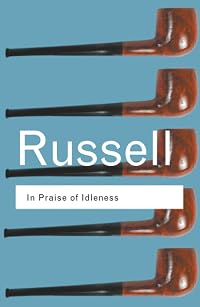
In Praise of Idleness
by Bertrand Russell
On This Page
Description
Bertrand Russell is considered "the Voltaire of his time," and Bradley Trevor Greive is considered one of the funniest people of his. Russell was a Nobel Laureate, and Greive is a New York Times bestselling author. Together, with Russell bringing the philosophy and Greive bringing the hilarious commentary, this book is a classic. In his celebrated essay, In Praise of Idleness, Russell champions the seemingly incongruous notion that realizing our full potential-and thus enjoying the greatest show more possible success and happiness-is not accomplished by working harder or smarter, but through harnessing the extraordinary power of idleness. Russell's penetrating insights and exquisite turns of phrase feel as fresh and relevant today as when they were first written. Arguing that we can achieve far more by doing far less and that traditional wealth accumulation is a form of cultural and moral poverty, Russell demands greater depth from our age of abundant creativity and heralds the next wave of enlightened entrepreneurs. show lessTags
Recommendations












Member Reviews
I love simplified philosophy: something my simple brain can chew on and possibly grow from. This book is a perfect example: a mix of Russell's wisdom with Grieve's humour and synthesis. Not only did I have something to ponder, did I learn and did I laugh but also shared for a few hours Russell's boundless optimism and endless curiosity. It's a fine thing to share in dark times and a reminder to take the time to look at the world with wonder.
The content in this collection of thoughtful essays is on average about a century old. Still, it contains a lot of what feels like relevant wisdom to our modern, distracted, complex world. Much of that sagacity is distilled in the first paragraphs of the preface:
I feel Russell would have had been disappointed with every media trend from the Television to Internet age:
I happen to be reading at the same time Robert Graves and considering his sacrificed sacred king model developed from James George Frazer and so this resonated with me in this concise and incisive commentary on the definition and state of modern civilisation:
This book contains essays on such aspects of social questions as tend to be ignored in the clash of politics. It emphasizes the dangers of too much organization in the realm of thought and too much strenuousness in action. ... It maintains that the importance of knowledge consists not only in its direct practical utility but also in the fact that it promotes a widely contemplative habit of mind ; on this ground, utility is to be found in much of the knowledge that is nowadaysshow more
labelled "useless."
...Passing further away from politics, the volume, after discussing the characteristics of Western civilization and the chances of the human race being vanquished by insects, concludes with a discussion of the nature of the soul. The general thesis which binds the essays together is that the world is suffering from intolerance and bigotry, and from the belief that vigorous action is admirable even when misguided ; whereas what is needed in our very complex modern society is calm consideration, with readiness to call dogmas in question and freedom of mind to do justice to the most diverse points of view.
I feel Russell would have had been disappointed with every media trend from the Television to Internet age:
The amusements of modern urban populations tend more and more to be passive and collective, and to consist of inactive observation of the skilled activities of others.
I happen to be reading at the same time Robert Graves and considering his sacrificed sacred king model developed from James George Frazer and so this resonated with me in this concise and incisive commentary on the definition and state of modern civilisation:
What do we, who stay at home, know about the savage?...show less
Sir James Fraser says he is always killing his god...
First of all, what is civilisation? Its first essential character, I should say, is forethought. This, indeed, is what mainly distinguishes men from brutes and adults from children. But forethought being a matter of degree, we can distinguish more or less civilised nations and epochs according to the amount of it that they display. And forethought is capable of almost precise measurement. I will not say that the average forethought of a community is inversely proportional to the rate of interest, though this is a view which might be upheld. But we can say that the degree of forethought involved in any act is measured by three factors; present pain, future pleasure, and the length of the interval between them. That is to say, the forethought is obtained by dividing the present pain by the future pleasure and then multiplying by the interval of time between them...
This brings me to another element which is essential to civilisation, namely knowledge. Forethought based upon superstition cannot count as fully civilised, although it may bring habits of mind essential to the growth of true civilisation. For instance, the Puritan habit of postponing pleasures to the next life undoubtedly facilitated the accumulation of capital required for industrialism. We may then define civilisation as: A manner of life due to the combination of knowledge and forethought.
In Praise of Idleness has become one of those life-changing books for me. I’d heard and read a lot about Bertrand Russell’s genius and intellect, but the book really blew me away. The collection of essays here offer a treasure trove of ideas and makes eerily accurate predictions about society and humanity.
There were a number of ideas that will stay with me. For example, Russell, while discussing education, hypothesizes that it is the uneducated that bully and lynch others because the assertion of dominance is a source of self-respect for them. He also notes that education is extremely important for the populace of a nation as it offers them the chance to form intelligent opinions on matters of governance and finance. These are show more simple, almost basic ideas that are taken to their full potential in Russell’s essays.
He also writes about death and offers some words on how to broach the subject with kids. He advises parents to talk about death with their children but not to let them get too absorbed with it because it will reduce their all-round development. He also notes that children should be deterred from taking on a religious point of view regarding death, pointing out that death should not be made less terrible than what it is. His argument is to persuade the importance of the cause to which the person has given his/her life towards rather than the act of death itself.
In another essay he writes about designing arguments. He says we should focus our ideas towards like-minded people and not for opponents. Why? It’s due to the fact that the appeal to reason becomes difficult when there’s a large group because we have fewer assumptions to begin from. When the assumptions aren’t found, men begin to rely on intuition which leads to strife in power.
Further along, in another essay Russell contends that people use reason to persuade a group that is sympathetic to their cause. The person using that reason believes in it wholly but has trouble demonstrating it to those who question it. He adds that there has to be some universal assumptions for reason to survive; otherwise, it only leads to strife and power play, which we can see in the world around us right now.
Having said all this, some of the essays are insignificant. A few offer socially dated ideas—women staying behind to work in the house isn’t acceptable by modern standards, among other things. Despite all this, the essays themselves are straightforward in their language and presentation, discussing philosophical and social topics in a way that even laymen can perceive.
There are a lot more interesting concepts and opinions within the book. Many of these have become reality for our current society and some have fallen flat. I strongly suggest picking this book up if you’re looking to expand your view of the world. I had a most excellent time with this. show less
There were a number of ideas that will stay with me. For example, Russell, while discussing education, hypothesizes that it is the uneducated that bully and lynch others because the assertion of dominance is a source of self-respect for them. He also notes that education is extremely important for the populace of a nation as it offers them the chance to form intelligent opinions on matters of governance and finance. These are show more simple, almost basic ideas that are taken to their full potential in Russell’s essays.
He also writes about death and offers some words on how to broach the subject with kids. He advises parents to talk about death with their children but not to let them get too absorbed with it because it will reduce their all-round development. He also notes that children should be deterred from taking on a religious point of view regarding death, pointing out that death should not be made less terrible than what it is. His argument is to persuade the importance of the cause to which the person has given his/her life towards rather than the act of death itself.
In another essay he writes about designing arguments. He says we should focus our ideas towards like-minded people and not for opponents. Why? It’s due to the fact that the appeal to reason becomes difficult when there’s a large group because we have fewer assumptions to begin from. When the assumptions aren’t found, men begin to rely on intuition which leads to strife in power.
Further along, in another essay Russell contends that people use reason to persuade a group that is sympathetic to their cause. The person using that reason believes in it wholly but has trouble demonstrating it to those who question it. He adds that there has to be some universal assumptions for reason to survive; otherwise, it only leads to strife and power play, which we can see in the world around us right now.
Having said all this, some of the essays are insignificant. A few offer socially dated ideas—women staying behind to work in the house isn’t acceptable by modern standards, among other things. Despite all this, the essays themselves are straightforward in their language and presentation, discussing philosophical and social topics in a way that even laymen can perceive.
There are a lot more interesting concepts and opinions within the book. Many of these have become reality for our current society and some have fallen flat. I strongly suggest picking this book up if you’re looking to expand your view of the world. I had a most excellent time with this. show less
I like reading the works of Bertrand Russell. He is a crisp and thoughtful writer, and a penetrating and skilled philosopher. But we can't be great at everything and unfortunately, "In Praise of Idleness" highlights Dr. Russell's naivete when it comes to social and political commentary.
And more unfortunate still, the most naive essay of all is the title essay. In it, Dr. Russell outlines a vision whereby all able-bodied individuals would need only to work for four hours a day. Russell abhors work, and true to his upper-cust raisings, cannot see why it is really all that necessary. What he does not realize is that the beauty of the capitalism he so detests is that it allows the individual - rather than a majority vote or a dictator - show more choose how much work they will do based on how much "reward" they want. Should they want high reward, they can choose to work more and harder. Should they want less financial reward, they can choose a less stressful job. (Russell also misses the fact that, while many of us do detest work, they would detest it more if they did not own the fruits of their labor via wages in a capitalistic system. After all, many people work only because there is a financial motivator.)
His essay extolling the usefulness of useless knowledge is actually quite good. Rather than arguing - as its title might suggest - against a pragmatic view of knowledge (that only "useful" knowledge is worth anything), Russell argues to expand the definition of "useful." Knowledge that contributes to an individuals mental well-being, knowledge that is interesting, and knowledge that is just plain fun to think about, is every bit as useful to individuals as knowlege that helps us dig ditches, structure economies, etc. (To be useful, knowledge need not always be SOCIALLY useful.)
Much of the rest of Russell's naivete comes from offering good criticisms of fascism and communism only to forget that these criticisms may be applied to the socialism that Russell champions. The fact that centralizing power, for instance, in a dictator is a reason to jettison fascism and Marxism is every bit a reason to be wary of any attempts at political centralization - even socialist ones! To put it bluntly, Russell is so interested in his utopian vision of socialism in the abstract that he forgets to think about what socialism actually looks like in practice. (In Russell's mind, for instance, socialism somehow avoids consolidating power in an omnipotent central government. But doesn't planning need planners and delegators? And how do they differ from dictators?)
To be honest, I think Bertrand Russell shows evidence in this book of a huge blindspot. As an upper-cruster, he is appalled that people have to do such dastardly things as work and contract their labor. As an upper-cruster, he thinks that a decent way of life is possible without the type of industry that requires people to work more than four hours per day. And as an upper-cruster, he believes that everyone should be guaranteed a certain level of income regardless of what they accomplish.
In other words, Russell is simply not as penetrating as a social theorist as he is as a philosopher. This book is as clearly written and entertaining as other books by Russell, but he is clearly out of his element. show less
And more unfortunate still, the most naive essay of all is the title essay. In it, Dr. Russell outlines a vision whereby all able-bodied individuals would need only to work for four hours a day. Russell abhors work, and true to his upper-cust raisings, cannot see why it is really all that necessary. What he does not realize is that the beauty of the capitalism he so detests is that it allows the individual - rather than a majority vote or a dictator - show more choose how much work they will do based on how much "reward" they want. Should they want high reward, they can choose to work more and harder. Should they want less financial reward, they can choose a less stressful job. (Russell also misses the fact that, while many of us do detest work, they would detest it more if they did not own the fruits of their labor via wages in a capitalistic system. After all, many people work only because there is a financial motivator.)
His essay extolling the usefulness of useless knowledge is actually quite good. Rather than arguing - as its title might suggest - against a pragmatic view of knowledge (that only "useful" knowledge is worth anything), Russell argues to expand the definition of "useful." Knowledge that contributes to an individuals mental well-being, knowledge that is interesting, and knowledge that is just plain fun to think about, is every bit as useful to individuals as knowlege that helps us dig ditches, structure economies, etc. (To be useful, knowledge need not always be SOCIALLY useful.)
Much of the rest of Russell's naivete comes from offering good criticisms of fascism and communism only to forget that these criticisms may be applied to the socialism that Russell champions. The fact that centralizing power, for instance, in a dictator is a reason to jettison fascism and Marxism is every bit a reason to be wary of any attempts at political centralization - even socialist ones! To put it bluntly, Russell is so interested in his utopian vision of socialism in the abstract that he forgets to think about what socialism actually looks like in practice. (In Russell's mind, for instance, socialism somehow avoids consolidating power in an omnipotent central government. But doesn't planning need planners and delegators? And how do they differ from dictators?)
To be honest, I think Bertrand Russell shows evidence in this book of a huge blindspot. As an upper-cruster, he is appalled that people have to do such dastardly things as work and contract their labor. As an upper-cruster, he thinks that a decent way of life is possible without the type of industry that requires people to work more than four hours per day. And as an upper-cruster, he believes that everyone should be guaranteed a certain level of income regardless of what they accomplish.
In other words, Russell is simply not as penetrating as a social theorist as he is as a philosopher. This book is as clearly written and entertaining as other books by Russell, but he is clearly out of his element. show less
This large-print, small-footprint gift book contains a slim Russell essay sandwiched between an industriously humorous introduction and a set of equally industriously humorous footnotes and illustrated in a peculiar quasi-Victorian manner (the illustration on p. 104 is unfortunate and characteristic). I chose it because I felt like having an easy read and it didn't disappoint on that account. Would make a nice impersonal Christmas present for that philosophy major on your list, just to convey the impression that you care about them without inviting the recipient to engage you in actual conversation about the topic.
Some judicious quotes:
From the introduction by Greive: "even in the most flattering photographs the great philosopher often show more resembles a bewigged ferret squinting into a hot wind." (13)
The rest of the quotes are Russell verbatim:
"a great deal of harm is being done in the modern world by belief in the virtuousness of work." (38)
"The morality of work is the morality of slaves, and the modern world has no need of slavery." (43)
"The idea that the poor should have leisure has always been shocking to the rich." (49)
"We keep a large percentage of the working population idle, because we can dispense with their labour by making the others overwork." (58)
"the necessity of keeping the poor contented, which has led the rich, for thousands of years, to preach the dignity of labor, while taking care themselves to remain undignified in this respect." (61)
"Broadly speaking, it is held that getting money is good and spending money is bad. Seeing that they are two sides of one transaction, this is absurd; one might as well maintain that keys are good, but keyholes are bad." (63) show less
Some judicious quotes:
From the introduction by Greive: "even in the most flattering photographs the great philosopher often show more resembles a bewigged ferret squinting into a hot wind." (13)
The rest of the quotes are Russell verbatim:
"a great deal of harm is being done in the modern world by belief in the virtuousness of work." (38)
"The morality of work is the morality of slaves, and the modern world has no need of slavery." (43)
"The idea that the poor should have leisure has always been shocking to the rich." (49)
"We keep a large percentage of the working population idle, because we can dispense with their labour by making the others overwork." (58)
"the necessity of keeping the poor contented, which has led the rich, for thousands of years, to preach the dignity of labor, while taking care themselves to remain undignified in this respect." (61)
"Broadly speaking, it is held that getting money is good and spending money is bad. Seeing that they are two sides of one transaction, this is absurd; one might as well maintain that keys are good, but keyholes are bad." (63) show less
I stumbled across this book quite by accident at the public library, and I now wish I had just ignored it. The title is highly provocative, but that's the only thing Russel seems to have put any thought into. His arguments are driven by emotion rather than reason, and he makes challenging statements which sound interesting but doesn't bother to explain his reasoning. Without explanation, his readers have no way of testing his theories, and so can't contradict or agree with him. He doesn't have the courage to open himself to criticism, and so as a work of philosophy, this book is a complete failure.
Bertrand Russell's mind is so far ahead that one might accuse him of having cheat codes unlocked.
Members
- Recently Added By
Lists

The Works of Bertrand Russell
62 works; 1 member

Books Read in 2025
4,091 works; 97 members
Author Information

425+ Works 39,452 Members
Bertrand Arthur William Russell (1872-1970) was a British philosopher, logician, essayist and social critic. He was best known for his work in mathematical logic and analytic philosophy. Together with G.E. Moore, Russell is generally recognized as one of the main founders of modern analytic philosophy. Together with Kurt Gödel, he is regularly show more credited with being one of the most important logicians of the twentieth century. Over the course of a long career, Russell also made contributions to a broad range of subjects, including the history of ideas, ethics, political and educational theory, and religious studies. General readers have benefited from his many popular writings on a wide variety of topics. After a life marked by controversy--including dismissals from both Trinity College, Cambridge, and City College, New York--Russell was awarded the Order of Merit in 1949 and the Nobel Prize for Literature in 1950. Noted also for his many spirited anti-nuclear protests and for his campaign against western involvement in the Vietnam War, Russell remained a prominent public figure until his death at the age of 97. (Bowker Author Biography) show less
Some Editions
Series
Belongs to Publisher Series
Unwin Books (8)
Nobelpreisträger Coron-Verlag (weiß) (1950 (Großbritannien))
Work Relationships
Is contained in
Common Knowledge
- Canonical title
- In Praise of Idleness
- Original title
- In Praise of Idleness and Other Essays
- Original publication date
- 1935
Classifications
Statistics
- Members
- 1,201
- Popularity
- 20,696
- Reviews
- 15
- Rating
- (4.02)
- Languages
- 12 — Chinese, English, Finnish, French, German, Italian, Japanese, Korean, Norwegian, Portuguese, Spanish, Turkish
- Media
- Paper, Ebook
- ISBNs
- 39
- ASINs
- 23