Plunkitt of Tammany Hall
by William L. Riordan
On This Page
Description
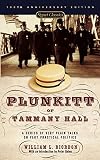
Plunkitt of Tammany Hall A Series of Very Plain Talks on Very Practical Politics William L. Riordan "Nobody thinks of drawin' the distinction between honest graft and dishonest graft." This classic work offers the unblushing, unvarnished wit and wisdom of one of the most fascinating figures ever to play the American political game and win. George Washington Plunkitt rose from impoverished beginnings to become ward boss of the Fifteenth Assembly District in New York, a key player in the show more powerhouse political team of Tammany Hall, and, not incidentally, a millionaire. In a series of utterly frank talks given at his headquarters (Graziano's bootblack stand outside the New York County Court House), he revealed to a sharp-eared and sympathetic reporter named William L. Riordan the secrets of political success as practiced and perfected by him and fellow Tammany Hall titans. The result is not only a volume that reveals more about our political system than does a shelfful of civics textbooks, but also an irresistible portrait of a man who would feel happily at home playing ball with today's lobbyists and king makers, trading votes for political and financial favors. Doing for twentieth-century America what Machiavelli did for Renaissance Italy, and as entertaining as it is instructive, Plunkitt of Tammany Hallis essential reading for those who prefer twenty-twenty vision to rose-colored glasses in viewing how our government works and why. With an Introduction by Peter Quinn and a New Afterword show lessTags
Recommendations













Member Reviews
George Washington Plunkitt was a very successful politician operating within New York City's infamous Tammany Hall machine that ran the city for good and ill from the late 1800s through the Depression years, when the rot that the machine's inattention to anything but their own bank accounts finally became apparent. Plunkett served in the New York State Assembly and then the New York State Senate, and evidently was instrumental in voting in many important civil projects for the city. But he is most remembered for his patronage work within his New York City district. In 1904, he indulged his desire to speak his mind (evidently quite unusual for a Tammany bigwig), sitting on a shoeshine chair outside a NYC courthouse and expounding about show more the benefits of Tammany politics to journalist William L. Riordon. The series of talks were published one at a time in several NY newspapers, and in 1905 they were gathered and published in Plunkitt of Tammany Hall.
In these talks, Plunkitt's main points were the differences between "honest graft" and "dishonest graft." "Dishonest graft" meant, to him, things like blackmailing prostitutes, street vendors and even store owners for protection payments. This to Plunkitt was abhorrent. "Honest graft," though, was what we'd essentially today call insider trading. For example, he would, via his position in state government, learn of a new bridge in the works, buy up the land around where the entrances to the bridge was to be built, and then sell those lots back to the city at a handsome profit. "I seen my chance, and I took it," is how Plunkitt describes such maneuverings. The Tammany Hall district leaders would, famously, take care of the working people in their districts. Plunkitt describes his penchant for showing up at fires in working class neighborhoods and handing out cash for new furniture and clothing and even rent for people who'd been burned out. And always, of course, there were patronage jobs to be arranged. Anything to earn some votes.
Plunkitt describes with horror and disdain the reformist program to provide a trained and worthy civil service and saves his particular contempt for the "worthlessness" of the civil service exam. In his view, city jobs should be handed out the old fashioned way, to the people in his district who vote the right way and can bring along some other votes to make their cases stronger and so deserve to be rewarded. Competence or knowledge of the work the job entails is way down the priority list. Plunkitt's criticisms of the civil service exams are often quite humorous.
As New York City historian Peter Quinn points out in his contemporary introduction to my Signet Classics edition of the book, it is sometimes difficult to know where in the quoting and composition of these talks, Plunkitt leaves off and Riordon comes in. But I think we can assume that while the wording of some passages may be Riordon's, but content overall is Plunkitt's. Tammany could get things done. As Riordon tells us at the end of his original introduction to this book,
"Plunkitt has been one of the great powers in Tammany Hall for over a quarter of a century. While he was in the Assembly and the State Senate he was one of the most influential members and introduced the bills that provided for the outlying pairs of New York city, the Harlem River Speedway {now the Harlem River Drive, I think}, the Washington Bridge, the 155th Street Viaduct, the grading of Eighth Avenue north of Fifty-seventh Street, additions to the Museum of Natural History, the West Side Court, and many other important improvements."
On the other hand, I think we can safely assume that Plunkitt made money for himself on just about all of these projects. I read this book because I did one of my periodical random selections from my home library using the LT "Go to a random book of yours" function. Interestingly, it tied in very closely to my last book, The New York Game: Baseball and the Rise of a New City, with it's detailed descriptions of the Tammany machine and the ruins it left the city in when the Depression hit. (See my review of that book, just above.) Overall, for me, although the individual talks did eventually become somewhat tedious, I found Plunkitt of Tammany Hall to be an interesting look inside that famous political machine from the point of view of one of it show less
In these talks, Plunkitt's main points were the differences between "honest graft" and "dishonest graft." "Dishonest graft" meant, to him, things like blackmailing prostitutes, street vendors and even store owners for protection payments. This to Plunkitt was abhorrent. "Honest graft," though, was what we'd essentially today call insider trading. For example, he would, via his position in state government, learn of a new bridge in the works, buy up the land around where the entrances to the bridge was to be built, and then sell those lots back to the city at a handsome profit. "I seen my chance, and I took it," is how Plunkitt describes such maneuverings. The Tammany Hall district leaders would, famously, take care of the working people in their districts. Plunkitt describes his penchant for showing up at fires in working class neighborhoods and handing out cash for new furniture and clothing and even rent for people who'd been burned out. And always, of course, there were patronage jobs to be arranged. Anything to earn some votes.
Plunkitt describes with horror and disdain the reformist program to provide a trained and worthy civil service and saves his particular contempt for the "worthlessness" of the civil service exam. In his view, city jobs should be handed out the old fashioned way, to the people in his district who vote the right way and can bring along some other votes to make their cases stronger and so deserve to be rewarded. Competence or knowledge of the work the job entails is way down the priority list. Plunkitt's criticisms of the civil service exams are often quite humorous.
As New York City historian Peter Quinn points out in his contemporary introduction to my Signet Classics edition of the book, it is sometimes difficult to know where in the quoting and composition of these talks, Plunkitt leaves off and Riordon comes in. But I think we can assume that while the wording of some passages may be Riordon's, but content overall is Plunkitt's. Tammany could get things done. As Riordon tells us at the end of his original introduction to this book,
"Plunkitt has been one of the great powers in Tammany Hall for over a quarter of a century. While he was in the Assembly and the State Senate he was one of the most influential members and introduced the bills that provided for the outlying pairs of New York city, the Harlem River Speedway {now the Harlem River Drive, I think}, the Washington Bridge, the 155th Street Viaduct, the grading of Eighth Avenue north of Fifty-seventh Street, additions to the Museum of Natural History, the West Side Court, and many other important improvements."
On the other hand, I think we can safely assume that Plunkitt made money for himself on just about all of these projects. I read this book because I did one of my periodical random selections from my home library using the LT "Go to a random book of yours" function. Interestingly, it tied in very closely to my last book, The New York Game: Baseball and the Rise of a New City, with it's detailed descriptions of the Tammany machine and the ruins it left the city in when the Depression hit. (See my review of that book, just above.) Overall, for me, although the individual talks did eventually become somewhat tedious, I found Plunkitt of Tammany Hall to be an interesting look inside that famous political machine from the point of view of one of it show less
This isn't really the kind of book you "like," or "dislike," it just Is. Towards the end it did get a little tiresome, mostly because it was so disheartening to realize that Plunkitt was, in some ways, better than most modern politicians. With all his disturbing ideas of "honest" graft, at did at least make some effort to take care of the folks who put him in office. These days, politicians just sell them out to the highest bidder, and the Civil Service "reform" that he railed against has been corrupted in its own way.
Reading this wasn't enjoyable, but it was enlightening and thought-provoking.
Reading this wasn't enjoyable, but it was enlightening and thought-provoking.
This isn't really the kind of book you "like," or "dislike," it just Is. Towards the end it did get a little tiresome, mostly because it was so disheartening to realize that Plunkitt was, in some ways, better than most modern politicians. With all his disturbing ideas of "honest" graft, at did at least make some effort to take care of the folks who put him in office. These days, politicians just sell them out to the highest bidder, and the Civil Service "reform" that he railed against has been corrupted in its own way.
Reading this wasn't enjoyable, but it was enlightening and thought-provoking.
Reading this wasn't enjoyable, but it was enlightening and thought-provoking.
George Washington Plunkitt was a Democratic Senator from New York in the late 1800s to early 1900s. He was a part of the political machine known as Tammany Hall which had a huge influence on New York City's politics during this same period. These politicians were famous for lending aid to many of the newly arriving immigrants during this period, as well as their questionable tactics. Plunkitt, who became a millionaire was famous for his "plain talks on very practical politics." In these talks he explains the difference between 'honest graft' and 'dishonest graft.' He favored the idea of 'you scratch my back and I'll scratch yours.' Many of the immigrants would vote for a candidate such as Plunkitt in exchange for the opportunity of show more receiving government jobs. This was very important during a time when there were so many immigrants and so few jobs to come by. He also felt that it was OK to use insider information to grow his wealth. This book is a great little snapshot of the history of New York politics during this era. show less
Ratings
Members
- Recently Added By
Lists

Author Information
2+ Works 579 Members
All Editions
Some Editions
Series
Belongs to Publisher Series
Common Knowledge
- Canonical title
- Plunkitt of Tammany Hall
- People/Characters
- George Washington Plunkitt
- Important places
- New York, New York, USA
- First words
- Everybody is talkin' these days about Tammany men growin' rich on graft, but nobody thinks of drawin' the distinction between honest graft and dishonest graft.
- Last words
- (Click to show. Warning: May contain spoilers.)Is it any wonder that scandals do not permanently disable Tammany and that it speedily recovers from what seems to be crushing defeat?
Classifications
- Genres
- Nonfiction, History, General Nonfiction, Politics and Government, Biography & Memoir
- DDC/MDS
- 329.3 — Society, government, & culture Political science [Formerly: Political Parties and conventions] Democratic
- LCC
- JK2319 .N57 .R5 — Political Science Political institutions and public administration (United States) Political institutions and public administration United States Political parties
- BISAC
Statistics
- Members
- 572
- Popularity
- 51,456
- Reviews
- 4
- Rating
- (3.56)
- Languages
- English, Estonian, French
- Media
- Paper, Audiobook, Ebook
- ISBNs
- 38
- UPCs
- 1
- ASINs
- 13