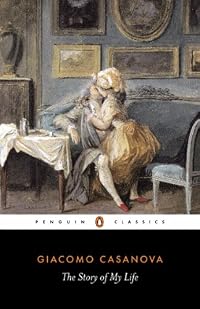
The Story of My Life
by Giacomo Girolamo Casanova
On This Page
Description
An abridged version of the Italian rogue's memoirs presents the most famous episodes in the life of the spy, swashbuckler, self-made gentleman, entrepreneur, poet, bon vivant, and lover of numerous women.Tags
Recommendations










Member Reviews
I picked this audiobook up because it's read by Benedict Cumberbatch, and honestly I thought I could listen to him read *anything* to me. I've been proven so, so very wrong. In fact, the bit that is essentially detailing a gang rape, but couched in words that reassure the reader/listener that Casanova and his buddies meant no harm and in fact after the first go-round the girl was pretty okay with it and actually liked what was being done to her was so much worse than its already horrendous nature would suggest because of the incongruity of it being delivered via the dulcet timber of Cumberbatch's voice. Even worse is reading/listening to this in the days of Kavanaugh et al. and letting it sink in in an even more absorbing way that this show more is all the Same Shit, Different Century. Cripes. show less
It took me a few months to read all 6 volumes, but it was well worth it. I really like Casanova's style of writing and his sense of humor.
These books really give you some insight in Europe in the 18th century. The man lived to be 73, so he's seen plenty! He also traveled a lot, he was, after all, banned from Venice for quite some years.
What really got me is that compared to today, the people then seemed quite free and modern man quite narrow-minded.
For example: it was very normal for a woman to have a lover. Especially if this lover had a higher status than her husband this could turn out very beneficial. The husband actually benefited from his wife's lover! Unimaginable today.
The justice 'system' then is incomparable with what we have show more today. Sometimes I was quite perplexed by some of the 'solutions' and sometimes they (almost?) made sense.
And Mr. Casanova himself? I think he rather liked himself, but he was quite pompous and arrogant. Still, a very good read. show less
These books really give you some insight in Europe in the 18th century. The man lived to be 73, so he's seen plenty! He also traveled a lot, he was, after all, banned from Venice for quite some years.
What really got me is that compared to today, the people then seemed quite free and modern man quite narrow-minded.
For example: it was very normal for a woman to have a lover. Especially if this lover had a higher status than her husband this could turn out very beneficial. The husband actually benefited from his wife's lover! Unimaginable today.
The justice 'system' then is incomparable with what we have show more today. Sometimes I was quite perplexed by some of the 'solutions' and sometimes they (almost?) made sense.
And Mr. Casanova himself? I think he rather liked himself, but he was quite pompous and arrogant. Still, a very good read. show less
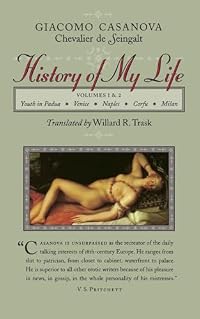
Being published in 1929, this is not the sexy details edition. Still it does cover his sensational escape from the dungeon of the Inquisition in Venice. It remains a good guide to his itinerary, and it does contain a number of his epigrams.
This is a severely abridged edition published by the Modern Library. As such, it's hard to get a real taste for the author's unconventionality and libertinism. What does come across is his appreciation for women and his clear understanding of his own character flaws. This is an interesting guy with a lot of insight into what makes modern people tick.
No translator is given.
As a history of the times interesting, but completely sanitized: a reader would be somewhat hard put to realize Casanova's reputation. In the introduction, Ernest Boyd comments on (and applauds) this,noting that:
"The original manuscript still reposes in the safe of the [publisher] and there is little chance of its being published in its enirety. Casanova used the crudest language in describing his amorous adventures ... "t would be a pity if a work of such intense human and historic interest should come to be classified as a mere piece of pornography."
As a history of the times interesting, but completely sanitized: a reader would be somewhat hard put to realize Casanova's reputation. In the introduction, Ernest Boyd comments on (and applauds) this,noting that:
"The original manuscript still reposes in the safe of the [publisher] and there is little chance of its being published in its enirety. Casanova used the crudest language in describing his amorous adventures ... "t would be a pity if a work of such intense human and historic interest should come to be classified as a mere piece of pornography."
The Complete Memoirs of Jacques Casanova de Seingalt
(The boy who never grew up)
I purchased what appeared to be an incomplete copy of this on Amazon and then went to the Gutenberg site to find the full 29 episodes of which one is rather incomplete. It comes with a warning:
[Transcriber's Note: These memoir's were not written for children, they may outrage readers also offended by Chaucer, La Fontaine, Rabelais and The Old Testament. D.W.]Giacomo Casanova. The Complete Memoirs of Jacques Casanova de Seingalt (Kindle Locations 9-10).
Maybe this is meant to be tongue in cheek but nevertheless this book will likely offend someone.
(As it turns out the Amazon edition is complete just presented differently in the table of contents.)
The show more Gutenberg version is translated by Arthur Machen with added information from Arthur Symons and was transcribed by David Widger (whom I will blame for all the misspellings and possible incorrect words.) There are quite a large number of questionable word usages here such as shew skew both being used for show and I've no idea if in some ancient version of English skew was some nuance of show that is different from shew but they often show up on the same page and in context both look to mean show. A search shows that the amazon version contains the same feature, so perhaps one day I'll locate the explanation of nuance.
Giacomo Casanova was born in Venice of Spanish and Italian parentage. Both his parents were actors though it would appear that there was a promise made that once married his mother would no longer work in that profession ; that was a condition that was never meant to be fulfilled, which is fortunate since his mother was widowed while the children were still young. He later created the name Chevalier de Seingalt which he used as readily as his given name and became Knight of the Golden Spur.
He begins his memoir by calling it a confession and accepting all responsibility for his acts; good and evil. He apparently felt a need to differentiate himself from Stoic's I can only think that much of his philosophy in life leaned enough in that direction that he was often mistook for one. He espouses a believe in a immaterial God and though he believes that god has given man freedom to do as he pleases he will lose that when he allows his passion to rule him. And of passion he says there are few who are truly wise enough to have mastered it.
Stoics characterized the wicked man as being like a dog tied to a cart and compelled to go wherever it goes. Casanova styled himself to be a man free to go where the wind blows him, yet if I were to look at passion as the cart he would often be taken where ever it goes. The difference here is that Casanova did not consider himself a wicked man. This is yet to be seen.
Much of what Casanova lays out to the reader might almost sound like rationalism except that it differs as much as do the Stoics in that Casanova seems to believe that Passion plays an important role. He called it treading on the precipice without falling into it. In some way this could give him a kinship with the fool of the Tarot cards. He speaks of deception in that men and women must dupe each other for love. And he almost passionately despises the fool whom he can dupe so easily almost using that as the justification for such deception. He makes no apologies nor does he regret his transgressions often attributing it to the folly of youth. And though he despises the fool the reader soon will see that he himself has often been caught out that way.
Casanova wrote the memoir when he was old and unable to preform as he had in his youth. He is quite free with his story and it perhaps might be considered more racy then than it is today. He is clear from the beginning and throughout that he has little intention of publishing this and that if it is published in the future some time he hopes someone might enjoy it. To this end and after reading much of the memoir it was easy for me to see that as he states many times this is so that he can recapture the enjoyment of his youth in the fondest of memories. He does caution that his memoirs are not meant for certain people and applauds the intelligence of those who become his most indulgent readers. The truth remains that these were written for the authors own enjoyment, which is possible the best way to go about it.
He establishes that not everything will be found here. Qualifying that there are things many might feel repugnant and offensive. Yet after I finished reading these I felt that there was quite enough; though not as much as one might find in today's erotica. Perhaps though, for his time, it was wise if there were more extreme and explicit memories; that he desisted in expression or this might never have made it to us today. Still considering the time of these events; there are things that we find taking place that would be considered quite heinous, but are treated lightly. Such things as the marriageable age of a young girl seems to be around fourteen and that might be moved if the young girl in question has developed well enough to appear that age. While today it is unquestionably too early in most societies, even for that time has to be a prior to the time a woman develops her self esteem and this leads me to wonder if that was to make them pliable enough to be molded by their husbands.
Casanova considers himself a man of natures more than a man of mind. And he seems to believe that this is possibly the very nature of men.He says he has always had a passion for women, the fairer sex. I found in reading this that he has many qualifiers and modifiers and will never include the whole of that gender. He doesn't quite consider himself a narcissist but he is in favor of self love over self loathing as he feels self loathing leads to death. One thing that confounded me was his love of women. His view of women seemed trapped in the era in which he existed but his love led him to a dichotomy of view that sometimes seemed progressive, but always when his passion took over he adopted the contemporary view. He loved an intelligent free thinking woman more than the more simple minded and yet seemed to remain at ease with letting the simple minded remain that way. If he had a flaw it is one that comes through to our era in that he had to have whichever of these he was courting at the time wrapped in an almost impossible outer beauty that would rival the male oriented publications of today.
For me it was this love of outer beauty and sometimes brutal disdain of what he considered ugly that began to give me a true look at the nature of this man. Though he derided the bigots of his era he was bigoted in many ways and he was quick to anger, easily offended, and mostly mercenary about his forgiveness. Love for him was a matter of conquest and this entailed everything from paying the closest attention to his object of beauty to putting no limit to what he would spend for her. If the conquest took longer than he felt necessary he would become angered and sometimes bordering on abusive to downright brutal. He was a sweet talker, he could fall in love at the drop of a hat, sometimes fall out just a quickly depending on his temperament. He could love more than one woman at a time but if his current love for one was deep enough he could not allow infidelity, though other times he found himself easy to share. Most times the love would wane as distance from the object increased and waxed as it decreased.
Most, though not all of the young ladies Casanova fell in love with, might today be considered under age. He had lovers that ranged from ten years old to thirty and beyond but most of those he fell madly in love with were around or below the age of seventeen. He seemed to have a fondness for sisters and friends and had a great share of threesome's and menage a trois. His love exploits sound contrived in that he always fell deeply in love while knowing that he was certain a marriage would end his life. He'd live in constant state of bliss and mortal fear until some circumstance occurred to alleviate his obligation to consummate his promises. Usually a lover that he could recognize as being more stable for his love would arrive or he's be thrown in jail or out of the country.
The whole of the memoir reads like the old classic romance novels with duels and tete a tete.s that led to more than just a conversation; all this with the trimming that would rival the works of Dumas. One might wonder if Dumas was inspired after reading the memoirs.
Casanova is not above showing himself the fool and showing his faults. His chief fault is that he is a gamer which in his case mostly involves gambling but seems also to be acquainted with scamming people and sometimes the gambling games were not so much chance. This placed him in an element that was quite seedy and often intersected with people who were a bit more street smart than he and he would always come to bad ends with them. A handful of times he was inflicted with venereal disease leading to his abstinence from sex; for usually around 6 weeks while he effected a cure. The first instance he gives leads later to a humorous meeting with a doctor in that community some years later. The doctor puts all that is his at Casanova's disposal because he had gained such wealth from all the patients that resulted from Casanova's indiscretions the last time he visited.
Putting aside Casanova's character and personality, which did not impress me, the memoirs do seem to be a treasure trove containing information about the life and times of a wide sample of countries in part of what we call the European Union. Even though it predates the Victorian era it seems a great read for people who love Victorian romance novels and steam-punk. It could serve as a good source for the writers of those types of novels. The beginning part and end part of this book go to great length to demonstrate the veracity of this memoir not only as the work of Jacques Casanova de Seingalt but as a work of historic value.
The amazon version seems to mirror this version though its table of contents is a bit skewed.
J.L. Dobias show less
(The boy who never grew up)
I purchased what appeared to be an incomplete copy of this on Amazon and then went to the Gutenberg site to find the full 29 episodes of which one is rather incomplete. It comes with a warning:
[Transcriber's Note: These memoir's were not written for children, they may outrage readers also offended by Chaucer, La Fontaine, Rabelais and The Old Testament. D.W.]Giacomo Casanova. The Complete Memoirs of Jacques Casanova de Seingalt (Kindle Locations 9-10).
Maybe this is meant to be tongue in cheek but nevertheless this book will likely offend someone.
(As it turns out the Amazon edition is complete just presented differently in the table of contents.)
The show more Gutenberg version is translated by Arthur Machen with added information from Arthur Symons and was transcribed by David Widger (whom I will blame for all the misspellings and possible incorrect words.) There are quite a large number of questionable word usages here such as shew skew both being used for show and I've no idea if in some ancient version of English skew was some nuance of show that is different from shew but they often show up on the same page and in context both look to mean show. A search shows that the amazon version contains the same feature, so perhaps one day I'll locate the explanation of nuance.
Giacomo Casanova was born in Venice of Spanish and Italian parentage. Both his parents were actors though it would appear that there was a promise made that once married his mother would no longer work in that profession ; that was a condition that was never meant to be fulfilled, which is fortunate since his mother was widowed while the children were still young. He later created the name Chevalier de Seingalt which he used as readily as his given name and became Knight of the Golden Spur.
He begins his memoir by calling it a confession and accepting all responsibility for his acts; good and evil. He apparently felt a need to differentiate himself from Stoic's I can only think that much of his philosophy in life leaned enough in that direction that he was often mistook for one. He espouses a believe in a immaterial God and though he believes that god has given man freedom to do as he pleases he will lose that when he allows his passion to rule him. And of passion he says there are few who are truly wise enough to have mastered it.
Stoics characterized the wicked man as being like a dog tied to a cart and compelled to go wherever it goes. Casanova styled himself to be a man free to go where the wind blows him, yet if I were to look at passion as the cart he would often be taken where ever it goes. The difference here is that Casanova did not consider himself a wicked man. This is yet to be seen.
Much of what Casanova lays out to the reader might almost sound like rationalism except that it differs as much as do the Stoics in that Casanova seems to believe that Passion plays an important role. He called it treading on the precipice without falling into it. In some way this could give him a kinship with the fool of the Tarot cards. He speaks of deception in that men and women must dupe each other for love. And he almost passionately despises the fool whom he can dupe so easily almost using that as the justification for such deception. He makes no apologies nor does he regret his transgressions often attributing it to the folly of youth. And though he despises the fool the reader soon will see that he himself has often been caught out that way.
Casanova wrote the memoir when he was old and unable to preform as he had in his youth. He is quite free with his story and it perhaps might be considered more racy then than it is today. He is clear from the beginning and throughout that he has little intention of publishing this and that if it is published in the future some time he hopes someone might enjoy it. To this end and after reading much of the memoir it was easy for me to see that as he states many times this is so that he can recapture the enjoyment of his youth in the fondest of memories. He does caution that his memoirs are not meant for certain people and applauds the intelligence of those who become his most indulgent readers. The truth remains that these were written for the authors own enjoyment, which is possible the best way to go about it.
He establishes that not everything will be found here. Qualifying that there are things many might feel repugnant and offensive. Yet after I finished reading these I felt that there was quite enough; though not as much as one might find in today's erotica. Perhaps though, for his time, it was wise if there were more extreme and explicit memories; that he desisted in expression or this might never have made it to us today. Still considering the time of these events; there are things that we find taking place that would be considered quite heinous, but are treated lightly. Such things as the marriageable age of a young girl seems to be around fourteen and that might be moved if the young girl in question has developed well enough to appear that age. While today it is unquestionably too early in most societies, even for that time has to be a prior to the time a woman develops her self esteem and this leads me to wonder if that was to make them pliable enough to be molded by their husbands.
Casanova considers himself a man of natures more than a man of mind. And he seems to believe that this is possibly the very nature of men.He says he has always had a passion for women, the fairer sex. I found in reading this that he has many qualifiers and modifiers and will never include the whole of that gender. He doesn't quite consider himself a narcissist but he is in favor of self love over self loathing as he feels self loathing leads to death. One thing that confounded me was his love of women. His view of women seemed trapped in the era in which he existed but his love led him to a dichotomy of view that sometimes seemed progressive, but always when his passion took over he adopted the contemporary view. He loved an intelligent free thinking woman more than the more simple minded and yet seemed to remain at ease with letting the simple minded remain that way. If he had a flaw it is one that comes through to our era in that he had to have whichever of these he was courting at the time wrapped in an almost impossible outer beauty that would rival the male oriented publications of today.
For me it was this love of outer beauty and sometimes brutal disdain of what he considered ugly that began to give me a true look at the nature of this man. Though he derided the bigots of his era he was bigoted in many ways and he was quick to anger, easily offended, and mostly mercenary about his forgiveness. Love for him was a matter of conquest and this entailed everything from paying the closest attention to his object of beauty to putting no limit to what he would spend for her. If the conquest took longer than he felt necessary he would become angered and sometimes bordering on abusive to downright brutal. He was a sweet talker, he could fall in love at the drop of a hat, sometimes fall out just a quickly depending on his temperament. He could love more than one woman at a time but if his current love for one was deep enough he could not allow infidelity, though other times he found himself easy to share. Most times the love would wane as distance from the object increased and waxed as it decreased.
Most, though not all of the young ladies Casanova fell in love with, might today be considered under age. He had lovers that ranged from ten years old to thirty and beyond but most of those he fell madly in love with were around or below the age of seventeen. He seemed to have a fondness for sisters and friends and had a great share of threesome's and menage a trois. His love exploits sound contrived in that he always fell deeply in love while knowing that he was certain a marriage would end his life. He'd live in constant state of bliss and mortal fear until some circumstance occurred to alleviate his obligation to consummate his promises. Usually a lover that he could recognize as being more stable for his love would arrive or he's be thrown in jail or out of the country.
The whole of the memoir reads like the old classic romance novels with duels and tete a tete.s that led to more than just a conversation; all this with the trimming that would rival the works of Dumas. One might wonder if Dumas was inspired after reading the memoirs.
Casanova is not above showing himself the fool and showing his faults. His chief fault is that he is a gamer which in his case mostly involves gambling but seems also to be acquainted with scamming people and sometimes the gambling games were not so much chance. This placed him in an element that was quite seedy and often intersected with people who were a bit more street smart than he and he would always come to bad ends with them. A handful of times he was inflicted with venereal disease leading to his abstinence from sex; for usually around 6 weeks while he effected a cure. The first instance he gives leads later to a humorous meeting with a doctor in that community some years later. The doctor puts all that is his at Casanova's disposal because he had gained such wealth from all the patients that resulted from Casanova's indiscretions the last time he visited.
Putting aside Casanova's character and personality, which did not impress me, the memoirs do seem to be a treasure trove containing information about the life and times of a wide sample of countries in part of what we call the European Union. Even though it predates the Victorian era it seems a great read for people who love Victorian romance novels and steam-punk. It could serve as a good source for the writers of those types of novels. The beginning part and end part of this book go to great length to demonstrate the veracity of this memoir not only as the work of Jacques Casanova de Seingalt but as a work of historic value.
The amazon version seems to mirror this version though its table of contents is a bit skewed.
J.L. Dobias show less
"The first English translation of the complete and unabridged Memoirs"
"The rare unabridged London edition of 1894 translated by Arthur Machen to which has been added the chapters discovered by Arthur Symons, a supplement and bibliography"
"The rare unabridged London edition of 1894 translated by Arthur Machen to which has been added the chapters discovered by Arthur Symons, a supplement and bibliography"
Members
- Recently Added By
Lists

Best Autobiographies and Memoirs
370 works; 67 members

Books Set in Italy
167 works; 19 members

Italian Literature
556 works; 38 members

Erotic Fiction
53 works; 5 members

Translingualism
191 works; 4 members

Mustich's 1000 Books to Read Before You Die: A Life Changing List
1,001 works; 18 members

Read in 2010
48 works; 1 member
Author Information

469+ Works 4,149 Members
Some Editions
Awards and Honors
Series
Belongs to Publisher Series
Work Relationships
Is contained in
Contains
Has the adaptation
Is abridged in
Has as a study
Common Knowledge
- Canonical title
- The Story of My Life
- Original title
- L'Histoire de Jacques Casanova de Seingalt vénitien, écrite par lui-même à Dux, en Bohême
- Alternate titles
- The Memoirs of Jacques Casanova de Seingalt; History of My Life; The Memoirs of Casanova
- Original publication date
- 1789 - 1798
- People/Characters
- Giacomo Casanova; Jacques Casanova De Seingalt
- Important places
- Venice, Veneto, Italy; Paris, France
- Related movies
- Il Casanova di Federico Fellini (1976 | IMDb); Casanova (2005 | IMDb)
- First words
- I begin by informing my reader that for everything good or bad I have done throughout my life, I am certain I have always earned due approbation or reproof, and must therefore consider myself a free man.
- Last words
- (Click to show. Warning: May contain spoilers.)"Irene left Trieste at the beginning of Lent with the company to wich she belonged. Three years later I saw her again in Padua. Her daughter had become a charming girl, and our acquaintance was renewed in the tenderest manner."
(Arthur Machen translation; New York, Putnam edition, 1968)
"At the beginning of Lent she left with the whole troupe, and three years later I saw her in Padua, where I resumed my acquaintance with her daughter on far more tender terms"
(Willard R.Trask translation, HBJ New York, 1971; after the 1960 F. A. Brockhaus, Wiesbaden & Librairie Plon, Paris, editions) - Original language*
- Französisch
- Disambiguation notice
- It seems very unlikely that Arthur Japin ever wrote this book, since even his own website www.arthurjapin.nl doesn't mention it. The title seems derived from the Dutch translation of Giacomo Casanova's Histoire de ma vie. Jap... (show all)in wrote a book with Casanova as one of the main characters - Een schitterend gebrek.
Giacomo Casanova; de geschiedenis van mijn levenis a selection of texts from Casanova's memoirs, edited by Arthur Japin and translated by Theo Kars. See Worldcat. Do not combine with Casanova or El primer amor de Casanova, both of which are translations of Japin's original work Een schitterend gebrek.
*Some information comes from Common Knowledge in other languages. Click "Edit" for more information.
Classifications
- Genres
- Biography & Memoir, Nonfiction, History
- DDC/MDS
- 940.253 — History & geography History of Europe History of Europe Europe: Renaissance, Reformation, Enlightenment, Napolean Age of Enlightenment 1648-1789 1715-1789, 18th Century
- LCC
- D285.8 .C4 .A313 — History of Europe, Asia, Africa and Oceania History (General) Modern history, 1453- 1715-1789. 18th century
- BISAC
Statistics
- Members
- 1,250
- Popularity
- 19,563
- Reviews
- 14
- Rating
- (3.83)
- Languages
- 11 — Czech, Dutch, English, Finnish, French, German, Italian, Portuguese, Russian, Spanish, Swedish
- Media
- Paper, Audiobook, Ebook
- ISBNs
- 73
- ASINs
- 81