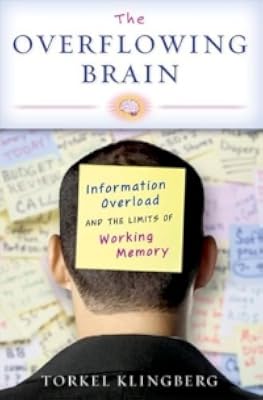
The Overflowing Brain: Information Overload and the Limits of Working Memory
by Torkel Klingberg
On This Page
Description
As the pace of technological change accelerates, we are increasingly experiencing a state of information overload. Statistics show that we are interrupted every three minutes during the course of the work day. Multitasking between email, cell-phone, text messages, and four or five websites while listening to an iPod forces the brain to process more and more informaton at greater and greater speeds. And yet the human brain has hardly changed in the last 40,000 years. Are all these high-tech advanTags
Recommendations











Member Reviews
Short but interesting read on the way the brain works, and why the overloading we experience today may be a direct result of how the brain evolved. Doesn't offer solutions to this problem, nor does it end with a bang (rather, it trails off into nothingness), but it does make an interesting logical argument about how central 'working memory' is to a number of cognitive constraints.
Klingberg gives a summary of the possible relationship of working memory to attention, concentration, and ability to tune-out distractions.
His postulations seem quite tentative in this book, but I believe that is to be expected; he is both summarizing and conjecturing at the cutting-edge of such research.
Because he's at the cutting-edge, he offers little advice on how to improve one's working memory, only indicating that meditation, and some specialized computer games seem to have boosted participants working memory and attention based on fMRI's that show the same brain structures activated.
Klingberg is optimistic: He believes working memory and attention CAN be improved and our presently busy lives may actually be improving our show more capacities rather than just overloading us, and such may, in part, be the explanation for the Flynn Effect.
I look forward to future updates from Torkel Klingberg. show less
His postulations seem quite tentative in this book, but I believe that is to be expected; he is both summarizing and conjecturing at the cutting-edge of such research.
Because he's at the cutting-edge, he offers little advice on how to improve one's working memory, only indicating that meditation, and some specialized computer games seem to have boosted participants working memory and attention based on fMRI's that show the same brain structures activated.
Klingberg is optimistic: He believes working memory and attention CAN be improved and our presently busy lives may actually be improving our show more capacities rather than just overloading us, and such may, in part, be the explanation for the Flynn Effect.
I look forward to future updates from Torkel Klingberg. show less
As a software designer, I am interested in perception and memory. Knowing how brains function helps me to design intuitive software. I was hopeful that this book would offer some insights, perhaps ideas as to how information can best be presented for maximum comprehension, retention, and analysis. I didn’t find that in this book. Any helpful tips were from the perspective on what a person can do to increase their own effectiveness, rather than how products, media, etc can be improved.
But even though this book wasn’t directly applicable, I found it quite interesting. I think it’s fascinating to learn about types of memory, how attention interacts with memory, brain development, cognitive improvement, etc. The author presents show more current scientific study results at just the right depth – not too simplified or too complex for an interested layperson. The explanations are full of relatable everyday examples. show less
But even though this book wasn’t directly applicable, I found it quite interesting. I think it’s fascinating to learn about types of memory, how attention interacts with memory, brain development, cognitive improvement, etc. The author presents show more current scientific study results at just the right depth – not too simplified or too complex for an interested layperson. The explanations are full of relatable everyday examples. show less
Torkel Klingberg, Professor of Developmental Cognitive Neuroscience at the Stockholm Brain Institute, is one of the world's leading experts on neuroplasticity and neurobiology of working memory. He has taken time from his prolific research and scientific publications to write a popular science book about this subject. The book is an intellectual delight that makes fascinating reading! It is clearly written at a level that is easily readable by interested nonspecialists and laypersons curious about cognitive science.
The book is written somewhat like a scientific mystery story, taking the reader on a step-by-step guided tour through recent worldwide psychological and neurobiological experiments. Each experiment uncovers an integral piece show more of the puzzle demonstrating exactly what is working memory and its relationship to intelligence and problem-solving.
In the introduction, Klingberg says: "I have tried to write a book on a series of associated studies that together build up a story. I will be drawing on as many bits of information as we need to piece together a jigsaw puzzle that gives at least part of the picture, even if it doesn't reproduce the entire scene."
The author begins by explaining some of the theories about how working memory evolved in primitive man. He ends by suggesting how working memory is continuing to evolve and adapt to the demands placed on it by modern culture. Along the way, the author shows us the importance of working memory to the understanding of Attention Deficit Hyperactivity Disorder (ADHD). We learn about what type of pastimes (e.g., playing chess, reading, playing computer games, doing crossword puzzles, etc.) has the ability to improve or train working memory and which do not. We are taken inside many of the leading experimental research projects attempting to train and improve working memory.
The author explains that there is a direct correlation between improvements in working memory and improvements in intelligence. The author explains The Flynn Effect which demonstrates that IQ performance has improved steadily throughout the past century. The author then goes on to hypothesize that much of this improvement can be attributed to improvements in working memory brought about by human adaptation to the ever-increasing complexity of modern life…and more recently, to the widespread trend toward multitasking.
I am not a scientist, but I found this book captivating, intriguing, compelling, and easily readable. As a caveat, I am a retired academic research librarian and have a strong interest in scientific experimentation and my career has been dominated by abundant exposure to academic writing of all kinds.
As a librarian, I strongly encourage the purchase of this book by all libraries, both academic and public. In addition, this book should be a welcome addition to the private libraries of psychologists, psychiatrists, neurologists, social scientist, or anyone in the general public who is interested in keeping abreast of the science of the mind. show less
The book is written somewhat like a scientific mystery story, taking the reader on a step-by-step guided tour through recent worldwide psychological and neurobiological experiments. Each experiment uncovers an integral piece show more of the puzzle demonstrating exactly what is working memory and its relationship to intelligence and problem-solving.
In the introduction, Klingberg says: "I have tried to write a book on a series of associated studies that together build up a story. I will be drawing on as many bits of information as we need to piece together a jigsaw puzzle that gives at least part of the picture, even if it doesn't reproduce the entire scene."
The author begins by explaining some of the theories about how working memory evolved in primitive man. He ends by suggesting how working memory is continuing to evolve and adapt to the demands placed on it by modern culture. Along the way, the author shows us the importance of working memory to the understanding of Attention Deficit Hyperactivity Disorder (ADHD). We learn about what type of pastimes (e.g., playing chess, reading, playing computer games, doing crossword puzzles, etc.) has the ability to improve or train working memory and which do not. We are taken inside many of the leading experimental research projects attempting to train and improve working memory.
The author explains that there is a direct correlation between improvements in working memory and improvements in intelligence. The author explains The Flynn Effect which demonstrates that IQ performance has improved steadily throughout the past century. The author then goes on to hypothesize that much of this improvement can be attributed to improvements in working memory brought about by human adaptation to the ever-increasing complexity of modern life…and more recently, to the widespread trend toward multitasking.
I am not a scientist, but I found this book captivating, intriguing, compelling, and easily readable. As a caveat, I am a retired academic research librarian and have a strong interest in scientific experimentation and my career has been dominated by abundant exposure to academic writing of all kinds.
As a librarian, I strongly encourage the purchase of this book by all libraries, both academic and public. In addition, this book should be a welcome addition to the private libraries of psychologists, psychiatrists, neurologists, social scientist, or anyone in the general public who is interested in keeping abreast of the science of the mind. show less
The book focuses on Working memory, what it is, what's known about how it works, it's limits and the implications of those limitations. Towards the end, it also explores possible ways to enhance working memory by drug or training. While the book was well written and understandable, I did not find it fascinating, either because the focus was so narrow or I already knew some of the information.
Overflowed my brain. I don't know if I have the bandwidth to deal with this book- frankly just got a little bored. It's far more scientific than I expected. Parts were interesting but it was just more technical than I thought it would be- or maybe I'm just dumb.
Ratings
Members
- Recently Added By
Lists

The Great Courses: The Learning Brain
61 works; 1 member

Books in the Bibliography of The Alchemy of Us by Ainissa Ramirez
181 works; 1 member
Author Information

8 Works 238 Members
Torkel Klingberg, MD, PhD, Professor of Cognitive Neuroscience, Karolinska Institute, Stockholm Brain Institute, Stockholm, Sweden
Classifications
Statistics
- Members
- 197
- Popularity
- 166,594
- Reviews
- 6
- Rating
- (3.65)
- Languages
- English, Swedish
- Media
- Paper, Ebook
- ISBNs
- 10
- ASINs
- 1