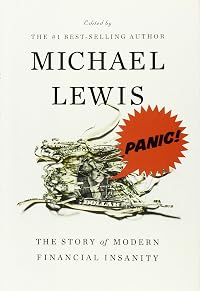
Panic: The Story of Modern Financial Insanity
by Michael Lewis
On This Page
Description
An analysis of five financial upheavals in recent history includes coverage of the 1987 stock market crash, the 1998 Russian default (and the consequent collapse of U.S. hedge fund Long-Term Capital Management), the Asian currency crisis of 1999, the Internet bubble of 1995-2001, and the 2008 sub-prime mortgage crisis, in an anecdotal report that reveals how public knowledge differed from what was actually taking place.Tags
Recommendations







Member Reviews
Another 'hindsight' review, this time of a collection of material from 2008, largely contemporaneous articles curated by Michael Lewis, one of late capitalism's best known chroniclers.
The material covers the stock market crash of 1987 (blamed at the time on automated trading), the Asian currency crisis and the problems at Long Term Capital Management in 1998, the internet stocks boom and bust in 2000 and the sub-prime mortgage market collapse in 2007.
Lewis' underlying thesis is what you would expect from an anarcho-capitalist - these were crises that failed to dent the underlying viability of capitalism and are just part of the creative destruction necessary to economic innovation.
Unfortunately, he published this book after the Bear show more Stearns crisis but before the bankruptcy of Lehmann so his four tales now look more like pre-shocks to the 2008 earthquake rather than relatively benign if troublesome shifts in the tectonic plates of the global economy.
Do not be put off by the initial articles on equity trading which are filled with technical information. The book does not continue in this vein by any means.
Although of rather antiquarian interest (in market terms), there is some fine and even amusing writing in these 55 or so news items, extracts from reports, satires and features. I learned a great deal about events I thought that I had lived through at the margin.
It is, however, a potboiler. The author was right to give his profits to charity rather than stake a claim to original work. His introductory comentaries are certainly a little perfunctory and even perhaps lazy. The book is really about the contributions of others.
Do we learn anything fundamentally new from this book? Not really. The education is in the detail and about the psychology of Wall Street. The bottom line is that American capitalism works as a form of punctuated equilibrium, learns by doing and corrects itself in the end.
Even the suffering aspects do not look quite as bad when some crises are presented as redistributions from rich investors to other rich investors, entrepreneurs (the internet boom) and the poor (or so Lewis claims a little unpersuasively in relation to the sub-prime crisis).
The cloud over the more Polly-Anna-ish aspects of the book is, of course, what happened in the year of publication (2008) from which the West is still not recovering seven years later - not really a global depression but a sort of lop-sided permanent doldrums.
The recent Legatum Institute Report suggests that the enthusiasm for capitalism of those years has somewhat dissipated but not in the direction of socialism - people just seem to want a capitalism that actually works.
Whether investors will go back and risk all on the next wave of technologies - AI, nano and bio - is an interesting question to ask. Perhaps the doldrums derive in part because the ordinary investor is risk-averse, nervous of the Wall Street insiders taking him for a ride.
Still, an entertaining slice of documentary history but really only one for people who are interested in markets and capitalism and as an adjunct to broader and wider reading elsewhere. It won't tell you much about the prospects for global recovery - if it ever comes. show less
The material covers the stock market crash of 1987 (blamed at the time on automated trading), the Asian currency crisis and the problems at Long Term Capital Management in 1998, the internet stocks boom and bust in 2000 and the sub-prime mortgage market collapse in 2007.
Lewis' underlying thesis is what you would expect from an anarcho-capitalist - these were crises that failed to dent the underlying viability of capitalism and are just part of the creative destruction necessary to economic innovation.
Unfortunately, he published this book after the Bear show more Stearns crisis but before the bankruptcy of Lehmann so his four tales now look more like pre-shocks to the 2008 earthquake rather than relatively benign if troublesome shifts in the tectonic plates of the global economy.
Do not be put off by the initial articles on equity trading which are filled with technical information. The book does not continue in this vein by any means.
Although of rather antiquarian interest (in market terms), there is some fine and even amusing writing in these 55 or so news items, extracts from reports, satires and features. I learned a great deal about events I thought that I had lived through at the margin.
It is, however, a potboiler. The author was right to give his profits to charity rather than stake a claim to original work. His introductory comentaries are certainly a little perfunctory and even perhaps lazy. The book is really about the contributions of others.
Do we learn anything fundamentally new from this book? Not really. The education is in the detail and about the psychology of Wall Street. The bottom line is that American capitalism works as a form of punctuated equilibrium, learns by doing and corrects itself in the end.
Even the suffering aspects do not look quite as bad when some crises are presented as redistributions from rich investors to other rich investors, entrepreneurs (the internet boom) and the poor (or so Lewis claims a little unpersuasively in relation to the sub-prime crisis).
The cloud over the more Polly-Anna-ish aspects of the book is, of course, what happened in the year of publication (2008) from which the West is still not recovering seven years later - not really a global depression but a sort of lop-sided permanent doldrums.
The recent Legatum Institute Report suggests that the enthusiasm for capitalism of those years has somewhat dissipated but not in the direction of socialism - people just seem to want a capitalism that actually works.
Whether investors will go back and risk all on the next wave of technologies - AI, nano and bio - is an interesting question to ask. Perhaps the doldrums derive in part because the ordinary investor is risk-averse, nervous of the Wall Street insiders taking him for a ride.
Still, an entertaining slice of documentary history but really only one for people who are interested in markets and capitalism and as an adjunct to broader and wider reading elsewhere. It won't tell you much about the prospects for global recovery - if it ever comes. show less
I was hoping that by reading about the folly of others I could be a bit wiser for the current financial crisis. But I still don't feel wise. This book does provide some relief for today's remorseful investor by telling stories of others who lost more.
"Everything, in retrospect, is obvious. But if everything were obvious, authors of histories of financial folly would be rich . . ." It is incredible how naive and stupid some of the pre-panic articles are. But on the other hand, many of the post-panic articles are equally over the top in finding conspiracies where in reality only simple capitalistic greed is present. Is being greedy (or stupid) against the law? An example of pre-panic swagger is this quote by Dave Barry; "You don’t have show more to take any risk, or work hard, or even have a central nervous system. That’s how profitable real estate is!"
This book was published November 17, 2008, and the current financial crisis has continued to play out since then. So the comments about the current sub-prime mortgage crisis probably will become quickly dated. Nevertheless, I found his predictions related to the current financial situation of interest. He says the coming recession will be longer and more persistent than any in recent memory. In absolute terms it won't be as bad as the 1930's depression because we're beginning from a higher starting point. However, in relative terms we may feel worse than those who lived through the 1930's. The reason is that our expectations are so high and our tolerance for discomfort so low that we'll cry like spoiled children. Perhaps this time it really is the end of the world as we know it.
Of the five financial crises examined, the differences are so large that there are few morsels of wisdom that can be carried forward to avoid the next crisis. However, I will make this prediction; If you had the job in the past of flipping derivatives based on sub-prime mortgages, you'd better start looking for a new job flipping hamburgers because your old job isn't coming back.
Read in January, 2009 show less
"Everything, in retrospect, is obvious. But if everything were obvious, authors of histories of financial folly would be rich . . ." It is incredible how naive and stupid some of the pre-panic articles are. But on the other hand, many of the post-panic articles are equally over the top in finding conspiracies where in reality only simple capitalistic greed is present. Is being greedy (or stupid) against the law? An example of pre-panic swagger is this quote by Dave Barry; "You don’t have show more to take any risk, or work hard, or even have a central nervous system. That’s how profitable real estate is!"
This book was published November 17, 2008, and the current financial crisis has continued to play out since then. So the comments about the current sub-prime mortgage crisis probably will become quickly dated. Nevertheless, I found his predictions related to the current financial situation of interest. He says the coming recession will be longer and more persistent than any in recent memory. In absolute terms it won't be as bad as the 1930's depression because we're beginning from a higher starting point. However, in relative terms we may feel worse than those who lived through the 1930's. The reason is that our expectations are so high and our tolerance for discomfort so low that we'll cry like spoiled children. Perhaps this time it really is the end of the world as we know it.
Of the five financial crises examined, the differences are so large that there are few morsels of wisdom that can be carried forward to avoid the next crisis. However, I will make this prediction; If you had the job in the past of flipping derivatives based on sub-prime mortgages, you'd better start looking for a new job flipping hamburgers because your old job isn't coming back.
Read in January, 2009 show less
An Interesting Look Back
The newest book edited by Michael Lewis, aptly named "Panic" is a collection of previously published articles before, during, and after the market collapses of 1987, the Asian financial crisis of 1998, the Dot Com bust in 2001 and the latest Subprime mortgage meltdown.
Though, none of the books contents represents any new analysis or synthesis of the events past, nor is much contextualization given by Lewis of the articles and events, I still felt that the book was a good read. Mostly because it was refreshing to re-read what people were feeling at the time. They give a snapshot in time of the over-confidence, anxieties, and overall market psychology that underlies the whole system.
Throughout the book there are show more some great quotes and one-liners such as "I guess if you're neither a bull nor a bear, you're a chicken." Or great anecdotes that illustrate the silliness of some of these ventures such as the story of Books-a-million or "From Rudolph the Red-Nosed Reindeer."
Mostly though, as a reader one comes away with the feeling that none of us are omniscient. Not the stock gurus, the appraisers, the agents, the economists, etc... We're all flying by the seat of our pants and nobody knows what is going to happen next, your guess is as good as mine. Which means, anytime you hear some Harvard MBA "analyst" tell you what the market's gonna do, you're just as well-off doing the opposite.
I do highly recommend this book, not just because I'm a Michael Lewis fan, but because I think the book illustrates both the complexity and the folly of the economic markets. There's no trying to make sense of it all, because there is no sense to begin with. show less
The newest book edited by Michael Lewis, aptly named "Panic" is a collection of previously published articles before, during, and after the market collapses of 1987, the Asian financial crisis of 1998, the Dot Com bust in 2001 and the latest Subprime mortgage meltdown.
Though, none of the books contents represents any new analysis or synthesis of the events past, nor is much contextualization given by Lewis of the articles and events, I still felt that the book was a good read. Mostly because it was refreshing to re-read what people were feeling at the time. They give a snapshot in time of the over-confidence, anxieties, and overall market psychology that underlies the whole system.
Throughout the book there are show more some great quotes and one-liners such as "I guess if you're neither a bull nor a bear, you're a chicken." Or great anecdotes that illustrate the silliness of some of these ventures such as the story of Books-a-million or "From Rudolph the Red-Nosed Reindeer."
Mostly though, as a reader one comes away with the feeling that none of us are omniscient. Not the stock gurus, the appraisers, the agents, the economists, etc... We're all flying by the seat of our pants and nobody knows what is going to happen next, your guess is as good as mine. Which means, anytime you hear some Harvard MBA "analyst" tell you what the market's gonna do, you're just as well-off doing the opposite.
I do highly recommend this book, not just because I'm a Michael Lewis fan, but because I think the book illustrates both the complexity and the folly of the economic markets. There's no trying to make sense of it all, because there is no sense to begin with. show less
Loved this book. Loved reading articles written during the financial chaos; it gives incredible perspective to what people were thinking and feeling. This book is not a thorough analysis of what happened to cause the various periods of financial instability, but it serves as a reminder even the best minds in the world can't predict periods of instability and sometimes can't even help return the market to stability.
Disappointed by the audiobook. There are no notifications when you've reached the end of a disk. Perhaps I should have read the summary a bit more carefully, as this is just an overview of past events - a collection of articles in the media while those events were happening. I was hoping to hear more of the Lewis insight and investigations akin to Moneyball. Maybe that's what got cut out in this abridged version.
Twenty years of writing proving that money makes liars and fools of us all.
Only aims to entertain.
Members
- Recently Added By
Author Information

33+ Works 35,690 Members
Michael Lewis was born in New Orleans, Louisiana on October 15, 1960. He received a BA in art history from Princeton University in 1982 and a Masters in economics from the London School of Economics in 1985. He is a non-fiction author/journalist of mostly financial themes. His books include Liar's Poker, Moneyball: The Art of Winning an Unfair show more Game, The Blind Side: Evolution of a Game, The Money Culture, Boomerang, Flash Boys: A Wall Street Revolt, The Big Short: Inside the Doomsday Machine and The Undoing Project: A Friendship That Changed Our Minds. (Bowker Author Biography) show less
Common Knowledge
- Disambiguation notice
- Lewis, Michael - editor, not author
Classifications
- Genres
- Economics, Business, Nonfiction, General Nonfiction, History
- DDC/MDS
- 338.542 — Society, government, & culture Economics Production Microeconomics Fluctuations Business Cycles
- LCC
- HB3722 .P36 — Social sciences Economic theory. Demography Economic theory. Demography Business cycles. Economic fluctuations
- BISAC
Statistics
- Members
- 679
- Popularity
- 42,090
- Reviews
- 7
- Rating
- (3.35)
- Languages
- English, Portuguese (Portugal)
- Media
- Paper, Audiobook
- ISBNs
- 11
- ASINs
- 6