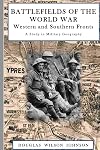
Battlefields of the World War: Western and Southern Fronts A Sudy in Military Geography
by Douglas Wilson Johnson
On This Page
Description
This is a fantastic book about the battles and battlefields from the ground-level view. It is very mat-of-fact in tone and brims with information not found elsewhere on these deadly battles. It includes important terrain photos, meant to be tactical impressions. From the Introduction . . . "Do the mountains defend the army, or does the army defend the mountains?" The problem is an old, one, and has claimed the attention of military authorities in all countries and in all times. Expressed in show more broader terms, it is the oft-debated question as to the relative influence of topography upon strategy and tactics under changing conditions of warfare. It is an ever-recurring question, for each "revolution" in methods of combat brings in its train a body of opinion intent on demonstrating that, under the new conditions of fighting, topographic obstacles have lost their significance, strategic gateways no longer exist, and commanding positions no longer "command." Then, as opposing forces share in the new discoveries, or profit in equal measure by new systems, the fundamental importance of topography reasserts itself, and each side maneuvers for an advantageous position on the terrain as one of the prerequisites to victory in battle. The question is still a live one. The warfare of today employs a variety of inventions and technical devices, each of which may appear to reduce, if not to destroy, the influence of topography upon military operations. What protection is a river channel, when the modern military engineer can throw bridges across it in a few hours, defended by artillery which can reach the enemy many miles beyond the farther bank? What need has the artillery for hill positions, when guns are now commonly concealed in valleys and ravines, firing with marvelous accuracy upon objectives the gunners never see? With sound-ranging and flashranging devices to spot enemy batteries, with airplanes and aerial photog'1lphy to locate these and other objectives and to exercise surveillance over enemy movements, of what significance is a paltry elevation of some few tens or hundreds of feet, dignified in earlier wars as "dominating heights?" So might one multiply, indefinitely, queries the common answer to which would seem to be that in the warfare of the present time the inventions of Man have reduced to insignificance the ro1e of Nature. show lessTags
Members
- Recently Added By
Author Information
12 Works 29 Members
Common Knowledge
- Important events
- World War I (1914 | 1918)
- Original language
- English
Classifications
Statistics
- Members
- 11
- Popularity
- 2,006,339
- Languages
- English
- Media
- Paper
- ISBNs
- 1