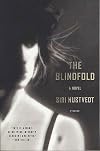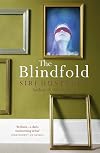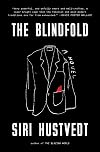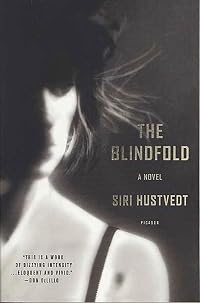
The Blindfold
by Siri Hustvedt
On This Page
Description
From the author of The Blazing World, "a work of dizzying intensity...eloquent and vivid" (Don DeLillo), about a young Midwestern woman who finds herself entangled in intense circumstances--physical, cerebral, and existential--when she moves to New York City. Iris Vegan, a young, impoverished graduate student from the Midwest, finds herself entangled with four powerful but threatening characters as she tries to adjust to life in New York City. Mr. Morning, an inscrutable urban recluse, show more employs Iris to tape-record verbal descriptions of objects that belonged to a murder victim. George, a photographer, takes an eerie portrait of Iris, which then acquires a strong life of its own, appearing and disappearing without warning around the city. After a series of blinding migraines, Iris ends up in a hospital room with Mrs. O., a woman who has lost her mind and memory to a stroke, but who nevertheless retains both the strength and energy to torment her fellow patient. And finally, there is Professor Rose, Iris's teacher and eventually her lover. While working with him on the translation of a German novella called The Brutal Boy, she discovers in its protagonist, Klaus, a vehicle for her own transformation and ventures out into the city again--this time dressed as a man. show lessTags
Recommendations

























Member Recommendations

unabridgedchick Strange, dark, and chilling!
Member Reviews
If you want to know what fiction is for, read The Blindfold. It is Iris Vegan's narrative of her early 20s in New York. Stephen and Iris are in a relationship. A third person enters, George, a recent friend of Stephen and a photographer, the three hang out. George takes photos of Iris by agreement one day and the relationship changes, art transforms her briefly as his model in one afternoon in a frenzy of photography. When George invites Stephen and Iris over to see the one photo worthy to be seen as art, Stephen has other plans, he is meeting someone. Here is what Iris thinks about that:
I imagine Stephen’s companion was a beautiful woman. Her form and colouring changed with my moving thoughts, but the idea that she existed remained show more to nag me, and even though she was only a spook of my jealousy, I couldn’t stop the surge of fantasies about her and Stephen. By the time I left the library, I had invented several elaborate plots involving the two of them, but hadn’t written a single word about Dorothea [her thesis subject on George Eliot’s Dorothea Brooke from Middlemarch she’d been working on]
We invent all the time, consumed by fictions, they trap us into seemingly ridiculous yet plausible narratives. We are our own invention. Thankfully we have writers to spin more interesting stories about those fantastical worlds that interrupt and damage our lives and selves all day long.
The self is an incomplete idea at any point. Iris is a young graduate student at university in New York. At that point, incompleteness seems more obvious, the self is emerging out of experiences and encounters. The novel comprises four sections, four periods of time or four episodes of interactions. Iris in various relationships. One with Stephen, one with George, one with doctors, one with Michael. Interwoven between these is the experience of a character in a novel named Klaus who Iris translates with her professor. Klaus’ experiences in the novel interact with her world. Another is with Paris, who is fascinated by her from the beginning and pops up regularly. And yet another is Mr Morning, who employs her to animate the objects that belong to a dead woman so he can write about them. She has to study the objects and read unemotionally into a tape recorder what she sees.
From the beginning Iris comes across as a tough talker, she appears centred, argumentative, engaging with ideas, no push over. She questions and asserts. But that is insufficient when emotions overwhelm, when the reality of surviving financially force decisions, or a migraine disables her and lands her in hospital. How does a girl pay the rent in a tough world? How smart does she have to be? Is giving emotionally just an opportunity for exploitation? What happens to that core self along the way when it is dispersed by interactions and experience?
The self constantly alters forms, appearance, adjusts and gives itself over to anything from love to friendship, to ideas. How does it emerge from it? For a young smart woman in a tough town, run mostly by men for their own needs, known for its violence, exploitation, its ability to devour and consume everything and transform it, perhaps the only recourse is a clever fictional narrative that imposes if not order on its universe but a way of interrogating it to understanding it. show less
I imagine Stephen’s companion was a beautiful woman. Her form and colouring changed with my moving thoughts, but the idea that she existed remained show more to nag me, and even though she was only a spook of my jealousy, I couldn’t stop the surge of fantasies about her and Stephen. By the time I left the library, I had invented several elaborate plots involving the two of them, but hadn’t written a single word about Dorothea [her thesis subject on George Eliot’s Dorothea Brooke from Middlemarch she’d been working on]
We invent all the time, consumed by fictions, they trap us into seemingly ridiculous yet plausible narratives. We are our own invention. Thankfully we have writers to spin more interesting stories about those fantastical worlds that interrupt and damage our lives and selves all day long.
The self is an incomplete idea at any point. Iris is a young graduate student at university in New York. At that point, incompleteness seems more obvious, the self is emerging out of experiences and encounters. The novel comprises four sections, four periods of time or four episodes of interactions. Iris in various relationships. One with Stephen, one with George, one with doctors, one with Michael. Interwoven between these is the experience of a character in a novel named Klaus who Iris translates with her professor. Klaus’ experiences in the novel interact with her world. Another is with Paris, who is fascinated by her from the beginning and pops up regularly. And yet another is Mr Morning, who employs her to animate the objects that belong to a dead woman so he can write about them. She has to study the objects and read unemotionally into a tape recorder what she sees.
From the beginning Iris comes across as a tough talker, she appears centred, argumentative, engaging with ideas, no push over. She questions and asserts. But that is insufficient when emotions overwhelm, when the reality of surviving financially force decisions, or a migraine disables her and lands her in hospital. How does a girl pay the rent in a tough world? How smart does she have to be? Is giving emotionally just an opportunity for exploitation? What happens to that core self along the way when it is dispersed by interactions and experience?
The self constantly alters forms, appearance, adjusts and gives itself over to anything from love to friendship, to ideas. How does it emerge from it? For a young smart woman in a tough town, run mostly by men for their own needs, known for its violence, exploitation, its ability to devour and consume everything and transform it, perhaps the only recourse is a clever fictional narrative that imposes if not order on its universe but a way of interrogating it to understanding it. show less
An experimental and I have to think, autobiographical novel that was at once self-deprecatory and congratulatory. It says look how quirky, interesting and downright weird my life is, but oh see how much of that is my fault. But not really.
Iris/Siri’s character is really hard to grasp. Most of that is the oblique prose and the fact that she’s always reacting to something or someone. She asserts things but only in response to provocation. Her personality is a mirror that reflects what people want. The only exception appears to be Stephen, but since he seems so conflicted about his relationship with Iris, maybe his desire to get away from her was what Iris really saw and then just gave him reasons.
The continuity is really weird and show more not easy to follow and I like books that play with time. The whole headache/hospital episode was hard to slot and seemed needlessly obscure, as did the rest of the timeline. This was my second book by Hustvedt and I don’t see myself tempted by her work again. show less
Iris/Siri’s character is really hard to grasp. Most of that is the oblique prose and the fact that she’s always reacting to something or someone. She asserts things but only in response to provocation. Her personality is a mirror that reflects what people want. The only exception appears to be Stephen, but since he seems so conflicted about his relationship with Iris, maybe his desire to get away from her was what Iris really saw and then just gave him reasons.
The continuity is really weird and show more not easy to follow and I like books that play with time. The whole headache/hospital episode was hard to slot and seemed needlessly obscure, as did the rest of the timeline. This was my second book by Hustvedt and I don’t see myself tempted by her work again. show less
This is a really bizarre book in what I'm guessing is post-modern style. A young woman has four loosely-connected, er, adventures with the weird. She's hired by a shadowy figure named Mr. Morning to study objects belonging to a dead person; she has a strange photo taken that seems to morph into other photos which appear all over the city; she endures a stay in a mental ward; and finally she has an affair with a professor. This depressing book is told in distinct sections which are presented out of chronological order. It's interesting, but the characters are mostly unlikeable and the plot threads are both seamy and strange. It's a very bleak book.
Siri Hustvedt’s first novel The Blindfold presents four interconnected accounts of several years of graduate study in literature at Columbia University in the late-twentieth century, told through the eyes of an American Midwesterner in her twenties and new to the cruelty, darkness, and pollution of New York City, noted for crime and grime in the 1970s and 1980s. The narrator struggles with poverty, hunger, sexual desire, neurological disorder, gender-role conflict, identity fragmentation, and madness. Black holes in her perceptual field feed her fascination with knowing the tactile world, listening, and finding the right words. Fearing that she may become a footnote in a psychiatric case history, the narrator is on a path to becoming show more a published writer. show less
I recorded this review as part of Bird Brian's Big Audio Project.
In a Guardian interview from 2010, Siri Hustvedt describes herself as wanting "to write something with an uncanny feeling" a few years after her marriage to Paul Auster. At the time of her marriage, she had been writing poetry, but she shifted her focus and crafted this unsettling, haunting novel.
On the surface, The Blindfold is about three years in the life of Iris Vegan, a graduate student at Columbia University with very few personal or financial resources, who struggles to navigate an ominous New York City. Beneath that surface, the novel explores the fragmentation of identity, the difficulty, perhaps impossibility, of Iris’s emerging with an integrated sense of show more self in a world where people put on and take off masks seemingly at will, where gender, age, and influence make it difficult for a young female student to find her identity without being coerced by others' desires. I found Iris's efforts in the face of medical traumas, poverty, and troubled personal relationships and encounters to be moving. I also believe that this novel’s power stems not only from Hustvedt’s unblinking examination of Iris’s struggles, but also from her presentation of some cracks in the armor of the powerful men whom Iris faces. This is a novel that does not provide a sense of closure. All the characters are missing pieces of themselves. All resort to silences, misdirections, projections, and disguises when interacting with others. In spite of this darkness, and of her apparent fragility, Iris keeps trying to connect meaningfully with others, and with herself. Her efforts are admirable, and provided me with a sense of hope for her, even as she runs away from another dangerous encounter in the novel’s climax.
The novel's central concerns are reflected in its structure. The Blindfold is comprised of four sections, with the first three focusing on specific episodes in Iris's life, taken out of chronological order, and the fourth section referring back to the previous sections as Iris narrates a linked series of new events. As Iris narrates this section, she attempts to put events back into an integrated whole. In the end, however, Hustvedt leaves the reader with a host of questions. In this final section, in spite of Iris’s efforts to relate an integrated story, in her narration events do not lead to a clear chronology. Motives remain obscure. The novel is shattered, mirroring Iris’s fragmented identity.
In part one, Iris accepts a position as a research assistant with Herbert B. Morning, a sinister and mysterious recluse who lives alone in a small apartment filled with boxes, each of which holds an object that belonged to a murder victim. Iris is tasked with tape recording whispered descriptions of each object. The symbolism in this section is clear -- the fragmented life of the victim, represented by possessions taken out of context, and stored in boxes like caskets. There also are indications of this encounter's fracturing Iris's identity: she adopts a pseudonym for the assignment, she disguises her voice by whispering, and she provides Morning with one of her own possessions at his request. As the situation becomes more ominous, Iris removes herself from it, thus establishing a pattern of escaping from challenging encounters with men. In this case, she can only protect her self by fleeing.
In part two, Iris's boyfriend Stephen introduces her to George, "an artist who took photographs," whose work consists of fragmented, disturbing images that he shows in pairs. Iris agrees to be photographed and is horrified by the photograph that George takes of her: "It wasn't a full-body shot. I was cut off below my breasts, and my extended arms were severed at the elbows. Photographs are cropped in all sorts of ways, and the results are seldom disturbing. The viewer fills in the missing pieces, but this picture was different. The convention didn't seem to work, and I had the awful impression that the parts of me that weren't in the photo were really absent" (62). Although Iris is shocked by the photograph, George and Stephen praise it. The rest of the section continues the themes of fragmentation and of Iris's lack of control over her life. Classmates and acquaintances mention the photograph to Iris, while remaining vague about exactly how and where they heard of it. And Iris's relationship with Stephen collapses under the weight of his indifference and his secrets, including the details of his relationship with George. Iris is turned into an object in this section, with acquaintances and strangers interpreting her image and superseding her understanding of herself with their interpretations.
In part three, Iris's serious migraines land her in the hospital, where she suffers from blinding pain and disorientation caused by auras and light sensitivity. She remains at a low status, because nurses and patients do not deem her to be seriously ill. She also has a problematic relationship with one of her roommates, Mrs. O., who is suffering from a neurological disorder and singles out Iris for periodic verbal and physical assaults. Throughout the section, while Iris suffers in pain and deals with the disorientation caused by medication and her condition, another roommate, Mrs. M., acts as a vocal Greek chorus. "Mrs. M. meant to dominate, to fill up the room with herself, but despite her incessant chatter and her bulk (she was a fleshy woman with Jowls and a substantial bosom), it was the small and silent Mrs. O. who took up space. She was a delicate woman in her late seventies, the victim of some nervous catastrophe. That event or series of events had left her incoherent. What remained was a fragmented being, a person shattered into a thousand pieces, but those bits of Mrs. O. inhabited the room like a crowd of invisible demons" (97) At one point, Iris wakes from a disturbing erotic dream to find Mrs. O. lying on her bed and kissing her. Mrs. O. is invading Iris's subconscious just as she takes control of her physical space.
In the fourth and longest section, Iris provides a disjointed attempt to pull together the pieces of her life into a whole. In addition to providing a sketchy chronological frame revisiting scenes from other sections, she focuses her discussion on her experiences at Columbia, all hinging on her relationship with Michael Rose, a professor for whom Iris works as a research assistant and translator. The Brutal Boy, the German novella that she translates, is about Klaus, a German boy who has sadistic fantasies. There are cross-currents related to power differentials throughout this section, as seen in Klaus's sadistic acts, in Iris's struggling to deal with Michael’s criticism of her translation, and in indications that Michael himself is struggling to control his attraction to Iris. During a period when Michael has left New York, Iris cross-dresses for a Halloween party, and continues to do so after the party is over. At first, this is a response to rapes in her neighborhood, but she ultimately is drawn to the freedom of slipping on a new identity, as she adopts the name Klaus. Dressed androgynously, she walks through dangerous neighborhoods, haunts seedy bars and clubs, and interacts with strangers. By taking on this identity, Iris transgresses gendered and spatial boundaries. It's another kind of escape - and in running from the dangers she faces as Iris, she is courting greater dangers.
Iris’s days as Klaus end when she runs into Michael, newly returned to New York, in one of her haunts. He is shocked by her appearance -- her excessive weight loss, her cropped hair, and her haunted, drawn face. After he leads her from the bar and orders her not to dress as Klaus again, the two embark on an affair. As she moves into a new role as Michael’s lover, Iris describes her initial sense of empowerment: “I started calling him Michael. In the beginning when I used the name, I always experienced a rush of feeling, a strong sense of having moved into a new position: universities may be the last place in America where first names still have the force of intimacy. ‘Michael’ was for me a clandestine sign, a key to our secret, and I used the name over and over, to him and to myself” (186). In the same paragraph, though, she quickly shifts into a troubled examination of the gap between her self-image and Michael’s view of her: “Sometimes after he was gone, I would examine myself naked in the mirror, and for an instant would imagine I saw what he saw--an enchanted body” (187). Iris is attempting to reduce herself to a sexual object. She does not succeed in this - she feels too disconnected from her body.
Michael adopts masks and plays a role as well: “There were moments when the physical fact of the man estranged me, when my idea of man and the man himself were disconnected, but they lasted only seconds. I was seduced through my ear. The more he talked, the more I wanted him, and he talked up a storm, wooing me with Catullus, Boccaccio, Donne, and Sidney, with Shakespeare and Wyatt, Fielding and Joyce, and that's how I like to remember him now, in midsentence, lying in my bed wit his eyes shut, quoting from memory” (187). Is Michael manipulating Iris as he takes on the persona of these brilliant writers? Or is he casting about for a way to integrate his physical, emotional, intellectual, and inner identities?
A heart-wrenching episode near the end of the novel provides further insight into Michael’s identity, which appears to be splintered just as Iris’s is. The scene begins playfully, as Michael and Iris walk home one night after he has given her a scarf. When she says that she could find her way home blindfolded, Michael improvises a blindfold from the scarf and challenges her to do just that. Iris feels empowered and free as she walks down the sidewalks, showing her mastery of the way home. She also describes an erotic sense of the disintegration of physical boundaries after Michael carries her into her apartment, “He kissed me, and it was good not to see him. He could have been any man. The anonymity was his and mine. Like a child, I felt that my blindness made me disappear, or at least made the boundaries of my body unstable. One of us gasped. I didn’t know who it was, and this confusion made my heart pound” (203). Iris’s blindness is another form of escaping from her body, from her identity. She is escaping into formlessness, erasing her body and her psyche as she does so.
However, Michael soon becomes violent - holding Iris down, calling her a witch, and slapping her. She fends him off by biting him. They both lie, stunned, in the bedroom. Iris throws off the scarf, wraps herself completely in a blanket, and withdraws. Michael sits on the corner of the bed and begins to cry. Iris watches him. At first she is disgusted by his appearance, but then she draws closer to him while he sobs harder and tries to speak. As she approaches him, touches him gently, and asks, “why?”, “Michael moved so that he could see himself in the long mirror opposite us. We stared at the reflection. I saw him, saw the soft, pale flesh of his belly, the deep navel and flaccid genitals. I looked away, I had seen it. In the mirror his body appeared as a thing of comic horror, vulnerable, aging, the site of decay” (206) Michael’s reflection reveals his age, his vulnerability, his lack of sexual power. His sight of himself displaces his formerly adopted image as a powerful professor and virile lover, who spoke the language of poets. Iris then shifts her focus to her reflection: “I moved behind him and studied my image in the glass -- the small head and wild hair, the colorless cheeks, the darkness under my eyes, my thin fingers holding the blanket. I let go, and the covering fell to the bed, exposing my naked body but what I saw was my mouth. The lips appeared very red and swollen, a lonely sign of blatant sexuality, an advertisement” (206). Iris gazes into the mirror, but she does not see herself as a whole, as a woman, as a person. She instead shatters into pieces, focuses only on her mouth, and thus defines herself solely as a sexual object. This scene resonates with Lacan’s theory of the mirror stage. Michael reacts to the distance between his adopted self image and his reflection by leaving Iris, in spite of her pleading with him to stay, to remain with her, so they can recreate themselves and start over.
In the novel’s final scenes, Iris, who is still recovering from the end of her relationship with Michael, searches for someone with whom she can discuss her disturbing experiences over the past months. She hopes to tell her friend Ruth over dinner, but when Ruth discloses that she is newly married and pregnant, Iris decides that her troubling disclosures are not compatible with Ruth’s new roles as wife and expectant mother. Iris later meets her friend Paris, an art critic, for another dinner, and she does tell him about all her experiences in detail. Her disclosure of her secrets leads to Paris’s removing his mask of concerned friend, and revealing himself to have manipulated Iris to extract an entertaining story. As he attempts to exercise his power over her sexually, Iris flees from his apartment and escapes underground into the IRT, “like a bat out of hell” (221). Iris is once again running away from a destructive relationship, fleeing from a man who is exercising power over her. As she disappears underground, I ached for her. However, I also hoped, perhaps against hope, that she would succeed in her quest to understand her self, and to connect with another person in a way that would be supportive and empowering, rather than destructive and confining. Hustvedt does not provide us with many clues pointing the way to this ending. In spite of this, I admire Iris’s not giving up and giving in. I hope that she emerges into the light.
Soundtrack for The Blindfold
Nico & The Velvet Underground- I’ll Be Your Mirror (Andy Warhol Video, 1966)
http://www.youtube.com/watch?v=-sKzMEQ6MUo
John Parish and Polly Jean Harvey - That Was My Veil
http://www.youtube.com/watch?v=IJH7W3mI21I
Throwing Muses - Ellen West
http://www.youtube.com/watch?v=5XTMgQtnYVQ
Kristin Hersh - Close Your Eyes (Demo)
http://www.youtube.com/watch?v=OlKxcXH2vPA
Kristin Hersh - Trouble
http://www.youtube.com/watch?v=5fqIsfZ_rcY
Ani DiFranco - Present/Infant (Live at Babeville)
http://www.youtube.com/watch?v=eU17oIHGUCc show less
In a Guardian interview from 2010, Siri Hustvedt describes herself as wanting "to write something with an uncanny feeling" a few years after her marriage to Paul Auster. At the time of her marriage, she had been writing poetry, but she shifted her focus and crafted this unsettling, haunting novel.
On the surface, The Blindfold is about three years in the life of Iris Vegan, a graduate student at Columbia University with very few personal or financial resources, who struggles to navigate an ominous New York City. Beneath that surface, the novel explores the fragmentation of identity, the difficulty, perhaps impossibility, of Iris’s emerging with an integrated sense of show more self in a world where people put on and take off masks seemingly at will, where gender, age, and influence make it difficult for a young female student to find her identity without being coerced by others' desires. I found Iris's efforts in the face of medical traumas, poverty, and troubled personal relationships and encounters to be moving. I also believe that this novel’s power stems not only from Hustvedt’s unblinking examination of Iris’s struggles, but also from her presentation of some cracks in the armor of the powerful men whom Iris faces. This is a novel that does not provide a sense of closure. All the characters are missing pieces of themselves. All resort to silences, misdirections, projections, and disguises when interacting with others. In spite of this darkness, and of her apparent fragility, Iris keeps trying to connect meaningfully with others, and with herself. Her efforts are admirable, and provided me with a sense of hope for her, even as she runs away from another dangerous encounter in the novel’s climax.
The novel's central concerns are reflected in its structure. The Blindfold is comprised of four sections, with the first three focusing on specific episodes in Iris's life, taken out of chronological order, and the fourth section referring back to the previous sections as Iris narrates a linked series of new events. As Iris narrates this section, she attempts to put events back into an integrated whole. In the end, however, Hustvedt leaves the reader with a host of questions. In this final section, in spite of Iris’s efforts to relate an integrated story, in her narration events do not lead to a clear chronology. Motives remain obscure. The novel is shattered, mirroring Iris’s fragmented identity.
In part two, Iris's boyfriend Stephen introduces her to George, "an artist who took photographs," whose work consists of fragmented, disturbing images that he shows in pairs. Iris agrees to be photographed and is horrified by the photograph that George takes of her: "It wasn't a full-body shot. I was cut off below my breasts, and my extended arms were severed at the elbows. Photographs are cropped in all sorts of ways, and the results are seldom disturbing. The viewer fills in the missing pieces, but this picture was different. The convention didn't seem to work, and I had the awful impression that the parts of me that weren't in the photo were really absent" (62). Although Iris is shocked by the photograph, George and Stephen praise it. The rest of the section continues the themes of fragmentation and of Iris's lack of control over her life. Classmates and acquaintances mention the photograph to Iris, while remaining vague about exactly how and where they heard of it. And Iris's relationship with Stephen collapses under the weight of his indifference and his secrets, including the details of his relationship with George. Iris is turned into an object in this section, with acquaintances and strangers interpreting her image and superseding her understanding of herself with their interpretations.
In part three, Iris's serious migraines land her in the hospital, where she suffers from blinding pain and disorientation caused by auras and light sensitivity. She remains at a low status, because nurses and patients do not deem her to be seriously ill. She also has a problematic relationship with one of her roommates, Mrs. O., who is suffering from a neurological disorder and singles out Iris for periodic verbal and physical assaults. Throughout the section, while Iris suffers in pain and deals with the disorientation caused by medication and her condition, another roommate, Mrs. M., acts as a vocal Greek chorus. "Mrs. M. meant to dominate, to fill up the room with herself, but despite her incessant chatter and her bulk (she was a fleshy woman with Jowls and a substantial bosom), it was the small and silent Mrs. O. who took up space. She was a delicate woman in her late seventies, the victim of some nervous catastrophe. That event or series of events had left her incoherent. What remained was a fragmented being, a person shattered into a thousand pieces, but those bits of Mrs. O. inhabited the room like a crowd of invisible demons" (97) At one point, Iris wakes from a disturbing erotic dream to find Mrs. O. lying on her bed and kissing her. Mrs. O. is invading Iris's subconscious just as she takes control of her physical space.
In the fourth and longest section, Iris provides a disjointed attempt to pull together the pieces of her life into a whole. In addition to providing a sketchy chronological frame revisiting scenes from other sections, she focuses her discussion on her experiences at Columbia, all hinging on her relationship with Michael Rose, a professor for whom Iris works as a research assistant and translator. The Brutal Boy, the German novella that she translates, is about Klaus, a German boy who has sadistic fantasies. There are cross-currents related to power differentials throughout this section, as seen in Klaus's sadistic acts, in Iris's struggling to deal with Michael’s criticism of her translation, and in indications that Michael himself is struggling to control his attraction to Iris. During a period when Michael has left New York, Iris cross-dresses for a Halloween party, and continues to do so after the party is over. At first, this is a response to rapes in her neighborhood, but she ultimately is drawn to the freedom of slipping on a new identity, as she adopts the name Klaus. Dressed androgynously, she walks through dangerous neighborhoods, haunts seedy bars and clubs, and interacts with strangers. By taking on this identity, Iris transgresses gendered and spatial boundaries. It's another kind of escape - and in running from the dangers she faces as Iris, she is courting greater dangers.
Iris’s days as Klaus end when she runs into Michael, newly returned to New York, in one of her haunts. He is shocked by her appearance -- her excessive weight loss, her cropped hair, and her haunted, drawn face. After he leads her from the bar and orders her not to dress as Klaus again, the two embark on an affair. As she moves into a new role as Michael’s lover, Iris describes her initial sense of empowerment: “I started calling him Michael. In the beginning when I used the name, I always experienced a rush of feeling, a strong sense of having moved into a new position: universities may be the last place in America where first names still have the force of intimacy. ‘Michael’ was for me a clandestine sign, a key to our secret, and I used the name over and over, to him and to myself” (186). In the same paragraph, though, she quickly shifts into a troubled examination of the gap between her self-image and Michael’s view of her: “Sometimes after he was gone, I would examine myself naked in the mirror, and for an instant would imagine I saw what he saw--an enchanted body” (187). Iris is attempting to reduce herself to a sexual object. She does not succeed in this - she feels too disconnected from her body.
Michael adopts masks and plays a role as well: “There were moments when the physical fact of the man estranged me, when my idea of man and the man himself were disconnected, but they lasted only seconds. I was seduced through my ear. The more he talked, the more I wanted him, and he talked up a storm, wooing me with Catullus, Boccaccio, Donne, and Sidney, with Shakespeare and Wyatt, Fielding and Joyce, and that's how I like to remember him now, in midsentence, lying in my bed wit his eyes shut, quoting from memory” (187). Is Michael manipulating Iris as he takes on the persona of these brilliant writers? Or is he casting about for a way to integrate his physical, emotional, intellectual, and inner identities?
A heart-wrenching episode near the end of the novel provides further insight into Michael’s identity, which appears to be splintered just as Iris’s is. The scene begins playfully, as Michael and Iris walk home one night after he has given her a scarf. When she says that she could find her way home blindfolded, Michael improvises a blindfold from the scarf and challenges her to do just that. Iris feels empowered and free as she walks down the sidewalks, showing her mastery of the way home. She also describes an erotic sense of the disintegration of physical boundaries after Michael carries her into her apartment, “He kissed me, and it was good not to see him. He could have been any man. The anonymity was his and mine. Like a child, I felt that my blindness made me disappear, or at least made the boundaries of my body unstable. One of us gasped. I didn’t know who it was, and this confusion made my heart pound” (203). Iris’s blindness is another form of escaping from her body, from her identity. She is escaping into formlessness, erasing her body and her psyche as she does so.
However, Michael soon becomes violent - holding Iris down, calling her a witch, and slapping her. She fends him off by biting him. They both lie, stunned, in the bedroom. Iris throws off the scarf, wraps herself completely in a blanket, and withdraws. Michael sits on the corner of the bed and begins to cry. Iris watches him. At first she is disgusted by his appearance, but then she draws closer to him while he sobs harder and tries to speak. As she approaches him, touches him gently, and asks, “why?”, “Michael moved so that he could see himself in the long mirror opposite us. We stared at the reflection. I saw him, saw the soft, pale flesh of his belly, the deep navel and flaccid genitals. I looked away, I had seen it. In the mirror his body appeared as a thing of comic horror, vulnerable, aging, the site of decay” (206) Michael’s reflection reveals his age, his vulnerability, his lack of sexual power. His sight of himself displaces his formerly adopted image as a powerful professor and virile lover, who spoke the language of poets. Iris then shifts her focus to her reflection: “I moved behind him and studied my image in the glass -- the small head and wild hair, the colorless cheeks, the darkness under my eyes, my thin fingers holding the blanket. I let go, and the covering fell to the bed, exposing my naked body but what I saw was my mouth. The lips appeared very red and swollen, a lonely sign of blatant sexuality, an advertisement” (206). Iris gazes into the mirror, but she does not see herself as a whole, as a woman, as a person. She instead shatters into pieces, focuses only on her mouth, and thus defines herself solely as a sexual object. This scene resonates with Lacan’s theory of the mirror stage. Michael reacts to the distance between his adopted self image and his reflection by leaving Iris, in spite of her pleading with him to stay, to remain with her, so they can recreate themselves and start over.
In the novel’s final scenes, Iris, who is still recovering from the end of her relationship with Michael, searches for someone with whom she can discuss her disturbing experiences over the past months. She hopes to tell her friend Ruth over dinner, but when Ruth discloses that she is newly married and pregnant, Iris decides that her troubling disclosures are not compatible with Ruth’s new roles as wife and expectant mother. Iris later meets her friend Paris, an art critic, for another dinner, and she does tell him about all her experiences in detail. Her disclosure of her secrets leads to Paris’s removing his mask of concerned friend, and revealing himself to have manipulated Iris to extract an entertaining story. As he attempts to exercise his power over her sexually, Iris flees from his apartment and escapes underground into the IRT, “like a bat out of hell” (221). Iris is once again running away from a destructive relationship, fleeing from a man who is exercising power over her. As she disappears underground, I ached for her. However, I also hoped, perhaps against hope, that she would succeed in her quest to understand her self, and to connect with another person in a way that would be supportive and empowering, rather than destructive and confining. Hustvedt does not provide us with many clues pointing the way to this ending. In spite of this, I admire Iris’s not giving up and giving in. I hope that she emerges into the light.
Soundtrack for The Blindfold
Nico & The Velvet Underground- I’ll Be Your Mirror (Andy Warhol Video, 1966)
http://www.youtube.com/watch?v=-sKzMEQ6MUo
John Parish and Polly Jean Harvey - That Was My Veil
http://www.youtube.com/watch?v=IJH7W3mI21I
Throwing Muses - Ellen West
http://www.youtube.com/watch?v=5XTMgQtnYVQ
Kristin Hersh - Close Your Eyes (Demo)
http://www.youtube.com/watch?v=OlKxcXH2vPA
Kristin Hersh - Trouble
http://www.youtube.com/watch?v=5fqIsfZ_rcY
Ani DiFranco - Present/Infant (Live at Babeville)
http://www.youtube.com/watch?v=eU17oIHGUCc show less
There is so much depth and meaning in this fairly short novel. Iris's story has a sometimes hallucinatory quality - it's almost as though her identity shifts as she encounters a variety of strange and sometimes dangerous characters in New York City.
She takes a job where she is paid to describe discarded objects that may have belonged to murdered women. She suspects her employer may be their murderer. A strange photograph taken of her by an artist disturbs her romantic relationship. She ends up in a hospital for her migraines and is tormented by an elderly woman who shares her room. After translating a story about a cruel German boy she begins to wander the streets at night, dressed as a man.
In some ways, this book could be compared to show more The Bell Jar - the descriptions of sickness, the sense of impending madness, the vividness of the city, and the discomfort of being a young woman. I think it is very well written, interesting, and dark. show less
She takes a job where she is paid to describe discarded objects that may have belonged to murdered women. She suspects her employer may be their murderer. A strange photograph taken of her by an artist disturbs her romantic relationship. She ends up in a hospital for her migraines and is tormented by an elderly woman who shares her room. After translating a story about a cruel German boy she begins to wander the streets at night, dressed as a man.
In some ways, this book could be compared to show more The Bell Jar - the descriptions of sickness, the sense of impending madness, the vividness of the city, and the discomfort of being a young woman. I think it is very well written, interesting, and dark. show less
La historia está formada por cuatro partes protagonizadas por Iris Vegan, una joven estudiante de literatura de la Universidad de Columbia. Aunque parezcan relatos independientes, en realidad comparten un nexo en común. En la primera parte, Iris es contratada por un excéntrico personaje para que describa ciertos objetos, y grabe dichas descripciones. En la segunda parte, se narra la relación de Iris con su novio Stephen, y George, amigo de ambos y fotógrafo. En la tercera parte, la protagonista, tras sufrir fuertes dolores de cabeza, es ingresada en el hospital, donde se nos cuenta la relación con sus compañeras de habitación. Y en la cuarta parte, la mejor del libro, sabremos de la relación de Iris con su profesor, además de show more conocer a un extraño crítico de arte.
‘Los ojos vendados’ (The Blindfold, 1992), fue la primera novela publicada por la escritora Siri Hustvedt. Se trata de un libro caracterizado por las emociones y sentimientos de su protagonista, por su fragilidad y el pequeño universo que nos presenta, con personajes un tanto extraños y aislados, rozando la locura. La prosa de Hustvedt es clara y evocadora, aunque se nota que es una primera novela. show less
‘Los ojos vendados’ (The Blindfold, 1992), fue la primera novela publicada por la escritora Siri Hustvedt. Se trata de un libro caracterizado por las emociones y sentimientos de su protagonista, por su fragilidad y el pequeño universo que nos presenta, con personajes un tanto extraños y aislados, rozando la locura. La prosa de Hustvedt es clara y evocadora, aunque se nota que es una primera novela. show less
Members
- Recently Added By
Lists

Llibres que he llegit el 2018
46 works; 1 member

Books Read in 2018
4,360 works; 110 members

2024. Nuestro año literario (Faustino Sánchez)
20 works; 1 member
Author Information

35+ Works 9,701 Members
Siri Hustvedt is the author of seven novels, four collections of essays, and two works of nonfiction. She has a PhD from Columbia University in English literature and is a lecturer in psychiatry at Weill Cornell Medical College. She is the recipient of numerous awards, including the International Gabbaron Prize for Thought and Humanities (2012). show more Her novel The Blazing World was nominated for the Booker Prize and won the Los Angeles Times Book Prize for Fiction (2014). In 2019, she received an American Academy of Arts and Letters Award for Literature; the European Essay Prize for "The Delusions of Certainty," a work on the mind-body problem; and the Princess of Asturias Award for Literature. Her work has been translated into more than thirty languages. She lives in Brooklyn, New York. show less
Some Editions
Work Relationships
Is abridged in
Common Knowledge
- Canonical title
- The Blindfold
- Original title
- The Blindfold
- Original publication date
- 1992
- People/Characters
- Iris Vegan
- Important places
- New York, New York, USA
- Dedication
- For Paul Auster
- First words
- Sometimes even now I think I see him in the street or standing in a window or bent over a book in a coffee shop. And in that instant, before I understand that it's someone else, my lungs tighten and I lose my breath.
- Last words
- (Click to show. Warning: May contain spoilers.)Then I took off my shoes and ran to the IRT, ran, as they say, like a bat out of hell.
Classifications
Statistics
- Members
- 700
- Popularity
- 40,739
- Reviews
- 19
- Rating
- (3.54)
- Languages
- 13 — Danish, Dutch, English, Estonian, French, German, Greek, Italian, Norwegian (Bokmål), Polish, Spanish, Swedish, Turkish
- Media
- Paper, Ebook
- ISBNs
- 43
- ASINs
- 8