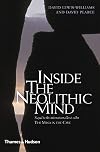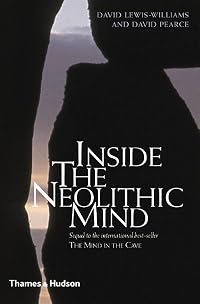
Inside the Neolithic Mind: Consciousness, Cosmos, and the Realm of the Gods
by David Lewis-Williams, D. G. Pearce
On This Page
Description
This brilliantly argued and elegantly written book examines the intricate web of belief, myth and society in the Neolithic period, continuing the story begun in the bestselling and critically acclaimed book 'The Mind in the Cave'.Tags
Recommendations
















Member Reviews
A hard turd forced out by two vein-faced bigots. One straining, the other pressing down on his gut. It purports to apply the findings of neuroscience to the archaeological remains of the Neolithic. In reality it claims religion to be the result of hallucinations and they propose in it’s place a religion of their own devising called Science. The book is marred by boasting, pride and arrogance. They make grandiose claims about how their thinking is much better than anyone else’s. Yet their reasoning is fundamentally flawed.
Take pages 78-9. They criticise the ‘functionalist’ explanation of ritual pig slaughter in Pacific societies, that it is to regulate the pig population. They call this a tautology and descriptive rather than show more explanatory: “The function of x is to do what it does”. They claim to be breaking out of the tautology by explaining that serial burials in the Near East were done to help the dead. Can’t they see that their explanation is just as functional? Their problem is that in their materialistic conception of the world slaughtering pigs controls their numbers, but the dead don’t need to be helped. If you think the dead need to be helped then doing something for them is just as functional. They say that helping the dead was done for mythological reasons. Maybe they had myths about how the dead would come back and get them if they weren’t serially buried. Maybe the Pacific societies had stories about what the pigs would do if there were too many of them. The problem is that the authors’ religious beliefs are intruding into the argument. They believe that too many pigs is a problem but they’re not afraid of ghosts.
Look, I believe in the Big Bang. I believe that it’s an event that has actually happened. I could tell you a story about how it happened. That story would be a myth, an attempt to explain in narrative some fundamental truth about the universe that explains the way it is. I could tell you the same story using a more precise language like mathematics. It would still be a myth. Just because it’s a myth doesn’t mean it isn’t true.
How can two people lacking even a basic self awareness hope to start their own religion? Or are they aware that their arguments are faulty? Do they have so little respect for the reader that they think we won’t notice? Is this a scam?
I’m particularly angry because the book claims to be about the Neolithic. I wanted to read a book about that. If I’d wanted the nasty views of two horrible bigots I’d have logged on to Twitter. show less
Take pages 78-9. They criticise the ‘functionalist’ explanation of ritual pig slaughter in Pacific societies, that it is to regulate the pig population. They call this a tautology and descriptive rather than show more explanatory: “The function of x is to do what it does”. They claim to be breaking out of the tautology by explaining that serial burials in the Near East were done to help the dead. Can’t they see that their explanation is just as functional? Their problem is that in their materialistic conception of the world slaughtering pigs controls their numbers, but the dead don’t need to be helped. If you think the dead need to be helped then doing something for them is just as functional. They say that helping the dead was done for mythological reasons. Maybe they had myths about how the dead would come back and get them if they weren’t serially buried. Maybe the Pacific societies had stories about what the pigs would do if there were too many of them. The problem is that the authors’ religious beliefs are intruding into the argument. They believe that too many pigs is a problem but they’re not afraid of ghosts.
Look, I believe in the Big Bang. I believe that it’s an event that has actually happened. I could tell you a story about how it happened. That story would be a myth, an attempt to explain in narrative some fundamental truth about the universe that explains the way it is. I could tell you the same story using a more precise language like mathematics. It would still be a myth. Just because it’s a myth doesn’t mean it isn’t true.
How can two people lacking even a basic self awareness hope to start their own religion? Or are they aware that their arguments are faulty? Do they have so little respect for the reader that they think we won’t notice? Is this a scam?
I’m particularly angry because the book claims to be about the Neolithic. I wanted to read a book about that. If I’d wanted the nasty views of two horrible bigots I’d have logged on to Twitter. show less
A very daring attempt to explain, frame and interpret what we now label as 'Neolithic art'. This does not regard the famous cave paintings from the south of France or Spain, because these date from a much older period (the Palaeolithic). Instead Lewis-Williams and Pearce focus on the art in the earliest towns and cities of the Neolithic Age, the period when man began to engage in agriculture, roughly 10,000 years ago in the Middle East, and about 8 to 5,000 years ago in Europe. More specifically, the authors zoom in on the plastered skulls and the anthropomorphic and geometric carvings in the Middle East and the megalithic structures in western Europe. They do this systematically using a very specific neurological model called the show more 'three stages theory'. This focuses on processes of ‘altered states of consciousness’, typical of (pseudo)religious rituals where dance, sound and hallucinatory substances are used, to get people into a state of trance. For Lewis-Williams, those experiences are the source of religious images and actions, and the entire book attempts to systematically view and explain the archaeological finds from that perspective.
Lewis-Williams's approach has met with quite a bit of resistance in archaeological circles, for indeed, it turns the classical paradigm that human behavior stems from adaptation to the environment on its head; for him, human action has its origin in the brain and nervous system. That sounds very deterministic, but Lewis-Williams has nuanced and adjusted his theory over the years. In this book he tries to illustrate this through the focus on Neolithic Art. Anyone interested in the archeology of the Middle East and Western Europe, from roughly 10,000 to 5,000 years ago, will certainly find what they are looking for in this book, with what seems a lot of new and detailed information. But the very theoretical approach, based on the neurological-cognitive model, often feels rather forced, especially because Lewis-Williams again and again tries to prove his point. I found this an interesting attempt to go beyond the limitations of the purely archaeological method, but at the same time a very speculative yet still quite deterministic approach. More on that in my History account on Goodreads: https://www.goodreads.com/review/show/923899251. show less
Lewis-Williams's approach has met with quite a bit of resistance in archaeological circles, for indeed, it turns the classical paradigm that human behavior stems from adaptation to the environment on its head; for him, human action has its origin in the brain and nervous system. That sounds very deterministic, but Lewis-Williams has nuanced and adjusted his theory over the years. In this book he tries to illustrate this through the focus on Neolithic Art. Anyone interested in the archeology of the Middle East and Western Europe, from roughly 10,000 to 5,000 years ago, will certainly find what they are looking for in this book, with what seems a lot of new and detailed information. But the very theoretical approach, based on the neurological-cognitive model, often feels rather forced, especially because Lewis-Williams again and again tries to prove his point. I found this an interesting attempt to go beyond the limitations of the purely archaeological method, but at the same time a very speculative yet still quite deterministic approach. More on that in my History account on Goodreads: https://www.goodreads.com/review/show/923899251. show less
This book is an attempt to explain some aspects of Neolithic religious ideas and practice which are suspected to have arisen from experience with altered states of mind. The authors' approach based on neurophysiology and comparisons with more recent shamanistic societies is interesting, but their explanations often seem too far-stretched and pushed.
Another brilliant book by the author of the brilliant book The Mind in the Cave. Williams and Pearce, by in-depth examination of the art of hunter-gatherers, usually in situ, show what the artists believed and how they viewed the cosmos. It is a history of human thought and consciousness, as well as early religions.
Beautiful full-color pictures of the art they are analyzing grace this volume.
Although this is a scholarly work of very high caliber, it is written in an interesting and flowing style.
Beautiful full-color pictures of the art they are analyzing grace this volume.
Although this is a scholarly work of very high caliber, it is written in an interesting and flowing style.
The authors take a multi-disciplinary approach to interpreting neolithic sites and artifacts. With little foundation in neurobiology, ethnography or archeaology, I was just along for the ride on this book. No idea where this book fits into the cannon of the research it draws on, but I found their thesis provocative and worth the read.
Counsciousness, Cosmos and the Realm of the Gods
Ratings
Members
- Recently Added By
Author Information

23+ Works 1,004 Members
David Lewis-Williams in Professor Emeritus and Senior Mentor in the Rock Art Research Institute, University of Witwatersrand, Johannesburg.
2 Works 260 Members
Work Relationships
Has the (non-series) prequel
Classifications
- Genres
- Anthropology, Nonfiction, History, General Nonfiction, Religion & Spirituality, Art & Design
- DDC/MDS
- 930.14 — History & geography History of ancient world (to ca. 499) Ancient History: China, Egypt, Rome, Greece Archaeology Neolithic Age [New Stone Age]
- LCC
- GN776 .L48 — Geography, Anthropology and Recreation Anthropology Anthropology Prehistoric archaeology
- BISAC
Statistics
- Members
- 256
- Popularity
- 126,454
- Reviews
- 6
- Rating
- (3.56)
- Languages
- Czech, English, Spanish
- Media
- Paper, Ebook
- ISBNs
- 7
- ASINs
- 4