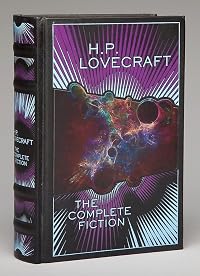
The Complete Fiction
by H. P. Lovecraft
On This Page
Description
Another excellent edition in the Knickerbocker Classic series, The Complete Fiction of H.P. Lovecraft collects the author's novel, four novellas, and fifty-three short stories. Written between the years 1917 and 1935, this collection features Lovecraft's trademark fantastical creatures and supernatural thrills, as well as many horrific and cautionary science-fiction themes, that have influenced some of today's writers and filmmakers, including Stephen King, Alan Moore, F. Paul Wilson, show more Guillermo del Toro, and Neil Gaiman. Included in this volume are The Case of Charles Dexter Ward, "The Call of Cthulhu," "The Dream-Quest of Unknown Kadath," "At the Mountains of Madness," "The Shadow Over Innsmouth," "The Colour Out of Space," "The Dunwich Horror," and many more hair-raising tales. The Knickerbocker Classics bring together the works of classic authors from around the world in stunning gift editions to be collected and enjoyed. Complete and unabridged, these elegantly designed cloth-bound hardcovers feature a slipcase and ribbon marker, as well as a comprehensive introduction providing the reader with enlightening information on the author's life and works. show lessTags
Recommendations

















Member Reviews
On the one hand it's great to have all the Lovecraft ouevre in a handy audio collection. On the other hand, Lovecraft really should be read in the deep bass monotone of a voice scraped raw from screaming at the nightmares visited upon their fevered brain each night and constantly on the verge of breaking into convulsions of emotion without ever actually doing so, and these do not sound like that. On the other other hand, it turns out NOT changing the bits of overtly racist language (usually cat names, and there must be a thesis in that, considering) doesn't draw that much more attention than changing them, one would almost appreciate the reminder of what a problematic fave he really is, if he didn't do it himself every few paragraphs in show more much more elevated literary language, so if your preference is for one or the other, this will provide you with the one, assuming you feel like putting up with it at all. Tell you what, though, Dream Quest Of Unknown Kadath really has one of the most faniciful and whimsical bits in Lovecraft with its army of cats that jump to the moon and rescue the beleagured hero. show less
Certainly an interesting read. Lovecraft has a seemingly boundless imagination for the horrors of earth and beyond, and the settings and beings that populate his dark, ancient universe are imbued with a sense of weirdness and fascination that I think very few of the creators he's inspired have been able to match. Other aspects of his fiction show less creativity: notably, his main characters are all basically the same person (the classic effete New Englander, a well-educated white man with a curious mind and sensitive temperament), who undergo the same character arc (making a discovery that induces a battle between curiosity and horror, ultimately leaving the narrator haunted by his newfound occult knowledge for the rest of his life). show more Since I like that character arc, I'm willing to give Lovecraft a pass on his repetetiveness. One gets the sense that Lovecraft's work offers deep, uncomfortable insight into his own psychology and emotional struggles, and it paints him as a deeply obsessive and tormented man, as well as a racist and elitist one. I'm appreciative of what he's contributed to the science fiction canon, and of his imagination and emotional honesty, even though what he reveals through his writing is often incredibly ugly.
My favorite stories from this collection were probably "The Case of Charles Dexter Ward," "The Color Out of Space," "The Shadow Out of Time," and "At the Mountains of Madness." The nastiest one has to be "Facts Concerning the Late Arthur Jermyn and His Family." show less
My favorite stories from this collection were probably "The Case of Charles Dexter Ward," "The Color Out of Space," "The Shadow Out of Time," and "At the Mountains of Madness." The nastiest one has to be "Facts Concerning the Late Arthur Jermyn and His Family." show less
What can we say about HP Lovecraft. Racist?....No. Misanthropic would be better term. It is far too easy to say he was a product of his generation. That would be an easy way out. We have to use our brains and understand just how he viewed the world. For as educated as he may have been; he was stunted socially. The language and attitude he used in his work came mostly from the fact that he really and truly never left his back yard. But I do believe as he approached the latter years of his life he began to see the world through a broader lens. Either way. His work, storytelling and the central idea of mankind being a small blip on the rear of the cosmic detail works. We are humans, we are small. Brilliant, flawed and special...but not show more impervious to the grand scheme that all must fall victim to. Is this really a review of a book...well yes it is. It is his world. This volume is very well put together. Nice thick and full of cosmic grief. show less
Howard Phillips Lovecraft was an odd soul. He was born in 1890 and lived 47 years only to die in sickness and poverty, questioning the merits of his work. In hindsight, Lovecraft is considered one of the masters of the horror genre. During his lifetime, however, he struggled to sell his stories and novellas to Weird Tales.
The first thing you notice when reading Lovecraft is the descriptive quality of his writing. Although it can feel plodding at times, it forces the reader to slow down and enter the terror of the situation. Any page will yield an example of this. Here's the beginning of The Outsider:
"Unhappy is he to whom the memories of childhood bring only fear and sadness. Wretched is he who looks back upon lone hours in vast and show more dismal chambers with brown hangings and maddening rows of antique books, or upon awed watches in twilight groves of grotesque, gigantic, and vine-encumbered trees that silently wave twisted branches far aloft" (164).
If you are willing to exit the furious pace of modern storytelling to enter Lovecraft's high-resolution stories, the details will linger in your mind.
Lovecraft's stories share a common theme: terror at the inconceivably other. He continually relates the mind-shattering terror one feels when one encounters cosmic beings that dwarf the categories of our human minds. For Lovecraft, humans are insignificant in the grand scale of the cosmos.
I can't help but process Lovecraft's themes in light of my Christian worldview. He was right—the cosmos is grander than we can possibly understand. A Judeo-Christian reflection on this leads to poetry:
"When I look at your heavens, the work of your fingers,
the moon and the stars, which you have set in place,
what is man that you are mindful of him,
and the son of man that you care for him" (Psalm 8:3-4 ESV)?
Where Lovecraft differs from Christianity is not the scale of cosmic otherness: it's that for Christians, the Other is invested personally in humanity. show less
The first thing you notice when reading Lovecraft is the descriptive quality of his writing. Although it can feel plodding at times, it forces the reader to slow down and enter the terror of the situation. Any page will yield an example of this. Here's the beginning of The Outsider:
"Unhappy is he to whom the memories of childhood bring only fear and sadness. Wretched is he who looks back upon lone hours in vast and show more dismal chambers with brown hangings and maddening rows of antique books, or upon awed watches in twilight groves of grotesque, gigantic, and vine-encumbered trees that silently wave twisted branches far aloft" (164).
If you are willing to exit the furious pace of modern storytelling to enter Lovecraft's high-resolution stories, the details will linger in your mind.
Lovecraft's stories share a common theme: terror at the inconceivably other. He continually relates the mind-shattering terror one feels when one encounters cosmic beings that dwarf the categories of our human minds. For Lovecraft, humans are insignificant in the grand scale of the cosmos.
I can't help but process Lovecraft's themes in light of my Christian worldview. He was right—the cosmos is grander than we can possibly understand. A Judeo-Christian reflection on this leads to poetry:
"When I look at your heavens, the work of your fingers,
the moon and the stars, which you have set in place,
what is man that you are mindful of him,
and the son of man that you care for him" (Psalm 8:3-4 ESV)?
Where Lovecraft differs from Christianity is not the scale of cosmic otherness: it's that for Christians, the Other is invested personally in humanity. show less
I first encountered H.P. Lovecraft's work as a teenager. My entry point was the same as it was for most people -- the Cthulhu stories, which Del Rey had published in a series of paperbacks with appropriately gruesome covers. After a while, my interest waned and I sold my copies. Recently, though, a friend's interest prompted me to revisit Lovecraft, this time undertaking his entire opus. And I'm glad I did.
Reading a compendium of Lovecraft's work revealed to me both that his work consists of more than the Cthulhu mythos tales and that the Cthulhu tales embody the essence of his perspective. Taken together, the reflect the world-view of a old-line American WASP terrified by a world shaped by forces beyond his comprehension. This really show more comes across in stories like "The Street" and "Facts Concerning the Late Arthur Jermyn and His Family," which reflect a fear of immigrants and Africans every bit as deeply expressed as that of the old gods and other supernatural beings. While it was shocking to read those stores today, they really helped me to better understand Lovecraft as a writer, and for that I will always value the perspective they offer. show less
Reading a compendium of Lovecraft's work revealed to me both that his work consists of more than the Cthulhu mythos tales and that the Cthulhu tales embody the essence of his perspective. Taken together, the reflect the world-view of a old-line American WASP terrified by a world shaped by forces beyond his comprehension. This really show more comes across in stories like "The Street" and "Facts Concerning the Late Arthur Jermyn and His Family," which reflect a fear of immigrants and Africans every bit as deeply expressed as that of the old gods and other supernatural beings. While it was shocking to read those stores today, they really helped me to better understand Lovecraft as a writer, and for that I will always value the perspective they offer. show less
I don't know if it was me looking for something new and unknown in my next reading adventure, but, whatever it is, there could not be a better introduction to the American Gothic Horror than this. The kind of cosmic terror that Lovecraft invented, embarking on the arcane, forbidden and ancient worlds, was as authentic and fearless and fits perfectly within my own existentialist beliefs. Being as this is a voluminous book, there was an unrealistic long wait list for the ebook version from the library and so I ordered the hardcover edition on Amazon. Now halfway through the book and so far my favourite is The Dream-Quest of Unknown Kadath. A story about Randolph Carter's search for the city beyond the cold waste and the ancient gods and show more his encounters with fantastical but ungodly beings, shapeless and unnamable creatures, crawling chaos, ghouls, shantaks, moon beasts, you name it, which really pushes the envelope of imagination.
And The Call of Cthulhu? No wonder it has spawned such a cult and entire mythos. show less
And The Call of Cthulhu? No wonder it has spawned such a cult and entire mythos. show less
Over the past decade or so, perhaps with the advent of the Internet, the works of H.P. Lovecraft (1890-1937) have become more and more a major fixture of "geek" culture, which has itself fused into the mainstream. "Cthulhu," a malevolent, octopoid alien "god" has been popping up as a meme, in various stages of ridiculousness, all over the place. Oftentimes, even referencing the name Cthulhu is a joke in and of itself. From obscurity to a major influence on horror and science fiction, the 1910s-1930s fictional creations of Lovecraft are reaching a cultural awareness never seen before. The "Cthulhu Mythos," the loosely linked "shared world" that the followers of Lovecraft, such as Derleth and others, propped up after his death has now show more appeared in movies, TV shows, and (of course) video and board games. While the fiction of Howard Phillips Lovecraft, citizen of Providence, R.I., copious letter writer to kindred spirits across the country, racist, atheist, and literary commentator has started to be critically respected, I sometimes get the feeling that his ubiquity in Internet culture has drowned his ideas under a sea of pop culture pablum like the waters of the Pacific over the sunken city of R'Lyeh. Okay, maybe that's a bit much. After all, Lovecraft himself enjoyed a good literary in-joke and I can't help but speculate how he, with his love of correspondence, would respond to the Internet.
The "Cthulhu Mythos" is, I guess, my area own area of geeky fandom, the one unabashed "nerd love" I allow myself in spite of its problems and flaws. In any case, I must admit I still have a soft spot for Lovecraft's creepy, surreal, intellectual short stories and novellas, collected in "The Complete Fiction." There were stories I had never read before as well as some favorites I had not visited for a few years. As the "Mythos" meme grows, I had been meaning to revisit these tales, so having everything nicely gathered together was a great way to read through Lovecraft's entire body of work.
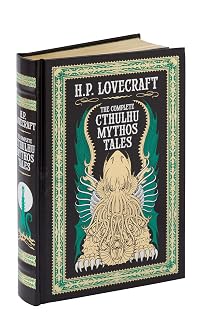
Barnes and Noble's handsome, almost art-deco inspired faux-leather tome collects all of H.P. Lovecraft's fiction in one hefty volume, including a selections of surviving stories from his childhood, some drafts, and his long essay on supernatural horror literature. It does exclude the work that he ghostwrote or revised (or completely rewrote) for other writers, however, with a few exceptions. Arranged chronologically by the month and year it was written, 1905-1935, the most interesting part of the collection, for me, was to see how Lovecraft's writing styles changed and evolved throughout his life from mere Poe pastiches to influence from Dunsany, to his own fully conceived style of weird fiction. The introductory notes on each story by eminent Lovecraft scholar S.T. Joshi are also very informative.
As for the style, I have read of some who opine that Lovecraft was "actually a horrible writer with great imagination," as if he were a mere hack, which I feel is a bit dogmatic. For me, Lovecraft's writing creates impeccable atmosphere and, if unconventional, really draws the reader into the detached yet fraught emotional state of his typical academic narrator thrust into horrific circumstances. Most effective through the first person voice, often through journal entries or letters explaining how a character happened to go mad, this detached, academic style gives the terrible events of the stories a hint of realism, of a found document or historic account. On the other hand, some criticism is understandable; Lovecraft's style is full of pages of exposition, overwrought descriptions, and he simply did not do dialogue. However, for me the style is well suited for the subject matter of totally unknown alien elements intruding on a once comfortably understood world.
It is Lovecraft's philosophy of telling his weird tales that I most appreciate, however. Written from a materialist perspective in which the "supernatural" are simply forces in the universe that humanity does not and can not understand; no comfortably understandable depraved vampires, angry ghosts, or seductive demons here, the cosmos is infinite, cold, ancient, and totally unconnected to human emotions and ideas; this I find far more chilling than, say, serial killers. As someone who craves knowledge, I am sure that I too would succumb to learning too much about our minute and tenuous place in the universe.
In stories such as "The Colour Out of Space," "The Whisperer in Darkness," and "The Shadow Over Innsmouth," Lovecraft's mastery of evoking dread and fear of the unknown as strange and alien influences converge horribly in small New England towns, bringing madness to unlucky folklorists, students, and artists. In the more dreamlike, fantastic tales like "The Doom that Came to Sarnath," "The Cats of Ulthar," and "The Strange High House in the Mist," illustrate Lovecraft at his most surreal and beautiful. Not every story is at these high levels, however; the "cat in the room" for some of these stories was Lovecraft's virulent racism and xenophobia which in a few tales virtually drip off of the page making them unpleasant to get through, to say the least. A few of these dragged on, along with some of the more turgid dream pieces but other stories are masterpieces of atmosphere and setting.
While "The Complete Fiction" may not be the best place for someone new to HPL's style to start, it is a great resource for a devotee to refer to Lovecraft's body of work. show less
The "Cthulhu Mythos" is, I guess, my area own area of geeky fandom, the one unabashed "nerd love" I allow myself in spite of its problems and flaws. In any case, I must admit I still have a soft spot for Lovecraft's creepy, surreal, intellectual short stories and novellas, collected in "The Complete Fiction." There were stories I had never read before as well as some favorites I had not visited for a few years. As the "Mythos" meme grows, I had been meaning to revisit these tales, so having everything nicely gathered together was a great way to read through Lovecraft's entire body of work.
Barnes and Noble's handsome, almost art-deco inspired faux-leather tome collects all of H.P. Lovecraft's fiction in one hefty volume, including a selections of surviving stories from his childhood, some drafts, and his long essay on supernatural horror literature. It does exclude the work that he ghostwrote or revised (or completely rewrote) for other writers, however, with a few exceptions. Arranged chronologically by the month and year it was written, 1905-1935, the most interesting part of the collection, for me, was to see how Lovecraft's writing styles changed and evolved throughout his life from mere Poe pastiches to influence from Dunsany, to his own fully conceived style of weird fiction. The introductory notes on each story by eminent Lovecraft scholar S.T. Joshi are also very informative.
As for the style, I have read of some who opine that Lovecraft was "actually a horrible writer with great imagination," as if he were a mere hack, which I feel is a bit dogmatic. For me, Lovecraft's writing creates impeccable atmosphere and, if unconventional, really draws the reader into the detached yet fraught emotional state of his typical academic narrator thrust into horrific circumstances. Most effective through the first person voice, often through journal entries or letters explaining how a character happened to go mad, this detached, academic style gives the terrible events of the stories a hint of realism, of a found document or historic account. On the other hand, some criticism is understandable; Lovecraft's style is full of pages of exposition, overwrought descriptions, and he simply did not do dialogue. However, for me the style is well suited for the subject matter of totally unknown alien elements intruding on a once comfortably understood world.
It is Lovecraft's philosophy of telling his weird tales that I most appreciate, however. Written from a materialist perspective in which the "supernatural" are simply forces in the universe that humanity does not and can not understand; no comfortably understandable depraved vampires, angry ghosts, or seductive demons here, the cosmos is infinite, cold, ancient, and totally unconnected to human emotions and ideas; this I find far more chilling than, say, serial killers. As someone who craves knowledge, I am sure that I too would succumb to learning too much about our minute and tenuous place in the universe.
In stories such as "The Colour Out of Space," "The Whisperer in Darkness," and "The Shadow Over Innsmouth," Lovecraft's mastery of evoking dread and fear of the unknown as strange and alien influences converge horribly in small New England towns, bringing madness to unlucky folklorists, students, and artists. In the more dreamlike, fantastic tales like "The Doom that Came to Sarnath," "The Cats of Ulthar," and "The Strange High House in the Mist," illustrate Lovecraft at his most surreal and beautiful. Not every story is at these high levels, however; the "cat in the room" for some of these stories was Lovecraft's virulent racism and xenophobia which in a few tales virtually drip off of the page making them unpleasant to get through, to say the least. A few of these dragged on, along with some of the more turgid dream pieces but other stories are masterpieces of atmosphere and setting.
While "The Complete Fiction" may not be the best place for someone new to HPL's style to start, it is a great resource for a devotee to refer to Lovecraft's body of work. show less
Members
- Recently Added By
Lists

Uni
9 works; 1 member

DELETE
48 works; 2 members

A Boston Reading List
120 works; 10 members
Books in Riverdale
123 works; 3 members
Author Information

Howard Phillips Lovecraft, 1890 - 1937 H. P. Lovecraft was born on August 20, 1890 in Providence, Rhode Island. His mother was Sarah Susan Phillips Lovecraft and his father was Winfield Scott Lovecraft, a traveling salesman for Gorham & Co. Silversmtihs. Lovecraft was reciting poetry at the age of two and when he was three years old, his father show more suffered a mental breakdown and was admitted to Butler Hospital. He spent five years there before dying on July 19, 1898 of paresis, a form of neurosyphillis. During those five years, Lovecraft was told that his father was paralyzed and in a coma, which was not the case. His mother, two aunts and grandfather were now bringing up Lovecraft. He suffered from frequent illnesses as a boy, many of which were psychological. He began writing between the ages of six and seven and, at about the age of eight, he discovered science. He began to produce the hectographed journals, "The Scientific Gazette" (1899-1907) and "The Rhode Island Journal of Astronomy" (1903-07). His first appearance in print happened, in 1906, when he wrote a letter on an astronomical matter to The Providence Sunday Journal. A short time later, he began writing a monthly astronomy column for The Pawtuxet Valley Gleaner - a rural paper. He also wrote columns for The Providence Tribune (1906-08), The Providence Evening News (1914-18), The Asheville (N.C.) Gazette-News (1915). In 1904, his grandfather died and the family suffered severe financial difficulties, which forced him and his mother to move out of their Victorian home. Devastated by this, he apparently contemplated suicide. In 1908, before graduating from high school, he suffered a nervous breakdown. He didn't receive a diploma and failed to get into Brown University, both of which caused him great shame. Lovecraft was not heard from for five years, re-emerging because of a letter he wrote in protest to Fred Jackson's love story in The Argosy. His letter was published in 1913 and caused great controversy, which was noted by Edward F. Daas, President of the United Amateur Press Association (UAPA). Daas invited Lovecraft to join the UAPA, which he did in early 1914. He eventually became President and Official Editor of the UAPA and served briefly as President of the rival National Amateur Press Association (NAPA). He published thirteen issues of his own paper, The Conservative (1915-23) and contributed poetry and essays to other journals. He also wrote some fiction which titles include "The Beast in the Cave" (1905), "The Alchemist" (1908), "The Tomb" and "Dagon" (1917). In 1919, Lovecraft's mother was deteriorating, mentally and physically, and was admitted to Butler Hospital. On May 24, 1921, his mother died from a gall bladder operation. While attending an amateur journalism convention in Boston, Lovecraft met his future wife Sonia Haft Greene, a Russian Jew. They were married on March 3, 1924 and Lovecraft moved to her apartment in Brooklyn. Sonia had a shop on Fifth Avenue that went bankrupt. In 1925, Sonia went to Cleveland for a job and Lovecraft moved to a smaller apartment in the Red Hook district of Brooklyn. In 1926, he decided to move back to Providence. Lovecraft had his aunts bar his wife, Sonia, from going to Providence to start a business because he couldn't have the stigma of a tradeswoman wife. They were divorced in 1929. After his return to Providence, he wrote his greatest fiction, which included the titles "The Call of Cthulhu" (1926), "At the Mountains of Madness" (1931), and "The Shadow Out of Time" (1934-35). In 1932, his aunt, Mrs. Clark, died; and he moved in with his other aunt, Mrs. Gamwell, in 1933. Suffering from cancer of the intestine, Lovecraft was admitted to Jane Brown Memorial Hospital and on March 15, 1937 he died. (Bowker Author Biography) show less
Some Editions
Awards and Honors
Awards
Distinctions
Notable Lists
Series
Belongs to Publisher Series
Work Relationships
Contains
Common Knowledge
- Canonical title
- The Complete Fiction
- Alternate titles*
- The Complete Fiction; The Complete Fiction of H. P. Lovecraft
- Original publication date
- 1916-1959 (original publication) (original publication)
- People/Characters
- Charles Dexter Ward
- Important places
- New England, USA
- First words
- The horrible conclusion which had been gradually obtruding itself upon my confused and reluctant mind was now an awful certainity.
- Last words
- (Click to show. Warning: May contain spoilers.)Radient with beauty, the Cup of the Ptolomies was carven of onyx.
*Some information comes from Common Knowledge in other languages. Click "Edit" for more information.
Classifications
Statistics
- Members
- 3,454
- Popularity
- 4,833
- Reviews
- 24
- Rating
- (4.34)
- Languages
- English, French, Italian, Swedish
- Media
- Paper, Audiobook, Ebook
- ISBNs
- 35
- UPCs
- 1
- ASINs
- 54