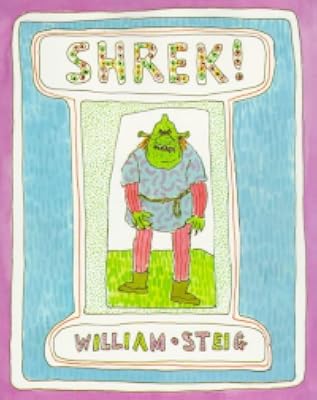
Shrek!
by William Steig
On This Page
Description
Horribly hideous Shrek leaves home and terrifies everyone he encounters in his search for his equally ugly bride.Tags
Recommendations

Member Reviews
A Thoroughly Unpleasant Children's Book
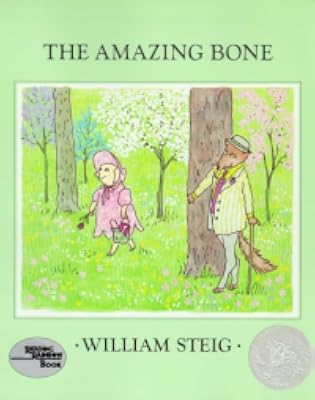
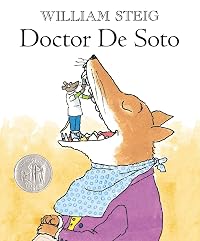
Picture book about a hideously ugly ogre who travels out into the world to find an ogress as ugly as he to marry. By 1990, when this was first published, author and illustrator William Steig had already been well-established for decades for such beloved children's classics as Sylvester and the Magic Pebble (1969), The Amazing Bone (1976) and Doctor De Soto (1982), which makes this utter misfire all the more inexplicable. The book's supposed message is of self-acceptance, and the line between that and being a complete sociopath is not a fine one, yet here Steig more than crosses it. Even in the grisliest folktales collected by the Grimm Brothers, there's a dearth of villains - let alone ostensible show more heroes - who make it a point to look their innocent victims in the eyes as they murder them, yet Shrek does precisely that to a hapless pheasant.
The writing is precisely as charming as the protagonist. The first section in verse reads:
It's difficult to imagine how a child might sing that meter and rhyming pattern.
That verse is sung by a witch, one of several "characters" (and I use that term generously) whom Shrek encounters on his quest who serve little purpose for the "story." The donkey, so memorable in the 2000 film adaptation, here is just... a donkey. Thanks to his doggerel introductory monologue, we know he lazes and spends his "days in the green,/A chewing, chomping rover." He takes Shrek to the castle, or more specifically, "To the nutty knight. Who guards the entrance. To the crazy castle. Where the repulsive princess. Waits." Why the donkey has this speech pattern - used only in this one line - is as much a mystery as is which children it would enchant.
As a picture book, what the writing lacks, the illustrations should be able to fill in, but once again, Steig fails to do so. His childlike drawing style familiar to those who have seen his earlier works is here employed to illustrate revolting subjects. If an actual child were to replicate this style, it would likely provoke a parent-teacher conference and perhaps some counseling sessions.
The only reason this book earns the star-and-a-half I gave it is because there were just enough elements to find a clear inspiration for the excellent film adaptation and the nearly equally excellent 2008 Broadway musical adaptation. It's also a tribute to the writers of those adaptations that they made it through all 28 fully-illustrated pages without being too nauseated to consider writing dozens of pages of script. For parents and educators looking to introduce young children to the joy of reading through this book, I'd recommend leaving the love of the superior versions unspoiled by this particular original source. show less
Picture book about a hideously ugly ogre who travels out into the world to find an ogress as ugly as he to marry. By 1990, when this was first published, author and illustrator William Steig had already been well-established for decades for such beloved children's classics as Sylvester and the Magic Pebble (1969), The Amazing Bone (1976) and Doctor De Soto (1982), which makes this utter misfire all the more inexplicable. The book's supposed message is of self-acceptance, and the line between that and being a complete sociopath is not a fine one, yet here Steig more than crosses it. Even in the grisliest folktales collected by the Grimm Brothers, there's a dearth of villains - let alone ostensible show more heroes - who make it a point to look their innocent victims in the eyes as they murder them, yet Shrek does precisely that to a hapless pheasant.
The writing is precisely as charming as the protagonist. The first section in verse reads:
"This is the way I cook my bats,
Stir my bats, taste my bats,
Season my bats in the morning;
Stew and brew and chew my bats
Diddle and fiddle and faddle my bats,
Early in the morning."
It's difficult to imagine how a child might sing that meter and rhyming pattern.
That verse is sung by a witch, one of several "characters" (and I use that term generously) whom Shrek encounters on his quest who serve little purpose for the "story." The donkey, so memorable in the 2000 film adaptation, here is just... a donkey. Thanks to his doggerel introductory monologue, we know he lazes and spends his "days in the green,/A chewing, chomping rover." He takes Shrek to the castle, or more specifically, "To the nutty knight. Who guards the entrance. To the crazy castle. Where the repulsive princess. Waits." Why the donkey has this speech pattern - used only in this one line - is as much a mystery as is which children it would enchant.
As a picture book, what the writing lacks, the illustrations should be able to fill in, but once again, Steig fails to do so. His childlike drawing style familiar to those who have seen his earlier works is here employed to illustrate revolting subjects. If an actual child were to replicate this style, it would likely provoke a parent-teacher conference and perhaps some counseling sessions.
The only reason this book earns the star-and-a-half I gave it is because there were just enough elements to find a clear inspiration for the excellent film adaptation and the nearly equally excellent 2008 Broadway musical adaptation. It's also a tribute to the writers of those adaptations that they made it through all 28 fully-illustrated pages without being too nauseated to consider writing dozens of pages of script. For parents and educators looking to introduce young children to the joy of reading through this book, I'd recommend leaving the love of the superior versions unspoiled by this particular original source. show less
I always think of the German word "schrecklich" - meaning awful or terrible - when I run across a reference to this book, its "hero," or the film based upon them, and that seems completely appropriate (perhaps it was even intentional, on Steig's part?), as Shrek! is the story of one nasty ogre! Uglier even than his ugly parents, with a foul stench that causes flowers to wilt, and a penchant for letting off steam through his ears, Shrek, having been booted from his home, embarks on a quest to find his ideal mate, eventually winning the hand of "the most stunningly ugly princess on the surface of the planet," and living horribly ever after with her...
An anti-fairy-tale like no other, this slender picture-book is one I have long been show more meaning to read, given the critical acclaim garnered by the film that is (loosely) based upon it. I've been holding off seeing that film, until I had a chance to read Steig's original, and that seems to have been a wise choice, judging by the number of online reviews I have read, complaining that the original does not live up to its (apparently) far sweeter film adaptation. For my part, I found Shrek to be an engagingly monstrous read - perfect for young readers who like "gross" stories and humor - and although I wouldn't say it lived up to some of Steig's other titles (books like Amos & Boris, or Sylvester and the Magic Pebble), I did enjoy certain moments - like the rhyming courting scene, between Shrek and his princess! - immensely. Recommended to young readers with a taste for truly disgusting monsters, and to fans of William Steig. show less
An anti-fairy-tale like no other, this slender picture-book is one I have long been show more meaning to read, given the critical acclaim garnered by the film that is (loosely) based upon it. I've been holding off seeing that film, until I had a chance to read Steig's original, and that seems to have been a wise choice, judging by the number of online reviews I have read, complaining that the original does not live up to its (apparently) far sweeter film adaptation. For my part, I found Shrek to be an engagingly monstrous read - perfect for young readers who like "gross" stories and humor - and although I wouldn't say it lived up to some of Steig's other titles (books like Amos & Boris, or Sylvester and the Magic Pebble), I did enjoy certain moments - like the rhyming courting scene, between Shrek and his princess! - immensely. Recommended to young readers with a taste for truly disgusting monsters, and to fans of William Steig. show less
I was a huge fan of the film Shrek when it came out, but I can’t believe that I didn’t know until this year that it was loosely based on this book - and on a book by one of my childhood authors, none the less! Obviously the film version extrapolates the story of Shrek the ogre’s escapades, painting him as a baddie with a heart of gold, but Steig’s original ogre is a much more fearsome character. His Shrek revels in frightening the populace, even down to the trees and plants, and shows absolutely no remorse for his frightening facade, whereas the Shrek from the film is only fierce in response to the negative attitude he elicits from those he meets and is truly a simple ogre wishing to live a quiet life in his swamp. Regardless of show more his more frightening features and behaviour, Stieg’s Shrek sets out on a quest after his fortune is read by a forest witch, determined to find the donkey of destiny, defeat the dragon, and marry the princess. The donkey in this story plays a relatively small role (“noble steed” would describe this donkey much better than Eddie Murphy’s miniature rendition), and Shrek defeats the dragon through sheer brute strength, but the story hits a high point when he meets the princess. Unlike the lovely Princess Fiona, this princess is equal in ugliness to Shrek, causing him to fall madly in love at first sight! Even though this ending doesn’t really give us the satisfaction of seeing Shrek and Princess Fiona accept their green and ogre-y selves as in the film, this ugly pair is still an amusing example of true love and expounds the same message - there’s someone for everyone, as long as you keep looking and stay true to yourself! show less
William Steig’s antihero and his compatriots spat flame on the conservative values within the conventions of children's entertainment with this book, written in 1990. Yet Steig also riffed repeatedly on classic fairytale tradition in the book, so that his Shrek existed with one fuming foot within the known sphere of family entertainment, and one squarely outside of it. I liked the movies alright, but this book was and is groundbreaking in ways the films would never dare to be. Uptight parents and institutions may flinch at the 'Jabbering Jackass!' comment, even if it's one of my favorite lines of all time.
Uses: Anyone who shows the film adapations at a school or library ought to be required to present this book as well.
Uses: Anyone who shows the film adapations at a school or library ought to be required to present this book as well.
I AM CRYING TEARS OF JOY, PAIN, AND HILARITY. Best kid's book ever. It reads like a giant shitpost and I LOVE IT.
Shrek is repulsive, and he delights in it! ("Any snake dumb enough to bite him instantly got convulsions and died.") Our ugly, cheerful hero is kicked out of the swamp by his parents and has a witch tell his fortune, which involves a donkey, a fight with a knight, and an ugly princess. ("And they lived horribly ever after, scaring the socks off all who fell afoul of them.")
See also: Miss Brooks Loves Books (And I Don't)
See also: Miss Brooks Loves Books (And I Don't)
Por incrível que pareça só agora li o livro do Steig sobre Shrek e olha, é bem diferente do filme, muito mais subversivo eu diria.
Members
- Recently Added By
Lists

Princess Tales
130 works; 4 members
Author Information

73+ Works 31,416 Members
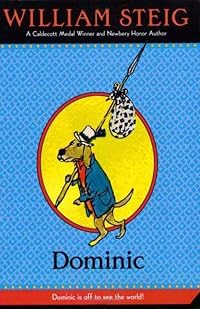
William Steig was born in Brooklyn, New York, on November 14, 1907, and spent his childhood in the Bronx. Steig found an outlet for his talent by creating cartoons for the high school newspaper. After high school graduation, Steig spent two years at City College, three years at the National Academy, and five days at the Yale School of Fine Arts show more before dropping out. During his early days as a free-lance artist, he supplemented his income with work in advertising, although he intensely disliked it. He illustrated for the The New Yorker, beginning in 1930. During the 1940s, Steig's creativity found a more agreeable outlet when he began carving figurines in wood; his sculptures are on display as part of the collection in the historic home of Franklin D. Roosevelt in Hyde Park, New York, and in several museums in New England. In 1967, Bob Kraus, a fellow cartoonist at The New Yorker, was in the process of organizing Windmill Books, an imprint for Harper & Row. Kraus suggested that Steig try writing and illustrating a book for a young audience. The result was Steig's letter-puzzle book entitled C D B!, published in 1968. Roland the Minstrel Pig, was published the same year. With his very next title, Sylvester and the Magic Pebble, he won the Caldecott Medal. The Amazing Bone was also a Caldecott Honor Book.In 1972, Steig published his first children's novel, Dominic, which won the Christopher Award. Abel's Island followed and was a Newberry Honor Book. William Steig died in October 3, 2003 in Boston Massachusettes. (Bowker Author Biography) show less
Awards and Honors
Awards
Work Relationships
Is contained in
Common Knowledge
- Original publication date
- 1990
- People/Characters
- Shrek; Fiona; Donkey; Cinderella; Prince Charming; Sleeping Beauty (show all 19); Doris; Lord Farquaad; Puss in Boots; Fiona's Fairy Godmother; King Harold; Queen Lillian; Raul; Captain Hook; Prince Arthur; Snow White; Nanny Dwarf; Merlin; Yeseth!
- Important places
- Far Far Away; Duloc; Worcestershire Academy
- Related movies
- Shrek (2001 | IMDb); Shrek 4-D (2003 | IMDb); Shrek 2 (2004 | IMDb); Shrek the Third (2007 | IMDb); Shrek the Halls (2007 | IMDb); Shrek Forever After (2010 | IMDb) (show all 12); Shrek in the Swamp Karaoke Dance Party (2001 | IMDb); Creating a Fairy Tale World: The Making of 'Shrek' (2001 | IMDb); Meet the Cast of Shrek 2 (2004 | IMDb); The Music of Shrek 2 (2004 | IMDb); Shrek: Smash n' Crash Racing (2006 | IMDb); 100 Things You Always Wanted to Know About Shrek But Were Afraid to Ask So We're Gonna Tell You Anyway Movie Special (2007 | IMDb)
- First words
- Once upon a time, a gruff, green ogre named Shrek lived in a stinky, squelchy swamp.
Classifications
Statistics
- Members
- 1,132
- Popularity
- 22,362
- Reviews
- 32
- Rating
- (3.54)
- Languages
- 9 — Danish, Dutch, English, French, German, Italian, Portuguese, Spanish, Swedish
- Media
- Paper, Audiobook, Ebook
- ISBNs
- 57
- UPCs
- 1
- ASINs
- 5